


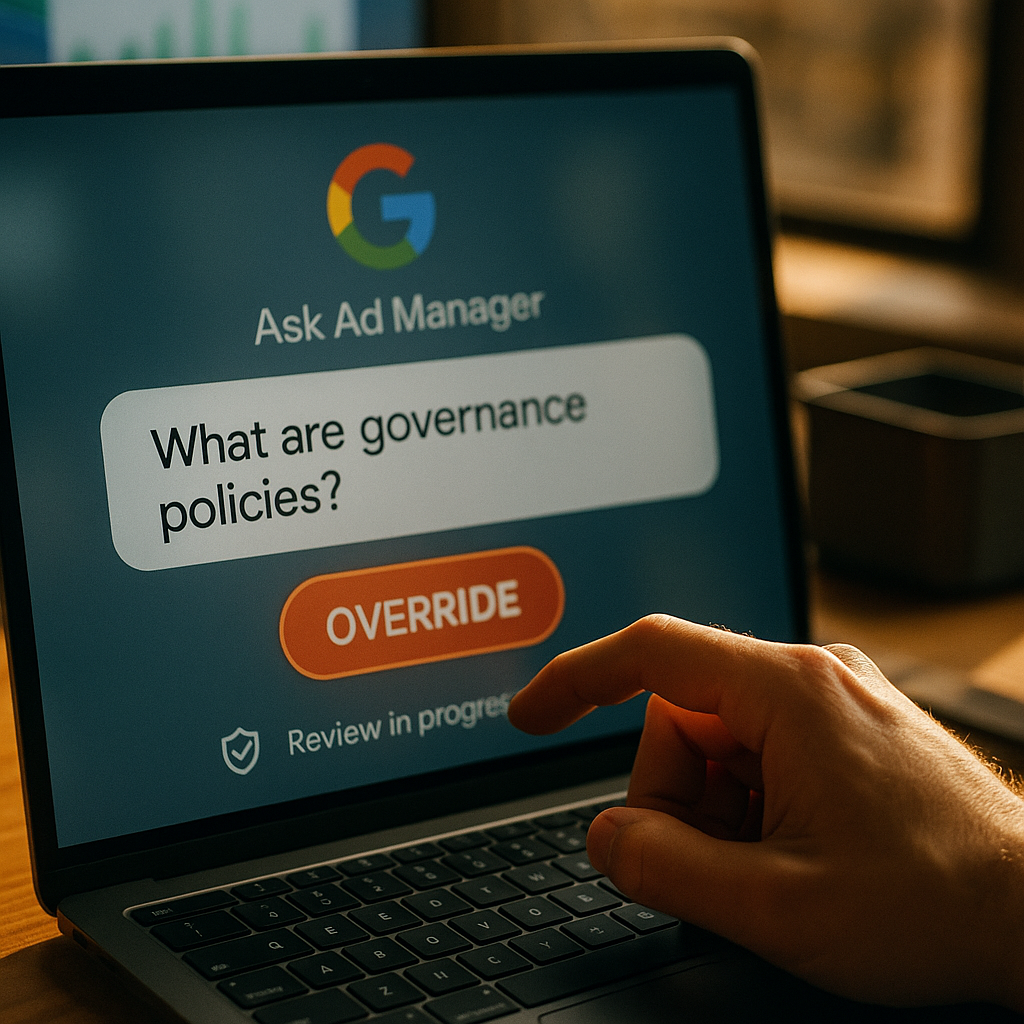
What happens when the AI tool your team uses to troubleshoot campaigns starts making the decisions instead of informing them? Google’s Ask Ad Manager assistant is evolving fast, and most brand governance frameworks aren’t built for the moment it crosses from advisory into autonomous inventory and pricing actions. That moment is closer than most teams realize.
From Copilot to Autonomous Agent: What’s Actually Changing
Ask Ad Manager launched as a conversational layer inside Google Ad Manager, letting publishers and buy-side teams query campaign data, surface anomalies, and get plain-language explanations of performance shifts. The product positioning was clear: AI assistant, human decides. That framing is quietly shifting.
Google has been building toward what it calls “agentic” AI behavior across its advertising infrastructure. In this model, the AI doesn’t just flag that your CPM floor is suppressing fill rate — it adjusts the floor. It doesn’t just recommend shifting budget to a higher-performing inventory segment — it executes the reallocation. The transition from suggestion to action changes everything about how your brand team needs to operate.
When AI moves from recommending a CPM floor adjustment to executing one, the legal, financial, and brand accountability shifts — and most governance frameworks aren’t written to handle that.
For context on how AI agents are being embedded across the broader ad ecosystem, the agentic advertising governance framework is worth reviewing before building your own override protocols. The core principle is the same: autonomous action requires human checkpoints that are explicit, documented, and enforceable.
Why Governance Frameworks Built for Manual Trading Won’t Hold
Most programmatic governance policies were written for a world where a human trader, a DSP interface, and an IO create a chain of custody. Someone approved the line item. Someone set the bid multipliers. When performance was off, someone was accountable. Autonomous AI breaks every link in that chain if you let it.
The risk isn’t that the AI makes a bad decision (though it will). The risk is that no one knows who owns the outcome. Consider three failure modes your current policies probably don’t address:
- Inventory adjacency violations: The AI optimizes toward high-performing inventory segments that happen to include content categories your brand safety policy prohibits. No human reviewed the segment expansion.
- Pricing floor drift: Autonomous pricing adjustments compound over a campaign flight, producing a final CPM that no human ever approved and that breaks your media plan assumptions.
- Budget velocity mismatches: The AI accelerates spend into a high-CTR window faster than your financial controls expect, creating a reconciliation problem with your finance team.
None of these are hypothetical edge cases. They’re the predictable outputs of AI optimizing toward the metrics it’s been given without the contextual guardrails a human trader would apply by default. Your AI ad ecosystem readiness assessment should already be flagging these gaps.
Building a Governance Policy That Accounts for AI Action
The starting point is a clear decision taxonomy. Not every AI action carries equal risk, and your governance policy shouldn’t treat them equally. Map AI actions into three tiers:
- Tier 1 — Inform only: AI surfaces data, anomalies, and recommendations. No action taken. No approval required.
- Tier 2 — Act within guardrails: AI can execute within pre-approved parameters. Example: bid adjustments within a +/- 15% band around the planned CPM, inventory restricted to pre-approved categories. Human is notified but does not need to pre-approve.
- Tier 3 — Human approval required: Any action outside pre-set parameters, including new inventory segments, budget reallocations above a defined threshold, or pricing floors below brand minimum.
This taxonomy needs to be documented in your media agency agreements, your DSP contracts, and your internal campaign SOPs. If it only exists in a slide deck, it won’t survive contact with an autonomous system. For those managing creator-adjacent paid campaigns, the same tiered logic applies to AI creator campaign governance at the approval layer.
Human Override Protocols: What “Override” Actually Means in Practice
The phrase “human override” sounds straightforward. In practice, most teams haven’t defined what it means operationally. An override protocol needs to specify four things: who can trigger it, how fast it must execute, what it actually stops, and how the action is logged.
Who can trigger it: Don’t leave this ambiguous. Your media manager should have override authority for Tier 2 actions. Tier 3 overrides, especially anything touching pricing floors or inventory category expansion, should require sign-off from a senior programmatic lead or VP-level stakeholder. Define it in writing.
Execution speed: If your AI is making pricing decisions at a cadence faster than your team can review them, the override protocol is functionally useless. You need to configure Ask Ad Manager’s action frequency to match your team’s review capacity. This is a technical setting conversation with your Google account team, not just a policy document decision.
What it actually stops: An override should pause AI action in the affected category, not just flag it for later review. If the AI has already expanded into a prohibited inventory segment and your “override” only logs a notification that gets reviewed 48 hours later, the damage is done. Build stop mechanisms, not just alert mechanisms.
Audit trail: Every AI action and every human override needs a timestamped log accessible to your team and your compliance function. FTC guidelines on automated decision systems are still evolving, but the direction is clear: accountability requires documentation. Start logging now.
Vendor Contract Language Needs to Catch Up
Here’s a practical gap most brand teams are ignoring: the indemnification clauses and liability frameworks in your Google Ad Manager agreements were not written for autonomous AI action. When an AI assistant transitions from making recommendations to making decisions, the contractual risk profile changes materially.
Work with your legal team to add language that explicitly defines the scope of autonomous AI action your brand authorizes, requires Google to notify you of changes to the autonomous capabilities of the tool, and establishes what happens when AI-generated actions produce outcomes outside your campaign parameters. Data protection regulators in markets like the EU are also watching automated decision-making with growing scrutiny — your DPA agreements need to reflect that.
For reference on how governance language is being applied to AI-generated ad recommendations more broadly, the GenStudio governance and brand safety framework offers a useful structural model, even if your stack is Google-centric.
The Accuracy Problem Nobody Wants to Acknowledge
AI agents operating in advertising environments are not infallible. Research on AI agent accuracy in campaign contexts — including analysis covered in what 99% AI agent accuracy actually means in practice — makes the point clearly: even a 1% error rate across thousands of autonomous pricing decisions in a single campaign flight generates a non-trivial number of bad outcomes. At scale, 1% isn’t a rounding error. It’s a budget problem.
Your governance policy needs an explicit error threshold: what percentage of AI-initiated actions can produce outcomes outside approved parameters before you pause autonomous operation entirely? Set that number before you need it, not after your CFO is asking questions.
Setting your AI error tolerance threshold after something goes wrong is like writing your data breach response plan after the breach. The window for smart governance is before full autonomy ships.
Training Your Team for the Autonomous Era
Governance documents mean nothing if the people operating your campaigns don’t understand what autonomous AI action looks like in practice or how to recognize when something is wrong. This is an upskilling problem, not just a policy problem.
Invest in training that specifically covers: how to read AI action logs in Ad Manager, what parameter drift looks like over a campaign flight, and when to escalate versus self-resolve. AI marketing fluency gaps at the senior level create the biggest exposure — executives who can’t interrogate an AI action log can’t make informed override decisions. The Google Ad Manager support documentation on Ask Ad Manager’s current capabilities is a useful baseline for your team’s orientation sessions.
Pair that with external resources from industry bodies like the IAB, which has been publishing guidance on AI accountability standards in programmatic environments, and keep your team’s knowledge current as the product evolves.
One more thing worth tracking: how AI-driven budget decisions in programmatic interact with your creator program spend allocations. The AI ad spend vs. creator budgets question is increasingly a governance issue, not just a media planning one, when autonomous tools can shift programmatic budgets without a human checkpoint.
Your concrete next step: Schedule a 90-minute cross-functional session with your media, legal, and finance leads this quarter to map your current governance framework against the three-tier AI action taxonomy above. The gaps you identify in that session are your governance roadmap. Don’t wait for Ask Ad Manager’s autonomous capabilities to outpace the conversation.
Frequently Asked Questions
What is Google Ask Ad Manager and how is it evolving toward autonomy?
Google Ask Ad Manager is a conversational AI assistant embedded in Google Ad Manager that allows users to query campaign data, diagnose performance issues, and receive recommendations in plain language. It is evolving from a purely advisory tool toward agentic behavior, meaning it is developing the capability to execute actions — such as adjusting pricing floors, reallocating inventory, or shifting budgets — without requiring a human to manually implement each decision. This shift from suggestion to autonomous action is what makes governance preparation urgent for brand and agency teams.
What governance policies should brands put in place before Ask Ad Manager becomes fully autonomous?
Brands should implement a tiered decision framework that classifies AI actions by risk level: informational actions that require no approval, actions within pre-approved parameters that proceed with notification, and high-impact actions (such as inventory category changes or CPM floor adjustments outside set thresholds) that require explicit human sign-off. This framework should be documented in internal SOPs, media agency agreements, and vendor contracts. Additionally, brands need audit logging, defined error tolerance thresholds, and clear escalation paths for each tier.
How do human override protocols work in an autonomous AI advertising environment?
An effective human override protocol must define four elements: who has authority to trigger an override and at what level, how quickly the override must execute relative to the AI’s action speed, what the override actually stops (action pause versus notification), and how every AI action and override is logged for audit purposes. Override mechanisms should stop AI actions in real time rather than simply flag them for later review. The protocol should be technically configured in the platform, not just documented in a policy file.
What contractual changes are needed to address autonomous AI in ad buying?
Existing Google Ad Manager agreements typically do not address autonomous AI action explicitly. Brands should work with legal teams to add contract language that defines the scope of AI autonomy the brand authorizes, requires the vendor to notify the brand of material changes to the tool’s autonomous capabilities, and establishes liability parameters when AI-generated actions produce out-of-specification outcomes. Data processing agreements may also need to be updated to reflect automated decision-making requirements under applicable data protection regulations.
How often should brands review and update their AI governance policies for programmatic tools?
Given the pace at which AI capabilities in ad platforms are evolving, governance policies for tools like Ask Ad Manager should be reviewed at minimum quarterly, and any time Google releases a material product update to the platform’s autonomous capabilities. Additionally, policies should be audited after any incident where AI-generated actions produce outcomes outside approved parameters. Treating governance documents as living operating procedures rather than static compliance files is essential in an environment where the underlying technology is changing continuously.
Top Influencer Marketing Agencies
The leading agencies shaping influencer marketing in 2026
Agencies ranked by campaign performance, client diversity, platform expertise, proven ROI, industry recognition, and client satisfaction. Assessed through verified case studies, reviews, and industry consultations.
Moburst

-
2

The Shelf
Boutique Beauty & Lifestyle Influencer AgencyA data-driven boutique agency specializing exclusively in beauty, wellness, and lifestyle influencer campaigns on Instagram and TikTok. Best for brands already focused on the beauty/personal care space that need curated, aesthetic-driven content.Clients: Pepsi, The Honest Company, Hims, Elf Cosmetics, Pure LeafVisit The Shelf → -
3

Audiencly
Niche Gaming & Esports Influencer AgencyA specialized agency focused exclusively on gaming and esports creators on YouTube, Twitch, and TikTok. Ideal if your campaign is 100% gaming-focused — from game launches to hardware and esports events.Clients: Epic Games, NordVPN, Ubisoft, Wargaming, Tencent GamesVisit Audiencly → -
4

Viral Nation
Global Influencer Marketing & Talent AgencyA dual talent management and marketing agency with proprietary brand safety tools and a global creator network spanning nano-influencers to celebrities across all major platforms.Clients: Meta, Activision Blizzard, Energizer, Aston Martin, WalmartVisit Viral Nation → -
5

The Influencer Marketing Factory
TikTok, Instagram & YouTube CampaignsA full-service agency with strong TikTok expertise, offering end-to-end campaign management from influencer discovery through performance reporting with a focus on platform-native content.Clients: Google, Snapchat, Universal Music, Bumble, YelpVisit TIMF → -
6

NeoReach
Enterprise Analytics & Influencer CampaignsAn enterprise-focused agency combining managed campaigns with a powerful self-service data platform for influencer search, audience analytics, and attribution modeling.Clients: Amazon, Airbnb, Netflix, Honda, The New York TimesVisit NeoReach → -
7

Ubiquitous
Creator-First Marketing PlatformA tech-driven platform combining self-service tools with managed campaign options, emphasizing speed and scalability for brands managing multiple influencer relationships.Clients: Lyft, Disney, Target, American Eagle, NetflixVisit Ubiquitous → -
8

Obviously
Scalable Enterprise Influencer CampaignsA tech-enabled agency built for high-volume campaigns, coordinating hundreds of creators simultaneously with end-to-end logistics, content rights management, and product seeding.Clients: Google, Ulta Beauty, Converse, AmazonVisit Obviously →