


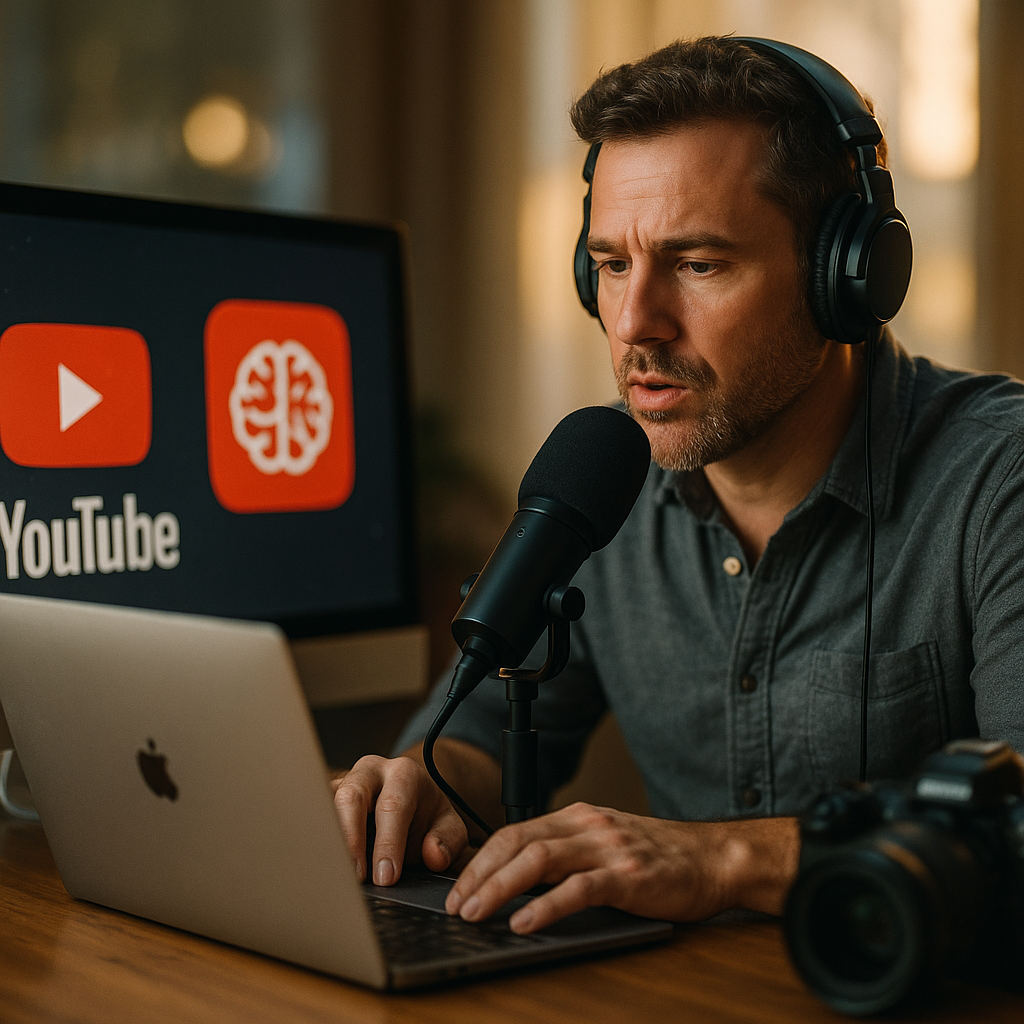
YouTube just made authenticity a policy. Faceless AI channels are being suppressed algorithmically, and brands still partnering with synthetic narrators are absorbing both reputational and distribution risk. The real-person storytelling premium is no longer a philosophical preference — it’s a measurable variable in campaign performance.
What YouTube Actually Did (and Why It Changes Your Creator Roster)
In its updated creator monetization and recommendation guidelines, YouTube moved to actively deprioritize channels that rely on AI-generated voiceovers, synthetic avatars, and templated mass-production formats — the category broadly called “faceless channels.” The platform’s stated rationale centers on viewer trust and content originality, but the operational consequence for brands is blunt: content featuring real human narrators is being surfaced more frequently, recommended more aggressively, and monetized at higher CPM tiers.
This isn’t YouTube acting as a moral authority. It’s YouTube protecting its ad revenue. When viewers skip or abandon AI-narrated content faster than human-narrated content, the algorithm responds accordingly. Completion rates drop. Click-through rates drop. Advertiser returns drop. YouTube’s crackdown is, at its core, an engagement optimization move.
For brand strategists, the implication is immediate: if a creator’s channel relies heavily on AI narration, your sponsored content is riding an algorithmically suppressed vehicle. For a deeper breakdown of platform-level suppression mechanics, see our guide on YouTube’s AI content suppression.
The Performance Data Is Not Ambiguous
Completion rate is the clearest signal. Across YouTube’s own internal data shared with select partners, human-narrated long-form content consistently outperforms AI-narrated equivalents by 20 to 35 percentage points on average watch time. On sponsored segments specifically, viewer retention cliffs are steeper on AI-voiced channels — audiences clock the synthetic quality and disengage before the call-to-action lands.
A sponsored segment that doesn’t reach its CTA might as well not exist. Completion rate isn’t a vanity metric on YouTube — it’s the bridge between impression and conversion.
The engagement gap compounds further at the comment and share level. Real-person creators generate parasocial connection. Audiences debate, question, defend, and evangelize for their favorite creators in ways they simply don’t for an AI avatar reading a script. That behavioral difference translates directly into earned media value and lower cost-per-conversion on brand recall studies.
HubSpot’s research on video content performance consistently flags authenticity signals — visible face, conversational tone, direct address — as primary drivers of viewer trust and downstream purchase intent. The data supports what experienced brand managers already felt intuitively: people buy from people.
Ethical Standard or Business Standard? Both.
There’s a temptation in marketing circles to treat the ethics conversation and the ROI conversation as separate tracks. They aren’t, at least not here.
Regulators are moving fast. The FTC’s updated disclosure framework increasingly focuses on synthetic content transparency. New York’s Synthetic Performer Law now imposes disclosure requirements on AI-generated talent used in commercial contexts. If your creator partner is using an AI voice to deliver your brand message without proper disclosure, you share liability exposure. Reviewing your AI talent compliance audit process isn’t optional anymore — it’s a pre-campaign checklist item.
Meanwhile, the FTC has been explicit that material connections must be disclosed and that synthetic content used to deceive consumers represents an unfair or deceptive trade practice. The intersection of AI narration and sponsored content is exactly the ambiguous zone regulators are targeting.
So the ethical standard and the business standard have merged. Human narration reduces regulatory exposure while simultaneously delivering stronger performance metrics. That’s a rare alignment, and brand programs should capitalize on it structurally, not just tactically.
What “Real Person” Actually Means in a Creator Contract
Here’s where program managers need precision. “Human narration” isn’t self-defining in a contract. Creators increasingly use AI tools to enhance, edit, or clone their own voices. A creator might film themselves but then use an AI voice clone for final audio delivery. Another might use a real voice but deploy an AI avatar as their visual identity.
Your Master Service Agreement needs to specify. At minimum, define “authentic human narration” as: original audio performed live by the contracted creator, not synthetically generated or cloned, and tied to visible on-screen presence where the platform format requires it. Your MSA templates with AI clauses should make these distinctions explicit and enforceable, including remediation rights if a creator delivers AI-assisted content without disclosure.
Contracts should also specify platform compliance alignment. If YouTube’s guidelines prohibit certain AI content formats, your agreement should require the creator to adhere to current platform standards — not just the standards at time of signing. Platforms update policies; your contracts should anticipate that.
Building Authenticity Into Your Roster Selection Process
Most brand teams are still selecting creators primarily on reach and demographic fit. Those remain valid filters, but a third dimension needs systematic weight: content production authenticity.
Practically, this means evaluating creator channels for:
- Consistent on-camera presence — not occasional cameos, but habitual face-to-camera storytelling that demonstrates an established parasocial relationship with their audience
- Narrative variability — AI-generated content tends toward formulaic structure; genuine human creators improvise, self-correct, and reference personal experience in ways that are difficult to fake at scale
- Comment quality and creator response patterns — real creators engage their communities; AI channels generate generic or absent creator responses
- Historical content consistency — a sudden shift to faceless or voiceover formats often signals a production pivot toward AI-assisted content mills
Tools like Sprout Social and dedicated influencer analytics platforms can surface engagement anomalies that correlate with AI-produced content. Some agencies now run AI detection audits on creator content libraries before onboarding. That’s not overcaution — that’s operational due diligence.
For compliance-certified programs, ARPP-certified creators provide a baseline assurance that content meets transparency and authenticity standards. That certification framework is particularly useful for teams operating across multiple markets where local regulatory variance creates audit complexity.
Pricing the Premium Into Your Creator Compensation Model
If authentic human narration delivers measurably better performance, the market will price it accordingly. It already is. Mid-tier creators who have built genuine on-camera audiences are commanding rate increases that outpace their follower growth — because buyers have figured out that the completion rate differential justifies higher CPM.
That changes how you model creator compensation. Performance-based contract structures that tie a portion of creator fees to completion rate, click-through, or attributed conversion become more defensible when you’ve verified that the creator’s authentic format drives those metrics. You’re not just paying for reach; you’re paying for a conversion-optimized delivery mechanism.
The creator who charges 40% more but drives 60% higher completion rates and 2x the attributed conversions isn’t expensive. The cheap AI-assisted creator who underdelivers is.
Consider building a two-tier compensation model: a base rate tied to deliverable completion, and a performance kicker tied to content-specific KPIs. This aligns incentives with authenticity — creators who invest in genuine on-camera storytelling are rewarded for the results that format produces. For detailed model structures, hybrid compensation frameworks offer a practical starting point.
The Operational Takeaway
Audit your active creator roster against YouTube’s current suppression criteria before your next campaign cycle. Flag any creator whose content library shows a heavy reliance on AI narration or faceless formats, and update your MSAs to include explicit authentic narration requirements with AI disclosure obligations. The brands that systematize this now will operate with both a compliance advantage and a measurable performance edge — the ones that don’t will spend the next 12 months diagnosing why their YouTube campaigns underperformed. Also review what brands must do now in response to YouTube’s AI content enforcement to ensure your program is fully aligned with current platform standards.
FAQs
What is YouTube’s faceless AI channel crackdown, and how does it affect brand campaigns?
YouTube has updated its monetization and recommendation algorithms to deprioritize channels that rely on AI-generated voiceovers, synthetic avatars, and templated mass-production formats. For brands, this means sponsored content placed on affected channels receives reduced organic distribution, lower recommendation frequency, and suppressed CPM returns. Campaigns built around human-narrated creator content are less exposed to these penalties.
How can I tell if a creator is using AI narration?
Look for consistent on-camera presence, narrative variability, and active community engagement in comments. AI-produced content tends to follow formulaic structures, lacks personal anecdote, and often shows absent or generic creator responses to audience comments. Running an AI content detection audit on a creator’s recent video library before onboarding is increasingly standard practice among professional brand teams.
Does using AI tools automatically make a creator’s content ineligible for brand programs?
Not automatically. The threshold question is whether AI tools are being used to enhance genuine human-created content or to replace authentic human narration entirely. A creator who uses AI for editing, captioning, or post-production while delivering live, on-camera narrative performance is in a fundamentally different category from one using AI voice cloning or synthetic avatars as their primary content format. Your MSA should define these distinctions explicitly.
What contract clauses should I add to address AI narration risks?
At minimum, define “authentic human narration” as live audio performed by the contracted creator without synthetic generation or voice cloning, tied to visible on-screen presence where the platform format requires it. Include platform compliance alignment language that requires creators to adhere to current platform guidelines throughout the contract term. Add disclosure obligations for any AI-assisted production elements, and include remediation rights if deliverables don’t meet these standards.
Is there a measurable ROI difference between human-narrated and AI-narrated creator content?
Yes. Human-narrated content on YouTube consistently shows 20 to 35 percentage point advantages in average watch time compared to AI-narrated equivalents, according to platform data shared with select partners. Completion rates on sponsored segments are particularly critical: viewers who do not reach the call-to-action cannot convert. The performance gap also extends to comment engagement, share behavior, and brand recall metrics, all of which affect total campaign ROI.
Top Influencer Marketing Agencies
The leading agencies shaping influencer marketing in 2026
Agencies ranked by campaign performance, client diversity, platform expertise, proven ROI, industry recognition, and client satisfaction. Assessed through verified case studies, reviews, and industry consultations.
Moburst

-
2

The Shelf
Boutique Beauty & Lifestyle Influencer AgencyA data-driven boutique agency specializing exclusively in beauty, wellness, and lifestyle influencer campaigns on Instagram and TikTok. Best for brands already focused on the beauty/personal care space that need curated, aesthetic-driven content.Clients: Pepsi, The Honest Company, Hims, Elf Cosmetics, Pure LeafVisit The Shelf → -
3

Audiencly
Niche Gaming & Esports Influencer AgencyA specialized agency focused exclusively on gaming and esports creators on YouTube, Twitch, and TikTok. Ideal if your campaign is 100% gaming-focused — from game launches to hardware and esports events.Clients: Epic Games, NordVPN, Ubisoft, Wargaming, Tencent GamesVisit Audiencly → -
4

Viral Nation
Global Influencer Marketing & Talent AgencyA dual talent management and marketing agency with proprietary brand safety tools and a global creator network spanning nano-influencers to celebrities across all major platforms.Clients: Meta, Activision Blizzard, Energizer, Aston Martin, WalmartVisit Viral Nation → -
5

The Influencer Marketing Factory
TikTok, Instagram & YouTube CampaignsA full-service agency with strong TikTok expertise, offering end-to-end campaign management from influencer discovery through performance reporting with a focus on platform-native content.Clients: Google, Snapchat, Universal Music, Bumble, YelpVisit TIMF → -
6

NeoReach
Enterprise Analytics & Influencer CampaignsAn enterprise-focused agency combining managed campaigns with a powerful self-service data platform for influencer search, audience analytics, and attribution modeling.Clients: Amazon, Airbnb, Netflix, Honda, The New York TimesVisit NeoReach → -
7

Ubiquitous
Creator-First Marketing PlatformA tech-driven platform combining self-service tools with managed campaign options, emphasizing speed and scalability for brands managing multiple influencer relationships.Clients: Lyft, Disney, Target, American Eagle, NetflixVisit Ubiquitous → -
8

Obviously
Scalable Enterprise Influencer CampaignsA tech-enabled agency built for high-volume campaigns, coordinating hundreds of creators simultaneously with end-to-end logistics, content rights management, and product seeding.Clients: Google, Ulta Beauty, Converse, AmazonVisit Obviously →