


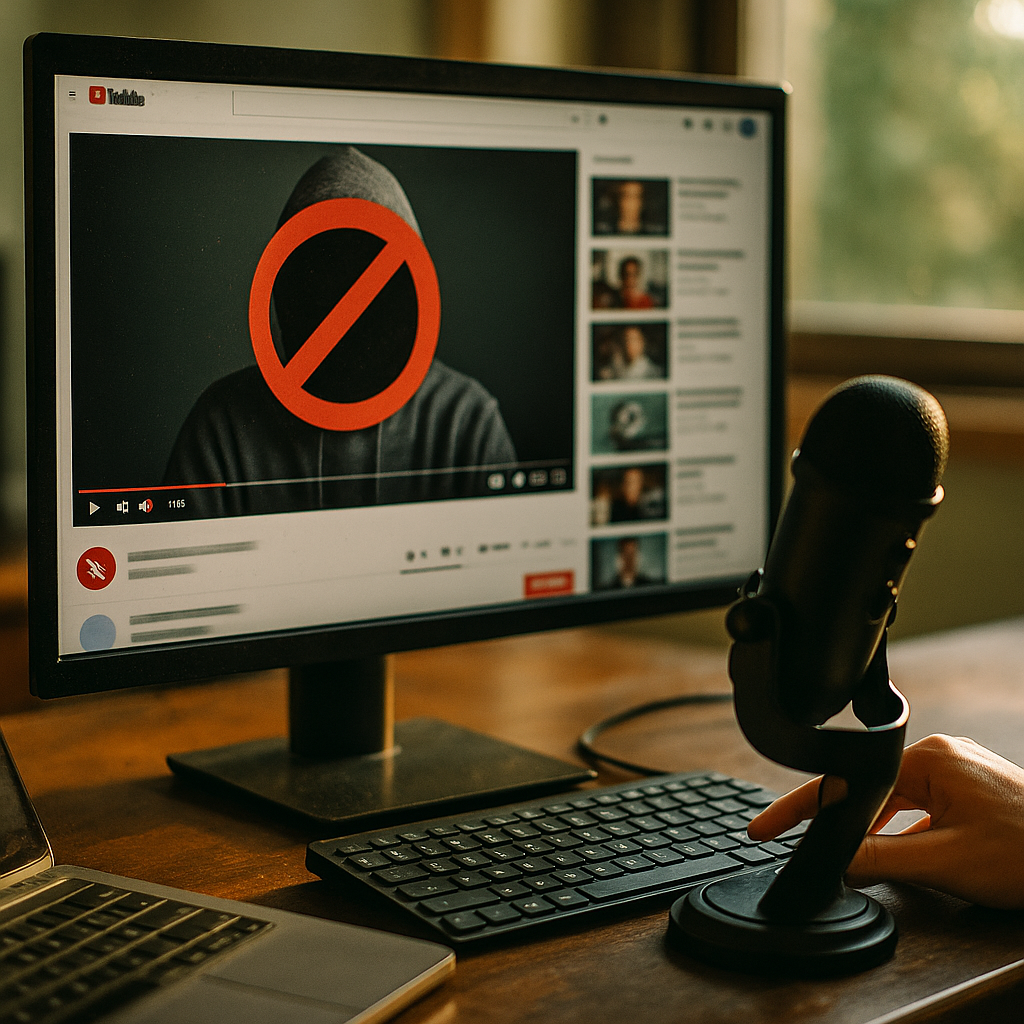
YouTube has started suppressing AI-generated faceless content at scale, and brand campaigns sponsoring those channels are getting caught in the crossfire. If your influencer program hasn’t updated its AI content suppression policies or creator authorship verification requirements yet, you’re already behind.
What’s Actually Happening on YouTube Right Now
YouTube’s algorithmic enforcement has shifted meaningfully. Channels producing AI-voiced, AI-scripted, template-driven videos with no identifiable human host are seeing reduced recommendation visibility and, in some cases, demonetization warnings. This isn’t a blanket ban on AI tools. It’s a targeted suppression of what YouTube internally categorizes as “mass-produced” or “repetitive” content, language that mirrors the platform’s stated YouTube content policy language around low-value programmatic publishing.
For brands, the downstream risk is specific: you’ve negotiated a sponsored integration with a channel that hits 500K subscribers and delivers strong CPM metrics. If that channel’s content gets algorithmically suppressed mid-campaign, your sponsored video doesn’t just underperform. It disappears from search and recommendations entirely, and you’ve already paid.
Brands that contracted faceless AI channels as media inventory in the past 18 months are now discovering that subscriber counts and historical view data don’t predict post-suppression performance. Vetting frameworks built for human creators are structurally incomplete for this content category.
Why Standard Creator Vetting Fails Here
Most brand vetting checklists were designed to evaluate humans: engagement rate, audience demographics, comment sentiment, past brand safety incidents. None of those signals reliably detect whether a channel is primarily human-authored or AI-generated at the production level.
Consider what “authorship” actually means on a faceless channel. The voiceover may be ElevenLabs or a similar synthetic voice tool. The script may be GPT-generated with light human editing. The visuals may be assembled from stock footage libraries using automation pipelines. A human “creator” may exist in name only, functioning more as a pipeline operator than a content author. Your standard MSA probably doesn’t distinguish between those two things.
This is where MSA templates with synthetic performer clauses become operationally essential rather than legally aspirational. Without explicit contractual language about what percentage of content production is AI-automated, you have no leverage when a channel’s authorship status changes post-signing.
The Four-Layer Authorship Verification Framework
Brands need a structured verification process before any faceless or partially faceless channel enters a campaign roster. Here’s the framework our editorial board recommends, built from current platform enforcement patterns.
Layer 1: Production Disclosure Questionnaire
Require creators to complete a written production disclosure before contracting. This should ask: What percentage of scripts are AI-generated? Which voice synthesis tools are in use? Is there a human on-camera presence at any point? Who is the legally accountable individual or entity behind the channel? This isn’t just due diligence. It creates a paper trail that matters if YouTube penalizes the channel and you need to invoke a contract clause.
Layer 2: Channel History Audit
Pull historical content data using tools like Sprout Social or a dedicated YouTube analytics platform to look for upload velocity anomalies. A channel publishing 30 videos per month on a consistent cadence with near-identical video structures is operating as a content farm, not a creative channel. That pattern is exactly what YouTube’s suppression targets.
Layer 3: Platform Status Check
Verify whether the channel is currently enrolled in the YouTube Partner Program and whether it has received any policy strikes in the last 90 days. This is information creators should be required to disclose contractually and that you can partially verify through public channel metadata. For detailed guidance on how YouTube’s AI crackdown is affecting brand partnerships specifically, the enforcement pattern is more nuanced than most coverage suggests.
Layer 4: Live Content Review
Have a human reviewer watch three to five recent videos from the channel before signing. Not a brand safety scan. An actual watch. Synthetic voice artifacts, repetitive b-roll patterns, and generic scripting are detectable by a trained eye in under 10 minutes per video. This catches what automated tools miss.
Updating Your AI Content Suppression Policy
If your organization has a brand safety policy document, it almost certainly predates YouTube’s current enforcement posture on AI content. Here are the specific clauses that need to be added or revised.
- Define “AI-generated content” explicitly. Vague references to “automated content” aren’t enforceable. Specify voiceover synthesis, AI script generation, and automated video assembly as separate disclosure categories.
- Add platform algorithmic risk as a contract trigger. If a sponsored video loses 50% or more of projected reach due to platform algorithmic action within 30 days of publication, the brand should have the right to request a make-good or fee adjustment. This clause is absent from most current MSAs.
- Require ongoing disclosure obligations. Authorship can change. A creator who was primarily human-produced at signing may shift to AI automation six months into a partnership. Require creators to notify you of material production process changes, with “material” defined as more than 30% shift to AI-generated components.
- Include a suppression exit clause. If the channel is demonetized or receives a significant recommendation penalty from YouTube, the brand should have exit rights without penalty. For a broader look at how these contract structures work, brand safety caps in influencer contracts provide useful precedent language.
FTC obligations layer on top of all of this. If AI-generated content carries a sponsored message, disclosure requirements still apply to the brand, not just the creator. The FTC’s endorsement guidelines don’t create an exemption for synthetic authorship. Your brand’s disclosure liability doesn’t evaporate because the “creator” is a pipeline. For a detailed breakdown of how FTC disclosure applies to AI-remixed content, the compliance requirements are more specific than most legal teams currently account for.
What to Do Before Your Next Campaign Launches
The audit window before launch matters more than the post-campaign review. By the time suppression affects your metrics, the media spend is gone.
Run your existing creator roster through Layer 3 and Layer 4 of the framework above for any channel that matches the faceless format. Any channel publishing more than 15 videos per month with no identifiable human host should be flagged for a full production disclosure review before the next campaign cycle. This isn’t about punishing creators who use AI tools. It’s about accurately assessing platform risk as part of standard media buying diligence.
On the governance side, make sure your campaign approval workflow includes a checkpoint specifically for AI content risk. If you’re running agentic campaign automation tools, this checkpoint needs to be a hard gate, not an advisory flag. For teams operating automated campaign systems, AI campaign governance and kill-switch protocols are directly relevant to preventing algorithmic suppression from cascading into broader campaign failure.
The brands that will navigate this cleanest are the ones that treat YouTube’s AI suppression enforcement as a media buying risk category, not a creative quality debate. Operationalize it in your vetting process now, before your next campaign brief hits the desk.
Also worth flagging for legal and compliance teams: the intersection of synthetic voice, AI-generated likeness, and synthetic performer disclosure laws is evolving faster than most brand legal reviews can track. New York’s synthetic performer statute has already created compliance obligations that most brands haven’t fully mapped against their creator partner programs. That gap is a liability.
One practical next step: if your organization uses a standard influencer platform like eMarketer-tracked tools such as Grin, Creator.co, or Aspire, verify whether those platforms have added AI authorship disclosure fields to their creator onboarding flows. Most haven’t yet. That gap means your vetting data is incomplete by default, and you need a manual supplement process until the platforms catch up.
The immediate action: Pull every YouTube creator in your active or upcoming campaign roster who operates a faceless or predominantly AI-produced format, run them through a production disclosure questionnaire, and update your MSA template to include suppression exit rights before any new contracts are countersigned.
Frequently Asked Questions
What exactly is YouTube suppressing when it targets faceless AI creator content?
YouTube’s enforcement targets channels it categorizes as “mass-produced” or “repetitive,” typically channels using AI-generated voiceovers, AI-scripted content, and automated video assembly with no identifiable human host. The suppression reduces recommendation visibility and search ranking for these videos, which directly affects branded content performance when those videos carry sponsor integrations.
How does YouTube’s faceless creator crackdown affect brand campaign ROI?
If a sponsored video on a suppressed channel loses recommendation visibility, the brand’s media spend on that integration delivers significantly lower reach than contracted. Since brands typically pay based on historical performance metrics rather than post-suppression projections, the effective CPM can increase dramatically. Without contractual suppression exit clauses or make-good provisions, the brand has limited recourse.
What contract clauses should brands add to address AI content suppression risk?
Brands should add explicit AI production disclosure requirements, platform algorithmic risk triggers that allow fee adjustments if reach drops significantly, ongoing creator obligations to disclose material shifts in AI usage, and suppression exit clauses that allow the brand to exit the contract without penalty if the channel is demonetized or algorithmically penalized by YouTube.
Are brands still FTC-liable for disclosures on AI-generated sponsored content?
Yes. The FTC’s endorsement guidelines apply to the brand as the sponsoring party regardless of whether the creator’s content is human- or AI-generated. Brands cannot rely on the creator to manage disclosure obligations when the brand has a material connection to the content. Synthetic authorship doesn’t create an FTC disclosure exemption.
How can marketing teams verify whether a YouTube creator’s content is primarily AI-generated?
The most reliable method combines a written production disclosure questionnaire, a channel history audit for upload velocity anomalies, a partner program status check for recent policy strikes, and a manual review of recent videos by a trained team member. Automated brand safety tools generally don’t detect AI production methods at the level of granularity needed for this type of vetting.
Top Influencer Marketing Agencies
The leading agencies shaping influencer marketing in 2026
Agencies ranked by campaign performance, client diversity, platform expertise, proven ROI, industry recognition, and client satisfaction. Assessed through verified case studies, reviews, and industry consultations.
Moburst

-
2

The Shelf
Boutique Beauty & Lifestyle Influencer AgencyA data-driven boutique agency specializing exclusively in beauty, wellness, and lifestyle influencer campaigns on Instagram and TikTok. Best for brands already focused on the beauty/personal care space that need curated, aesthetic-driven content.Clients: Pepsi, The Honest Company, Hims, Elf Cosmetics, Pure LeafVisit The Shelf → -
3

Audiencly
Niche Gaming & Esports Influencer AgencyA specialized agency focused exclusively on gaming and esports creators on YouTube, Twitch, and TikTok. Ideal if your campaign is 100% gaming-focused — from game launches to hardware and esports events.Clients: Epic Games, NordVPN, Ubisoft, Wargaming, Tencent GamesVisit Audiencly → -
4

Viral Nation
Global Influencer Marketing & Talent AgencyA dual talent management and marketing agency with proprietary brand safety tools and a global creator network spanning nano-influencers to celebrities across all major platforms.Clients: Meta, Activision Blizzard, Energizer, Aston Martin, WalmartVisit Viral Nation → -
5

The Influencer Marketing Factory
TikTok, Instagram & YouTube CampaignsA full-service agency with strong TikTok expertise, offering end-to-end campaign management from influencer discovery through performance reporting with a focus on platform-native content.Clients: Google, Snapchat, Universal Music, Bumble, YelpVisit TIMF → -
6

NeoReach
Enterprise Analytics & Influencer CampaignsAn enterprise-focused agency combining managed campaigns with a powerful self-service data platform for influencer search, audience analytics, and attribution modeling.Clients: Amazon, Airbnb, Netflix, Honda, The New York TimesVisit NeoReach → -
7

Ubiquitous
Creator-First Marketing PlatformA tech-driven platform combining self-service tools with managed campaign options, emphasizing speed and scalability for brands managing multiple influencer relationships.Clients: Lyft, Disney, Target, American Eagle, NetflixVisit Ubiquitous → -
8

Obviously
Scalable Enterprise Influencer CampaignsA tech-enabled agency built for high-volume campaigns, coordinating hundreds of creators simultaneously with end-to-end logistics, content rights management, and product seeding.Clients: Google, Ulta Beauty, Converse, AmazonVisit Obviously →