


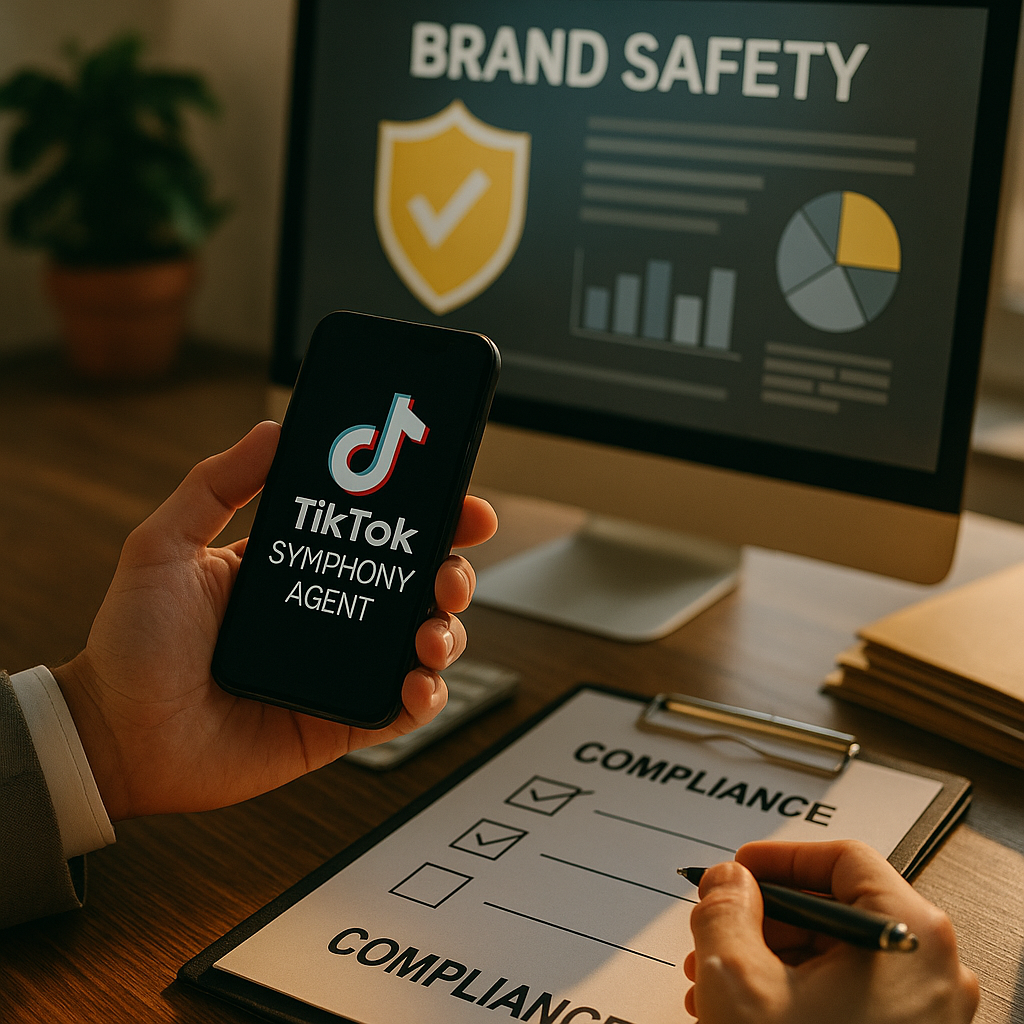
Your Brand’s Video Library Is About to Become an Autonomous Ad Machine
Brands using TikTok Symphony Agent can now transform existing video assets into AI-generated shoppable ads without a human creative director in the loop. If your legal and compliance team hasn’t defined the guardrails yet, the platform’s automation will fill that vacuum with its own defaults.
TikTok Symphony, the platform’s AI creative suite, is moving fast. The Symphony Agent capability specifically allows automated creative transformation of uploaded brand footage into commerce-ready ad units. According to TikTok for Business, Symphony tools are already being tested at scale with enterprise advertisers. What brands haven’t caught up on is the compliance architecture that needs to sit underneath this automation before it runs unsupervised.
What “Automated Creative Transformation” Actually Means for Your Assets
Let’s be precise about the mechanic. Symphony Agent ingests existing brand video content, identifies product moments, extracts clips, applies AI-generated voiceover or script overlays, adds interactive commerce elements, and outputs shoppable ad units. The transformation is non-trivial. The output is a new creative artifact that may not look or sound like anything your brand team originally approved.
That’s the core legal exposure. Your original video went through an approval chain. The AI-transformed version did not. In regulated categories including alcohol, pharmaceuticals, financial services, and food, that gap matters enormously.
Every AI-transformed ad unit is, legally speaking, a new piece of creative. Compliance teams that treat it as a derivative of an already-approved asset are taking on undisclosed risk.
The FTC’s position on AI-generated advertising disclosures continues to evolve, but the underlying principle is stable: material connections and claims must be accurate regardless of how the content was produced. An AI that extracts a product close-up and adds a “clinically proven” overlay from a different approved context has just created a potentially misleading claim. And it happened in milliseconds.
Where to Start: The Parameter Configuration Conversation
Most brand teams approach Symphony configuration as a marketing operations decision. It shouldn’t be. The parameter-setting conversation needs legal, compliance, and procurement at the table before the first automated campaign runs.
Specifically, your configuration framework should address five domains:
- Content scope: Which video assets are eligible for AI transformation? Not everything in your asset library qualifies. Footage that includes talent under separate likeness agreements, user-generated content acquired for specific uses, or clips from campaigns with geographically limited rights should be explicitly excluded.
- Claim integrity: What product claims, testimonials, or efficacy language can the AI surface or amplify? Define a closed list of permitted claims and a hard block list. Symphony’s prompting layer can reference this if your team builds the right constraints upstream.
- Audience targeting guardrails: Shoppable ads generated from AI transformation need the same audience exclusions as manually created ads. If your brand has age restrictions, the AI output inherits them. Verify this is enforced at the campaign level, not assumed.
- Disclosure requirements: AI-generated creative requires disclosure in most major markets. Your Symphony configuration should mandate the appropriate label placement. For context on how this plays out in influencer-adjacent content, the FTC disclosure framework for AI-remixed content is directly applicable here.
- Human review triggers: Define what outputs require mandatory human sign-off before activation. A useful rule of thumb: any ad unit featuring talent, making a comparative claim, or targeting a sensitive demographic should route to a reviewer before serving.
The Talent and IP Problem Nobody Is Talking About Loudly Enough
Here’s where brands are most exposed. A creator who shot a campaign video for your brand six months ago may not have consented to their likeness being used in AI-generated derivative content. Their original contract almost certainly didn’t contemplate it.
New York’s synthetic performer law and the evolving AI talent disclosure landscape create real liability when AI tools transform footage that includes identifiable individuals. Before you configure Symphony Agent to access any video asset containing on-screen talent, your team needs to audit whether existing talent agreements cover AI-generated derivatives. Our coverage of the NY synthetic performer compliance framework outlines the audit steps brands should follow.
The same principle applies to licensed music, branded environments, and third-party products that appear incidentally in footage. If a frame of your video shows a competitor’s product in the background, and Symphony extracts and amplifies that frame, you have a problem that no amount of post-hoc takedown will cleanly fix.
Practical fix: maintain a cleared asset list. Only video that has been affirmatively cleared for AI transformation use should be eligible for Symphony ingestion. This is an operational step, not just a policy one. The cleared list needs to live in your DAM system with a flag that Symphony’s API can reference, or alternatively, in a separate dedicated folder that the platform can access.
Governance Architecture for AI-Driven Ad Creation
Parameter configuration is a one-time task done wrong if it’s treated as a setup step rather than an ongoing governance function. As Symphony’s capabilities expand and TikTok’s commerce infrastructure deepens (TikTok Shop’s shoppable ad volume is growing rapidly across Southeast Asia, the US, and Western Europe), the parameters you set today will need quarterly review at minimum.
Your governance framework should include a defined owner for Symphony configuration. In most organizations, this sits uncomfortably between performance marketing, legal, and brand. Assign it explicitly. The agentic campaign governance model, including override protocols and kill-switch procedures, is the right operational template here. AI that can create and serve ads autonomously needs a human-accessible emergency stop that’s faster than a standard campaign pause.
Logging matters too. Every AI-generated creative variation should be captured in your ad records. The UK ICO and various EU data protection authorities have begun scrutinizing automated decision-making in advertising contexts. Demonstrating that your brand had defined parameters, reviewed outputs, and maintained records is the baseline for any regulatory inquiry defense.
Brands that document their AI creative governance now will have a significant compliance advantage when regulators inevitably turn their attention to automated shoppable ad systems.
Connecting This to Broader Creator Commerce Compliance
TikTok Symphony Agent doesn’t exist in isolation. It sits inside a broader creator commerce ecosystem where your brand is simultaneously running creator-led campaigns, TikTok Shop affiliate programs, and now AI-automated ad units. Compliance obligations compound.
If a creator’s original video is transformed by Symphony into a shoppable ad, the original creator brief’s brand safety and disclosure standards need to carry through to the AI output. That’s not automatic. It requires deliberate policy linkage. For brands managing this, the creator brief compliance standards framework provides a useful structural starting point.
Data considerations are equally important. Symphony’s processing of your video assets involves platform-side AI training infrastructure. Your data governance team should understand what eMarketer’s commerce media research has consistently flagged: brands often underestimate how much proprietary creative data they share with platform AI systems during standard tool activation. Check your TikTok Business Center data terms before enabling Symphony at scale.
Similarly, if your shoppable ads are collecting purchase intent data through TikTok Shop integrations, review your creator commerce data minimization obligations with your privacy team. The AI creative layer and the commerce data layer are increasingly the same system.
Finally, contract infrastructure needs updating. If you’re working with creators whose existing MSAs don’t include AI transformation clauses, now is the time to add them. The MSA templates with AI synthetic performer clauses available to compliance teams represent the current best practice for closing this gap before it becomes a dispute.
The immediate next step: Pull your top 20 video assets currently in TikTok Business Center and run them against a cleared-for-AI-transformation checklist that your legal team builds in the next two weeks. That list is your actual Symphony configuration starting point, not the platform’s default settings.
Frequently Asked Questions
What is TikTok Symphony Agent and how does it affect brand advertising?
TikTok Symphony Agent is part of TikTok’s AI creative suite that can automatically transform existing brand video assets into shoppable ad units. It extracts product moments, applies AI-generated overlays or voiceovers, and adds interactive commerce elements without requiring manual creative production. For brands, this means existing video libraries can generate new ad variants at scale, but also that AI-created outputs may not reflect brand-approved messaging unless proper configuration guardrails are set in advance.
What legal risks does AI-generated creative transformation create for brands?
The primary risks include talent likeness rights (creators in original footage may not have consented to AI derivatives), claim integrity (AI may surface or recombine product claims in misleading ways), disclosure compliance (AI-generated ads require appropriate labels in most markets), and IP exposure from licensed assets or third-party content within source footage. Each AI-transformed output is legally a new creative unit that carries its own compliance obligations.
How should brands structure their Symphony Agent configuration before enabling automation?
Brands should define five configuration domains before enabling Symphony at scale: which assets are cleared for AI transformation, what product claims are permitted or blocked, which audience targeting exclusions apply, what disclosure labels must appear, and what output types require human review before serving. This framework should be built collaboratively by legal, compliance, and marketing operations teams, not set unilaterally by performance marketers.
Do existing creator contracts cover AI transformation of footage?
In most cases, creator agreements executed before AI creative tools became widespread do not include explicit AI transformation permissions. Brands need to audit existing talent agreements to determine whether AI derivative use is covered. For new agreements, contracts should include explicit AI and synthetic performer clauses. Brands operating in jurisdictions with synthetic performer laws, such as New York, face specific legal exposure for AI use of creator likenesses without updated consent.
How frequently should brands review their Symphony Agent compliance parameters?
At minimum, quarterly review is recommended, aligned with platform capability updates and regulatory changes. TikTok’s Symphony tools are actively expanding, meaning parameters set at launch may not account for new automation capabilities. Additionally, talent agreements, licensed asset terms, and regulatory guidance on AI advertising disclosure are all evolving, making periodic re-assessment of the full parameter framework an operational necessity rather than an optional best practice.
Top Influencer Marketing Agencies
The leading agencies shaping influencer marketing in 2026
Agencies ranked by campaign performance, client diversity, platform expertise, proven ROI, industry recognition, and client satisfaction. Assessed through verified case studies, reviews, and industry consultations.
Moburst

-
2

The Shelf
Boutique Beauty & Lifestyle Influencer AgencyA data-driven boutique agency specializing exclusively in beauty, wellness, and lifestyle influencer campaigns on Instagram and TikTok. Best for brands already focused on the beauty/personal care space that need curated, aesthetic-driven content.Clients: Pepsi, The Honest Company, Hims, Elf Cosmetics, Pure LeafVisit The Shelf → -
3

Audiencly
Niche Gaming & Esports Influencer AgencyA specialized agency focused exclusively on gaming and esports creators on YouTube, Twitch, and TikTok. Ideal if your campaign is 100% gaming-focused — from game launches to hardware and esports events.Clients: Epic Games, NordVPN, Ubisoft, Wargaming, Tencent GamesVisit Audiencly → -
4

Viral Nation
Global Influencer Marketing & Talent AgencyA dual talent management and marketing agency with proprietary brand safety tools and a global creator network spanning nano-influencers to celebrities across all major platforms.Clients: Meta, Activision Blizzard, Energizer, Aston Martin, WalmartVisit Viral Nation → -
5

The Influencer Marketing Factory
TikTok, Instagram & YouTube CampaignsA full-service agency with strong TikTok expertise, offering end-to-end campaign management from influencer discovery through performance reporting with a focus on platform-native content.Clients: Google, Snapchat, Universal Music, Bumble, YelpVisit TIMF → -
6

NeoReach
Enterprise Analytics & Influencer CampaignsAn enterprise-focused agency combining managed campaigns with a powerful self-service data platform for influencer search, audience analytics, and attribution modeling.Clients: Amazon, Airbnb, Netflix, Honda, The New York TimesVisit NeoReach → -
7

Ubiquitous
Creator-First Marketing PlatformA tech-driven platform combining self-service tools with managed campaign options, emphasizing speed and scalability for brands managing multiple influencer relationships.Clients: Lyft, Disney, Target, American Eagle, NetflixVisit Ubiquitous → -
8

Obviously
Scalable Enterprise Influencer CampaignsA tech-enabled agency built for high-volume campaigns, coordinating hundreds of creators simultaneously with end-to-end logistics, content rights management, and product seeding.Clients: Google, Ulta Beauty, Converse, AmazonVisit Obviously →