


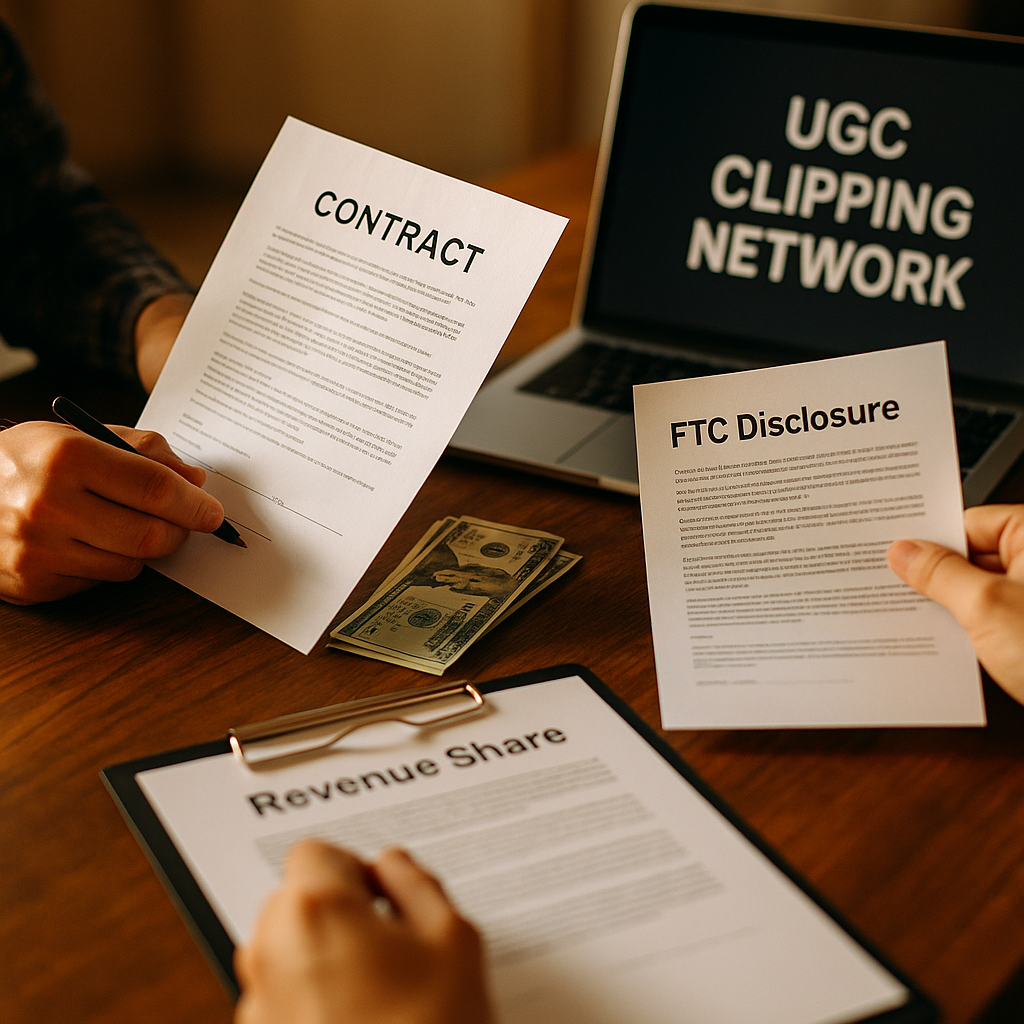
Brands licensing access to UGC clipping networks are signing contracts that their legal teams have never seen before — and most of those contracts are missing three critical clauses. The UGC clipping network contract framework is still being written in real time, which means the brands that build rigorous participation agreements now will own a significant compliance and competitive advantage.
What a UGC Clipping Network Actually Is (And Why It Changes Everything)
A UGC clipping network, sometimes called a coordinated authentic account distribution network, is not an influencer roster. It is a licensed infrastructure play. Instead of contracting with individual creators, a brand pays for access to a platform or operator that manages a distributed pool of real accounts — often hundreds or thousands — that organically clip, reshare, and amplify branded content. The accounts are genuine. The coordination is not disclosed. That gap is where your legal exposure lives.
The distinction matters enormously for contract structure. When you hire a single creator, you govern one relationship. When you license a network, you are effectively a party to every post those accounts publish on your behalf, even if you never spoke to the account holder directly. UGC clipping network compliance is not optional — it is the load-bearing wall of your participation agreement.
Structuring the Participation Agreement: Four Non-Negotiable Clauses
Most network operators will hand you a thin service agreement that covers licensing fees, content usage rights, and maybe a vague indemnification clause. Reject it as a starting point. Your legal team needs to build or heavily annotate the agreement around these four pillars:
- Account Authenticity Warranty: The operator must warrant, in writing, that every account in the network is operated by a real human with no artificial follower inflation, no bot-assisted engagement, and no cross-posting via automation tools that violate platform terms of service. This warranty should survive termination.
- Disclosure Obligation Assignment: The agreement must specify exactly who is responsible for ensuring each account publishes an FTC-compliant disclosure. Do not accept shared responsibility language. Assign primary obligation to the network operator, with a secondary contractual duty on your brand to audit compliance quarterly.
- Audit Rights: You need the contractual right to request a full account list, post-level performance data, and disclosure status reports on demand or at defined intervals. Without this clause, you cannot defend yourself in an FTC enforcement action.
- Termination for Regulatory Cause: Include a clean exit trigger if any regulatory body (FTC, state AG, EU DMA authority) opens an investigation related to the network’s distribution practices, not just practices directly tied to your campaign.
A participation agreement that lacks audit rights is not a contract — it is a liability transfer mechanism that moves risk entirely onto the brand while giving the operator full operational opacity.
Revenue-Share Architecture: Aligning Incentives Without Creating FTC Problems
Revenue-share arrangements in clipping networks are genuinely new territory. The most common model ties the operator’s fee to impressions delivered, with a base licensing fee plus a per-thousand-impression variable. Some operators are now proposing performance-based tiers tied to downstream conversion metrics via affiliate links or promo codes embedded in clips.
Performance-based structures are operationally attractive. They are also a disclosure minefield. When a network account earns a material financial benefit tied directly to a specific clip’s performance, that account holder has a material connection to the brand. The performance-based contract mechanics that apply to individual creators apply here too — arguably with more regulatory scrutiny because the coordination is harder to see.
Best practice: structure the operator’s revenue share at the network level, not the account level. If individual account holders are compensated based on clip performance, each of those accounts becomes a compensated endorser under FTC guidelines, and every clip they publish requires explicit disclosure. Make this explicit in the contract. If the operator’s model cannot accommodate that requirement, walk away.
FTC Disclosure Architecture for Network Distribution
The FTC’s endorsement guides do not carve out an exception for network-mediated distribution. Coordination plus compensation equals a material connection that must be disclosed, full stop. The practical challenge is that clipping network accounts are not posting polished sponsored content — they are posting short-form clips that feel organic. Cramming “#ad” into a TikTok comment or Instagram Reel caption is technically compliant but operationally fragile at scale.
Your disclosure architecture needs three layers:
- In-content disclosure: A verbal or on-screen “paid partnership” or “sponsored” label within the first three seconds of any video clip. The FTC has been explicit that end-of-video or buried-caption disclosures do not meet the clear and conspicuous standard.
- Platform-native disclosure tools: Where available (Meta’s paid partnership label, TikTok’s branded content toggle), these must be activated. Your participation agreement should require the operator to contractually mandate this with network accounts.
- Contractual disclosure audit: The operator must provide weekly post-level disclosure compliance reports during any active campaign. Non-compliant posts must be taken down or corrected within 24 hours. Both obligations need to sit in the contract with defined financial penalties for breach.
For brands running campaigns across jurisdictions, the UK’s prominence rules for sponsored content add an additional layer — UK-targeted clips must meet the CAP Code’s prominence standards, which are stricter than FTC minimums in several respects.
Platform ToS Risk: The Clause Nobody Reads Until It’s Too Late
Every major platform — TikTok, Instagram, YouTube — prohibits coordinated inauthentic behavior in its terms of service. The question of whether a licensed clipping network constitutes “coordinated inauthentic behavior” is genuinely unsettled, but the risk is not hypothetical. Meta has suspended brand ad accounts for indirect association with coordinated amplification schemes. TikTok’s trust and safety team has removed entire content clusters tied to undisclosed coordinated campaigns.
Your participation agreement must include a platform suspension indemnification clause. If a platform takes action against your brand account, your organic presence, or your paid media delivery as a result of the operator’s network activities, the operator must indemnify you for measurable losses including lost media investment, audience reach damage, and crisis management costs.
This is not a theoretical ask. Given that agentic AI systems are increasingly being layered into network distribution to optimize clip timing and account selection, the platform detection risk is growing, not shrinking. Automated coordination is exactly what platform integrity teams are trained to identify.
Intellectual Property and Content Licensing in a Network Context
When a clipping network account reposts or remixes your brand’s video asset, who owns the resulting clip? The operator’s standard agreement will almost certainly assert that the network or the individual account holder retains rights to any derivative content. That is a problem if the clip performs well and you want to repurpose it in paid media.
Negotiate a broad, irrevocable, royalty-free license to any derivative content generated by network accounts during the campaign term. Pair this with a morality clause that lets you remove your brand association from any clip that appears alongside content that violates your brand safety standards. The creator film licensing frameworks used in premium brand deals provide a solid structural template to adapt here.
Clipping network operators rarely anticipate sophisticated IP licensing demands. That negotiating gap is your leverage — use it to secure content rights that would otherwise cost multiples of your licensing fee in a traditional creator deal.
Minimum Viable Contract Checklist Before You Sign
Before any brand signs a UGC clipping network participation agreement, verify these items are present and unambiguous:
- Account authenticity warranty with financial penalty for breach
- Named disclosure responsibility with compliance audit rights
- Revenue-share structure that does not create undisclosed per-account financial incentives
- Platform suspension indemnification covering ad accounts and organic presence
- Irrevocable content license for all derivative clips
- Termination for regulatory cause, with 30-day notice and fee proration
- Jurisdiction-specific disclosure schedules (FTC, CAP Code, ARPP where relevant)
If your current operator cannot accommodate these terms, that is the answer to your due diligence question. Operators running legitimate networks will have no objection to transparency obligations. The ones who push back hardest on audit rights are the ones whose networks cannot withstand scrutiny. Review your creator brief disclosure standards and apply the same framework to network operators — they are content distribution partners, and the same accountability logic applies.
Start with your legal team drafting a network-specific MSA addendum before your next RFP. The conversation you have with an operator about whether they will accept your terms tells you more than any sales deck ever will.
Frequently Asked Questions
Does the FTC require disclosure on every post from a UGC clipping network?
Yes. If there is a material connection between the brand and the account publishing the clip — whether through direct payment, indirect revenue share, or free product — the FTC requires clear and conspicuous disclosure. The fact that distribution is mediated through a network operator rather than a direct brand relationship does not eliminate the disclosure obligation. The FTC’s 2023 revised endorsement guides make clear that indirect material connections carry the same disclosure requirements as direct ones.
Who is liable if a network account fails to disclose: the brand or the operator?
Both can be liable. The FTC has historically pursued brands as the advertiser of record, even when disclosure failures were operationally the responsibility of an intermediary. Your participation agreement should assign primary operational responsibility to the operator, but your brand retains residual regulatory exposure. This is why audit rights and contractual compliance obligations are non-negotiable, not nice-to-have.
What is the difference between a UGC clipping network and a traditional influencer network?
A traditional influencer network aggregates individual creator relationships and brokers individual campaign deals. A UGC clipping network licenses access to a coordinated distribution infrastructure where content is amplified across many accounts simultaneously, often without individual creator briefings or per-post approvals. The coordination at scale creates different legal, disclosure, and platform ToS risks than individual creator relationships.
Can revenue-share arrangements with clipping networks be structured to avoid per-account disclosure requirements?
Potentially, if the financial arrangement exists solely between the brand and the network operator, with no performance-based compensation flowing to individual account holders. The moment individual accounts receive material benefits tied to specific post performance, those accounts become compensated endorsers. Structure operator fees as network-level licensing fees, not per-account performance payouts, and have your legal team confirm the compensation flow does not trigger individual endorser status.
How should brands handle platform ToS risk when using clipping networks?
Require a contractual indemnification from the network operator covering platform enforcement actions, including ad account suspensions and organic content removal. Additionally, conduct pre-campaign due diligence to verify the operator’s network accounts are operating within platform guidelines. Review the operator’s own terms of service to confirm they explicitly prohibit platform ToS violations by network accounts, and include that prohibition as a pass-through obligation in your participation agreement.
Top Influencer Marketing Agencies
The leading agencies shaping influencer marketing in 2026
Agencies ranked by campaign performance, client diversity, platform expertise, proven ROI, industry recognition, and client satisfaction. Assessed through verified case studies, reviews, and industry consultations.
Moburst

-
2

The Shelf
Boutique Beauty & Lifestyle Influencer AgencyA data-driven boutique agency specializing exclusively in beauty, wellness, and lifestyle influencer campaigns on Instagram and TikTok. Best for brands already focused on the beauty/personal care space that need curated, aesthetic-driven content.Clients: Pepsi, The Honest Company, Hims, Elf Cosmetics, Pure LeafVisit The Shelf → -
3

Audiencly
Niche Gaming & Esports Influencer AgencyA specialized agency focused exclusively on gaming and esports creators on YouTube, Twitch, and TikTok. Ideal if your campaign is 100% gaming-focused — from game launches to hardware and esports events.Clients: Epic Games, NordVPN, Ubisoft, Wargaming, Tencent GamesVisit Audiencly → -
4

Viral Nation
Global Influencer Marketing & Talent AgencyA dual talent management and marketing agency with proprietary brand safety tools and a global creator network spanning nano-influencers to celebrities across all major platforms.Clients: Meta, Activision Blizzard, Energizer, Aston Martin, WalmartVisit Viral Nation → -
5

The Influencer Marketing Factory
TikTok, Instagram & YouTube CampaignsA full-service agency with strong TikTok expertise, offering end-to-end campaign management from influencer discovery through performance reporting with a focus on platform-native content.Clients: Google, Snapchat, Universal Music, Bumble, YelpVisit TIMF → -
6

NeoReach
Enterprise Analytics & Influencer CampaignsAn enterprise-focused agency combining managed campaigns with a powerful self-service data platform for influencer search, audience analytics, and attribution modeling.Clients: Amazon, Airbnb, Netflix, Honda, The New York TimesVisit NeoReach → -
7

Ubiquitous
Creator-First Marketing PlatformA tech-driven platform combining self-service tools with managed campaign options, emphasizing speed and scalability for brands managing multiple influencer relationships.Clients: Lyft, Disney, Target, American Eagle, NetflixVisit Ubiquitous → -
8

Obviously
Scalable Enterprise Influencer CampaignsA tech-enabled agency built for high-volume campaigns, coordinating hundreds of creators simultaneously with end-to-end logistics, content rights management, and product seeding.Clients: Google, Ulta Beauty, Converse, AmazonVisit Obviously →