


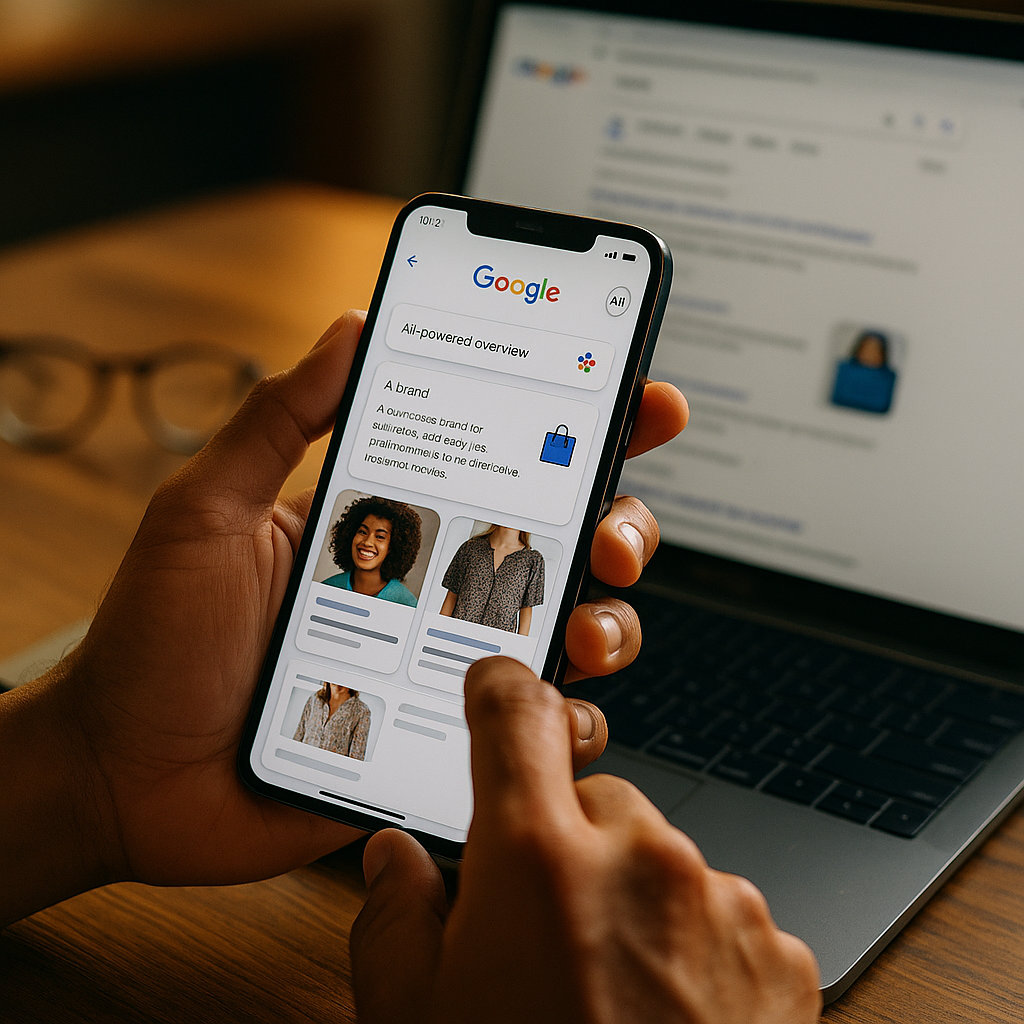
What happens to your influencer program when a procurement AI builds the vendor shortlist before your brand ever enters the conversation? That’s not a hypothetical. Google AI Mode’s continuous background agents are already synthesizing market intelligence and surfacing creator and vendor recommendations without a single user-initiated query — and most attribution models weren’t built for this.
The Architecture Shift Brands Are Missing
Traditional search assumes intent. A user types a query, results surface, a click generates a signal, and attribution captures that moment. Google AI Mode breaks every link in that chain. Its agentic layer doesn’t wait for a prompt. It monitors configured briefs, tracks competitive signals, and compiles shortlists proactively — think of it as a always-on research analyst running in the background of a buyer’s workflow.
For brand marketers, this creates a structural problem. Your entire digital presence was optimized for reactive discovery. Someone searches “top beauty influencer agencies” and your content ranks. But when an AI agent assembles that list before the human buyer ever types anything, ranking in traditional SERPs is secondary. What matters is whether the agent’s training data, live crawl behavior, and synthesis logic have indexed your brand as a credible, structured source of information.
Over 40% of B2B buyers in a recent Forrester survey reported using AI agents to pre-filter vendor shortlists before engaging sales — a figure that has grown sharply as agentic tools reach enterprise procurement workflows.
The implications for influencer marketing specifically are significant. Agencies, platforms, and creator management tools are now competing not just for search rankings but for agent legibility — the degree to which an AI system can parse, trust, and cite your brand’s positioning accurately.
What “Continuous Background Agents” Actually Do
Google AI Mode’s background agents operate through a combination of persistent task queues, scheduled synthesis cycles, and real-time web crawling. A media buyer at a CPG brand might configure an agent to “monitor the nano-influencer landscape in wellness and flag emerging creators with above-average engagement in the 35-50 female demographic.” The agent doesn’t wait to be asked. It synthesizes signals continuously and delivers a structured brief when thresholds are met.
This changes creator discovery in three concrete ways:
- Passive brand indexing replaces active SEO: Agents crawl structured data, schema markup, and entity relationships. A creator or agency without proper structured data is effectively invisible to the agent layer, regardless of their organic ranking.
- Velocity signals replace static authority: Agents weight recent content output, sentiment trajectory, and cross-platform consistency more heavily than domain authority metrics that took years to build.
- Synthesis bias introduces new competitive risk: When an agent compiles a shortlist, early inclusions create momentum. Brands and creators who appear in initial agent outputs get cited more frequently as training data updates — a compounding advantage that late movers will struggle to close.
If your agency isn’t already auditing how AI agents parse your positioning, the CMO readiness audit for creator campaigns is a practical starting point for identifying the gaps before a procurement agent fills the shortlist without you.
Attribution Models Are Broken. Here’s Why.
Attribution was already under pressure. Privacy deprecation, cross-device fragmentation, and walled garden reporting had eroded confidence in last-click and even multi-touch models. Agentic AI delivers the final blow to any model that assumes a traceable, linear path from awareness to conversion.
When a buyer’s AI agent surfaces your brand in a synthesized shortlist, the “exposure” event generates no pixel, no click, no UTM parameter. The agent’s recommendation is internal to the buyer’s workflow. You may win a contract without a single trackable digital touchpoint preceding it. Your CRM shows an inbound inquiry from a cold lead, but the actual discovery happened silently inside an AI agent three weeks earlier.
This matters for budget allocation. Marketing teams optimizing spend based on last-touch or even data-driven attribution will systematically underfund the content, structured data, and entity optimization efforts that drive agent legibility — because those inputs never appear in the attribution report.
The fix isn’t a new attribution tool. It’s a parallel measurement architecture. Smart teams are building agent presence audits alongside their traditional analytics: running test queries through AI Mode, Microsoft Copilot, and Perplexity to assess how their brand is represented in synthesized outputs, and tracking shifts over time as a leading indicator of pipeline influence. For deeper context on how AI mode agents shape vendor shortlisting, the strategic framing there is directly applicable to influencer program positioning.
Creator Content Discovery Through an Agent Lens
For creators and the brands partnering with them, agent-driven discovery creates a new content brief imperative. An agent evaluating creator fit for a brand campaign isn’t watching a video end-to-end. It’s parsing metadata, transcript text, structured descriptions, engagement pattern data from the Google ecosystem, and cross-platform signals to assess topical authority, audience alignment, and brand safety simultaneously.
Creators who publish content optimized for human consumption but not machine interpretation are losing ground in agent-driven shortlisting. Practical implications:
- Video transcripts must be accurate, keyword-coherent, and structured — auto-captions with errors are noise to an agent parser.
- About pages and creator media kits need entity-level specificity: niche, audience demographics, past brand categories, and measurable performance claims in structured, crawlable formats.
- Content cadence matters. Agents track recency and consistency. A creator who published strong content eighteen months ago but has been sporadic since will score lower on velocity signals, regardless of historical performance.
Brands need to communicate this to creator partners explicitly. Your campaign briefs should now include agent-optimization requirements, not just platform-specific creative guidance. The work on optimizing creator briefs for AI discovery outlines the specific brief elements that improve agent legibility at the creator level.
Brands that align creator brief requirements with AI agent parsing logic — structured metadata, entity-rich descriptions, and consistent topical signals — will appear more frequently in proactively generated vendor shortlists than competitors relying solely on traditional SEO.
GEO as the Strategic Response
Generative Engine Optimization (GEO) is the discipline that addresses agent legibility directly. Where traditional SEO optimizes for crawl and rank, GEO optimizes for synthesis: ensuring that when an AI agent compiles a response about your category, your brand is included, accurately represented, and cited with supporting evidence.
For influencer marketing brands and agencies, GEO strategy requires:
- Entity establishment: Your brand, key executives, and flagship products need clear entity profiles across Wikidata, Google’s Knowledge Graph, and major industry databases. Agents use entity graphs to validate credibility before citing a source.
- Structured claim packaging: Every differentiating claim (ROI benchmarks, platform specialization, creator network size) should be packaged in schema-marked, machine-readable formats on your owned properties.
- Third-party citation velocity: Agents weight external citations heavily. PR, analyst coverage, and trade publication mentions (structured, not just text mentions) function as trust signals in agent synthesis logic.
- Cross-platform signal consistency: Contradictory positioning across LinkedIn, your website, and your agency listing pages creates synthesis ambiguity. Agents default to the most frequently corroborated signal.
The connection between GEO execution and measurable cost-per-acquisition reduction is increasingly well-documented. Brands appearing consistently in agent-generated shortlists are reporting shorter sales cycles and higher close rates on inbound inquiries, precisely because the pre-qualification work was done silently by the buyer’s AI before first contact.
Governance matters here too. As brands deploy their own agentic tools for competitor monitoring and creator vetting, human override protocols need to be built into the workflow from the start. The governance frameworks for agentic advertising oversight apply directly to this operational layer.
What to Restructure Before the Next Procurement Cycle
The window to establish agent presence ahead of competitors is narrow. Agents build their synthesis models from existing indexed content, and compounding citation effects mean early movers have a structural advantage that grows over time.
The priority actions are specific. Conduct an agent presence audit using Google AI Mode, Perplexity, and Microsoft Copilot: ask the kinds of questions a media buyer would ask when vetting agencies or creator partners in your category. Document how your brand is currently represented. Identify the claims being made about competitors that you should be making more clearly. Then restructure your content, schema, and entity profiles to close those gaps systematically.
For creators specifically, eMarketer data shows that AI-assisted discovery tools are now part of the standard workflow at a significant share of enterprise brand marketing teams. Being undetectable to those tools is no longer a niche technical risk — it’s a revenue risk.
Finally, connect your GEO and agent legibility efforts to your attribution governance. Work with your analytics team to build agent presence as a leading indicator metric in your measurement stack. Traditional marketing attribution tools will not capture this signal natively — you’ll need to build the reporting layer deliberately.
Start with the audit. Run it this week, before the next procurement cycle starts without you.
FAQs
What is Google AI Mode and how does it affect brand marketers?
Google AI Mode is an agentic layer within Google’s search and workspace ecosystem that uses continuous background agents to synthesize market intelligence, monitor configured topics, and deliver vendor or creator shortlists proactively — without waiting for a user to submit a search query. For brand marketers, this means traditional SEO visibility is no longer sufficient for discovery; brands must also optimize for agent legibility through structured data, entity profiles, and consistent cross-platform positioning.
How do continuous background agents change attribution models?
Background agents discover and recommend brands silently, generating no clickstream data, no UTM parameters, and no pixel events. When a buyer’s agent surfaces your brand in a synthesized shortlist and the buyer later contacts you, the attribution model records a cold inbound with no prior touchpoint. This causes systematic undervaluation of the content and GEO efforts that drove agent inclusion. Marketers need a parallel measurement architecture — including agent presence audits — to capture this influence.
What is GEO and why does it matter for influencer marketing brands?
Generative Engine Optimization (GEO) is the practice of optimizing content, structured data, and entity profiles so that AI agents and generative search engines accurately represent your brand in synthesized responses. For influencer marketing agencies and creator platforms, GEO determines whether your brand appears in proactively generated vendor shortlists assembled by buyers’ AI agents. Strong GEO execution correlates with shorter sales cycles and higher inbound close rates.
How should brands restructure creator briefs for agent-driven discovery?
Creator briefs should now include agent-optimization requirements alongside standard creative guidance. This means requiring accurate, structured video transcripts; entity-rich creator descriptions with specific niche, audience demographics, and performance data in crawlable formats; and consistent content cadence to generate positive velocity signals. Agents parsing creator suitability weight machine-readable structure and topical consistency heavily, so briefs that don’t address these elements leave creator partners disadvantaged in automated shortlisting.
Which AI tools should marketers use to audit their agent presence?
The most actionable audit approach involves running category-relevant vendor queries through Google AI Mode, Microsoft Copilot, and Perplexity — the three platforms with the widest enterprise adoption in B2B procurement workflows. Document how your brand is represented, what claims are associated with your category competitors, and where your positioning is absent or misrepresented. This baseline audit should be repeated quarterly, as agent synthesis models update with new crawl and citation data continuously.
Top Influencer Marketing Agencies
The leading agencies shaping influencer marketing in 2026
Agencies ranked by campaign performance, client diversity, platform expertise, proven ROI, industry recognition, and client satisfaction. Assessed through verified case studies, reviews, and industry consultations.
Moburst

-
2

The Shelf
Boutique Beauty & Lifestyle Influencer AgencyA data-driven boutique agency specializing exclusively in beauty, wellness, and lifestyle influencer campaigns on Instagram and TikTok. Best for brands already focused on the beauty/personal care space that need curated, aesthetic-driven content.Clients: Pepsi, The Honest Company, Hims, Elf Cosmetics, Pure LeafVisit The Shelf → -
3

Audiencly
Niche Gaming & Esports Influencer AgencyA specialized agency focused exclusively on gaming and esports creators on YouTube, Twitch, and TikTok. Ideal if your campaign is 100% gaming-focused — from game launches to hardware and esports events.Clients: Epic Games, NordVPN, Ubisoft, Wargaming, Tencent GamesVisit Audiencly → -
4

Viral Nation
Global Influencer Marketing & Talent AgencyA dual talent management and marketing agency with proprietary brand safety tools and a global creator network spanning nano-influencers to celebrities across all major platforms.Clients: Meta, Activision Blizzard, Energizer, Aston Martin, WalmartVisit Viral Nation → -
5

The Influencer Marketing Factory
TikTok, Instagram & YouTube CampaignsA full-service agency with strong TikTok expertise, offering end-to-end campaign management from influencer discovery through performance reporting with a focus on platform-native content.Clients: Google, Snapchat, Universal Music, Bumble, YelpVisit TIMF → -
6

NeoReach
Enterprise Analytics & Influencer CampaignsAn enterprise-focused agency combining managed campaigns with a powerful self-service data platform for influencer search, audience analytics, and attribution modeling.Clients: Amazon, Airbnb, Netflix, Honda, The New York TimesVisit NeoReach → -
7

Ubiquitous
Creator-First Marketing PlatformA tech-driven platform combining self-service tools with managed campaign options, emphasizing speed and scalability for brands managing multiple influencer relationships.Clients: Lyft, Disney, Target, American Eagle, NetflixVisit Ubiquitous → -
8

Obviously
Scalable Enterprise Influencer CampaignsA tech-enabled agency built for high-volume campaigns, coordinating hundreds of creators simultaneously with end-to-end logistics, content rights management, and product seeding.Clients: Google, Ulta Beauty, Converse, AmazonVisit Obviously →