


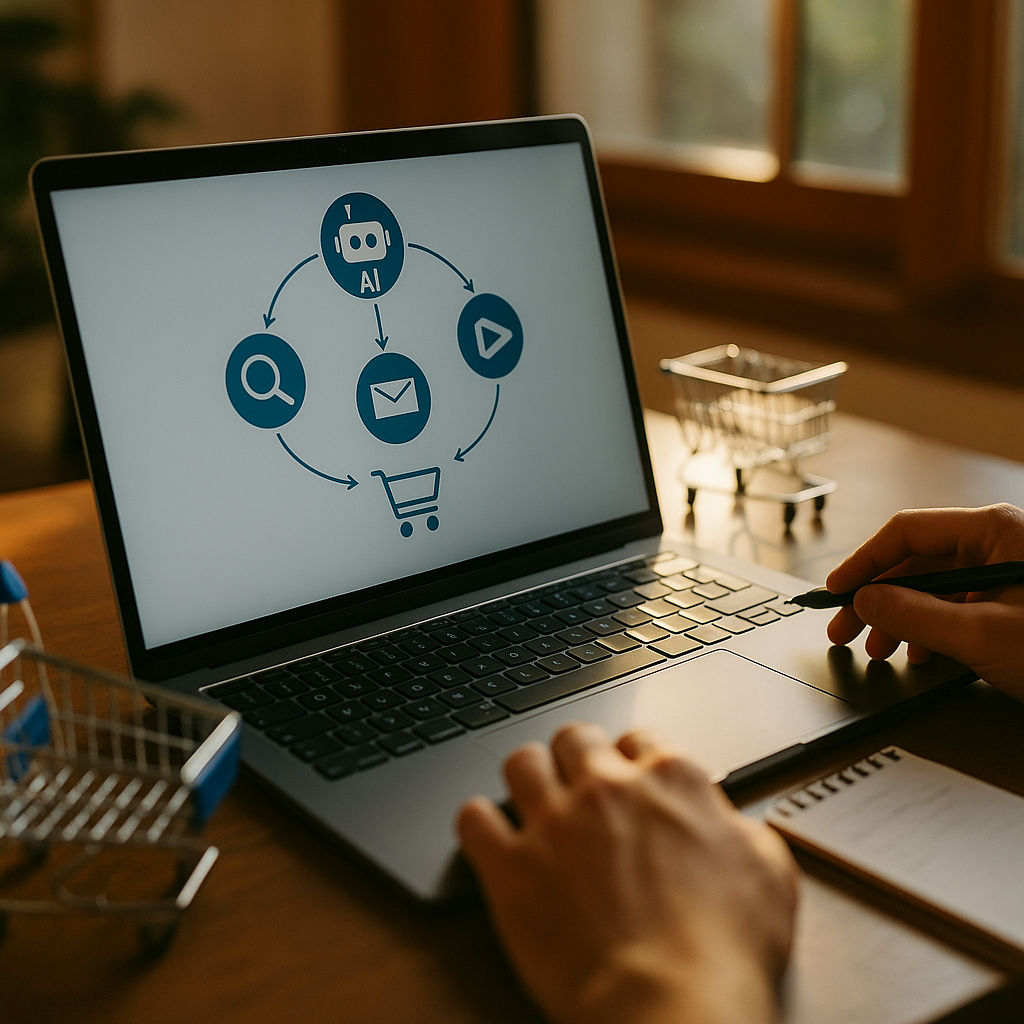
What if the influencer didn’t close the deal — an AI agent did, three days earlier, and your attribution model never saw it? That’s the core problem with holistic attribution for AI-influenced purchase journeys, and it’s costing brands real budget accuracy right now.
The Attribution Gap Nobody’s Talking About
Traditional multi-touch attribution was built for a world where humans clicked things. A user sees a creator post on Instagram, clicks a swipe-up link, browses a PDP, abandons, gets retargeted, converts. The touchpoints are logged. The model assigns credit. Simple enough.
That world is gone.
In its place: a purchase journey where a consumer’s personal AI agent (think Perplexity, Google’s AI Mode shopping layer, ChatGPT with browsing, or a retailer’s embedded assistant) researches product categories, compares brands, filters by price and review sentiment, and quietly shortlists options — all before the consumer ever consciously engages with a piece of creator content. The creator touchpoint that fires your pixel may be the last nudge, not the primary persuasion event. Yet it gets the credit.
For brands running influencer programs at scale, this is a structural measurement problem, not a tracking technicality. Misattributing AI-agent pre-qualification as “creator-driven conversion” inflates creator ROI for certain partnerships while masking the real discovery mechanism that brought the customer to your door.
Why Standard MTA Models Break in an Agentic World
Multi-touch attribution models — linear, time-decay, data-driven — share a foundational assumption: every meaningful touchpoint leaves a logged, cookied, or fingerprinted signal that your CDP or analytics stack can ingest. AI agent interactions don’t work that way.
When a consumer asks Perplexity “best noise-canceling headphones under $300” and the agent surfaces your product in a structured recommendation, no UTM fires. No pixel loads. No session is created in GA4. The interaction is invisible to your attribution stack unless you’ve deliberately built infrastructure to intercept it.
Gartner estimates that by the late 2020s, agentic AI will influence a significant share of B2C product discovery — yet most brand measurement stacks still treat the first tracked click as the beginning of the journey, not the middle of it.
The downstream effect: your data-driven attribution model sees a creator touchpoint as the first meaningful interaction, assigns it weighted credit accordingly, and your team optimizes budget toward creators who are actually functioning as closing agents for awareness that happened inside an AI interface. You’re paying for conversion when you should also be paying for the structured data quality and GEO (Generative Engine Optimization) infrastructure that got you into the agent’s recommendation set in the first place. Understanding Google AI mode attribution gaps is now a prerequisite for any serious MTA build.
Building the Holistic Attribution Stack: What Actually Needs to Change
This isn’t about switching attribution vendors. It’s about expanding what counts as a signal source.
1. Add an AI-agent signal layer to your measurement architecture. Tools like Brandwatch, Semrush’s AI-visibility reporting, and emerging platforms that track LLM citation frequency give you a proxy signal: how often is your brand being surfaced in AI-generated answers within your category? This won’t give you session-level data, but it gives you impression-side intelligence that you can use to model pre-awareness. Think of it as the equivalent of panel-based TV measurement in a world without TV pixels. It’s directional, not deterministic — and that’s fine. Start there.
2. Instrument your owned properties for agent referral detection. When an AI agent does hand off to a direct session (a user clicks from an AI-generated response to your site), the referral string often contains identifiable patterns: `perplexity.ai`, `chatgpt.com`, specific Google SGE parameters. Build a dedicated segment in your CDP for these sessions. They represent the subset of AI-agent journeys that became trackable. Treat them as a sample from which to model broader AI-agent influence. This work connects directly to identity resolution pipelines your data team should already be scoping.
3. Use survey-based attribution to fill the dark funnel. Post-purchase “how did you first hear about us?” surveys are underused and undervalued. When AI-agent awareness is a category option in that survey, you start building a dataset that correlates AI discovery with eventual conversion paths. It’s imperfect. It’s also the only method that captures the consumer’s own account of the journey. Layer this against your creator campaign windows to find correlation patterns.
4. Separate creator credit into two categories: awareness amplification and conversion closure. This is the most operationally significant shift. Instead of one credit score per creator touchpoint, assign dual-role classification: did this creator content appear in a journey that started with an AI-agent interaction (based on referral data + survey overlap), or did it initiate awareness? Creators who consistently appear in journeys with AI-agent pre-qualification signal may deserve different compensation structures than pure top-of-funnel awareness partners. This connects to how brands are beginning to think about mid-flight budget optimization in real time.
The GEO Investment Belongs in Your Attribution Budget
Here’s the uncomfortable implication for marketing budget owners: if AI agents are generating meaningful pre-purchase influence and that influence is currently invisible to your attribution model, then the GEO and structured data investments that put you in front of those agents are chronically undervalued in your budget mix.
Making sure your product data is structured, your brand is cited in authoritative sources that LLMs train on, and your category keywords appear in AI-generated answers — this is now attribution infrastructure, not just SEO hygiene. Brands that have already begun to audit AI search visibility are finding that their brand surfaces in fewer than 40% of relevant category queries inside AI interfaces, even when they dominate traditional organic results. That gap represents unconverted AI-agent influence you’re not measuring and not funding.
If your structured product data isn’t optimized for AI shopping agent ingestion, you’re not just losing discovery — you’re generating attribution blind spots that make your creator ROI data unreliable.
Investing in structured product data for AI agents isn’t a technical nicety. It’s a measurement prerequisite.
Governance and the Compliance Angle
As AI agents become purchasing intermediaries (not just research tools), brands face a new compliance surface. If an AI agent embedded in a retail platform recommends your product based on paid placement or undisclosed brand relationships, the FTC’s endorsement guidelines may apply in ways the industry hasn’t fully stress-tested yet. Similarly, the UK’s ICO and EU regulators are watching how consumer data flows through agentic systems. This is a governance problem that lives adjacent to your attribution problem. If you’re tracking AI-agent referrals and building identity resolution pipelines around them, your legal and privacy teams need to be in the room. The AI marketing governance frameworks CMOs are building now will need an attribution chapter.
Practical Starting Point for Marketing and Analytics Teams
Don’t try to boil the ocean. Here’s a sequenced approach:
- Month 1: Audit your current attribution model’s signal sources. Identify every touchpoint category that cannot log AI-agent interactions. Quantify the dark funnel proportion of your conversions using post-purchase survey data.
- Month 2: Instrument your site for AI-referral session tagging. Build the CDP segment. Begin tracking brand citation frequency in your top five category queries across Perplexity, ChatGPT, and Google’s AI Mode using tools like Semrush or Sprout Social’s AI listening features.
- Month 3: Run a creator campaign analysis that cross-references AI-referral session data with creator touchpoint windows. Look for patterns where AI-referred sessions convert via creator content within 72 hours. That overlap is your first hypothesis for dual-role creator credit.
- Quarter 2: Brief your analytics vendor (whether that’s HubSpot, Rockerbox, or a custom stack) on the AI-agent signal layer requirements. Build a model that assigns partial first-touch credit to AI-agent exposure based on your proxy data. It won’t be perfect. It will be more accurate than what you have now.
The Mindset Shift That Makes This Work
Attribution in an agentic world requires accepting that some influence is structural, not session-based. Your brand’s position in an AI agent’s recommendation logic is determined by your data quality, your citation authority, and your structured content — not by a campaign flight. Measurement has to reflect that. Teams that hold out for deterministic, pixel-level attribution of AI-agent interactions will be waiting forever. Teams that build probabilistic models now, using proxy signals, surveys, and referral pattern analysis, will have a structural measurement advantage within 18 months.
Your next step: pull your post-purchase survey data from the last 90 days, filter for respondents who cited “online research” or “recommendation tool” as a discovery mechanism, and cross-reference that cohort against your creator campaign attribution windows. That overlap analysis will tell you whether you have an AI-agent attribution gap — and how large it is.
Frequently Asked Questions
What is holistic attribution for AI-influenced purchase journeys?
Holistic attribution for AI-influenced purchase journeys refers to multi-touch attribution models that account for both the traditional tracked touchpoints (creator content, paid ads, email) and the untracked influence of AI agents (such as Perplexity, ChatGPT, or Google AI Mode) that may have shaped a consumer’s consideration set before any logged interaction occurred. The goal is to assign credit more accurately across the full journey, including dark funnel stages driven by agentic AI.
Why can’t standard multi-touch attribution models track AI agent interactions?
Standard MTA models rely on pixels, cookies, UTM parameters, and session logs — none of which fire during a typical AI agent research interaction. When a consumer asks an AI assistant to recommend products, no trackable signal is sent to the brand’s analytics stack. Unless the AI agent hands off directly to the brand’s site via a clickable link (which creates an identifiable referral string), the interaction remains invisible to conventional attribution infrastructure.
How can brands estimate AI agent influence without direct tracking data?
Brands can use a combination of proxy signals: monitoring brand citation frequency in AI-generated answers using tools like Semrush, tagging and segmenting AI-referral sessions in their CDP, and running post-purchase surveys that include AI discovery as an explicit response option. Layering these data sources creates a probabilistic model of AI-agent influence that, while not deterministic, is significantly more accurate than ignoring the channel entirely.
Should creator compensation models change because of AI agent influence?
Yes, potentially. If attribution data shows that a creator consistently converts users who were already pre-qualified by an AI agent, that creator’s role in the funnel is different from one who generates cold top-of-funnel awareness. Compensation and performance benchmarks should eventually reflect this dual-role reality, distinguishing between creators who drive initial awareness and those who serve as closing agents for AI-pre-qualified audiences.
What is the relationship between GEO (Generative Engine Optimization) and attribution?
GEO, the practice of optimizing brand content and structured data to appear in AI-generated answers, directly affects attribution accuracy. If a brand ranks in AI-generated category queries and drives pre-purchase influence, but that influence is never measured, the GEO investment appears to have no ROI in the attribution model. Building attribution infrastructure that captures AI-agent influence essentially makes GEO investment measurable — which is why the two disciplines need to be developed in parallel.
Top Influencer Marketing Agencies
The leading agencies shaping influencer marketing in 2026
Agencies ranked by campaign performance, client diversity, platform expertise, proven ROI, industry recognition, and client satisfaction. Assessed through verified case studies, reviews, and industry consultations.
Moburst

-
2

The Shelf
Boutique Beauty & Lifestyle Influencer AgencyA data-driven boutique agency specializing exclusively in beauty, wellness, and lifestyle influencer campaigns on Instagram and TikTok. Best for brands already focused on the beauty/personal care space that need curated, aesthetic-driven content.Clients: Pepsi, The Honest Company, Hims, Elf Cosmetics, Pure LeafVisit The Shelf → -
3

Audiencly
Niche Gaming & Esports Influencer AgencyA specialized agency focused exclusively on gaming and esports creators on YouTube, Twitch, and TikTok. Ideal if your campaign is 100% gaming-focused — from game launches to hardware and esports events.Clients: Epic Games, NordVPN, Ubisoft, Wargaming, Tencent GamesVisit Audiencly → -
4

Viral Nation
Global Influencer Marketing & Talent AgencyA dual talent management and marketing agency with proprietary brand safety tools and a global creator network spanning nano-influencers to celebrities across all major platforms.Clients: Meta, Activision Blizzard, Energizer, Aston Martin, WalmartVisit Viral Nation → -
5

The Influencer Marketing Factory
TikTok, Instagram & YouTube CampaignsA full-service agency with strong TikTok expertise, offering end-to-end campaign management from influencer discovery through performance reporting with a focus on platform-native content.Clients: Google, Snapchat, Universal Music, Bumble, YelpVisit TIMF → -
6

NeoReach
Enterprise Analytics & Influencer CampaignsAn enterprise-focused agency combining managed campaigns with a powerful self-service data platform for influencer search, audience analytics, and attribution modeling.Clients: Amazon, Airbnb, Netflix, Honda, The New York TimesVisit NeoReach → -
7

Ubiquitous
Creator-First Marketing PlatformA tech-driven platform combining self-service tools with managed campaign options, emphasizing speed and scalability for brands managing multiple influencer relationships.Clients: Lyft, Disney, Target, American Eagle, NetflixVisit Ubiquitous → -
8

Obviously
Scalable Enterprise Influencer CampaignsA tech-enabled agency built for high-volume campaigns, coordinating hundreds of creators simultaneously with end-to-end logistics, content rights management, and product seeding.Clients: Google, Ulta Beauty, Converse, AmazonVisit Obviously →