


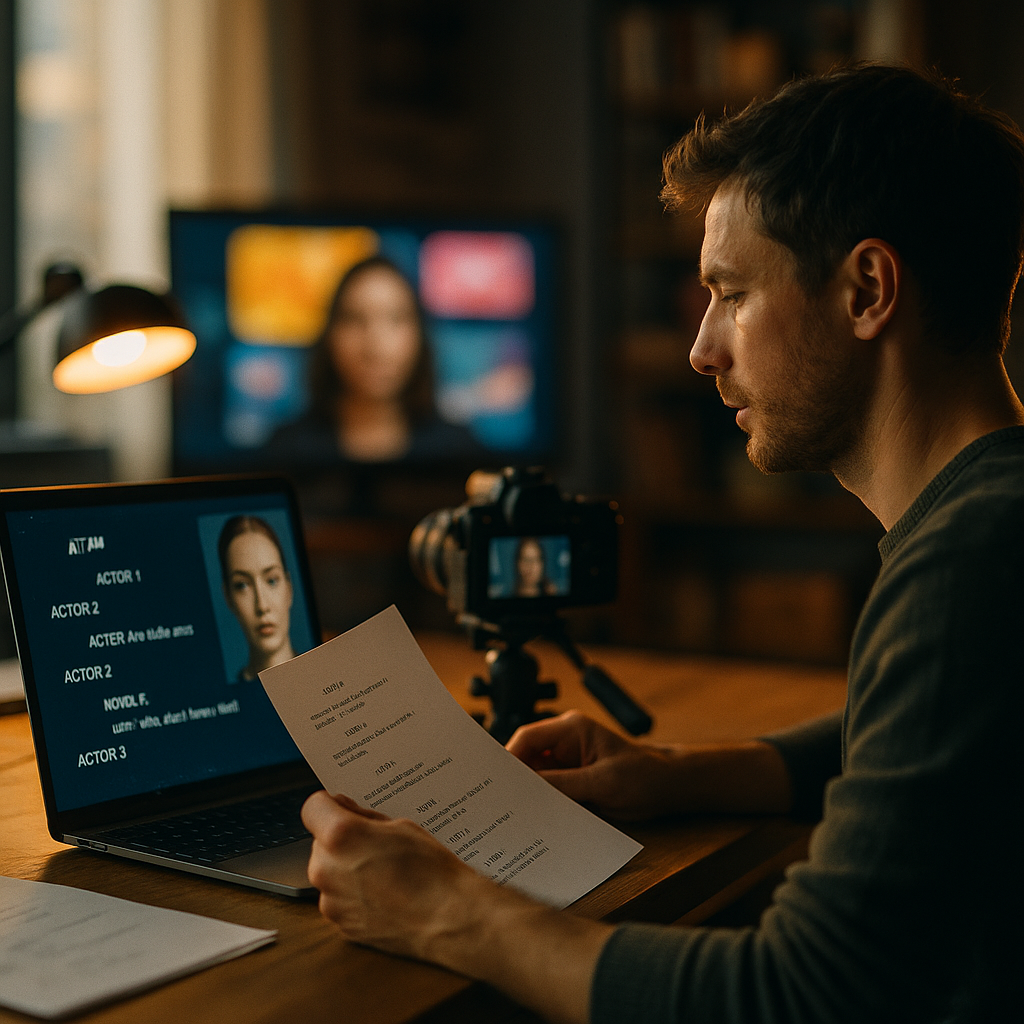
Brands producing one microdrama series now need up to forty platform-specific variants per episode. That production math is breaking traditional workflows. AI-driven personalized microdrama assets offer a way out, but only if your team builds the right infrastructure before hitting record.
Why Microdrama Is a Supply Chain Problem
Microdrama, the short-form scripted content format exploding across TikTok, Xiaohongshu, and YouTube Shorts, has moved from novelty to budget line item for most mid-market and enterprise brands. The format works. Completion rates on branded microdrama content consistently outperform standard product videos, and the emotional narrative arc creates dwell time that algorithmic feeds reward.
But here is where most brand teams miscalculate: they think about microdrama as a creative problem. It is actually a supply chain problem. A single hero episode needs reformatting for TikTok’s 9:16 vertical crop, YouTube’s 16:9 landscape option, Instagram Reels’ algorithm-preferred cut length, and platform-specific caption behavior. Then layer on regional variants: different spoken language, culturally appropriate talent representation, compliant disclosure language for each market. Then segment-level personalization: the version served to a Gen Z first-time buyer should feel different from the one served to a loyalty-tier repeat customer.
Traditional production answers this with reshoots. Generative AI answers it with structured adaptation pipelines.
The Architecture Behind Scalable Adaptation
Before you can automate adaptation, you need what production teams are calling a “master asset architecture.” Think of it as building for disaggregation from day one.
This means shooting your hero content with deliberate modularity: clean isolated audio tracks, background plates without embedded text, talent performances captured with neutral headroom for crop flexibility, and script segments written in discrete beats that can be reordered or swapped. Tools like Runway and Adobe’s Firefly Video are now capable of in-painting background changes, extending frame edges for aspect ratio shifts, and generating lip-sync-accurate dubbed audio overlays, but only if your source material is clean enough to work with.
The generative layer then operates on top of these modular elements. Large language models handle script localization, adjusting idiom, formality register, and humor cadence by region. Text-to-speech systems with voice cloning (within consent frameworks) reproduce talent voiceovers in target languages without re-recording sessions. HeyGen‘s video translation product, for example, already handles multi-language avatar lip-sync at production quality, and brands like e-commerce players expanding into Southeast Asia are using it to generate regional variants in hours rather than weeks.
The brands winning at AI-driven microdrama adaptation are not the ones with the biggest generative AI budgets. They are the ones who invested in clean, modular source production before any AI touched the footage.
Audience-level personalization runs through a separate but connected layer. Behavioral signals from your CRM, combined with platform audience data, feed a decisioning model that selects or assembles the appropriate variant. This is where integrating your AI asset production with sentiment-driven distribution becomes operationally critical rather than optional.
Governance: The Part Most Teams Skip
Autonomous content adaptation at scale creates real compliance exposure. When AI is localizing dialogue, swapping talent representations, or adjusting product claims for regional markets, your legal and brand team cannot manually review every output. This is not hypothetical. Regulatory bodies in the EU and UK are actively scrutinizing AI-generated advertising content for accuracy and disclosure compliance. The FTC and UK ICO both have updated guidance on synthetic media disclosure that applies directly to AI-adapted branded content.
The operational solution is layered approval gates, not blanket human review of every asset. You design your workflow so that high-risk adaptation categories (product claims, pricing, regulated category language, talent likeness usage) trigger mandatory human review, while low-risk adaptations (aspect ratio crop, caption style, background color palette) pass through automatically. This is precisely the kind of structure covered in frameworks around human override policies for brand voice that forward-looking marketing operations teams are formalizing now.
Your AI adaptation pipeline also needs a provenance log. Every generated variant should carry metadata recording which base asset it derived from, which model version processed it, which parameters were applied, and which human reviewer (if any) approved it. That audit trail is your legal protection and your quality control mechanism.
Platform-Specific Considerations That Change the Calculus
Not all platform adaptations are equal work. TikTok’s algorithm favors content where meaningful visual action occurs in the first 1.5 seconds, which means your AI adaptation layer needs to be instructed to prioritize hook-forward assembly for that platform. YouTube Shorts rewards retention through the midpoint, so the same content may need a different narrative beat placement. Instagram Reels currently penalizes content with visible TikTok watermarks but also rewards aesthetic consistency with a creator’s feed, which matters when you are distributing through creator whitelisting rather than brand handles.
These are not small details. Building platform behavior rules into your adaptation prompt library, and updating them on a quarterly review cycle, is operational hygiene. The brands managing AI media buying across TikTok, YouTube, and Pinterest already understand that each platform’s algorithm is effectively a different distribution contract, and your content needs to be built to honor each one.
Regional adaptation adds another dimension. Beyond language, consider: acceptable emotional register (direct persuasion lands differently in Japanese versus Brazilian markets), platform dominance by region (Douyin versus TikTok, Instagram versus LINE), and visual signaling that reads as premium or accessible depending on cultural context. AI localization tools are increasingly sophisticated on language, but cultural nuance still requires regional market input at the prompt-design stage, not at the output review stage.
Building the Workflow: A Practical Sequence
Here is how a functional AI-driven microdrama adaptation workflow actually sequences, based on what production-forward brand teams are implementing:
- Pre-production asset design: Script in modular beats. Brief talent for clean coverage. Shoot background plates separately. Capture isolated audio stems.
- Master asset ingest: Tag every element in your DAM (digital asset management system) with metadata: beat number, emotional register, talent appearance, product claim flags, regional restriction flags.
- Adaptation brief creation: Define target platform, audience segment, and region. This brief populates the parameters your generative AI layer uses.
- Automated adaptation run: Generative tools handle crop, reorder, dub, localize captions, and apply brand-compliant visual treatments.
- Risk-tiered review: Governance rules route high-risk outputs to human review. Standard outputs publish directly to a staging environment.
- Performance feedback loop: Engagement data from published variants feeds back to update adaptation parameters. What worked in a specific market or segment becomes an input for the next production cycle.
That feedback loop is where operational efficiency compounds. Teams using this model report that by the third campaign cycle, their AI adaptation accuracy (meaning outputs that pass review without revision) improves significantly because the models are learning from market-specific performance signals. For more on structuring that learning loop, the approach outlined for AI marketing testing with clean data applies directly to content adaptation quality.
An adaptation workflow without a performance feedback loop is just an expensive formatter. The compounding value comes when the system learns which variants actually convert in each market.
Talent, Likeness Rights, and the Consent Infrastructure You Need
This section exists because most brands underestimate it. When your AI adaptation pipeline includes voice cloning, avatar generation, or synthetic talent representation, you are operating in a domain where intellectual property law is actively evolving and talent union positions (SAG-AFTRA in the US context) are increasingly explicit. Your production contracts need to include specific language about AI adaptation rights: which uses are permitted, for which platforms, in which regions, for what duration.
This is not just legal caution. It is operational necessity. Building an adaptation pipeline on talent assets without clear rights documentation means a single dispute can strand your entire variant library. Build the consent infrastructure before production starts, not after a variant is already performing.
Consider also how generative AI governance frameworks at the CMO level are treating synthetic talent representation as a category requiring explicit policy, not case-by-case judgment. Aligning your production workflow to that policy framework before scale is the right sequencing.
What Good Looks Like at Scale
A mature AI-driven microdrama adaptation operation produces a single hero production that branches into dozens of compliant, platform-optimized, audience-tailored variants, with the majority of that branching happening without additional human production sessions. Speed to market drops from weeks to days. Per-variant cost drops by a factor that makes personalization economically viable at mid-market budgets, not just enterprise ones.
For brands working with creator networks, these same pipelines can extend to faster influencer campaign activation by generating briefing-aligned content variants that creators can customize rather than build from zero. That hybrid human-AI production model is where most sophisticated brand teams are landing.
Measurement infrastructure matters here too. Platforms like Sprout Social and eMarketer research both point to engagement rate variance across platform-specific content formats as a primary indicator of adaptation quality. Build your reporting to surface that variance at the variant level, not just the campaign level, so you can identify which adaptation parameters are driving performance differences.
Start by auditing your last three hero productions for modular asset quality. If your footage requires reshoots to support AI adaptation, that is the first problem to solve before any generative tooling is worth buying.
FAQs
What is an AI-driven personalized microdrama asset?
It is a short-form scripted video asset that has been adapted from a hero production using generative AI tools to suit different platforms, audience segments, or regional markets, without requiring a separate human-directed production session for each variant.
Which generative AI tools are most relevant for microdrama adaptation?
Runway and Adobe Firefly Video handle video editing, frame extension, and visual in-painting. HeyGen and similar platforms manage multilingual lip-sync and avatar dubbing. Large language models like those from OpenAI or Anthropic handle script localization and caption adaptation. The right stack depends on your primary adaptation needs.
How do brands manage compliance when AI is generating content variants automatically?
The standard approach is a risk-tiered governance model. Low-risk adaptations (aspect ratio, caption style) publish automatically. High-risk content (product claims, regulated language, talent likeness) triggers mandatory human review. A provenance log tracking each variant’s origin, model version, and approval status is essential for audit purposes.
Do talent contracts need to be updated for AI adaptation workflows?
Yes. Standard talent agreements typically do not cover AI-generated voice cloning, avatar creation, or synthetic representation. Brands need explicit contractual language covering which AI adaptation uses are permitted, across which platforms, regions, and time periods, before production begins.
How long does it take to see ROI from an AI microdrama adaptation workflow?
Most brand teams report meaningful per-variant cost reduction by the second campaign cycle, once the modular asset architecture and governance gates are operating smoothly. The compounding benefit, where the system improves adaptation accuracy based on performance feedback, typically becomes measurable by the third cycle.
Can smaller brands or mid-market teams realistically implement this?
Yes, though the starting point differs. Mid-market teams should prioritize two or three high-value adaptation dimensions (platform crop plus language localization, for example) rather than attempting full-scale personalization from the start. The modular production discipline and governance structure are more important than the breadth of AI tooling at the outset.
Top Influencer Marketing Agencies
The leading agencies shaping influencer marketing in 2026
Agencies ranked by campaign performance, client diversity, platform expertise, proven ROI, industry recognition, and client satisfaction. Assessed through verified case studies, reviews, and industry consultations.
Moburst

-
2

The Shelf
Boutique Beauty & Lifestyle Influencer AgencyA data-driven boutique agency specializing exclusively in beauty, wellness, and lifestyle influencer campaigns on Instagram and TikTok. Best for brands already focused on the beauty/personal care space that need curated, aesthetic-driven content.Clients: Pepsi, The Honest Company, Hims, Elf Cosmetics, Pure LeafVisit The Shelf → -
3

Audiencly
Niche Gaming & Esports Influencer AgencyA specialized agency focused exclusively on gaming and esports creators on YouTube, Twitch, and TikTok. Ideal if your campaign is 100% gaming-focused — from game launches to hardware and esports events.Clients: Epic Games, NordVPN, Ubisoft, Wargaming, Tencent GamesVisit Audiencly → -
4

Viral Nation
Global Influencer Marketing & Talent AgencyA dual talent management and marketing agency with proprietary brand safety tools and a global creator network spanning nano-influencers to celebrities across all major platforms.Clients: Meta, Activision Blizzard, Energizer, Aston Martin, WalmartVisit Viral Nation → -
5

The Influencer Marketing Factory
TikTok, Instagram & YouTube CampaignsA full-service agency with strong TikTok expertise, offering end-to-end campaign management from influencer discovery through performance reporting with a focus on platform-native content.Clients: Google, Snapchat, Universal Music, Bumble, YelpVisit TIMF → -
6

NeoReach
Enterprise Analytics & Influencer CampaignsAn enterprise-focused agency combining managed campaigns with a powerful self-service data platform for influencer search, audience analytics, and attribution modeling.Clients: Amazon, Airbnb, Netflix, Honda, The New York TimesVisit NeoReach → -
7

Ubiquitous
Creator-First Marketing PlatformA tech-driven platform combining self-service tools with managed campaign options, emphasizing speed and scalability for brands managing multiple influencer relationships.Clients: Lyft, Disney, Target, American Eagle, NetflixVisit Ubiquitous → -
8

Obviously
Scalable Enterprise Influencer CampaignsA tech-enabled agency built for high-volume campaigns, coordinating hundreds of creators simultaneously with end-to-end logistics, content rights management, and product seeding.Clients: Google, Ulta Beauty, Converse, AmazonVisit Obviously →