


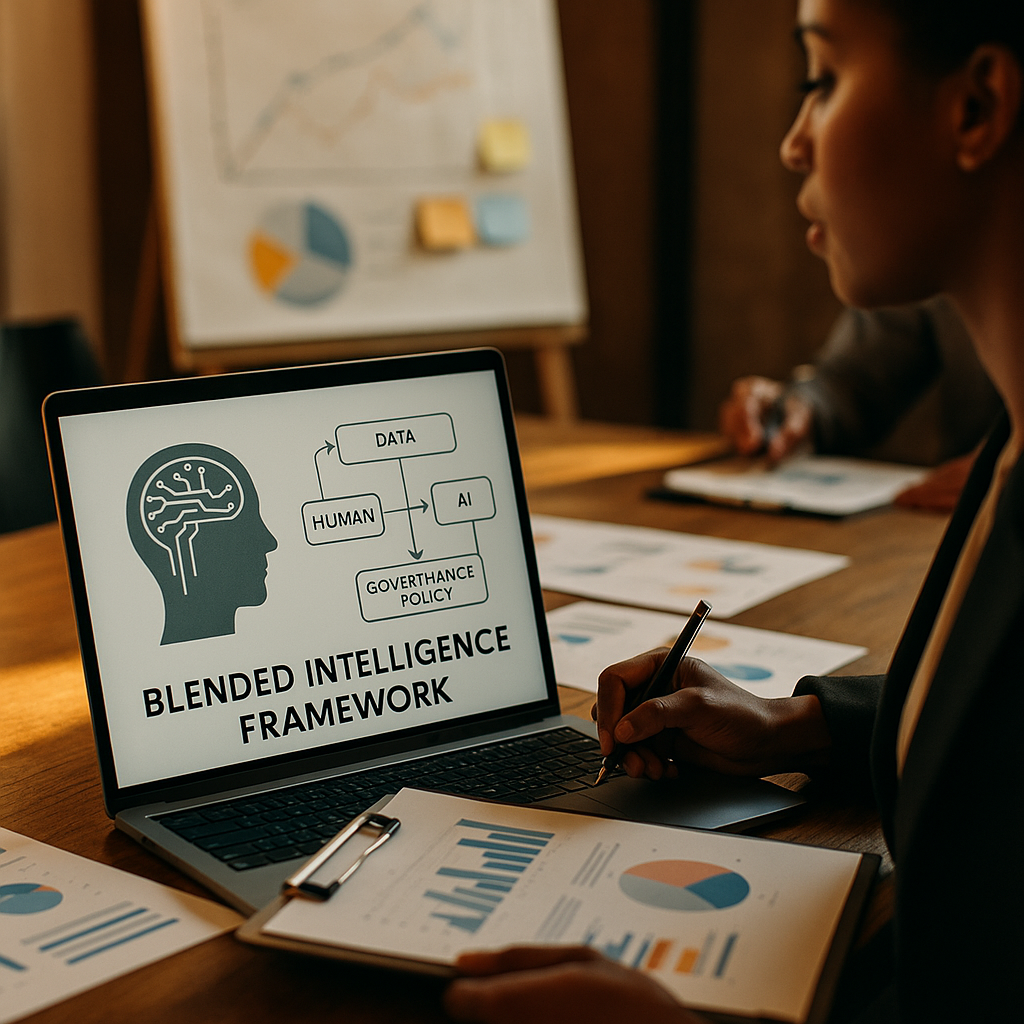
Only 23% of brand marketers have a documented policy governing how human creative judgment interacts with AI-generated content at scale. That gap is exactly what the Roni Sebastian Blended Intelligence Framework, spotlighted at Cannes Lions, was built to close — and why it deserves a seat in your campaign governance stack, not just your inspiration folder.
What the Blended Intelligence Framework Actually Says
Roni Sebastian, Chief Creative Officer at Monks, presented a model that reframes the AI-in-marketing debate entirely. The question is no longer whether humans or machines produce better creative. It is who directs whom, and at which stage.
The framework positions human creative intelligence as the irreplaceable source of cultural insight, emotional truth, and strategic intent. AI handles what humans are structurally bad at: producing 200 ad variants overnight, testing audience-specific copy across 14 markets simultaneously, and localizing visual assets without losing brand coherence. The division of labor sounds obvious stated that way. In practice, most organizations have it backwards — letting AI generate the concept and humans approve the output. Sebastian flips that hierarchy.
For a deeper look at how this model applies to creator strategy specifically, see our analysis of the Monks Blended Intelligence Model for campaign architects.
Why This Needs to Be Policy, Not Principle
Principles age badly. A framework presented at a festival becomes a LinkedIn post, then a team lunch discussion, then nothing. If you want Blended Intelligence to actually govern how your campaigns run, it needs to be operationalized as a formal policy document with decision rights, approval gates, and measurable compliance criteria.
Consider what happens without it. A performance team under deadline pressure hands a creative brief directly to a generative AI platform. The output is fast, passable, and completely divorced from the brand’s cultural positioning in the target market. It ships. Weeks later, sentiment data flags a tone problem in three regional markets. You have no audit trail showing where human review was supposed to happen and did not.
Campaign governance is not about slowing AI down. It is about ensuring that when AI accelerates execution, it is accelerating the right creative direction — one that a human with genuine cultural and brand knowledge deliberately set.
The Cannes Lions conversation around content distribution over production volume reinforces exactly this point: brands that win are not producing more, they are distributing smarter, with stronger creative signal at the root.
The Four Governance Layers You Need
Operationalizing Blended Intelligence as a governance policy requires four distinct layers, each with a clear owner and a defined handoff protocol.
Layer 1: Creative Insight Authority. A named human (or small human team) holds final authority over the originating creative idea, cultural framing, and emotional tone. This is not the CMO rubber-stamping. This is a creative director or senior strategist with documented accountability for the campaign’s strategic intent. Their brief becomes the constraint file that every AI system downstream must operate within.
Layer 2: AI Execution Parameters. Before any generative or optimization AI touches a campaign asset, the policy must specify which platforms are approved, what asset types it can produce, and which brand elements are locked versus variable. Think of this as the machine’s permission slip. Tools like Meta’s Advantage+ Creative and Google’s Performance Max are powerful precisely because they make autonomous decisions. Your policy needs to define the sandbox they operate in.
Layer 3: Human Review Checkpoints. Not every AI output needs a human to look at it. But specific trigger points must. The policy should specify: before any asset enters a new regional market, before any creative variant crosses a spend threshold (define yours: $25K, $50K, whatever your risk tolerance dictates), and before any AI-generated content touches a regulated category (health claims, financial offers, influencer disclosures under FTC guidelines). For a detailed model of how these checkpoints work in UGC contexts, the UGC workflow brand safety framework is directly applicable here.
Layer 4: Performance Signal Routing. AI scaling only gets smarter if the performance data loops back to the humans setting creative direction. Your governance policy must define who reviews which signals, on what cadence, and has authority to pull a creative direction entirely. This is where most frameworks fall apart: the data exists, but no human is accountable for acting on it.
Localization Is Where Governance Fails Most Often
Sebastian’s framework specifically highlights localization as a high-risk handoff zone. Brand teams routinely task AI with adapting a hero campaign across markets — different languages, different cultural contexts, different regulatory environments. The AI is excellent at linguistic adaptation. It is not equipped to know that a particular visual metaphor lands differently in Southeast Asia than it does in Western Europe, or that a humor register that performs well in Brazil reads as flippant in Japan.
Your policy needs a localization review gate staffed by people with genuine regional knowledge, not just language fluency. This is a budget and headcount decision, not just a process one. If your governance policy cannot fund the human oversight it requires, it will not hold under delivery pressure.
Understanding where AI and human judgment diverge in blended campaigns is essential reading for any team building these review gates for the first time.
Connecting Governance to Measurement Infrastructure
A governance policy without measurement teeth is decoration. For Blended Intelligence to deliver ROI accountability, you need to track not just campaign outcomes but the fidelity of the human-AI handoffs themselves.
Specifically, measure: the percentage of AI-produced variants that required human correction at review gates (your rework rate), the average time between creative brief sign-off and first AI output (your speed advantage), and the performance delta between AI-optimized variants and non-optimized controls (your AI lift metric). These three numbers tell you whether the framework is working or whether humans are either rubber-stamping AI outputs or unnecessarily bottlenecking them.
For teams building this measurement layer from scratch, a solid campaign measurement infrastructure is the prerequisite. You cannot govern what you cannot measure.
The broader question of AI versus human judgment in campaign decisions has useful benchmarks worth incorporating into your governance KPI set as well.
According to eMarketer, brands using structured human-AI creative workflows report 31% higher creative consistency scores across markets compared to those using AI with ad hoc human review. Governance structure is the variable that explains the gap.
Building the Policy Document: What to Include
When drafting the actual governance policy, keep it operable, not inspirational. It should contain: a one-page statement of the Blended Intelligence principle as your organization applies it, a role-responsibility matrix showing who owns each of the four layers above, a decision tree for when human review is mandatory versus optional, a list of approved AI platforms and their permitted use cases, escalation procedures when AI outputs conflict with brand safety standards, and a quarterly review cadence to update the policy as both AI capabilities and your campaign portfolio evolve.
If your organization works with influencer partners at scale, integrate creator content governance into the same document. The same human-AI hierarchy that governs paid media creative should govern how creator briefs are developed, how UGC is selected for amplification, and how creator-produced assets are adapted across formats. Keeping these streams in separate policy silos creates operational incoherence and compliance gaps. For brands exploring how UGC routing at scale intersects with AI automation, the governance connection is direct.
Start with your next campaign in pre-production. Map every point where AI currently touches the work. Assign a human owner to each handoff. That gap analysis is your governance policy’s first draft.
FAQs
What is the Roni Sebastian Blended Intelligence Framework?
It is a creative operations model developed by Roni Sebastian, Chief Creative Officer at Monks, which positions human creative intelligence as the director of strategic and cultural insight, while AI handles scaling, testing, and localization. The model was presented at Cannes Lions and argues that most organizations have the human-AI hierarchy inverted, letting AI generate concepts and humans approve outputs, rather than the reverse.
Why should a brand treat Blended Intelligence as a governance policy rather than a creative philosophy?
Creative philosophies without operational structure rarely survive delivery pressure. A governance policy assigns decision rights, defines AI use parameters, mandates human review checkpoints, and creates accountability for performance outcomes. Without policy structure, AI executes without adequate human direction, leading to brand consistency failures, localization errors, and compliance gaps.
Which AI platforms need to be covered in a Blended Intelligence governance policy?
Any platform making autonomous creative or optimization decisions on your behalf, including Meta Advantage+ Creative, Google Performance Max, and generative AI tools used for copy, image, or video production. The policy should specify which platforms are approved, what asset types they may produce, and which brand elements are locked from AI modification.
How do you measure whether the Blended Intelligence governance framework is working?
Track three core metrics: rework rate (percentage of AI outputs requiring human correction at review gates), speed advantage (time from creative brief sign-off to first AI output), and AI lift (performance delta between AI-optimized variants and human-only controls). These metrics diagnose whether humans are bottlenecking AI unnecessarily or whether AI is operating without adequate direction.
How does localization fit into Blended Intelligence governance?
Localization is one of the highest-risk handoff zones in the framework. AI handles linguistic adaptation well but lacks the cultural knowledge to flag when a visual metaphor, humor register, or brand claim will land differently across markets. Governance policy must require human review by regionally knowledgeable staff before any AI-adapted asset enters a new market, which is a budget and headcount commitment, not just a process addition.
Can this governance model apply to influencer and UGC campaigns?
Yes, and it should. The same human-AI hierarchy that governs paid media creative should govern how creator briefs are developed, how UGC is selected for paid amplification, and how creator assets are adapted across formats. Keeping influencer and paid media governance in separate policy silos creates compliance gaps and creative inconsistency.
Top Influencer Marketing Agencies
The leading agencies shaping influencer marketing in 2026
Agencies ranked by campaign performance, client diversity, platform expertise, proven ROI, industry recognition, and client satisfaction. Assessed through verified case studies, reviews, and industry consultations.
Moburst

-
2

The Shelf
Boutique Beauty & Lifestyle Influencer AgencyA data-driven boutique agency specializing exclusively in beauty, wellness, and lifestyle influencer campaigns on Instagram and TikTok. Best for brands already focused on the beauty/personal care space that need curated, aesthetic-driven content.Clients: Pepsi, The Honest Company, Hims, Elf Cosmetics, Pure LeafVisit The Shelf → -
3

Audiencly
Niche Gaming & Esports Influencer AgencyA specialized agency focused exclusively on gaming and esports creators on YouTube, Twitch, and TikTok. Ideal if your campaign is 100% gaming-focused — from game launches to hardware and esports events.Clients: Epic Games, NordVPN, Ubisoft, Wargaming, Tencent GamesVisit Audiencly → -
4

Viral Nation
Global Influencer Marketing & Talent AgencyA dual talent management and marketing agency with proprietary brand safety tools and a global creator network spanning nano-influencers to celebrities across all major platforms.Clients: Meta, Activision Blizzard, Energizer, Aston Martin, WalmartVisit Viral Nation → -
5

The Influencer Marketing Factory
TikTok, Instagram & YouTube CampaignsA full-service agency with strong TikTok expertise, offering end-to-end campaign management from influencer discovery through performance reporting with a focus on platform-native content.Clients: Google, Snapchat, Universal Music, Bumble, YelpVisit TIMF → -
6

NeoReach
Enterprise Analytics & Influencer CampaignsAn enterprise-focused agency combining managed campaigns with a powerful self-service data platform for influencer search, audience analytics, and attribution modeling.Clients: Amazon, Airbnb, Netflix, Honda, The New York TimesVisit NeoReach → -
7

Ubiquitous
Creator-First Marketing PlatformA tech-driven platform combining self-service tools with managed campaign options, emphasizing speed and scalability for brands managing multiple influencer relationships.Clients: Lyft, Disney, Target, American Eagle, NetflixVisit Ubiquitous → -
8

Obviously
Scalable Enterprise Influencer CampaignsA tech-enabled agency built for high-volume campaigns, coordinating hundreds of creators simultaneously with end-to-end logistics, content rights management, and product seeding.Clients: Google, Ulta Beauty, Converse, AmazonVisit Obviously →