


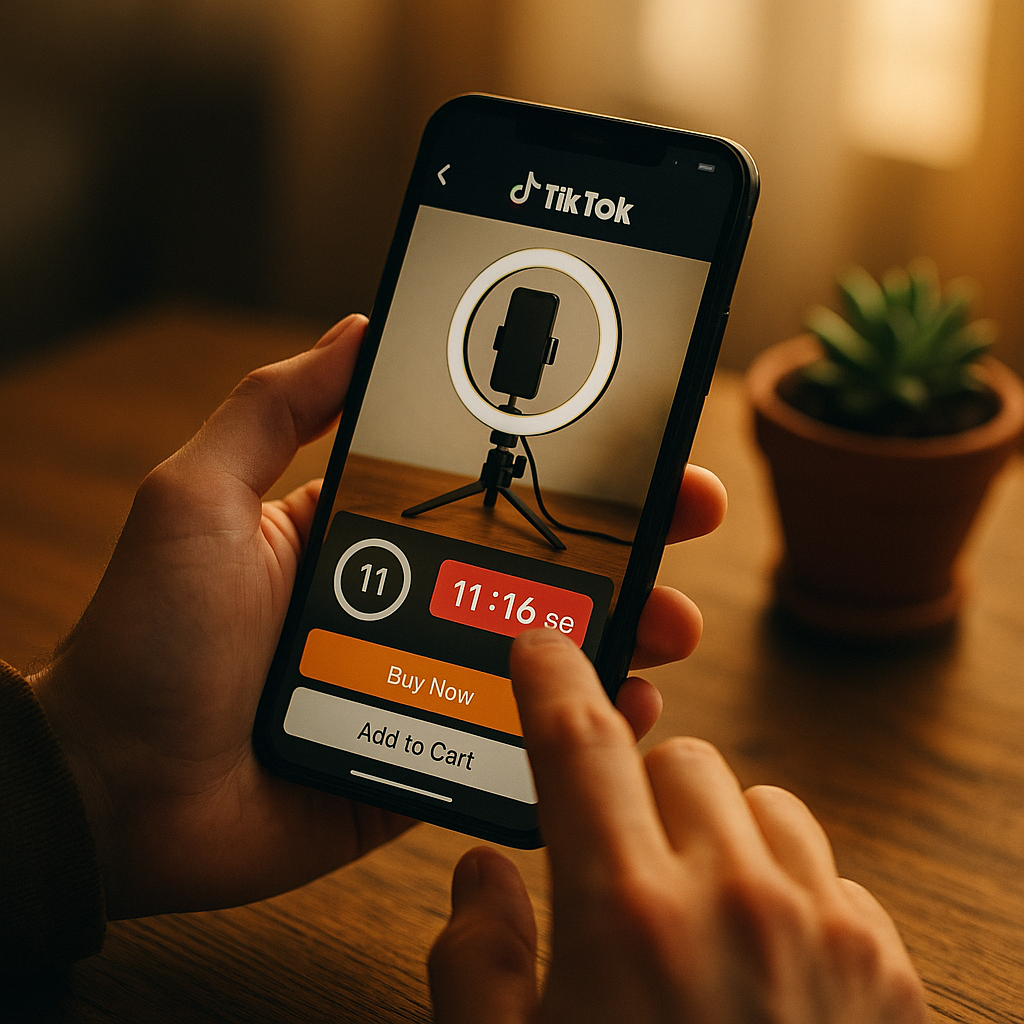
Sixty-two percent of TikTok Shop viewers say a visible countdown timer made them buy faster than they intended, according to internal platform data shared with sellers last quarter. That’s the entire point of a TikTok Shop livestream countdown timer — and it’s also exactly why the FTC is watching. Urgency sells. Fake urgency gets you sued.
Brands running livestream commerce at scale are caught between two pressures: hosts need tension to convert, and legal needs claims that hold up under scrutiny. This playbook shows you how to structure countdown-driven broadcasts that do both.
Why Countdown Timers Work (and Why That’s the Risk)
Scarcity triggers loss aversion. Viewers don’t want to miss a deal, so they act before thinking too hard. TikTok Shop’s own livestream tools — the countdown sticker, the “X left in stock” banner, the flash-sale ribbon — are engineered around this exact psychology. When they’re used honestly, they’re a legitimate merchandising tactic. When the countdown resets after it hits zero, or the “last 12 units” banner sits at 12 for forty minutes, you’ve crossed into deceptive scarcity territory.
The FTC has been explicit about this. Under its guidance on deceptive advertising practices, false urgency and fabricated scarcity claims are treated the same as any other misrepresentation: if a reasonable consumer relies on the claim to make a purchase decision, and the claim isn’t true, that’s actionable.
A countdown timer isn’t a design element. It’s a factual claim about time and inventory — and the FTC treats it exactly that way.
This is the mental shift brand teams need to make. Your host isn’t just performing urgency. They’re making a verifiable statement every time they say “only 20 minutes left” or “we’re almost sold out.” Treat the script accordingly.
For a deeper breakdown of how scarcity language gets scripted safely, our earlier piece on countdown timer scripts covers the line-by-line phrasing to avoid. This article goes one layer up: the broadcast structure itself.
The Four-Block Broadcast Structure
Instead of scattering countdown moments randomly through a stream, build the broadcast around four repeatable blocks. This gives hosts a rhythm to follow and gives your compliance team a predictable script to review before air.
- Block 1 — Setup (0-10 min): Introduce the product, establish real inventory numbers, and set the timer live on screen. No urgency language yet. This is proof-of-stock, not persuasion.
- Block 2 — Build (10-25 min): Layer in social proof, demos, and Q&A. The timer runs in the background. Hosts reference it factually (“we’re at the 15-minute mark”) rather than emotionally.
- Block 3 — Push (last 10 minutes): This is where urgency language intensifies, but only against numbers that are actually true at that moment. If inventory is genuinely dropping, say so with real figures pulled from the dashboard.
- Block 4 — Close: Timer hits zero, offer ends, and — critically — it stays ended. No stealth extension. No “one more minute for latecomers” unless that extension was pre-planned and disclosed.
That last point trips up more brands than anything else. A five-minute grace period feels harmless in the moment. Do it twice in one stream and you’ve built a pattern regulators (and savvy viewers recording screen captures) will notice.
Real Inventory, Real Numbers
The single biggest compliance risk in livestream commerce is a countdown or stock counter that doesn’t reflect reality. If your TikTok Shop backend shows 340 units and your on-screen graphic says “62 left,” that’s a discrepancy someone can screenshot and report.
Fix this at the operations level, not the script level:
- Sync the on-screen stock ticker directly to your TikTok Shop inventory feed rather than a manually updated overlay.
- Assign someone off-camera to monitor the live dashboard and flag the host in real time if numbers shift unexpectedly.
- Never pre-set a “starting inventory” number that’s artificially lower than what’s actually available in the warehouse.
This connects directly to how product tags influence reach — TikTok’s Shop algorithm favors streams with consistent tag-to-inventory accuracy, so getting this right is a discoverability win too, not just a legal safeguard.
Scripting the Host: What to Say vs. What Not to Say
Hosts are performers, not lawyers. They need language that sounds natural on camera but has already been vetted for accuracy. Build a phrase bank in advance rather than trusting improvisation during a live, high-adrenaline sales push.
Safe framing sounds like this:
- “We started this drop with 500 units — the counter you see is pulling live from our system.”
- “Timer’s at eight minutes. When it hits zero, this price goes back up. We’re not extending it today.”
- “If you’re on the fence, the next batch won’t ship until next month — that’s the real restock timeline.”
Risky framing sounds like this:
- “This is your LAST CHANCE EVER” (rarely true, and courts have flagged “last chance” language before when it’s repeated across streams).
- “Selling out fast!” when the stock ticker hasn’t moved in ten minutes.
- Any countdown that restarts, pauses, or “glitches” back to a higher number after hitting zero.
If your brand runs supplement, skincare, or wellness livestreams, the stakes are higher still — those categories draw extra FTC attention when urgency claims stack on top of health claims. Our guide on supplement livestream compliance is worth pairing with this playbook if that’s your vertical. Beauty brands managing restock drops face a similar layering problem — see beauty restock livestream urgency for category-specific scripting.
Segment Design: Where Urgency Fits in the Bigger Show
A countdown timer doesn’t work in isolation. It needs to sit inside a broader livestream segment structure that builds toward the urgency moment rather than opening with it. Streams that lead with scarcity from minute one tend to see viewers bounce — the FOMO hasn’t been earned yet.
We’ve broken down segment pacing in detail in livestream segments that capture impulse buys, and the scripting mechanics for the sales moment itself in structuring scripts for impulse buys. Read those alongside this piece if you’re building a full show rundown rather than a single segment.
One pattern worth stealing from top-performing Shop creators: stack multiple small countdown moments rather than one giant timer for the whole stream. A 90-minute broadcast with three distinct 10-minute urgency windows (each tied to a different SKU or bundle) converts better than one long countdown, and it’s easier to keep every claim accurate because the inventory math resets cleanly between segments.
Multiple short, honest urgency windows outperform one long countdown — and they’re dramatically easier to keep compliant.
Documentation: Your Best Defense
If the FTC or a state AG ever asks about a specific stream, “we didn’t mean to mislead anyone” isn’t a defense. Records are. Build a lightweight compliance trail for every livestream:
- Screen-record the entire broadcast, including the on-screen inventory ticker.
- Export the TikTok Shop backend inventory log for the exact stream window.
- Save the host script with timestamps showing when urgency language was scheduled to appear.
- Log any real-time adjustments (price changes, extended windows) with a reason and an approver.
This isn’t bureaucracy for its own sake. Marketing teams that treat livestream commerce with the same rigor as paid media compliance — documented approvals, audit trails, retained creative — are the ones who survive a platform investigation or regulatory inquiry without a program shutdown. According to eMarketer, livestream shopping in the US is projected to keep growing at double-digit rates, which means more regulatory attention is coming, not less.
Brands should also loop in whoever manages influencer contracts. If a third-party creator is hosting the stream on your brand’s behalf, your FTC exposure doesn’t disappear just because you didn’t write the script yourself. Disclosure and accuracy obligations follow the brand, per FTC endorsement guidelines.
Training Hosts Without Killing the Energy
The pushback from talent teams is predictable: “If we hand hosts a legal script, the stream feels stiff.” Fair concern. But the fix isn’t a word-for-word teleprompter — it’s a constraint-based brief.
Give hosts:
- A list of numbers that are true at broadcast time (real stock count, real time remaining, real price).
- Three or four pre-approved urgency phrases they can rotate between naturally.
- A hard rule: never invent a number, never promise an extension that hasn’t been cleared.
Within those guardrails, let them perform. Energy and compliance aren’t actually in tension — the tension only shows up when hosts are improvising numbers they don’t have in front of them. Put a live dashboard on a second monitor facing the host, out of camera view, and most of the risk disappears before it starts.
Bringing It Together
Build the four-block structure, sync your inventory ticker to reality, script urgency language against numbers hosts can see in real time, and document everything. Run one internal test stream against this checklist before your next major drop — it’s the fastest way to catch a compliance gap before a live audience does.
Frequently Asked Questions
Is a countdown timer on TikTok Shop livestreams legal?
Yes, countdown timers are legal and widely used. The legal risk comes from inaccuracy — a timer or stock counter that doesn’t reflect real inventory or a real deadline can be treated as a deceptive scarcity claim under FTC rules.
What counts as a false urgency claim?
Common examples include a countdown that resets after hitting zero, a “limited stock” banner that doesn’t match backend inventory, or repeated “last chance” language used across multiple streams for the same product.
Do these rules apply if a third-party creator is hosting the stream?
Yes. Brand liability generally follows the product and the offer, not just who’s speaking on camera. If you’re sponsoring or supplying the offer, your compliance obligations apply regardless of who hosts.
How long should an urgency window last in a livestream?
Shorter, honest windows tend to outperform long ones. Many top-performing Shop streams use multiple 8-12 minute urgency segments tied to specific SKUs rather than one extended countdown for the entire broadcast.
What documentation should brands keep for compliance purposes?
At minimum: a full screen recording of the stream, an exported inventory log covering the broadcast window, the approved host script with timestamps, and a record of any real-time changes with an approver noted.
Top Influencer Marketing Agencies
The leading agencies shaping influencer marketing in 2026
Agencies ranked by campaign performance, client diversity, platform expertise, proven ROI, industry recognition, and client satisfaction. Assessed through verified case studies, reviews, and industry consultations.
Moburst

-
2

The Shelf
Boutique Beauty & Lifestyle Influencer AgencyA data-driven boutique agency specializing exclusively in beauty, wellness, and lifestyle influencer campaigns on Instagram and TikTok. Best for brands already focused on the beauty/personal care space that need curated, aesthetic-driven content.Clients: Pepsi, The Honest Company, Hims, Elf Cosmetics, Pure LeafVisit The Shelf → -
3

Audiencly
Niche Gaming & Esports Influencer AgencyA specialized agency focused exclusively on gaming and esports creators on YouTube, Twitch, and TikTok. Ideal if your campaign is 100% gaming-focused — from game launches to hardware and esports events.Clients: Epic Games, NordVPN, Ubisoft, Wargaming, Tencent GamesVisit Audiencly → -
4

Viral Nation
Global Influencer Marketing & Talent AgencyA dual talent management and marketing agency with proprietary brand safety tools and a global creator network spanning nano-influencers to celebrities across all major platforms.Clients: Meta, Activision Blizzard, Energizer, Aston Martin, WalmartVisit Viral Nation → -
5

The Influencer Marketing Factory
TikTok, Instagram & YouTube CampaignsA full-service agency with strong TikTok expertise, offering end-to-end campaign management from influencer discovery through performance reporting with a focus on platform-native content.Clients: Google, Snapchat, Universal Music, Bumble, YelpVisit TIMF → -
6

NeoReach
Enterprise Analytics & Influencer CampaignsAn enterprise-focused agency combining managed campaigns with a powerful self-service data platform for influencer search, audience analytics, and attribution modeling.Clients: Amazon, Airbnb, Netflix, Honda, The New York TimesVisit NeoReach → -
7

Ubiquitous
Creator-First Marketing PlatformA tech-driven platform combining self-service tools with managed campaign options, emphasizing speed and scalability for brands managing multiple influencer relationships.Clients: Lyft, Disney, Target, American Eagle, NetflixVisit Ubiquitous → -
8

Obviously
Scalable Enterprise Influencer CampaignsA tech-enabled agency built for high-volume campaigns, coordinating hundreds of creators simultaneously with end-to-end logistics, content rights management, and product seeding.Clients: Google, Ulta Beauty, Converse, AmazonVisit Obviously →