


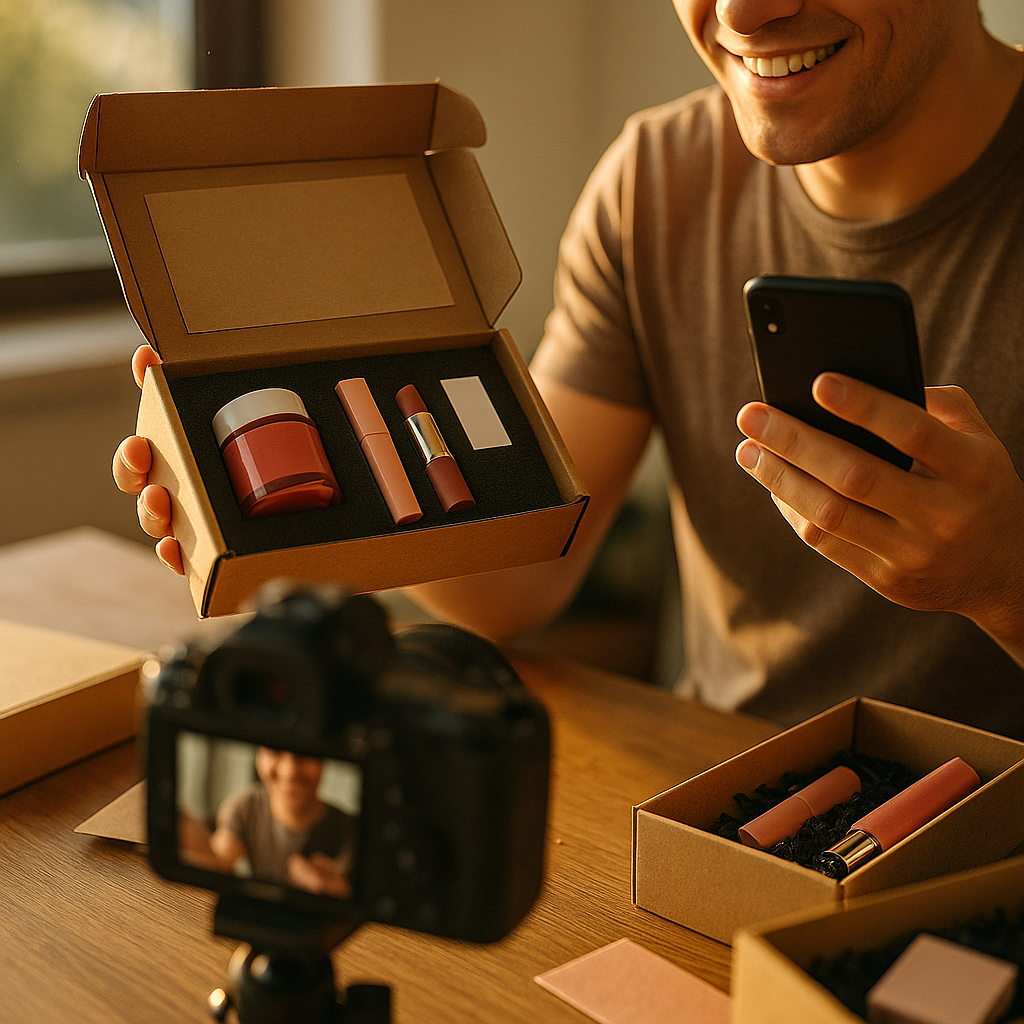
Physical Mail Is Having a Moment — And Brands Are Paying Attention
When a brand sends a creator a generic PR package stuffed with bubble wrap and a printed spec sheet, it ends up in the trash. When Glossier sends a hand-addressed, wax-sealed envelope with a personalized note inside a custom-printed kit, it ends up on TikTok. That distinction is the entire argument for what we’re calling the Paperization Premium: the measurable brand lift and UGC yield that comes from investing in physical, high-touch creator outreach in a world drowning in digital noise.
Why the Physical Channel Is Back at the Strategy Table
Digital fatigue is quantifiable now. Statista data shows the average person encounters between 6,000 and 10,000 digital ad impressions per day. Against that backdrop, a well-executed tactile mailer arrives as a genuine interruption — the good kind. It occupies physical space. It has weight. It smells like something. It creates a moment that no push notification can replicate.
For brands running influencer programs, the ROI logic is straightforward. A creator who receives something they find genuinely beautiful or surprising is far more likely to post about the unboxing spontaneously, without it being a paid deliverable. That earned content carries more credibility than a contracted post and costs a fraction of standard CPM rates once you factor in the amplification across the creator’s audience and the secondary shares that follow.
Brands that invest in premium physical creator kits report unboxing content rates as high as 60-80% of recipients — without contractual posting requirements. That’s earned media with near-zero paid media overhead.
This isn’t nostalgia marketing. It’s a calculated response to platform saturation. And the brands executing it well are treating physical outreach as a full creative discipline, not a logistics afterthought.
The Three Functions a Great Creator Kit Should Serve
Most brand teams think about creator kits as product delivery vehicles. That’s the wrong frame entirely. A high-performing physical kit operates on three levels simultaneously:
- Status signal: The kit itself communicates that the brand sees the creator as someone worth impressing. This shapes the creator’s posture before they’ve even opened anything.
- UGC trigger: The packaging, reveal experience, and unboxing ritual are all content. If you’ve designed the kit thoughtfully, the creator doesn’t need to be briefed on what to film — the kit directs them naturally.
- Brand immersion: Physical objects create tactile memory in a way that a brand deck sent via email simply cannot. A creator who has held your product in a beautifully crafted context has a different relationship with it than one who received a standard shipper box.
Rare Beauty does this exceptionally well. Their creator outreach kits often include handwritten notes from brand team members, packaging that echoes the product’s visual identity, and layered reveal moments that naturally unfold as a video sequence. The result: creators post unboxing content that feels personal, not promotional.
Tactile Packaging as a Content Direction Strategy
Here’s a reframe worth putting in front of your creative director: physical packaging is a silent creative brief. Every structural choice — the unboxing sequence, the texture of the outer envelope, whether something is tied with ribbon or sealed with wax — guides what a creator will film and in what order.
If you’ve spent time on creator brief strategy, you know that over-direction kills authentic content. A well-designed physical kit solves this problem elegantly. Instead of writing a 12-point brief that tells a creator exactly how to hold the product and what to say, you build those story beats into the packaging experience itself. The creator discovers them organically. The content they produce looks genuinely spontaneous because, to a meaningful degree, it is.
Consider the layered unboxing architecture used by luxury fragrance brands like Maison Margiela when they seed creators: outer packaging that feels archival, inner tissue in brand colors, a separate handwritten card, then the product in its own dedicated container. Each layer is a new scene. A creator filming this has a natural three-to-five-beat story without anyone telling them to create one.
This connects directly to how smart brands think about physical activations as UGC engines more broadly. The principle is consistent: design the environment or object so that creating content about it is the natural response.
Budget Architecture: What “Premium” Actually Costs
The word “premium” makes finance teams nervous. So let’s put numbers on it.
A standard influencer gifting package typically runs $15 to $40 per unit in packaging and fulfillment costs. A genuinely high-touch creator kit — custom-printed outer box, tissue, handwritten note, insert card with a QR code linking to personalized brand content — lands between $80 and $150 per unit depending on volume. At 200 units for a mid-tier campaign, that’s a $30,000 line item versus a $6,000 one.
The question to ask finance is not “does this cost more?” It does. The question is: what’s the CPM equivalent of the earned UGC this generates? If 60% of 200 recipients post organically, and each post reaches an average audience of 50,000, you’ve generated 6 million organic impressions from a $30,000 investment. That’s a $5 CPM for content that reads as authentic creator endorsement, not advertising. Compare that against eMarketer’s reported average CPMs for social display, which routinely exceed $20 for comparable audiences, and the premium kit math holds up.
The brands getting this wrong are the ones applying premium kit treatment to every creator on their roster regardless of tier or relationship stage. Reserve the full-investment kit for creators you’ve identified as genuine brand fit, with meaningful audience overlap and a track record of authentic content. For broader gifting at scale, a thoughtfully designed mid-tier kit outperforms a generic mailer without requiring luxury production costs.
Offline Kits as Competitive Differentiation
Most brands in any given category are running the same digital playbook: sponsored posts, affiliate codes, contracted TikTok deliverables. Physical outreach is genuinely uncommon. That asymmetry matters.
When a creator receives an exceptional physical kit from your brand and a standard DM from your competitor, you haven’t just won their attention. You’ve created a comparison that almost always surfaces in their content. Creators talk to their audiences about the brands that treat them well. They also talk, less explicitly but unmistakably, about the brands that don’t.
In a category where everyone is buying the same TikTok placements, a $100 physical kit that generates genuine enthusiasm from a mid-tier creator can deliver more brand equity per dollar than a $5,000 sponsored post that reads as obligatory.
This dynamic is especially pronounced in beauty, wellness, food and beverage, and lifestyle categories where product experience is central to the brand proposition. But it’s increasingly visible in SaaS and B2B contexts too, where companies like Notion, Figma, and Loom have used premium physical merchandise drops and creator kits to build community and generate content from developer and creator audiences who aren’t accustomed to being treated as VIPs.
For brands thinking about how offline tactics integrate with digital content strategy, it’s worth revisiting how OOH and offline channels amplify creator campaigns when they’re deliberately connected. Physical touchpoints don’t replace digital strategy — they create content fuel for it.
Compliance, FTC, and the Gifting Disclosure Question
One area brands consistently underinvest in: disclosure guidance for gifted physical products. Under FTC guidelines, a creator who receives free product and posts about it is required to disclose the relationship, even if no payment was made and no post was contractually required. This applies whether the creator received a $15 standard mailer or a $150 premium kit.
Build disclosure instructions into the physical kit itself. A card that clearly explains the brand relationship, what the creator is free to say (and not say), and how to disclose appropriately on each platform is not just a legal protection — it signals professionalism. Creators who work with multiple brands simultaneously appreciate brands that remove the guesswork.
For teams building out their broader creator compliance infrastructure, the same rigor that applies to high-specificity creator briefs applies here: clear expectations, documented in writing (or in this case, in the kit itself), reduce both legal exposure and creative ambiguity.
UGC Amplification: What Happens After the Post
The kit generates content. Now what?
Brands that treat creator unboxing posts as organic wins and walk away are leaving performance on the table. The smarter move: monitor for organic posts, reach out to creators who posted without a contract, obtain usage rights (with compensation, explicitly agreed), and run that content as paid social through your own channels. Authentic unboxing content systematically outperforms studio-produced brand ads in click-through and conversion rate metrics, per Sprout Social research on UGC performance.
This creates a flywheel. Physical investment generates earned content. Earned content gets amplified via paid spend. Paid amplification extends reach beyond the creator’s own audience. The total media value of that $150 kit, when the paid layer is accounted for, looks dramatically different from the initial line item.
For teams building out this amplification infrastructure, the mechanics of UGC paid amplification bundles are worth understanding in detail before you run your first physical kit campaign at scale.
Your immediate next step: audit your current creator gifting process and ask one question — if a creator filmed the unboxing exactly as they received it, would the result be content worth paying to amplify? If the answer is no, that’s your brief for the redesign.
Frequently Asked Questions
What is a high-touch creator kit, and how is it different from standard PR gifting?
A high-touch creator kit is a deliberately designed physical package intended to create an immersive brand experience and trigger organic content creation. Unlike standard PR gifting, which prioritizes product delivery efficiency, a high-touch kit treats the packaging, reveal sequence, and inserts as creative assets in their own right. The goal is to make the unboxing experience inherently content-worthy without requiring the creator to be contracted for a post.
Do physical creator kits require FTC disclosure if no payment is involved?
Yes. Under FTC guidelines, any material connection between a brand and a creator — including receipt of free products — requires disclosure when the creator posts about that product. This applies regardless of whether a posting contract exists. Brands should include clear, platform-specific disclosure guidance inside every creator kit they send.
What ROI metrics should brands track for physical creator kit campaigns?
Key metrics include organic post rate (what percentage of recipients posted without being contracted), earned impression volume from those posts, estimated CPM compared to paid social benchmarks, and downstream usage rights acquisition rate. If you’re running paid amplification on organic UGC generated by the kit, add CTR and conversion rate for that paid content versus studio-produced creative.
Which creator tiers benefit most from premium physical kit investment?
Mid-tier creators (roughly 50,000 to 500,000 followers) typically offer the highest return on premium kit investment. They’re influential enough to generate meaningful reach but rare enough in their experience of receiving genuinely impressive brand outreach that a premium kit creates a stronger differential impact. Mega-creators receive dozens of packages weekly and are less likely to respond to packaging quality alone without a contractual relationship.
How do you scale physical creator kits without losing the personalization that makes them effective?
The key is modular personalization: design a base kit that holds consistent brand quality, then add a personalized layer (handwritten name on the outer packaging, a card referencing something specific about the creator’s content, or a product customized with their handle) that scales via fulfillment automation tools like Printful, Sendoso, or PFL. Full bespoke production at scale is cost-prohibitive, but personalization signals can be engineered into the process without custom-building every unit.
Top Influencer Marketing Agencies
The leading agencies shaping influencer marketing in 2026
Agencies ranked by campaign performance, client diversity, platform expertise, proven ROI, industry recognition, and client satisfaction. Assessed through verified case studies, reviews, and industry consultations.
Moburst

-
2

The Shelf
Boutique Beauty & Lifestyle Influencer AgencyA data-driven boutique agency specializing exclusively in beauty, wellness, and lifestyle influencer campaigns on Instagram and TikTok. Best for brands already focused on the beauty/personal care space that need curated, aesthetic-driven content.Clients: Pepsi, The Honest Company, Hims, Elf Cosmetics, Pure LeafVisit The Shelf → -
3

Audiencly
Niche Gaming & Esports Influencer AgencyA specialized agency focused exclusively on gaming and esports creators on YouTube, Twitch, and TikTok. Ideal if your campaign is 100% gaming-focused — from game launches to hardware and esports events.Clients: Epic Games, NordVPN, Ubisoft, Wargaming, Tencent GamesVisit Audiencly → -
4

Viral Nation
Global Influencer Marketing & Talent AgencyA dual talent management and marketing agency with proprietary brand safety tools and a global creator network spanning nano-influencers to celebrities across all major platforms.Clients: Meta, Activision Blizzard, Energizer, Aston Martin, WalmartVisit Viral Nation → -
5

The Influencer Marketing Factory
TikTok, Instagram & YouTube CampaignsA full-service agency with strong TikTok expertise, offering end-to-end campaign management from influencer discovery through performance reporting with a focus on platform-native content.Clients: Google, Snapchat, Universal Music, Bumble, YelpVisit TIMF → -
6

NeoReach
Enterprise Analytics & Influencer CampaignsAn enterprise-focused agency combining managed campaigns with a powerful self-service data platform for influencer search, audience analytics, and attribution modeling.Clients: Amazon, Airbnb, Netflix, Honda, The New York TimesVisit NeoReach → -
7

Ubiquitous
Creator-First Marketing PlatformA tech-driven platform combining self-service tools with managed campaign options, emphasizing speed and scalability for brands managing multiple influencer relationships.Clients: Lyft, Disney, Target, American Eagle, NetflixVisit Ubiquitous → -
8

Obviously
Scalable Enterprise Influencer CampaignsA tech-enabled agency built for high-volume campaigns, coordinating hundreds of creators simultaneously with end-to-end logistics, content rights management, and product seeding.Clients: Google, Ulta Beauty, Converse, AmazonVisit Obviously →