


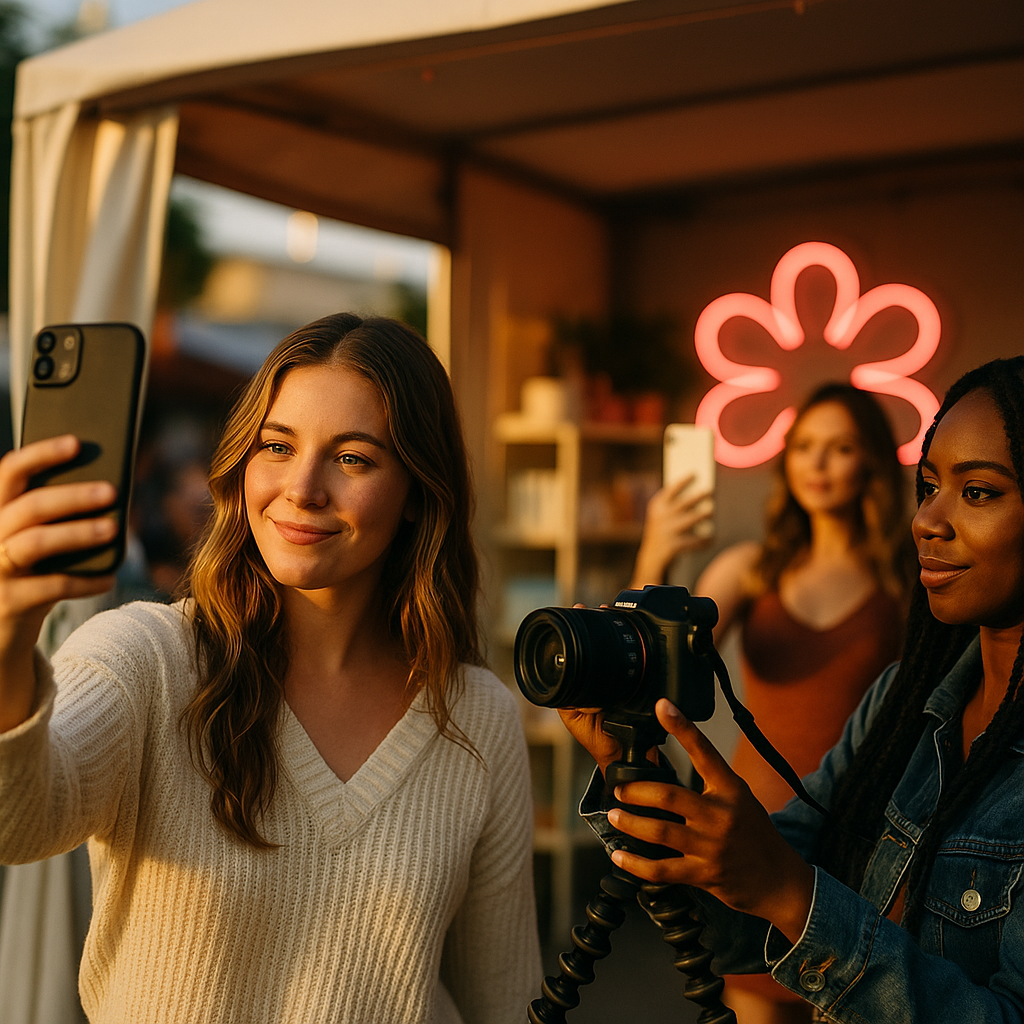
The Pop-Up Is a Content Studio Now
Brands that treat pop-up activations as temporary retail moments are leaving significant earned media on the table. The ones winning treat every square foot as a content production set — one designed to generate creator posts, consumer UGC, and structured signals that generative AI engines can actually cite.
Here’s the uncomfortable truth: a pop-up that doesn’t produce scalable content artifacts has an ROI problem. Foot traffic alone doesn’t justify the build cost. The content output does.
Why Physical Activations Are Underbuilt for Content
Most experiential budgets are allocated to the experience itself: the fabrication, the talent, the venue, the catering. Content capture is treated as an afterthought, usually a single photographer and a brand hashtag on a vinyl banner. That model is structurally broken.
When Experiential Marketing Summit data shows that 85% of consumers are more likely to purchase after participating in a live brand experience, that’s not just a conversion argument — it’s a content funnel argument. The moment of participation is the highest-intent, highest-emotion window you have to generate authentic UGC. If you’re not engineering that window deliberately, you’re wasting it.
A pop-up that doesn’t produce scalable content artifacts has an ROI problem. The content output — not foot traffic — is what justifies the build cost.
The design failure usually happens upstream, in the brief. Experiential teams build for in-person delight; social teams show up at the end to capture what they can. What’s needed is a single integrated brief that reverse-engineers the activation from the content output backward. For a structured approach to that kind of brief architecture, see how cross-platform participatory campaigns are structured to drive coordinated content from multiple creator types simultaneously.
Designing the Space Around Capture Moments
Think in zones. Every immersive activation should have at least three distinct content zones, each optimized for a different content format and a different audience type.
Zone 1: The Hero Shot. This is the Instagrammable set piece — the oversized installation, the unexpected visual, the thing that makes people stop mid-stride. It should be designed for static photography and short-form video at a specific focal length. Lighting should be tuned for phone cameras, not just professional equipment. Brands like Glossier, Jacquemus, and Alo Yoga have made this an institutional competency. The hero shot is where casual consumers create; it doesn’t require a brief or a fee.
Zone 2: The Process Moment. This is where participation generates documentation. A personalization station, a mixing experience, a live customization. The process is inherently video-native — it has a beginning, a middle, and a reveal. TikTok’s algorithm rewards this structure. Reels reward it. Creators gravitating toward “watch me make this” content will find their own framing here if the experience is interesting enough.
Zone 3: The Structured Creator Briefing Area. For the paid and gifted creators you’ve pre-activated, build a designated space with clean backgrounds, branded props, good acoustics, and a content menu. This is where your creator brief gets executed. A modular brief approach works well here: give creators three to five specific content moments to capture, but leave the framing and voice entirely open. Open-ended briefs consistently outperform scripted ones on engagement metrics — and they generate more authentic UGC that reads as discovery rather than advertising.
The UGC and Creator Content Feedback Loop
Consumer UGC and creator content are not the same thing, and conflating them is a strategic error. Consumer UGC is high volume, variable quality, and highly trusted by other consumers. Creator content is lower volume, higher production quality, and engineered for distribution reach. You need both, and they should amplify each other.
The operational model that works: creators arrive first, publish during the event’s public window, and seed the visual language that consumers then mimic. This is the “aesthetic priming” effect — when a creator posts a specific shot composition from your activation, their audience shows up looking for that shot. Your consumer UGC then inherits the creator’s framing. The result is a more cohesive earned media library that’s easier to repurpose across paid and owned channels.
For multi-platform distribution strategy, the content produced at the activation should be pre-categorized by format: vertical video for TikTok and Reels, widescreen for YouTube Shorts previews, static for Pinterest and Instagram grid. Briefing creators on multi-platform content clipping before they arrive means you’re not scrambling to repurpose footage after the fact.
Generative Engine Citation: The Layer Most Brands Miss
Here’s where the conversation gets genuinely interesting. Generative AI engines — ChatGPT, Perplexity, Google’s AI Overviews — are increasingly being asked questions like “What are the best brand pop-up experiences this year?” or “Which brands have the most immersive retail activations?” If your activation generates structured, citable content, you can appear in those answers. If it only generates Instagram carousels, you likely won’t.
What does “structured citable content” look like from a physical activation?
- Long-form creator recap posts and YouTube videos that describe the activation in detail, name the brand, and include specific sensory or experiential language
- Press coverage on publications with high domain authority
- Brand-owned landing pages with structured data markup describing the event
- Creator-generated content that answers implicit questions (“What’s inside the [Brand] pop-up?” “Is the [Brand] experience worth it?”)
The principle at work here is the same one that governs how creator briefs can be structured for AI citation: generative engines pull from sources that answer questions directly, contain original descriptive language, and come from credible publishers. Brief your creators to produce that kind of content, not just aesthetic clips.
Generative AI engines are now a discovery channel. If your pop-up activation only generates social clips and no structured, descriptive content, you’re invisible to AI-powered search entirely.
Practically, this means at least two or three of your activated creators should be briefed to produce longer-form content: a YouTube walkthrough, a Substack or blog recap, a TikTok video that explicitly explains what the experience is and why someone should care. That content becomes the citation substrate for AI engines. Short-form clips are reach vehicles; long-form descriptive content is your generative search asset.
Rights, Compliance, and UGC Ownership
Before you build a repurposing strategy around consumer UGC, make sure your rights framework is airtight. FTC guidelines require that any material connection between a brand and a creator is disclosed — this applies to gifted experiences, not just paid posts. If consumers are incentivized to post (say, through a contest or a prize), that incentive constitutes a material connection under current interpretation.
For paid creators, your activation brief should specify usage rights explicitly: which platforms, for how long, and whether the brand can use the content in paid media. This is a common gap in experiential programs. Agencies manage the event, but the content rights conversation doesn’t happen until post-production, when leverage is gone. Lock it in the initial agreement.
Brands using participatory brand narratives as part of their earned media strategy should also have a clear policy for how consumer UGC is credited and compensated when it gets repurposed in brand advertising. Platforms like HubSpot and specialized UGC rights management tools like TINT and Billo can automate permissions capture at scale.
Measurement: What a Pop-Up UGC Engine Actually Produces
Define your content KPIs before the activation opens, not after. Track separately:
- Volume: Total pieces of UGC and creator content generated during and within 72 hours of the activation
- Reach: Aggregate impressions across all organic creator and consumer posts
- Earned media value (EMV): A contested metric, but useful for internal benchmarking when applied consistently. Tools like Sprout Social and CreatorIQ can calculate this at the campaign level
- AI citation rate: Query generative engines directly with relevant search prompts two to four weeks post-activation to see whether your event is surfacing in answers
- Content reuse rate: What percentage of creator and consumer content was repurposed in owned or paid channels, and what was the performance delta vs. studio-produced assets
That last metric matters more than most brands realize. eMarketer research has consistently shown that UGC-based creative outperforms brand-produced creative in paid social click-through rates. If you’re running paid media and not feeding it with activation-sourced UGC, you’re paying more per result than you need to.
For earned media amplification through creator-led activation content, the brief structure matters at least as much as the physical design. Review how live campaign briefs drive earned media to see the brief elements that consistently generate secondary sharing, which is where real distribution scale comes from.
Your next step: Audit your last experiential activation against these three questions: Did we produce citable long-form content? Did we lock content rights before the event opened? Did we track AI citation post-activation? If the answer to any of these is no, those are your three highest-leverage fixes for the next one.
Frequently Asked Questions
What makes a pop-up activation effective as a UGC engine?
Effective UGC-generating pop-ups are designed around content capture from the start, not as an afterthought. This means building distinct zones optimized for different content formats (hero shots, process moments, creator briefing areas), ensuring lighting and acoustics work for phone cameras, and pre-activating creators whose content seeds the visual language that consumer UGC then follows. The brief and the build must be designed together.
How do you get both creators and everyday consumers to generate content at the same event?
The key is staging. Pre-activated creators should arrive early and publish during the public opening window, which primes the aesthetic expectations of their audience. When that audience arrives, they already have a mental template for what to capture. Brands should also design “ambient UGC triggers” — visually compelling moments that require no instruction — so consumer content happens organically without a formal call to action.
Can content from a physical pop-up actually get cited by generative AI engines?
Yes, but only if the activation generates structured, descriptive, question-answering content — not just short-form social clips. Creator YouTube walkthroughs, long-form blog recaps, press coverage, and brand-owned landing pages with schema markup are the types of content generative engines like ChatGPT and Perplexity pull from when answering discovery queries about brand experiences. Short-form vertical video rarely surfaces in AI-generated answers.
What content rights issues should brands anticipate with activation UGC?
Three key areas: First, FTC disclosure requirements apply when consumers are incentivized to post, not just paid creators. Second, paid creator agreements must specify usage rights — platforms, duration, and paid media usage — before the activation, not after. Third, consumer UGC repurposed in paid advertising requires explicit permission from the creator, which platforms like TINT can automate through rights management workflows.
How should brands measure the ROI of a pop-up designed as a content engine?
Track five metrics separately: total UGC and creator content volume within 72 hours; aggregate organic reach across all posts; earned media value (EMV) using a consistent calculation method; AI citation rate (queried directly in generative engines two to four weeks post-event); and content reuse rate — the percentage of activation content repurposed in paid or owned channels, benchmarked against studio-produced creative performance.
Top Influencer Marketing Agencies
The leading agencies shaping influencer marketing in 2026
Agencies ranked by campaign performance, client diversity, platform expertise, proven ROI, industry recognition, and client satisfaction. Assessed through verified case studies, reviews, and industry consultations.
Moburst

-
2

The Shelf
Boutique Beauty & Lifestyle Influencer AgencyA data-driven boutique agency specializing exclusively in beauty, wellness, and lifestyle influencer campaigns on Instagram and TikTok. Best for brands already focused on the beauty/personal care space that need curated, aesthetic-driven content.Clients: Pepsi, The Honest Company, Hims, Elf Cosmetics, Pure LeafVisit The Shelf → -
3

Audiencly
Niche Gaming & Esports Influencer AgencyA specialized agency focused exclusively on gaming and esports creators on YouTube, Twitch, and TikTok. Ideal if your campaign is 100% gaming-focused — from game launches to hardware and esports events.Clients: Epic Games, NordVPN, Ubisoft, Wargaming, Tencent GamesVisit Audiencly → -
4

Viral Nation
Global Influencer Marketing & Talent AgencyA dual talent management and marketing agency with proprietary brand safety tools and a global creator network spanning nano-influencers to celebrities across all major platforms.Clients: Meta, Activision Blizzard, Energizer, Aston Martin, WalmartVisit Viral Nation → -
5

The Influencer Marketing Factory
TikTok, Instagram & YouTube CampaignsA full-service agency with strong TikTok expertise, offering end-to-end campaign management from influencer discovery through performance reporting with a focus on platform-native content.Clients: Google, Snapchat, Universal Music, Bumble, YelpVisit TIMF → -
6

NeoReach
Enterprise Analytics & Influencer CampaignsAn enterprise-focused agency combining managed campaigns with a powerful self-service data platform for influencer search, audience analytics, and attribution modeling.Clients: Amazon, Airbnb, Netflix, Honda, The New York TimesVisit NeoReach → -
7

Ubiquitous
Creator-First Marketing PlatformA tech-driven platform combining self-service tools with managed campaign options, emphasizing speed and scalability for brands managing multiple influencer relationships.Clients: Lyft, Disney, Target, American Eagle, NetflixVisit Ubiquitous → -
8

Obviously
Scalable Enterprise Influencer CampaignsA tech-enabled agency built for high-volume campaigns, coordinating hundreds of creators simultaneously with end-to-end logistics, content rights management, and product seeding.Clients: Google, Ulta Beauty, Converse, AmazonVisit Obviously →