


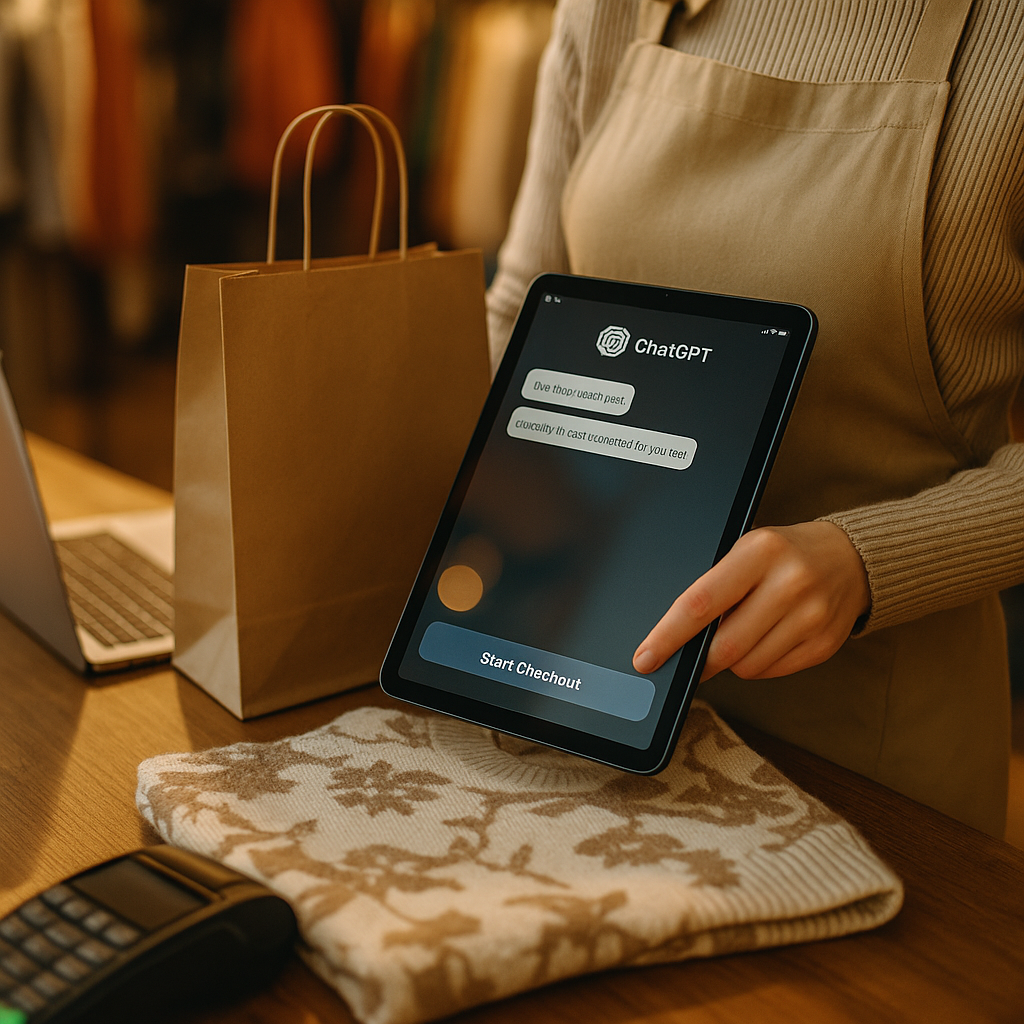
Roughly 800 million weekly active users now touch ChatGPT, and a growing share of them are asking it what to buy. Perplexity Shopping and OpenAI’s Instant Checkout aren’t experimental features anymore — they’re becoming real discovery surfaces that sit upstream of Google, upstream of Amazon, and increasingly upstream of your paid media funnel. The question for brands isn’t whether to pay attention. It’s how fast you can get positioned before your competitors figure it out.
Why This Isn’t Just Another Shiny Object
Marketers have heard “new platform, act now” a thousand times. Fair skepticism. But conversational commerce is different because it changes the mechanics of discovery itself. Instead of a user typing three keywords into a search box and scrolling ten blue links, they’re having a conversation, getting a synthesized answer, and in some cases checking out without ever leaving the chat window.
That’s a fundamentally different funnel. There’s no SERP to rank on. There’s no product listing ad to bid for. There’s an AI model deciding, based on training data, retrieval signals, and merchant feeds, which three or four products to actually mention by name.
If your product isn’t in the consideration set the AI generates, you don’t lose the sale — you never even entered the conversation.
That’s the risk. It’s also the opportunity, because early movers on these surfaces are getting outsized visibility relative to their actual market share, simply because the competitive set hasn’t caught up yet.
Perplexity Shopping: What It Actually Does
Perplexity has been building toward commerce for a while, first through its Shopping hub and buy-with-Pro features, then expanding merchant integrations and checkout partnerships. The pitch is simple: ask Perplexity a comparison question — “best running shoes for flat feet under $150” — and it returns a synthesized answer with actual product cards, pricing, and purchase links, sometimes with in-app checkout depending on the merchant integration.
For brands, this matters for a few reasons:
- Answer-first discovery. Perplexity’s whole value proposition is citation-backed answers, so it’s pulling from product data, reviews, and merchant feeds rather than pure ad inventory.
- Comparison intent is high-value. Users showing up in this mode are often bottom-funnel; they’ve already decided to buy something, they’re deciding what.
- Structured data matters more than ever. Perplexity’s retrieval systems favor clean, well-structured product information, similar to how generative engine optimization has become critical for traditional AI search visibility. Brands that have already invested in tools that improve product citations have a head start here.
The catch? Perplexity’s shopping user base is still a fraction of Google Shopping’s, and merchant partnerships remain limited compared to established retail media networks. This is a bet on where volume is heading, not where it already is.
ChatGPT Instant Checkout: The Bigger Distribution Play
OpenAI’s Instant Checkout, built on its commerce protocol work with partners including Shopify and Etsy, is arguably the more consequential rollout simply because of scale. When you have hundreds of millions of weekly users, even a modest conversion rate on shopping queries represents meaningful transaction volume.
Instant Checkout lets users complete a purchase directly inside a ChatGPT conversation, without redirecting to a merchant site. That’s a genuine shift in control. The brand’s website — historically the final checkpoint before conversion, complete with upsells, loyalty sign-ups, and retargeting pixels — gets bypassed entirely.
Ask yourself: what happens to your CRM data capture, your post-purchase email flow, your on-site personalization stack, if the transaction never touches your domain?
This is where the operational risk conversation gets real. Attribution models built around last-click or even multi-touch web analytics don’t have a clean way to capture “recommended and purchased inside ChatGPT.” Marketing teams already wrestling with AI-driven traffic showing up as direct or unattributed in GA4 attribution blind spots are about to see that problem compound.
The Discovery Funnel Just Got Shorter
Traditional retail funnels have stages: awareness, consideration, comparison, purchase, retention. Each stage historically offered brands multiple touchpoints to influence the outcome, whether through SEO, paid search, influencer content, or on-site conversion optimization.
Conversational commerce compresses consideration and comparison into a single AI-generated response. There’s no ten-blue-links moment where a brand can win through sheer volume of content or aggressive bidding. There’s one answer, maybe a handful of product mentions, and then a checkout button.
That compression cuts both ways. Brands with strong product data, credible third-party validation (reviews, editorial mentions, comparison content), and clean merchant feeds are well-positioned to be the AI’s pick. Brands relying purely on paid media dominance to win the click may find that lever doesn’t exist in this environment — at least not yet, since neither Perplexity nor OpenAI has rolled out mature paid placement models for shopping results at the scale of Google Ads.
That will change. Monetization always follows engagement. But right now, being cited well matters more than having the biggest media budget, which is a genuinely different game for performance marketing teams used to buying their way into visibility.
What Brands Should Actually Do Right Now
This isn’t a “wait and see” moment, but it’s also not a moment to blow a quarter’s budget chasing a channel that represents low single-digit percentage points of traffic. A pragmatic approach looks like this:
- Audit your product feed hygiene. Titles, structured data, pricing accuracy, and availability signals feed both traditional retail media and these new AI surfaces. If your feed is a mess for Google Shopping, it’s a mess for Perplexity too.
- Get merchant integrations sorted early. If you’re on Shopify, check your eligibility for OpenAI’s commerce protocol integration. Being technically capable of Instant Checkout before your competitors is a real advantage.
- Monitor citation frequency, not just rankings. Set up regular queries — manually or through GEO monitoring tools — to see whether your products show up when a customer asks a comparison question relevant to your category.
- Fix your attribution model before launch, not after. Work with your analytics team now to define how AI-referred and AI-checkout traffic gets tagged and reported, borrowing from the same frameworks used for AI assistant channel tracking.
- Treat browser-based agents as a related but distinct threat surface. Instant Checkout inside ChatGPT is one thing; autonomous agentic browsers making purchase decisions on your behalf is another. Both are converging, and brands need a POV on both, as covered in the agentic browser landscape.
Where This Intersects With Influencer and Creator Strategy
Here’s the part brand teams often miss: these AI shopping surfaces don’t generate product recommendations out of thin air. They’re trained on and retrieve from a mix of merchant data, reviews, editorial content, and — increasingly — creator content that’s been indexed, cited, or referenced across the web.
That means the influencer content you’re already producing has a second life as training and retrieval fodder for AI answer engines. A well-reviewed product with strong creator-driven UGC and consistent third-party mentions is more likely to surface in a Perplexity comparison answer than a product with a thin digital footprint, regardless of paid spend.
This is a reason to think about creator content less as a campaign flight and more as durable brand infrastructure. Programs that convert creator collaborations into reusable paid inventory are also, incidentally, building the kind of consistent, citable content trail these AI systems favor.
It’s worth benchmarking against how other platforms are handling agent-driven shoppable formats, too. TikTok’s Symphony Agent work on shoppable ads offers a useful comparison point for what verification and brand safety checks should look like before you greenlight agent-driven shoppable ad formats anywhere in your stack.
The Risk Side Nobody’s Pricing In Yet
Every new discovery surface brings compliance questions, and conversational commerce is no exception. If an AI model recommends your product based on inaccurate pricing pulled from a stale feed, who’s liable for the resulting customer complaint? If Instant Checkout completes a transaction using stored payment credentials inside ChatGPT, what’s your recourse in a dispute?
The FTC has already signaled interest in how AI-mediated commerce handles disclosure, deceptive practices, and consumer protection. Brands should assume increased regulatory scrutiny is coming, not hope it won’t.
There’s also a brand safety dimension. An AI system summarizing your product incorrectly, misquoting specs, or comparing you unfavorably to a competitor based on outdated data is a new flavor of the same problem marketing teams have been managing with AI-generated content drift. Except here, you don’t control the output at all. You only control the inputs: your feed, your structured data, your public-facing content.
Procurement and legal teams evaluating any commerce integration should apply the same rigor used for other AI vendor relationships, including scrutiny of uptime guarantees and data handling terms, similar to how teams already vet AI vendor SLAs elsewhere in the martech stack.
How Big Is This, Really?
Numbers are still thin because the category is young, but signal is building. eMarketer and Statista have both flagged conversational AI commerce as a fast-growing subset of retail traffic worth tracking quarter over quarter, even if it remains a small share of total e-commerce revenue today. The honest answer is that nobody has definitive attribution data yet, largely because the attribution tooling itself is still catching up, which is exactly the point made earlier about GA4 blind spots.
Treat any confident percentage you see quoted right now with mild suspicion. Directionally, though, the trend is unambiguous: conversational interfaces are becoming a purchase channel, not just a research tool.
A Practical Next Step
Run a one-week audit: pull your top twenty SKUs, query them through Perplexity and ChatGPT using realistic customer language, and document whether your brand shows up, how it’s described, and whether pricing is accurate. That single exercise will tell you more about your AI shopping readiness than any vendor pitch deck, and it costs nothing but a few hours of a marketer’s time.
FAQs
What is Perplexity Shopping and how is it different from Google Shopping?
Perplexity Shopping surfaces product recommendations inside AI-generated, citation-backed answers rather than a traditional search results grid. It favors well-structured product data and third-party validation over paid bidding, which is currently the primary mechanism behind Google Shopping placements.
Does ChatGPT Instant Checkout support all online retailers?
No. Instant Checkout currently works through specific commerce protocol integrations, including partnerships with platforms like Shopify and Etsy sellers who’ve opted in. Broader merchant support is expanding but not yet universal.
How do brands track sales that come from AI shopping surfaces?
Attribution is still immature. Most analytics platforms, including GA4, don’t natively distinguish AI-referred or AI-checkout traffic without custom tagging and UTM strategies, which marketing teams need to build proactively rather than retrofit later.
Should brands pay to be featured in AI shopping results?
Neither Perplexity nor OpenAI currently offers mature, large-scale paid placement for shopping results comparable to Google Ads. Visibility today is driven more by product data quality, reviews, and citation-worthy content than by media spend.
What’s the biggest risk of ignoring these platforms right now?
The bigger near-term risk isn’t missing sales volume, it’s ceding the data and content foundation that determines future AI visibility. Competitors optimizing their feeds and content now will have a durable advantage once these surfaces scale.
Top Influencer Marketing Agencies
The leading agencies shaping influencer marketing in 2026
Agencies ranked by campaign performance, client diversity, platform expertise, proven ROI, industry recognition, and client satisfaction. Assessed through verified case studies, reviews, and industry consultations.
Moburst

-
2

The Shelf
Boutique Beauty & Lifestyle Influencer AgencyA data-driven boutique agency specializing exclusively in beauty, wellness, and lifestyle influencer campaigns on Instagram and TikTok. Best for brands already focused on the beauty/personal care space that need curated, aesthetic-driven content.Clients: Pepsi, The Honest Company, Hims, Elf Cosmetics, Pure LeafVisit The Shelf → -
3

Audiencly
Niche Gaming & Esports Influencer AgencyA specialized agency focused exclusively on gaming and esports creators on YouTube, Twitch, and TikTok. Ideal if your campaign is 100% gaming-focused — from game launches to hardware and esports events.Clients: Epic Games, NordVPN, Ubisoft, Wargaming, Tencent GamesVisit Audiencly → -
4

Viral Nation
Global Influencer Marketing & Talent AgencyA dual talent management and marketing agency with proprietary brand safety tools and a global creator network spanning nano-influencers to celebrities across all major platforms.Clients: Meta, Activision Blizzard, Energizer, Aston Martin, WalmartVisit Viral Nation → -
5

The Influencer Marketing Factory
TikTok, Instagram & YouTube CampaignsA full-service agency with strong TikTok expertise, offering end-to-end campaign management from influencer discovery through performance reporting with a focus on platform-native content.Clients: Google, Snapchat, Universal Music, Bumble, YelpVisit TIMF → -
6

NeoReach
Enterprise Analytics & Influencer CampaignsAn enterprise-focused agency combining managed campaigns with a powerful self-service data platform for influencer search, audience analytics, and attribution modeling.Clients: Amazon, Airbnb, Netflix, Honda, The New York TimesVisit NeoReach → -
7

Ubiquitous
Creator-First Marketing PlatformA tech-driven platform combining self-service tools with managed campaign options, emphasizing speed and scalability for brands managing multiple influencer relationships.Clients: Lyft, Disney, Target, American Eagle, NetflixVisit Ubiquitous → -
8

Obviously
Scalable Enterprise Influencer CampaignsA tech-enabled agency built for high-volume campaigns, coordinating hundreds of creators simultaneously with end-to-end logistics, content rights management, and product seeding.Clients: Google, Ulta Beauty, Converse, AmazonVisit Obviously →