


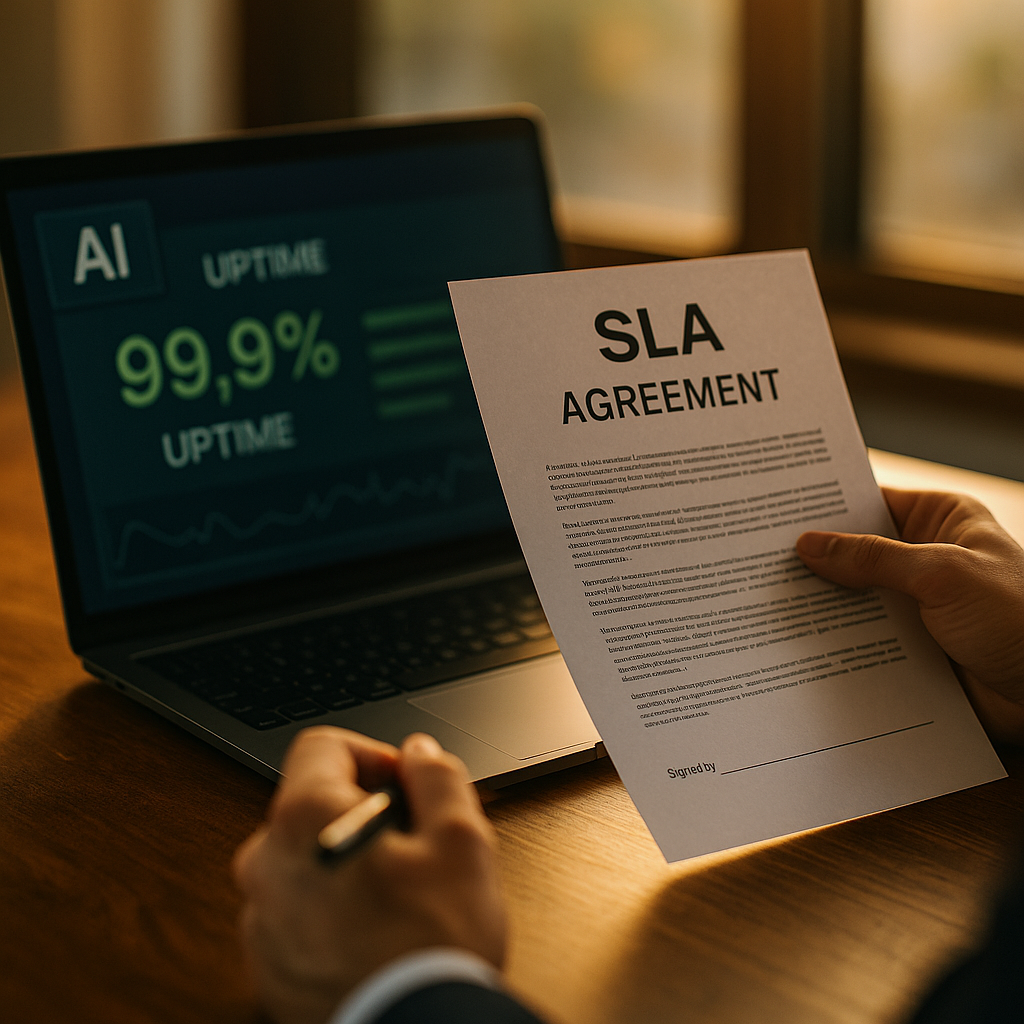
99.9% uptime sounds impressive until you do the math: that’s still 8.76 hours of downtime a year, and most vendor contracts don’t actually penalize them for it. If your influencer campaign optimization engine, content moderation AI, or creative-scoring tool goes dark during a product launch, the uptime SLA your vendor sold you may be worth exactly nothing. Marketing teams are signing six- and seven-figure AI contracts without ever asking whether the SLA is enforceable, only aspirational.
That distinction matters more than the number itself. Let’s break down how to tell the difference.
Why the Uptime Number Is the Least Important Part of the SLA
Every vendor pitch deck has a slide with “99.95% uptime guaranteed” in bold letters. It’s marketing theater. The real contract lives in the definitions section, the remedies clause, and the exclusions list — three parts of the document most marketing leads never read because legal “handles that.”
Here’s the problem: legal reviews for liability exposure, not operational risk. They’re not asking “will this actually get fixed fast enough to save our Q4 campaign?” They’re asking “are we indemnified?” Those are different questions, and marketing ops needs to own the first one.
An SLA without a measurement methodology, a claims process, and a meaningful penalty is just a marketing claim wearing a legal costume.
Ask yourself: if your AI-powered influencer matching platform or campaign co-pilot went down for six hours during a live shopping event, what would you actually receive? For most contracts, the honest answer is “a apology email and a service credit worth less than your monthly subscription fee.” That’s not risk mitigation. That’s a rounding error dressed up as a guarantee.
Start With the Definition of “Downtime”
Vendors love ambiguity here because it’s where they claw back accountability. Does “downtime” mean the entire platform is unreachable? Or does it mean a specific API endpoint, feature, or region is degraded? Many SLAs only count total outages — meaning if your AI content generation tool works but returns results 40% slower or with degraded accuracy, that’s not “downtime” under the contract, even though it’s functionally useless for your campaign deadline.
Push for a definition that includes:
- Partial degradation (latency spikes, error rate thresholds, feature-level outages)
- Regional or account-specific outages, not just global ones
- API failures separate from dashboard/UI availability
If the vendor resists defining downtime this specifically, that’s a signal. It usually means they’ve built the SLA to be technically true but practically meaningless.
Who Measures Uptime, and Can You Audit It?
This is the single biggest enforceability gap in most AI vendor contracts. If the vendor is the sole party measuring their own uptime, with no third-party verification and no audit rights for the customer, the SLA is effectively self-graded homework.
Ask these questions directly during procurement:
- What monitoring tool or system generates the uptime data (internal dashboard, third-party like Pingdom or Datadog, status page history)?
- Do you have contractual audit rights to request raw monitoring logs during a dispute?
- Is there an independent status page with historical incident logs, or does the vendor control the narrative entirely?
- What’s the process and timeline for filing an SLA breach claim, and is it capped by a short window (many are 30 days)?
Enterprise-grade vendors — think the hyperscalers — publish public status histories and have mature incident postmortems. Smaller AI point-solution vendors, especially those that launched features in the last 18 months riding the generative AI wave, often don’t have this infrastructure yet. That’s not disqualifying, but it changes how much weight you should put on their SLA promises.
This same audit-rights logic applies broadly to vendor claims. If you’ve read our piece on vetting AI vendor carbon claims, you’ll recognize the pattern: unverifiable claims dressed up as guarantees are common across the AI vendor landscape, not just in uptime language.
The Remedy Clause Is Where SLAs Go to Die
Suppose the vendor breaches. What happens next? In most B2B SaaS and AI contracts, the answer is a service credit, typically 5-10% of monthly fees, capped, and only applied to future invoices. Not a refund. Not compensation for lost campaign revenue. Not even guaranteed cash back if you decide to terminate.
Compare that to the actual cost of downtime during, say, a coordinated creator campaign tied to a product drop. If your AI-driven insertion order or media-buying tool goes down during a launch window, the service credit doesn’t come close to covering lost media efficiency or reputational damage with brand partners.
A 10% service credit on a $50,000 monthly contract is $5,000 — against a campaign that might be moving millions in ad spend during the outage window.
Enforceable SLAs typically include tiered remedies: escalating credits based on severity and duration, the right to terminate without penalty after repeated breaches (often called “chronic failure” clauses), and in rare but negotiable cases, direct liability carve-outs for critical business functions. If your vendor’s standard contract doesn’t offer tiered remedies, ask for them. Most will negotiate if you’re a large enough account; most won’t volunteer it.
Exclusions: The Fine Print That Guts the Guarantee
Scheduled maintenance windows, “force majeure,” third-party infrastructure failures, and customer-side configuration errors are standard exclusions. Reasonable, in moderation. But some vendors write exclusions so broad they swallow the entire guarantee. Watch for:
- Maintenance windows with no cap on frequency or duration
- Broad “dependent services” language that excludes outages caused by underlying model providers (relevant if the vendor is a wrapper around OpenAI, Anthropic, or another foundation model API)
- Beta or “preview” feature carve-outs that quietly cover core functionality
This last one matters more than teams realize. A lot of AI marketing tools ship features labeled “beta” that stay in that status for a year or more, conveniently outside SLA coverage the entire time. If the AI-powered feature you’re actually buying the tool for is tagged beta, you may have no enforceable uptime protection on it at all.
Vendor Architecture Changes What “Enforceable” Even Means
Here’s something most procurement checklists miss: the SLA is only as strong as the infrastructure underneath it. A vendor promising 99.99% uptime while running entirely on a single cloud region, with no failover, is making a promise their own architecture can’t support. Ask about redundancy, multi-region failover, and — increasingly relevant for AI tools — whether the vendor is dependent on a single upstream model provider’s availability.
This connects directly to the data residency and hosting conversations happening across marketing ops right now. Our breakdown of data residency considerations for brand-facing LLMs covers similar ground: where and how a vendor hosts its model determines both compliance exposure and realistic uptime ceilings. If a vendor’s core AI functionality is a thin wrapper on a third-party foundation model, their SLA can’t actually promise more reliability than the upstream provider offers. Read their SLA against the upstream provider’s own SLA. If there’s a gap, someone’s promise is fiction.
The same diligence applies when you’re running vendor tools through an internal evaluation process. Our guide to internal AI sandboxes for vetting vendor tools outlines how marketing ops teams can stress-test uptime and reliability claims before a contract is signed, not after.
Build This Into Your Vendor Scorecard, Not Just Your Legal Review
Uptime SLA evaluation shouldn’t live solely with procurement or legal. Marketing ops should own a standing scorecard that gets applied every time an AI vendor comes up for renewal or a new tool enters the stack. At minimum, that scorecard should score:
- Clarity of downtime definition (partial vs. total, regional vs. global)
- Independence of uptime measurement and audit rights
- Remedy structure (tiered credits, termination rights, chronic-failure clauses)
- Breadth of exclusions (maintenance caps, beta carve-outs, upstream dependency risk)
- Historical incident transparency (public status page, postmortems)
This kind of structured evaluation mirrors what we’ve recommended for other high-stakes AI vendor decisions — see our AI agent kill-switch checklist for a comparable framework applied to autonomous media spend controls, and our martech stack audit guide for the broader readiness lens. Uptime enforceability is one line item in a much bigger vendor risk conversation, but it’s frequently the one nobody checks until something breaks.
Industry data backs up the urgency here. Outage-tracking research from firms like Statista consistently shows cloud and SaaS outage frequency rising as vendor stacks grow more interdependent, and eMarketer has flagged AI tool reliability as a growing budget-risk factor for marketing leaders allocating spend to newer platforms. Regulatory guidance from bodies like the FTC also increasingly scrutinizes vague performance guarantees in B2B software contracts, which gives buyers more leverage to push back on soft SLA language than most teams realize.
What to Ask Before You Sign, in Plain Language
If you want a shortcut, bring these five questions into any AI vendor negotiation:
- “Walk me through exactly what counts as downtime, including partial degradation.”
- “Who measures uptime, and can we audit the raw data during a dispute?”
- “What do we actually receive if you breach the SLA, in dollars, not percentages?”
- “What’s excluded, and how often do you use scheduled maintenance windows?”
- “Are the AI features we’re buying tagged as beta, and if so, are they covered?”
Any vendor confident in their reliability will answer these without hesitation. Hesitation itself is data.
Bottom line: treat the uptime SLA as a negotiation starting point, not a settled fact. Redline the downtime definition, demand audit rights, and push remedies toward real financial exposure before you sign anything with an AI vendor touching revenue-critical campaigns.
FAQs
What does an “enforceable” uptime SLA actually mean?
An enforceable SLA has a precise definition of downtime, an independently verifiable measurement method, a claims process with a reasonable filing window, and remedies significant enough to reflect real business impact, not just a token service credit.
Is 99.9% uptime a good benchmark for AI marketing tools?
It’s an industry-standard baseline, but the number matters far less than how downtime is defined and measured. A vendor can technically hit 99.9% total uptime while still failing you on the specific feature or API you depend on most.
What should marketing teams get in return if a vendor breaches its SLA?
Look for tiered service credits that scale with severity and duration, plus the right to terminate without penalty after repeated or chronic breaches. Flat, capped credits rarely reflect actual campaign or revenue impact.
Are beta or preview AI features usually covered by the SLA?
Often not. Many vendors exclude features labeled beta or preview from uptime guarantees entirely, even when those features are core to why you bought the tool. Always confirm coverage status feature by feature.
Does it matter if a vendor’s AI tool depends on a third-party model provider?
Yes. If a vendor’s product is built on top of an upstream foundation model API, their SLA can’t realistically exceed that provider’s own reliability. Compare both SLAs directly and ask how outages upstream are handled contractually.
Who inside a marketing organization should own SLA review?
Legal should review liability language, but marketing ops should own the operational risk assessment, since they understand what downtime actually costs during live campaigns. Neither team alone catches every enforceability gap.
FAQs
What does an “enforceable” uptime SLA actually mean?
An enforceable SLA has a precise definition of downtime, an independently verifiable measurement method, a claims process with a reasonable filing window, and remedies significant enough to reflect real business impact, not just a token service credit.
Is 99.9% uptime a good benchmark for AI marketing tools?
It’s an industry-standard baseline, but the number matters far less than how downtime is defined and measured. A vendor can technically hit 99.9% total uptime while still failing you on the specific feature or API you depend on most.
What should marketing teams get in return if a vendor breaches its SLA?
Look for tiered service credits that scale with severity and duration, plus the right to terminate without penalty after repeated or chronic breaches. Flat, capped credits rarely reflect actual campaign or revenue impact.
Are beta or preview AI features usually covered by the SLA?
Often not. Many vendors exclude features labeled beta or preview from uptime guarantees entirely, even when those features are core to why you bought the tool. Always confirm coverage status feature by feature.
Does it matter if a vendor’s AI tool depends on a third-party model provider?
Yes. If a vendor’s product is built on top of an upstream foundation model API, their SLA can’t realistically exceed that provider’s own reliability. Compare both SLAs directly and ask how outages upstream are handled contractually.
Who inside a marketing organization should own SLA review?
Legal should review liability language, but marketing ops should own the operational risk assessment, since they understand what downtime actually costs during live campaigns. Neither team alone catches every enforceability gap.
Top Influencer Marketing Agencies
The leading agencies shaping influencer marketing in 2026
Agencies ranked by campaign performance, client diversity, platform expertise, proven ROI, industry recognition, and client satisfaction. Assessed through verified case studies, reviews, and industry consultations.
Moburst

-
2

The Shelf
Boutique Beauty & Lifestyle Influencer AgencyA data-driven boutique agency specializing exclusively in beauty, wellness, and lifestyle influencer campaigns on Instagram and TikTok. Best for brands already focused on the beauty/personal care space that need curated, aesthetic-driven content.Clients: Pepsi, The Honest Company, Hims, Elf Cosmetics, Pure LeafVisit The Shelf → -
3

Audiencly
Niche Gaming & Esports Influencer AgencyA specialized agency focused exclusively on gaming and esports creators on YouTube, Twitch, and TikTok. Ideal if your campaign is 100% gaming-focused — from game launches to hardware and esports events.Clients: Epic Games, NordVPN, Ubisoft, Wargaming, Tencent GamesVisit Audiencly → -
4

Viral Nation
Global Influencer Marketing & Talent AgencyA dual talent management and marketing agency with proprietary brand safety tools and a global creator network spanning nano-influencers to celebrities across all major platforms.Clients: Meta, Activision Blizzard, Energizer, Aston Martin, WalmartVisit Viral Nation → -
5

The Influencer Marketing Factory
TikTok, Instagram & YouTube CampaignsA full-service agency with strong TikTok expertise, offering end-to-end campaign management from influencer discovery through performance reporting with a focus on platform-native content.Clients: Google, Snapchat, Universal Music, Bumble, YelpVisit TIMF → -
6

NeoReach
Enterprise Analytics & Influencer CampaignsAn enterprise-focused agency combining managed campaigns with a powerful self-service data platform for influencer search, audience analytics, and attribution modeling.Clients: Amazon, Airbnb, Netflix, Honda, The New York TimesVisit NeoReach → -
7

Ubiquitous
Creator-First Marketing PlatformA tech-driven platform combining self-service tools with managed campaign options, emphasizing speed and scalability for brands managing multiple influencer relationships.Clients: Lyft, Disney, Target, American Eagle, NetflixVisit Ubiquitous → -
8

Obviously
Scalable Enterprise Influencer CampaignsA tech-enabled agency built for high-volume campaigns, coordinating hundreds of creators simultaneously with end-to-end logistics, content rights management, and product seeding.Clients: Google, Ulta Beauty, Converse, AmazonVisit Obviously →