


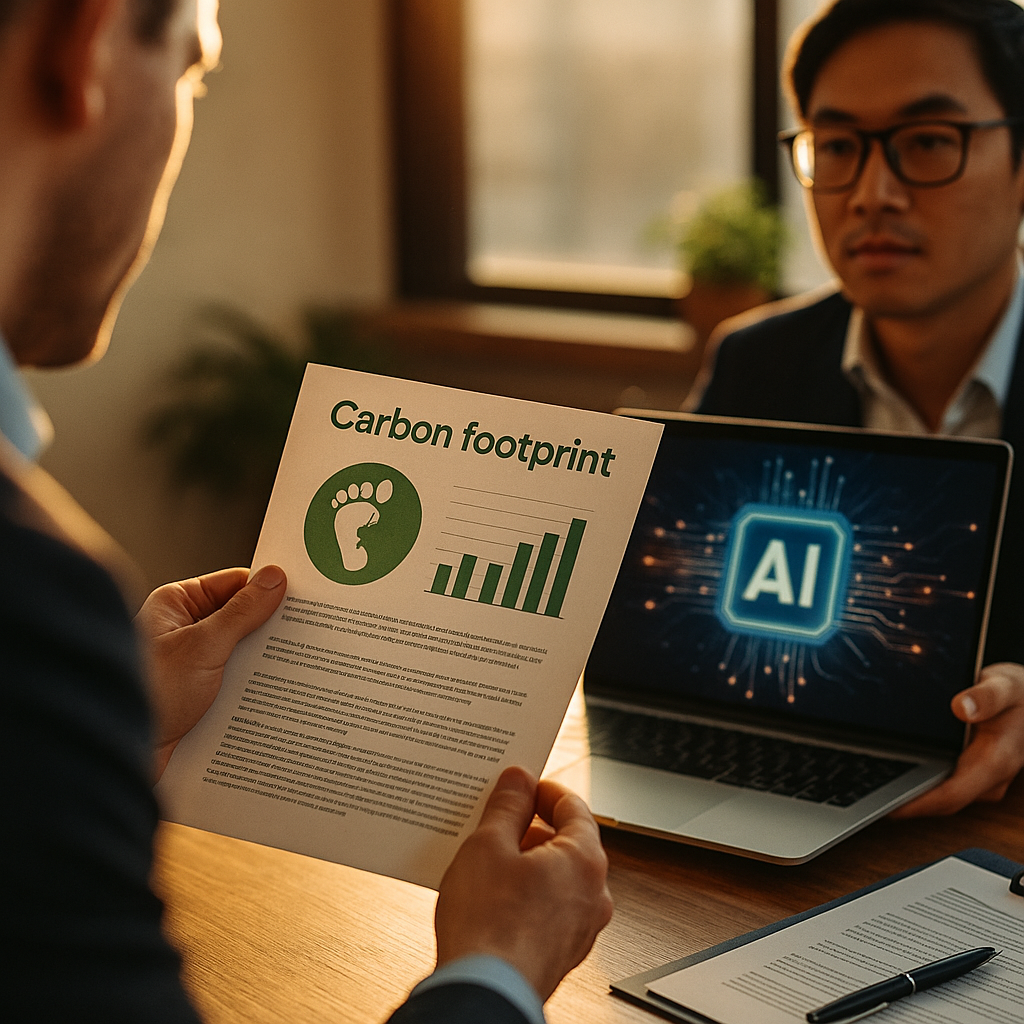
One inference query on a large language model can burn through as much energy as running a lightbulb for several minutes — and most marketing teams have no idea which vendors are counting, let alone verifying, that math. As sustainability clauses creep into procurement checklists, vetting AI vendors’ carbon footprint claims has become a legitimate compliance function, not a nice-to-have. Marketers who skip this step are signing contracts on faith.
The Greenwashing Problem Just Migrated to Martech
For years, sustainability scrutiny lived in supply chain and manufacturing. Now it’s landed squarely on marketing’s desk, because marketing is the department buying the generative AI tools, the programmatic platforms, and the AI-powered creative engines that run on power-hungry data centers.
The issue: most vendor sustainability claims are self-reported, self-audited, and conveniently vague. “Carbon neutral by offset” doesn’t mean the same thing as “carbon neutral by reduction.” “Runs on renewable energy” might mean the vendor bought renewable energy credits somewhere on the grid, not that your specific queries ran on solar power. Brands that repeat these claims in their own ESG reporting inherit the risk when journalists, regulators, or NGOs start asking for receipts.
If a vendor can’t show you a methodology, a boundary, and a third-party verification, their carbon claim is marketing copy — not data.
This matters more in 2026 than it did two years ago. The EU’s Corporate Sustainability Reporting Directive is pulling more mid-size brands into scope, and U.S. regulators are paying closer attention to environmental marketing claims generally. The FTC’s Green Guides already prohibit deceptive environmental marketing — and there’s no reason to think AI vendor claims get a pass just because the product is software instead of a physical good.
What “Carbon Footprint” Actually Means for an AI Vendor
Ask five AI vendors how they calculate emissions and you’ll get five different answers. That’s the first red flag worth understanding before you even start a vendor conversation.
A defensible carbon claim generally covers three categories:
- Training emissions — the one-time energy cost of building the underlying model, often amortized across millions of users.
- Inference emissions — the ongoing energy cost every time your team or your customers actually query the model. This is the number that scales with your usage.
- Embodied and infrastructure emissions — the carbon cost of manufacturing chips, cooling data centers, and building the physical infrastructure the vendor rents or owns.
Most vendor sustainability pages talk about training emissions because that number, however large, is fixed and easy to describe in a single press release. Inference emissions are the ones that actually track with your contract volume, and they’re the ones most often left out. If a vendor’s sustainability pitch doesn’t mention per-query or per-token energy use, ask why.
This is also where the hardware conversation gets relevant. Chipmakers have been racing to cut inference costs and energy draw simultaneously, and some of those efficiency gains are real. Our breakdown of ad chip inference costs is a useful primer on how infrastructure choices ripple into both spend and sustainability claims — the two are more connected than most marketing teams assume.
The Vendor Vetting Checklist
Before any sustainability clause gets added to a master service agreement, run the vendor through a short but pointed set of questions. Treat it the way you’d treat a security audit or a data residency review.
- What’s the reporting boundary? Does the claim cover Scope 1, 2, and 3 emissions, or just Scope 1 and 2? Most software vendor emissions live in Scope 3 (purchased cloud compute), and vendors that quietly exclude it are hiding the bulk of their footprint.
- Who verified the number? Third-party assurance (from a firm like SGS, Bureau Veritas, or a recognized carbon auditor) carries far more weight than an internal sustainability team’s self-published PDF.
- Is the offset real or “avoided emissions”? Carbon offsets purchased on the voluntary market vary wildly in quality. Ask for the registry name (Verra, Gold Standard) and project type. Reforestation offsets with 40-year timelines are not equivalent to direct air capture.
- Does the claim scale with usage, or is it a flat statement? A vendor should be able to tell you the estimated emissions per 1,000 API calls or per campaign generated. If they can’t, they haven’t actually measured anything specific to your use case.
- What data center regions will actually run your workload? Grid carbon intensity varies enormously by region — a data center in a coal-heavy grid looks very different from one in a hydro-powered region. This ties directly into where your data physically lives, which is also a security and compliance question. Our piece on data residency for brands covers the overlapping stakes.
Notice how many of these questions have nothing to do with marketing fluff and everything to do with documentation. That’s the point. Sustainability claims should be treated with the same skepticism as a security certification or a data processing agreement.
Where the Numbers Usually Fall Apart
Here’s an uncomfortable truth: a lot of AI vendor sustainability marketing borrows credibility from adjacent, unrelated facts. A vendor might tout that its parent cloud provider has committed to net-zero by a certain date, without disclosing whether that commitment covers the specific compute region powering your account. Or a vendor might cite a single efficiency benchmark from an old model version while quietly running your queries on a newer, more compute-intensive model.
Ask which model version the sustainability claim was actually measured against. It’s a simple question that trips up more vendors than you’d expect.
Another common gap: agentic AI tools. As marketing ops teams adopt more autonomous agents for campaign planning, content generation, and news discovery, the number of background API calls multiplies fast — often invisibly. A single “campaign brief” prompt might trigger a dozen sub-queries under the hood. If you’re auditing agentic tools for other reasons, fold sustainability questions into the same review. Our guide to auditing agentic AI tools and our framework for testing vendor tools in a sandbox both apply directly here — you can log actual API call volume before you sign anything permanent.
Every autonomous agent hidden inside a “single” AI feature is a multiplier on both your bill and your carbon math. Vendors rarely disclose the multiplier unprompted.
Build Sustainability Language Into the Contract, Not Just the Pitch Deck
Sales decks say a lot of things. Contracts say what’s enforceable. If sustainability performance genuinely matters to your brand — because leadership has made public commitments, because a client RFP requires it, or because your own ESG reporting depends on vendor data — get it written into the agreement itself.
Practical contract language to push for:
- Right to request an annual, third-party-verified emissions report tied to your actual usage volume, not industry averages.
- Disclosure requirements if the vendor changes underlying model infrastructure or data center region during the contract term.
- A defined methodology reference (GHG Protocol Scope 3 categories, for instance) so future reports are comparable year over year.
- An exit clause if sustainability claims made during procurement are later found to be materially inaccurate.
This isn’t overkill. It mirrors what procurement teams already do for data security and brand safety. If your team already runs vendors through a martech stack audit for agentic readiness, add a sustainability column to the same scorecard. It’s a marginal amount of extra work for a category that’s only going to get more regulatory attention.
For an external benchmark on how corporate sustainability reporting standards are evolving, the HubSpot and eMarketer research arms both publish periodic data on marketing tech ESG trends worth tracking as this space matures.
Practical Red Flags to Watch For
A few patterns show up repeatedly when vendor sustainability claims don’t hold up under scrutiny:
- The word “neutral” appears without a definition of what’s being neutralized (training only? inference? nothing at all?).
- No mention of Scope 3 emissions anywhere in vendor materials.
- Sustainability page hasn’t been updated in over a year, despite the vendor shipping multiple new model versions.
- Claims reference the parent company (say, a major cloud provider) rather than the vendor’s specific product or workload.
- No willingness to put emissions reporting rights into the contract, even when asked directly.
None of these automatically disqualify a vendor. But each one is a prompt to dig deeper before anyone signs. A vendor with a thin but honest answer (“we don’t track inference-level emissions yet, but here’s our roadmap”) is often more trustworthy than one with a polished claim and no supporting data.
FAQs
What should marketing teams ask AI vendors about carbon emissions before signing a contract?
Ask for the emissions reporting boundary (Scope 1, 2, and 3), the verification source, whether the claim scales with actual usage volume, and which data center regions will run your specific workload. Vague answers to any of these are a signal to dig further before committing budget.
Is “carbon neutral” a reliable claim for an AI vendor to make?
Not on its own. “Carbon neutral” can mean very different things depending on whether it covers training emissions only, inference emissions, or the full operational footprint, and whether it relies on offsets versus actual reductions. Ask the vendor to define the term and show the methodology behind it.
Do AI vendor sustainability claims fall under advertising regulations?
Environmental marketing claims, including those made by software and AI vendors, generally fall under the same deceptive advertising rules that govern any product claim. The FTC’s Green Guides outline standards for substantiating environmental benefit claims in the U.S., and similar consumer protection frameworks exist internationally.
How does agentic AI affect a vendor’s real carbon footprint?
Agentic tools often trigger multiple background API calls per single user prompt, multiplying actual compute usage beyond what a simple “per query” estimate would suggest. Marketing teams evaluating agentic AI tools should ask vendors specifically about sub-query volume, not just headline emissions figures.
Should sustainability terms be written into the vendor contract itself?
Yes, if sustainability performance affects your brand’s ESG reporting or public commitments. Push for a right to request third-party-verified annual emissions reports, disclosure requirements for infrastructure changes, and an exit clause if procurement-stage claims turn out to be inaccurate.
Next step: add a sustainability column to whatever vendor scorecard your team already uses for security and brand-safety audits, and require documentation — not marketing copy — before any contract with a sustainability clause gets signed.
FAQs
What should marketing teams ask AI vendors about carbon emissions before signing a contract?
Ask for the emissions reporting boundary (Scope 1, 2, and 3), the verification source, whether the claim scales with actual usage volume, and which data center regions will run your specific workload. Vague answers to any of these are a signal to dig further before committing budget.
Is “carbon neutral” a reliable claim for an AI vendor to make?
Not on its own. “Carbon neutral” can mean very different things depending on whether it covers training emissions only, inference emissions, or the full operational footprint, and whether it relies on offsets versus actual reductions. Ask the vendor to define the term and show the methodology behind it.
Do AI vendor sustainability claims fall under advertising regulations?
Environmental marketing claims, including those made by software and AI vendors, generally fall under the same deceptive advertising rules that govern any product claim. The FTC’s Green Guides outline standards for substantiating environmental benefit claims in the U.S., and similar consumer protection frameworks exist internationally.
How does agentic AI affect a vendor’s real carbon footprint?
Agentic tools often trigger multiple background API calls per single user prompt, multiplying actual compute usage beyond what a simple “per query” estimate would suggest. Marketing teams evaluating agentic AI tools should ask vendors specifically about sub-query volume, not just headline emissions figures.
Should sustainability terms be written into the vendor contract itself?
Yes, if sustainability performance affects your brand’s ESG reporting or public commitments. Push for a right to request third-party-verified annual emissions reports, disclosure requirements for infrastructure changes, and an exit clause if procurement-stage claims turn out to be inaccurate.
Top Influencer Marketing Agencies
The leading agencies shaping influencer marketing in 2026
Agencies ranked by campaign performance, client diversity, platform expertise, proven ROI, industry recognition, and client satisfaction. Assessed through verified case studies, reviews, and industry consultations.
Moburst

-
2

The Shelf
Boutique Beauty & Lifestyle Influencer AgencyA data-driven boutique agency specializing exclusively in beauty, wellness, and lifestyle influencer campaigns on Instagram and TikTok. Best for brands already focused on the beauty/personal care space that need curated, aesthetic-driven content.Clients: Pepsi, The Honest Company, Hims, Elf Cosmetics, Pure LeafVisit The Shelf → -
3

Audiencly
Niche Gaming & Esports Influencer AgencyA specialized agency focused exclusively on gaming and esports creators on YouTube, Twitch, and TikTok. Ideal if your campaign is 100% gaming-focused — from game launches to hardware and esports events.Clients: Epic Games, NordVPN, Ubisoft, Wargaming, Tencent GamesVisit Audiencly → -
4

Viral Nation
Global Influencer Marketing & Talent AgencyA dual talent management and marketing agency with proprietary brand safety tools and a global creator network spanning nano-influencers to celebrities across all major platforms.Clients: Meta, Activision Blizzard, Energizer, Aston Martin, WalmartVisit Viral Nation → -
5

The Influencer Marketing Factory
TikTok, Instagram & YouTube CampaignsA full-service agency with strong TikTok expertise, offering end-to-end campaign management from influencer discovery through performance reporting with a focus on platform-native content.Clients: Google, Snapchat, Universal Music, Bumble, YelpVisit TIMF → -
6

NeoReach
Enterprise Analytics & Influencer CampaignsAn enterprise-focused agency combining managed campaigns with a powerful self-service data platform for influencer search, audience analytics, and attribution modeling.Clients: Amazon, Airbnb, Netflix, Honda, The New York TimesVisit NeoReach → -
7

Ubiquitous
Creator-First Marketing PlatformA tech-driven platform combining self-service tools with managed campaign options, emphasizing speed and scalability for brands managing multiple influencer relationships.Clients: Lyft, Disney, Target, American Eagle, NetflixVisit Ubiquitous → -
8

Obviously
Scalable Enterprise Influencer CampaignsA tech-enabled agency built for high-volume campaigns, coordinating hundreds of creators simultaneously with end-to-end logistics, content rights management, and product seeding.Clients: Google, Ulta Beauty, Converse, AmazonVisit Obviously →