


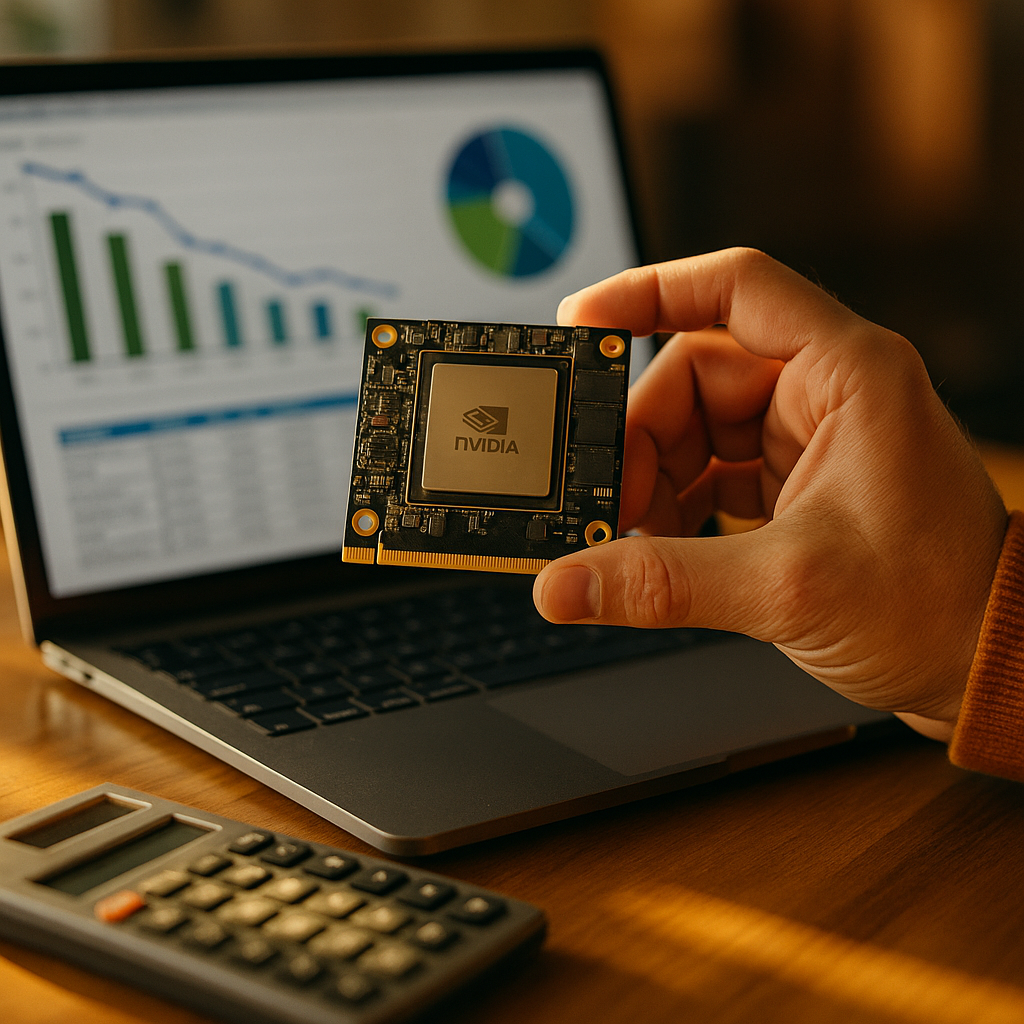
NVIDIA now claims its latest inference silicon can cut real-time ad-personalization costs by more than half. That’s the kind of number that gets CMOs into rooms with CTOs. But before you rewrite next year’s martech budget around new NVIDIA advertising AI chips, it’s worth asking what “faster inference” actually buys a brand running programmatic and creator-driven campaigns at scale.
This isn’t a chip review for engineers. It’s a translation exercise: what does silicon-level speed mean for the marketer who owns CPMs, personalization latency, and the finance conversation about AI spend?
What NVIDIA Actually Announced
NVIDIA’s newest inference-optimized chips, built on its Blackwell Ultra and Rubin architectures, are being marketed directly at ad-tech and retail media workloads. That’s a notable shift. Historically, NVIDIA sold raw compute to hyperscalers and let them figure out the ad-serving application layer. Now the company is explicitly tuning silicon and software stacks for the specific math behind real-time bidding, creative assembly, and personalization scoring.
The pitch is simple: ad personalization is fundamentally an inference problem, not a training problem. Every time a user loads a page, an app opens, or a video ad slot fills, a model has to score hundreds or thousands of candidate ads, creatives, or product recommendations in under 100 milliseconds. Do that faster and cheaper, and you change the unit economics of the entire real-time bidding ecosystem.
NVIDIA’s argument, backed by internal benchmarks on its NIM inference microservices, is that new chip generations deliver 30x-40x throughput gains on transformer-based recommendation models compared to previous-generation GPUs. Even if you discount vendor benchmarks by half, that’s still a meaningful jump for anyone running large-scale personalization at auction speed.
Inference cost, not model sophistication, has been the real bottleneck holding back real-time personalization at scale. Faster chips don’t make ads smarter. They make it economically viable to run smarter models on every single impression.
Why Inference Speed Is an Advertiser Problem, Not Just an Infrastructure One
Here’s the thing most marketing leaders miss: the cost of your personalization model doesn’t show up as a separate line item. It’s baked into your DSP fees, your retail media platform margins, and the “AI premium” that vendors quietly add to CPMs. When Google, Amazon, and The Trade Desk all run recommendation and bidding models on the same underlying infrastructure constraints, cheaper inference eventually flows through to lower platform costs, or at least slower CPM inflation.
Think about what real-time personalization actually requires operationally. A single ad decision might involve pulling identity signals, scoring dozens of creative variants, running brand safety checks, and predicting conversion probability, all before the page finishes loading. Each of those steps is an inference call. Multiply that by billions of daily impressions across a platform like Meta or TikTok, and you understand why inference cost has been the silent tax on ambitious personalization strategies.
Faster, cheaper inference chips mean platforms can afford to run more sophisticated models, more often, without the compute bill spiraling. That’s the theory. Whether it translates into savings for advertisers or just fatter margins for ad platforms is the real question worth pressuring your vendors on.
The Real-World Cost Math
Let’s get concrete. Industry estimates from eMarketer suggest global programmatic ad spend will keep climbing past $200 billion annually, with an increasing share going toward AI-driven optimization layers rather than raw media. If inference costs drop 50-70% on next-gen chips, ad platforms that pass savings through could realistically decompress CPMs enmiquenrly, or reinvest the savings into deeper personalization: more creative variants tested per user, more granular audience micro-segments, faster A/B iteration cycles.
For brand teams, that has three practical implications:
- Personalization at greater granularity becomes affordable. Instead of five audience segments, platforms can justify scoring fifty, because the marginal inference cost per additional segment keeps falling.
- Real-time creative optimization gets less throttled. Dynamic creative optimization (DCO) tools that used to cap variant testing due to compute budgets can now test more combinations per session.
- Latency-sensitive formats become viable. Connected TV, in-app video, and live commerce all demand sub-second ad decisions. Cheaper inference makes it economically sane to run full personalization models in these formats instead of falling back to simpler rule-based targeting.
None of this means your media budget shrinks automatically. It means the ceiling on what’s computationally possible moves higher, and the platforms you buy from will use that headroom to sell you more sophisticated (and probably more expensive) targeting products. Cheaper compute rarely means cheaper marketing. It usually means more marketing, packaged as innovation.
What This Means for Your Martech Stack
If inference costs are falling industry-wide, your own martech vendors should be feeling it too, particularly any tool doing real-time scoring: identity resolution platforms, recommendation engines, attribution models. It’s a reasonable moment to revisit vendor pricing conversations and ask directly: are you passing on infrastructure savings, or absorbing them into margin?
This is also a good trigger point for a broader martech stack audit, specifically checking whether your current CDP, DSP, and personalization layers are actually architected to take advantage of faster inference, or whether they’re bottlenecked elsewhere, in data pipelines, identity graphs, or legacy batch-processing workflows that never got rebuilt for real-time.
Worth noting: a chip is only as useful as the software stack running on it. NVIDIA’s NIM microservices and Dynamo inference framework are designed to help ad-tech vendors actually capture those throughput gains. If your DSP or retail media partner hasn’t upgraded their serving stack to exploit the new hardware, you won’t see any of the promised cost benefits. Ask vendors directly what inference stack they’re running and whether they’ve benchmarked cost-per-impression improvements. Vague answers are a red flag.
Retail Media and Commerce: Where the Impact Lands First
Retail media networks are probably the first place brands will feel this shift, because retail media inherently requires real-time inference: product recommendations, dynamic pricing signals, and on-site personalization all happen at the moment of intent, not in a batch job overnight. Amazon, Walmart Connect, and Instacart’s ad businesses all depend on split-second scoring models to decide which sponsored product shows up in which slot.
As commerce increasingly runs through agentic shopping flows and automated product feeds, the pressure on inference speed only grows. If you’re already thinking about how agent-driven commerce changes feed requirements, it’s worth reviewing how agentic commerce protocols are reshaping what retailers expect from brand data feeds, since faster inference and agent-mediated shopping are converging trends, not separate ones.
Similarly, CTV and live commerce personalization depend on identity resolution happening in near real time. If your stack still relies on overnight batch matching, faster inference chips upstream won’t help you; the bottleneck is elsewhere in your pipeline. That’s exactly the kind of gap a real-time identity resolution review is meant to catch.
The Governance and Risk Angle Nobody’s Talking About
Faster inference means models make more decisions, more often, with less human oversight in the loop. That’s an efficiency win and a governance risk simultaneously. If your personalization engine is scoring and serving creative variants in under 50 milliseconds, at what point does a human actually review what’s being shown to which audience?
This matters more as regulators pay closer attention to automated ad targeting. The Federal Trade Commission has flagged algorithmic targeting and automated decision-making as an enforcement priority, and the UK Information Commissioner’s Office has issued similar guidance on automated profiling. Speed without oversight is a compliance liability waiting to surface, especially if a personalization model starts making problematic inferences about sensitive categories at scale before anyone notices.
Brands should treat any inference-speed upgrade as a trigger to revisit their AI governance checklist, not just their cost model. That includes making sure there’s still a functional kill-switch process if a personalization engine starts misbehaving at machine speed. Our AI agent kill-switch checklist is a useful starting point for that conversation with your risk and legal teams.
So, Should You Change Anything Right Now?
Not dramatically. But there are three moves worth making this quarter:
- Ask your DSP and retail media partners directly whether they’ve adopted inference-optimized infrastructure and whether any cost savings are reflected in pricing or added as new premium personalization tiers.
- Audit your own real-time infrastructure to confirm you’re not the bottleneck. Faster upstream inference is useless if your identity resolution or attribution stack still runs in batch cycles.
- Revisit governance controls before adopting any new real-time personalization feature that leans on faster inference, since speed without oversight is where compliance problems tend to start.
The chips are real, and the throughput gains are probably real too, at least directionally. What’s not guaranteed is that any of it translates into lower costs for the brand actually buying the media. That part depends entirely on how much leverage you have in vendor negotiations, and whether you’re asking the right questions before renewal season, not after.
Frequently Asked Questions
What are NVIDIA’s new advertising-focused AI chips designed to do?
NVIDIA’s latest inference-optimized chips, built on Blackwell Ultra and Rubin architectures, are tuned specifically for ad-tech workloads like real-time bidding, creative scoring, and personalization models. They’re designed to run inference (not training) faster and cheaper, which is the specific compute task behind serving personalized ads at auction speed.
Will faster AI chips actually lower advertising costs for brands?
Not automatically. Faster inference lowers the compute cost for ad platforms and DSPs, but whether that savings passes through to advertisers depends on vendor pricing decisions. Historically, infrastructure savings in ad-tech have often been reinvested into more sophisticated (and pricier) targeting products rather than passed on as lower CPMs.
What is real-time ad personalization, and why does inference speed matter?
Real-time ad personalization means scoring and serving customized ad creative, product recommendations, or bids within milliseconds of a user’s page load or app interaction. Inference speed matters because every personalization decision requires a live model calculation; faster inference means more sophisticated models can run within tight latency windows without breaking the ad auction timeline.
How should marketing teams evaluate whether new AI chip advances actually benefit their programs?
Ask vendors directly whether they’ve upgraded their inference stack to use new hardware, and whether cost savings show up in pricing or just fund new premium features. Separately, audit your own martech stack to confirm you’re not bottlenecked elsewhere, such as batch-based identity resolution or legacy attribution systems that can’t take advantage of faster upstream inference.
Does faster inference create new compliance risks for advertisers?
Yes. Faster inference means personalization models make more decisions with less opportunity for human review. Regulators including the FTC and UK ICO have flagged automated targeting and profiling as enforcement priorities, so brands adopting faster real-time personalization should revisit governance and kill-switch protocols alongside any cost or performance gains.
Top Influencer Marketing Agencies
The leading agencies shaping influencer marketing in 2026
Agencies ranked by campaign performance, client diversity, platform expertise, proven ROI, industry recognition, and client satisfaction. Assessed through verified case studies, reviews, and industry consultations.
Moburst

-
2

The Shelf
Boutique Beauty & Lifestyle Influencer AgencyA data-driven boutique agency specializing exclusively in beauty, wellness, and lifestyle influencer campaigns on Instagram and TikTok. Best for brands already focused on the beauty/personal care space that need curated, aesthetic-driven content.Clients: Pepsi, The Honest Company, Hims, Elf Cosmetics, Pure LeafVisit The Shelf → -
3

Audiencly
Niche Gaming & Esports Influencer AgencyA specialized agency focused exclusively on gaming and esports creators on YouTube, Twitch, and TikTok. Ideal if your campaign is 100% gaming-focused — from game launches to hardware and esports events.Clients: Epic Games, NordVPN, Ubisoft, Wargaming, Tencent GamesVisit Audiencly → -
4

Viral Nation
Global Influencer Marketing & Talent AgencyA dual talent management and marketing agency with proprietary brand safety tools and a global creator network spanning nano-influencers to celebrities across all major platforms.Clients: Meta, Activision Blizzard, Energizer, Aston Martin, WalmartVisit Viral Nation → -
5

The Influencer Marketing Factory
TikTok, Instagram & YouTube CampaignsA full-service agency with strong TikTok expertise, offering end-to-end campaign management from influencer discovery through performance reporting with a focus on platform-native content.Clients: Google, Snapchat, Universal Music, Bumble, YelpVisit TIMF → -
6

NeoReach
Enterprise Analytics & Influencer CampaignsAn enterprise-focused agency combining managed campaigns with a powerful self-service data platform for influencer search, audience analytics, and attribution modeling.Clients: Amazon, Airbnb, Netflix, Honda, The New York TimesVisit NeoReach → -
7

Ubiquitous
Creator-First Marketing PlatformA tech-driven platform combining self-service tools with managed campaign options, emphasizing speed and scalability for brands managing multiple influencer relationships.Clients: Lyft, Disney, Target, American Eagle, NetflixVisit Ubiquitous → -
8

Obviously
Scalable Enterprise Influencer CampaignsA tech-enabled agency built for high-volume campaigns, coordinating hundreds of creators simultaneously with end-to-end logistics, content rights management, and product seeding.Clients: Google, Ulta Beauty, Converse, AmazonVisit Obviously →