


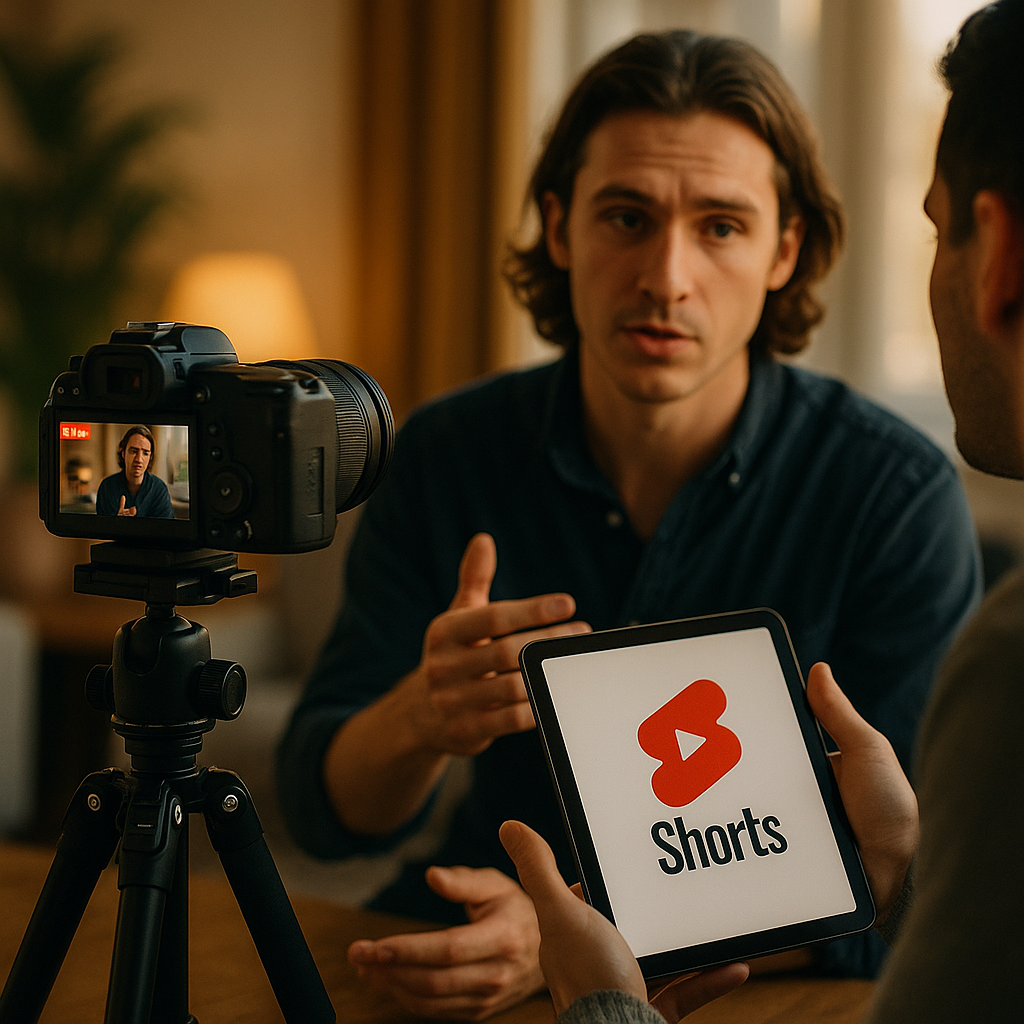
YouTube now pulls more watch time from Shorts and live streams combined than from traditional uploads on many channels — and the platform’s own recommendation engine is quietly blending the three into a single, format-agnostic feed. If your creator briefs still treat live-stream and short-form as separate line items, you’re already behind. The live-stream and short-form convergence happening on YouTube right now isn’t a trend to watch. It’s a production model brands need to brief for today.
The Format Line Is Disappearing, Not Blurring
For years, YouTube strategy meant picking a lane: long-form for depth, Shorts for discovery, live for community. That separation is collapsing. YouTube has been actively clipping live streams into Shorts automatically, surfacing them in the same feed real-time, and encouraging creators to treat a single stream as raw material for a dozen downstream assets.
Think about what a gaming creator or a beauty influencer does now during a two-hour live session. They’re not just streaming. They’re generating clip-worthy moments that get cut, captioned, and republished as Shorts within minutes — sometimes by the creator, sometimes by fans, increasingly by AI-assisted editing tools built into YouTube Studio. The stream is the source. The Shorts are the distribution engine. And the brand deal sitting inside that stream now has to survive three different consumption contexts: live, clipped, and algorithmically resurfaced.
This matters for media planning because attribution gets messy fast. A single sponsored segment might generate a live view count, a Shorts view count, and a suggested-video view count — each measured differently, each with different completion benchmarks. Brands that only brief for the live moment are leaving the highest-volume format on the table.
A brand mention that lives only in a 90-minute stream reaches the superfans. The same mention, clipped into a 40-second Short, reaches the algorithm — and the algorithm is where incremental reach actually lives.
Why This Is Happening Now
Three forces are pushing this convergence, and none of them are going away.
- Creator economics. Live streaming is time-intensive and monetizes poorly per hour compared to Shorts ad revenue and brand deals. Repurposing live content into Shorts is the only way many creators make the math work.
- Platform incentives. YouTube’s Partner Program and recommendation system reward cross-format posting frequency. A channel that streams weekly and clips daily outperforms one that only uploads long-form, according to trends creators themselves report across YouTube’s own creator insights tools.
- Audience behavior. Viewers increasingly discover a creator through a Short, then migrate to live streams for deeper engagement, then return to Shorts for daily touchpoints. It’s a loop, not a funnel.
According to eMarketer’s research on short-form video consumption, short-form remains the fastest-growing video category by time spent across nearly every demographic, while live commerce and live-stream engagement have grown in parallel rather than in competition. Brands that assumed one format would cannibalize the other were wrong. They’re reinforcing each other.
What This Means for the Creator Brief
Here’s the operational problem: most brand briefs are written for one deliverable. “One 60-second dedicated segment during a live stream.” “Three Shorts posted over two weeks.” Separate contracts, separate approval flows, separate KPIs. That structure doesn’t match how creators actually produce content anymore.
A modern brief needs to account for the full lifecycle of a piece of content — live, clipped, and re-surfaced — as one connected asset family, not three unrelated deliverables. That means rethinking usage rights, disclosure placement, and performance benchmarks all at once.
Usage rights need to cover derivative clips
If a creator streams a product integration for two hours, who owns the right to clip that into Shorts? Does the brand get approval over which moments get cut? Most existing contracts are silent on this, because they were written when live and short-form were negotiated separately. Update your standard agreement to explicitly grant (or restrict) derivative-clip rights, including fan-made and auto-generated clips from YouTube’s own tools.
This is the same rights-clarity problem brands have faced with full-screen CTV creator partnerships, where a single asset gets repurposed across surfaces with different audience expectations. The lesson transfers directly: define usage scope before the camera rolls, not after the clip goes viral.
Disclosure has to survive re-editing
The FTC’s endorsement guidance requires clear and conspicuous disclosure regardless of format, but a #ad tag spoken once during minute 47 of a live stream doesn’t survive a 40-second clip cut from minute 12. Brief creators to bake disclosure into every clip-worthy segment, not just the stream’s opening. If your legal team hasn’t reviewed how disclosure requirements apply to derivative Shorts, that’s a gap worth closing now — see the FTC’s endorsement guidelines for the baseline standard, and pair it with the more detailed compliance framework in this FTC compliance guide if your brand makes any functional or performance claims during the segment.
Benchmarks need format-specific math
Completion rate on a two-hour stream and completion rate on a 30-second Short are not comparable metrics, yet plenty of brands still report them on the same scorecard. Set separate, format-appropriate KPIs: average concurrent viewers and chat engagement for live; view-through rate and shares for Shorts; suggested-video click-through for the algorithmic tail. Reporting them together without context misleads whoever’s reading the campaign recap — usually a CMO who doesn’t have time to parse the nuance.
Briefing for the Hybrid Format, Practically
So what does an actual brief look like when it’s built for convergence instead of against it? A few structural changes make the biggest difference.
- Name the source moment explicitly. Tell the creator which segment of the live stream is the “hero moment” intended for clipping. Don’t leave it to chance — creators clip for engagement, not brand recall, unless directed otherwise.
- Pre-approve a clip template. Give creators a caption format, a disclosure placement, and a call-to-action structure they can drop into any derivative Short without needing brand sign-off on every single cut. This speeds up turnaround and keeps compliance consistent.
- Budget for the tail, not just the live event. Live streams get most of the planning attention because they’re the “event.” But the Shorts generated afterward often accumulate more total views over a 30-day window. Allocate a portion of the fee structure to reward strong-performing derivative clips, not just the live appearance.
- Coordinate timing with organic discovery windows. YouTube’s algorithm favors Shorts posted within 24-48 hours of a live event for cross-promotion. Build that turnaround time into your production schedule instead of treating clip creation as an afterthought.
This mirrors the approach brands are already taking with YouTube creator takeover strategy, where a single high-visibility placement is deliberately engineered to generate a wave of secondary content. Convergence briefing is really an extension of that same principle applied to live-stream commerce and community formats.
Where Brands Are Getting This Wrong
The most common mistake? Treating the live stream as the “premium” placement and the Shorts as a bonus throw-in. That pricing logic is backwards for reach, even if it’s understandable for cost. A dedicated live-stream mention might reach 8,000 concurrent viewers. The clipped version, if it performs, can reach 800,000 over the following month through suggested feed placement. Paying for the smaller, more expensive audience while under-briefing the larger one is a budget allocation error, not just a creative one.
The second mistake is over-scripting the live component. Live audiences tune in for spontaneity — heavily scripted brand reads during a stream get called out in chat in real time, which then gets clipped and circulated for the wrong reasons. Compare this to the lighter-touch approach recommended in briefing creators for haul and tutorial formats: give creators talking points and boundaries, not a script. That principle applies doubly to live formats, where audiences are primed to detect and punish anything that feels canned.
Third: ignoring sound-off viewing. A huge share of Shorts get watched muted, especially in-feed during commutes or work breaks. If your live-stream brand moment relies entirely on spoken mentions with no on-screen reinforcement, the clipped version loses the message entirely. Borrow from the discipline used in sound-off social video briefing and require caption overlays and on-screen branding as a non-negotiable part of any live segment likely to get clipped.
Measuring Across the Format Mix
Reporting is the part most teams haven’t solved yet. If you’re running campaigns across live, Shorts, and long-form simultaneously, resist the urge to force one dashboard metric across all three. Instead, build a lightweight scorecard structured by format tier:
- Live tier: peak concurrent viewers, average watch duration, real-time chat sentiment, click-throughs during the stream window.
- Short-form tier: view-through rate, share rate, comment-to-view ratio, audience retention curve at the 3-second and 15-second marks.
- Algorithmic tail tier: suggested/browse feed impressions over 30 days, subscriber conversion from clipped content, branded search lift.
This tiered approach borrows structure from the broader work brands are doing on format taxonomy, budget, and ROI — the core idea being that lumping every format into one blended CPM or CPV obscures which part of the campaign is actually driving business outcomes. HubSpot’s guidance on video marketing measurement makes a similar point: match the KPI to the format’s actual job in the funnel, not to whatever’s easiest to pull from one platform report.
Sprout Social’s research on social video engagement benchmarks reinforces this too — cross-format campaigns consistently outperform single-format ones on total reach, but only when each format is measured against its own realistic ceiling rather than a shared average.
The Next Step
Stop briefing live-stream and Shorts as separate deliverables with separate contracts. Write one brief that names the hero moment, pre-clears derivative clip rights and disclosure placement, and budgets for the algorithmic tail — because on YouTube in 2026, that tail is where most of your actual reach is going to land.
FAQs
What is live-stream and short-form convergence on YouTube?
It refers to YouTube’s growing practice of blending live-stream content with Shorts, where streams get automatically or manually clipped into short-form videos that surface in the same recommendation feed as regular uploads. The result is that live and short-form are no longer separate content strategies but interconnected parts of one distribution loop.
Do brands need separate contracts for live segments and the Shorts clipped from them?
Not necessarily separate contracts, but the existing agreement needs explicit language covering derivative-clip usage rights, who has editorial control over what gets clipped, and how disclosure requirements apply to each derivative piece. Treating them as one connected asset family in a single agreement is usually more efficient than negotiating each format separately.
How should disclosure work when a live stream gets clipped into multiple Shorts?
Disclosure needs to appear in every clip-worthy segment, not just once at the start of the stream. Brief creators to repeat or visually reinforce the disclosure (on-screen text plus verbal mention) at natural clip points, since a single early disclosure won’t carry over into clips cut from later in the stream.
Which metrics matter most for a hybrid live and short-form campaign?
Use tiered KPIs rather than one blended metric: concurrent viewers and chat engagement for the live component, view-through and share rate for Shorts, and suggested-feed impressions plus subscriber conversion for the algorithmic tail that follows in the days after.
Should brands pay more for the live segment or the Shorts it generates?
Reach data increasingly favors the Shorts tail, which can outperform the live audience by an order of magnitude over 30 days. Budget allocation should reflect that reality, with a meaningful portion of the fee tied to derivative clip performance rather than the live appearance alone.
FAQs
What is live-stream and short-form convergence on YouTube?
It refers to YouTube’s growing practice of blending live-stream content with Shorts, where streams get automatically or manually clipped into short-form videos that surface in the same recommendation feed as regular uploads. The result is that live and short-form are no longer separate content strategies but interconnected parts of one distribution loop.
Do brands need separate contracts for live segments and the Shorts clipped from them?
Not necessarily separate contracts, but the existing agreement needs explicit language covering derivative-clip usage rights, who has editorial control over what gets clipped, and how disclosure requirements apply to each derivative piece. Treating them as one connected asset family in a single agreement is usually more efficient than negotiating each format separately.
How should disclosure work when a live stream gets clipped into multiple Shorts?
Disclosure needs to appear in every clip-worthy segment, not just once at the start of the stream. Brief creators to repeat or visually reinforce the disclosure (on-screen text plus verbal mention) at natural clip points, since a single early disclosure won’t carry over into clips cut from later in the stream.
Which metrics matter most for a hybrid live and short-form campaign?
Use tiered KPIs rather than one blended metric: concurrent viewers and chat engagement for the live component, view-through and share rate for Shorts, and suggested-feed impressions plus subscriber conversion for the algorithmic tail that follows in the days after.
Should brands pay more for the live segment or the Shorts it generates?
Reach data increasingly favors the Shorts tail, which can outperform the live audience by an order of magnitude over 30 days. Budget allocation should reflect that reality, with a meaningful portion of the fee tied to derivative clip performance rather than the live appearance alone.
Top Influencer Marketing Agencies
The leading agencies shaping influencer marketing in 2026
Agencies ranked by campaign performance, client diversity, platform expertise, proven ROI, industry recognition, and client satisfaction. Assessed through verified case studies, reviews, and industry consultations.
Moburst

-
2

The Shelf
Boutique Beauty & Lifestyle Influencer AgencyA data-driven boutique agency specializing exclusively in beauty, wellness, and lifestyle influencer campaigns on Instagram and TikTok. Best for brands already focused on the beauty/personal care space that need curated, aesthetic-driven content.Clients: Pepsi, The Honest Company, Hims, Elf Cosmetics, Pure LeafVisit The Shelf → -
3

Audiencly
Niche Gaming & Esports Influencer AgencyA specialized agency focused exclusively on gaming and esports creators on YouTube, Twitch, and TikTok. Ideal if your campaign is 100% gaming-focused — from game launches to hardware and esports events.Clients: Epic Games, NordVPN, Ubisoft, Wargaming, Tencent GamesVisit Audiencly → -
4

Viral Nation
Global Influencer Marketing & Talent AgencyA dual talent management and marketing agency with proprietary brand safety tools and a global creator network spanning nano-influencers to celebrities across all major platforms.Clients: Meta, Activision Blizzard, Energizer, Aston Martin, WalmartVisit Viral Nation → -
5

The Influencer Marketing Factory
TikTok, Instagram & YouTube CampaignsA full-service agency with strong TikTok expertise, offering end-to-end campaign management from influencer discovery through performance reporting with a focus on platform-native content.Clients: Google, Snapchat, Universal Music, Bumble, YelpVisit TIMF → -
6

NeoReach
Enterprise Analytics & Influencer CampaignsAn enterprise-focused agency combining managed campaigns with a powerful self-service data platform for influencer search, audience analytics, and attribution modeling.Clients: Amazon, Airbnb, Netflix, Honda, The New York TimesVisit NeoReach → -
7

Ubiquitous
Creator-First Marketing PlatformA tech-driven platform combining self-service tools with managed campaign options, emphasizing speed and scalability for brands managing multiple influencer relationships.Clients: Lyft, Disney, Target, American Eagle, NetflixVisit Ubiquitous → -
8

Obviously
Scalable Enterprise Influencer CampaignsA tech-enabled agency built for high-volume campaigns, coordinating hundreds of creators simultaneously with end-to-end logistics, content rights management, and product seeding.Clients: Google, Ulta Beauty, Converse, AmazonVisit Obviously →