


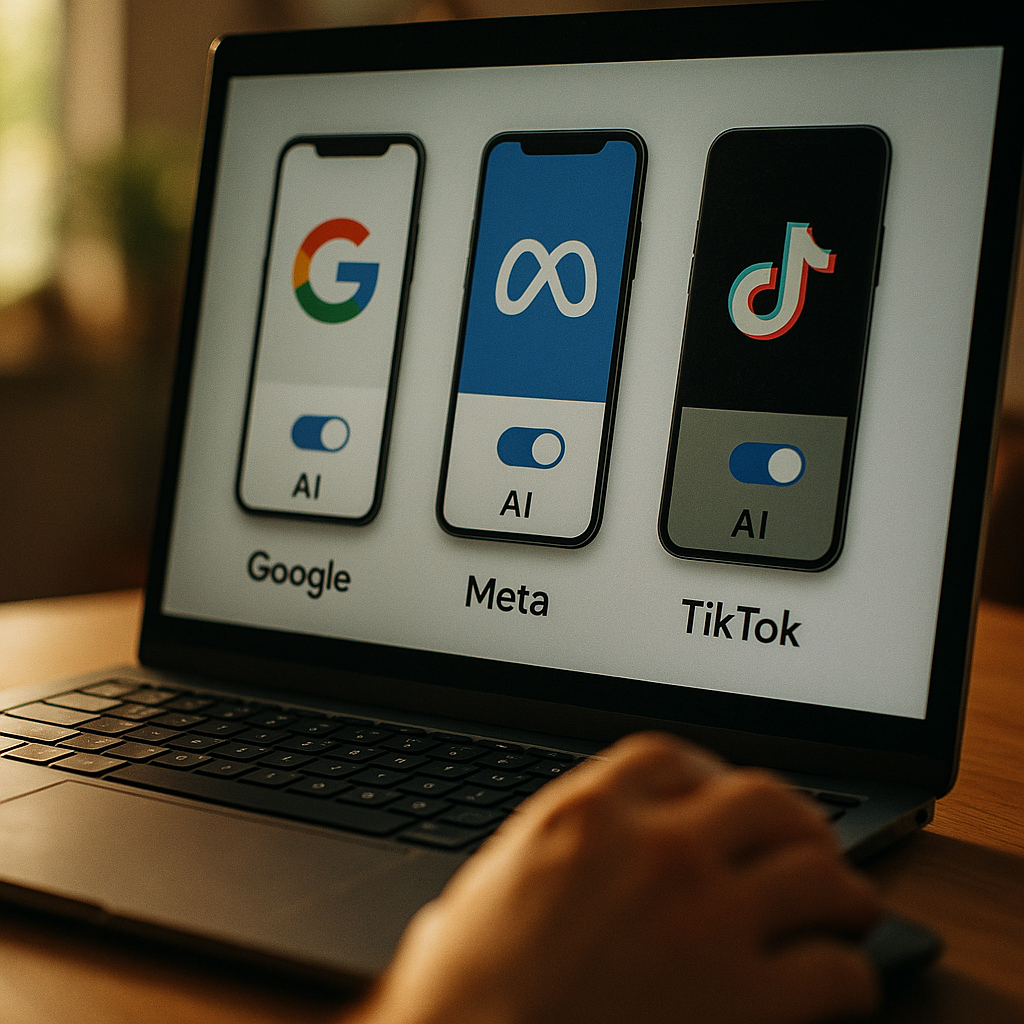
Meta now auto-labels AI-modified ads whether you toggle it on or not. Google’s Gemini-generated creative gets a “Made with AI” tag by default in some formats. TikTok flags synthetic media if it detects certain generation signatures, even from third-party tools. If your compliance team assumed AI disclosure was a manual, one-time checkbox, you’re already behind. AI disclosure settings are becoming platform-enforced defaults, not brand preferences, and getting the configuration wrong risks ad rejections, shadowbans, or FTC scrutiny.
This isn’t a hypothetical compliance exercise anymore. It’s an operational one, and it touches every ad account your team manages.
Why This Suddenly Matters to Every Media Buyer
Regulators moved faster than most marketing teams expected. The FTC’s endorsement guidance already covers synthetic and AI-generated content, and platform policy teams have been building enforcement mechanics around it. Meta, Google, and TikTok each rolled out some version of automatic AI content detection tied to their ad managers over the past year. The catch: automatic detection and automatic disclosure are not the same thing, and each platform handles the gap differently.
Get it wrong and you’re not just risking a policy strike. You’re risking consumer trust, ASA or FTC inquiry exposure, and — increasingly — algorithmic deprioritization if a platform suspects underreporting.
Platforms are shifting AI disclosure from a brand-side ethics question to a machine-detected compliance layer. Treat it like tax reporting, not brand voice.
Google Ads: Automatic Detection, Manual Override for Edge Cases
Google’s approach is the most mature of the three, largely because it’s had years of practice with Political Content and Restricted Financial Products disclosure frameworks. The same infrastructure now powers AI content labeling.
Inside Google Ads Manager, synthetic and AI-generated visual content triggers automatic labeling when produced through Google’s own tools — think Product Studio, Gemini-assisted creative, or Performance Max auto-generated assets. That labeling is not optional. You cannot disable it, and attempting to strip metadata to avoid detection violates Google Ads policy outright.
Where manual settings come in: third-party AI content, meaning assets built in Midjourney, Runway, or a custom diffusion model and then uploaded to Google Ads. Google doesn’t always detect this automatically, especially with photorealistic outputs that lack embedded provenance metadata (C2PA credentials, for example). That’s on you to disclose manually through the ad’s asset-level annotation fields.
Practical configuration steps:
- Enable “Content Attributes” tagging at the asset library level, not just per-campaign, so labeling persists across reused creative.
- Assign a compliance reviewer role in Google Ads’ user permissions to approve AI-flagged assets before they leave draft status.
- Audit Performance Max asset groups monthly. Auto-generated variations sometimes slip past manual review because they’re spawned mid-flight, not at upload.
If you’re running Performance Max heavily, this audit cadence matters more than most teams realize. Google’s own Performance Max documentation confirms asset generation happens continuously, not just at campaign launch, which means your disclosure obligations are also continuous. For teams already stress-testing PMax ROAS claims, this is one more variable worth folding into your verification framework.
Meta Ads Manager: The Toggle That Isn’t Really a Toggle
Meta introduced its AI disclosure toggle inside Ads Manager with a straightforward premise: tell us if your ad used AI to generate or significantly alter image, video, or audio, and we’ll label it “AI Info” for users. Simple, in theory.
In practice, Meta layers automatic detection underneath the manual toggle. If Meta’s classifier detects generative signatures — certain diffusion artifacts, synthetic voice patterns, or metadata from partnered AI tools like Meta AI’s own image generator — it applies the label regardless of what you selected in the disclosure field.
This creates a real operational risk: if your manual toggle says “no AI used” but Meta’s backend disagrees, you get an inconsistency flag. Enough of those and Meta’s trust systems start treating your account as high-risk for policy review, which slows down approval times across unrelated campaigns too.
Manually marking “no AI” on an asset that trips Meta’s classifier doesn’t remove the label. It just adds a compliance discrepancy to your account history.
To configure this correctly:
- Set disclosure defaults at the ad account level for any team using generative tools regularly, so individual buyers aren’t guessing per-upload.
- Cross-reference Meta’s Meta Business Help Center AI content policy quarterly. Meta updates classifier sensitivity without much fanfare, and what passed silently last quarter might get flagged this quarter.
- For UGC and creator-sourced content run through brand ad accounts, require creators to disclose AI editing tools used (voice cloning, AI b-roll, face-swap effects) as part of the content submission brief. Build this into your creator contracts, not just your ad ops checklist.
That last point matters more than it sounds. Brands running influencer content through Advantage+ or boosted posts inherit the disclosure risk of whatever the creator used to produce the asset, even if the brand had no direct hand in generation. If you’re building out a broader UGC performance tracking system, this is worth folding into your UGC performance dashboard as a compliance field, not an afterthought.
TikTok Ads Manager: Least Mature, Most Aggressive Enforcement
TikTok’s disclosure tooling lags Google and Meta in sophistication but doesn’t lag in enforcement appetite. TikTok has been notably aggressive about pulling ads suspected of undisclosed synthetic media, sometimes erring toward over-flagging rather than under-flagging.
Inside TikTok Ads Manager, the AI-generated content toggle sits at the individual ad level, not account-wide. That’s a meaningful operational difference from Meta. If you’re running fifty ad variants through Smart+ campaigns, someone needs to toggle disclosure fifty times, or build an API-based bulk update, because there’s no account default to fall back on.
TikTok’s automatic detection also skews toward audio. Voice cloning and AI-generated voiceovers trigger flags more reliably than AI-generated visuals on the platform, likely reflecting TikTok’s audio-first content culture and the platform’s early emphasis on music/voice authenticity enforcement. If your team leans on AI voiceover tools for localization or rapid creative testing, budget extra review time here.
Configuration recommendations specific to TikTok:
- Use TikTok’s Business API to bulk-apply disclosure tags across Smart+ campaign variants rather than relying on manual per-ad toggling, which doesn’t scale past a handful of creatives.
- Flag any AI voice tool (ElevenLabs-style cloning, TikTok’s own AI voiceover feature, third-party dubbing for localization) at the brief stage, before the creative reaches Ads Manager.
- Expect slower ad review turnaround on flagged content. TikTok’s manual review queue for AI-flagged ads runs longer than standard review, so build a buffer into launch timelines.
Brands doing multi-market UGC localization should pay particular attention here, since AI dubbing and voice adaptation are exactly the kind of content TikTok’s classifier is tuned to catch. It’s worth reviewing how this intersects with broader AI UGC localization workflows before scaling a campaign across regions.
Building One Disclosure Workflow Across Three Different Systems
Here’s the uncomfortable truth: there’s no unified disclosure standard across Google, Meta, and TikTok. Each platform defines “AI-generated” slightly differently, each has different detection thresholds, and each punishes non-disclosure differently. Trying to run three separate, siloed compliance processes is how things slip through.
The more durable approach is building one internal disclosure taxonomy that maps to all three platforms’ requirements, then translating it per-platform at the point of upload.
A workable structure looks like this:
- Classify at creation, not at upload. Every asset gets tagged with its generation method (fully AI-generated, AI-assisted/edited, human-created with AI enhancement, fully human) inside your DAM or creative ops tool before it ever touches an ads manager.
- Map classifications to platform-specific triggers. “AI-assisted” might require disclosure on Meta but not trigger Google’s automatic labeling threshold. Document these mappings and update them quarterly, since platform thresholds shift.
- Centralize review ownership. One person or team owns final disclosure sign-off across all three platforms, rather than leaving it to individual media buyers making per-platform judgment calls.
- Log everything. If the FTC or a regulator ever asks, “did you know this was AI-generated,” you want a timestamped record showing you classified and disclosed appropriately, not a shrug.
This kind of centralized governance model overlaps significantly with the broader shift toward agentic media buying, where platforms are making more creative and targeting decisions autonomously. If your team is already evaluating how much control to hand over to automated systems, the disclosure question fits naturally into that conversation. Our breakdown of agentic media buying governance covers adjacent territory worth reading alongside this.
It’s also worth stress-testing vendor claims here. Some AI creative and matching platforms market “built-in compliance” features that amount to little more than a metadata tag. Before trusting a vendor’s disclosure automation claim, run it through the same rigor you’d apply to any vendor scorecard process you’d use for a media-buying tool.
What Happens When You Get It Wrong
The penalty structures differ by platform, but none of them are trivial. Google can suspend ad serving account-wide for repeated policy violations, not just pull the individual ad. Meta’s trust scoring affects auction dynamics broadly, meaning non-compliant accounts may see costs rise even on fully compliant campaigns. TikTok’s review delays compound quickly if your account gets tagged for elevated scrutiny, turning what should be a same-day approval into a multi-day bottleneck.
Beyond platform penalties, there’s the regulatory layer. The FTC has signaled continued interest in synthetic media disclosure in advertising, and state-level attorneys general have started following suit. The eMarketer research on AI content in advertising suggests disclosure scrutiny is only intensifying as generative tools become standard in creative production, not a novelty.
None of this means avoiding AI creative tools. It means building the disclosure infrastructure with the same seriousness you’d apply to data privacy compliance, because that’s effectively what this has become.
FAQs
Frequently Asked Questions
Do I need to disclose AI use if I only used AI for minor edits like background removal?
Generally no, across all three platforms. Minor enhancements like background removal, color correction, or cropping typically fall below the threshold for mandatory disclosure. The trigger point is usually “significant” generation or alteration, such as creating synthetic people, voices, or scenes that didn’t exist in the original footage. Check each platform’s current policy language directly, since thresholds shift.
Can Meta, Google, or TikTok detect AI content I didn’t disclose?
Yes, increasingly so. All three platforms run classifier models that detect generative artifacts, embedded metadata (like C2PA content credentials), and known signatures from popular AI tools. Detection accuracy varies by content type. Meta and Google are more reliable on visual content; TikTok skews stronger on audio and voice detection.
What happens if I mark an ad as “not AI-generated” but the platform’s classifier disagrees?
You get an inconsistency flag, which can trigger manual review, ad rejection, or in repeated cases, elevated scrutiny across your entire ad account. It’s treated as a potential compliance evasion signal, not a minor error, so accuracy in manual disclosure fields matters even when detection seems unlikely.
Does AI disclosure apply to creator-sourced UGC run through my ad account?
Yes. If a creator used AI tools (voice cloning, AI editing, synthetic backgrounds) in content that your brand then runs as a paid ad, the disclosure obligation typically follows the ad, not the original creator. Build AI tool disclosure into creator content briefs so you have this information before the asset reaches your ads manager.
Is there a unified AI disclosure standard across ad platforms?
Not currently. Google, Meta, and TikTok each define AI-generated and AI-assisted content differently, apply different detection thresholds, and enforce non-compliance through different mechanisms. Brands running cross-platform campaigns need an internal classification taxonomy that maps to each platform’s specific requirements rather than assuming one disclosure standard covers all three.
How often do platform AI disclosure policies change?
Frequently enough that quarterly review is a reasonable minimum cadence. Meta and Google have both adjusted classifier sensitivity and disclosure requirements multiple times as generative AI tools have proliferated. Assign someone on your compliance or ad ops team to monitor policy update pages directly rather than relying on secondhand summaries.
Build your AI disclosure workflow once, at the creative classification stage, and translate it per-platform, rather than reinventing compliance logic every time you launch a new campaign. The brands treating this as infrastructure now will spend less time firefighting ad rejections later.
Top Influencer Marketing Agencies
The leading agencies shaping influencer marketing in 2026
Agencies ranked by campaign performance, client diversity, platform expertise, proven ROI, industry recognition, and client satisfaction. Assessed through verified case studies, reviews, and industry consultations.
Moburst

-
2

The Shelf
Boutique Beauty & Lifestyle Influencer AgencyA data-driven boutique agency specializing exclusively in beauty, wellness, and lifestyle influencer campaigns on Instagram and TikTok. Best for brands already focused on the beauty/personal care space that need curated, aesthetic-driven content.Clients: Pepsi, The Honest Company, Hims, Elf Cosmetics, Pure LeafVisit The Shelf → -
3

Audiencly
Niche Gaming & Esports Influencer AgencyA specialized agency focused exclusively on gaming and esports creators on YouTube, Twitch, and TikTok. Ideal if your campaign is 100% gaming-focused — from game launches to hardware and esports events.Clients: Epic Games, NordVPN, Ubisoft, Wargaming, Tencent GamesVisit Audiencly → -
4

Viral Nation
Global Influencer Marketing & Talent AgencyA dual talent management and marketing agency with proprietary brand safety tools and a global creator network spanning nano-influencers to celebrities across all major platforms.Clients: Meta, Activision Blizzard, Energizer, Aston Martin, WalmartVisit Viral Nation → -
5

The Influencer Marketing Factory
TikTok, Instagram & YouTube CampaignsA full-service agency with strong TikTok expertise, offering end-to-end campaign management from influencer discovery through performance reporting with a focus on platform-native content.Clients: Google, Snapchat, Universal Music, Bumble, YelpVisit TIMF → -
6

NeoReach
Enterprise Analytics & Influencer CampaignsAn enterprise-focused agency combining managed campaigns with a powerful self-service data platform for influencer search, audience analytics, and attribution modeling.Clients: Amazon, Airbnb, Netflix, Honda, The New York TimesVisit NeoReach → -
7

Ubiquitous
Creator-First Marketing PlatformA tech-driven platform combining self-service tools with managed campaign options, emphasizing speed and scalability for brands managing multiple influencer relationships.Clients: Lyft, Disney, Target, American Eagle, NetflixVisit Ubiquitous → -
8

Obviously
Scalable Enterprise Influencer CampaignsA tech-enabled agency built for high-volume campaigns, coordinating hundreds of creators simultaneously with end-to-end logistics, content rights management, and product seeding.Clients: Google, Ulta Beauty, Converse, AmazonVisit Obviously →