


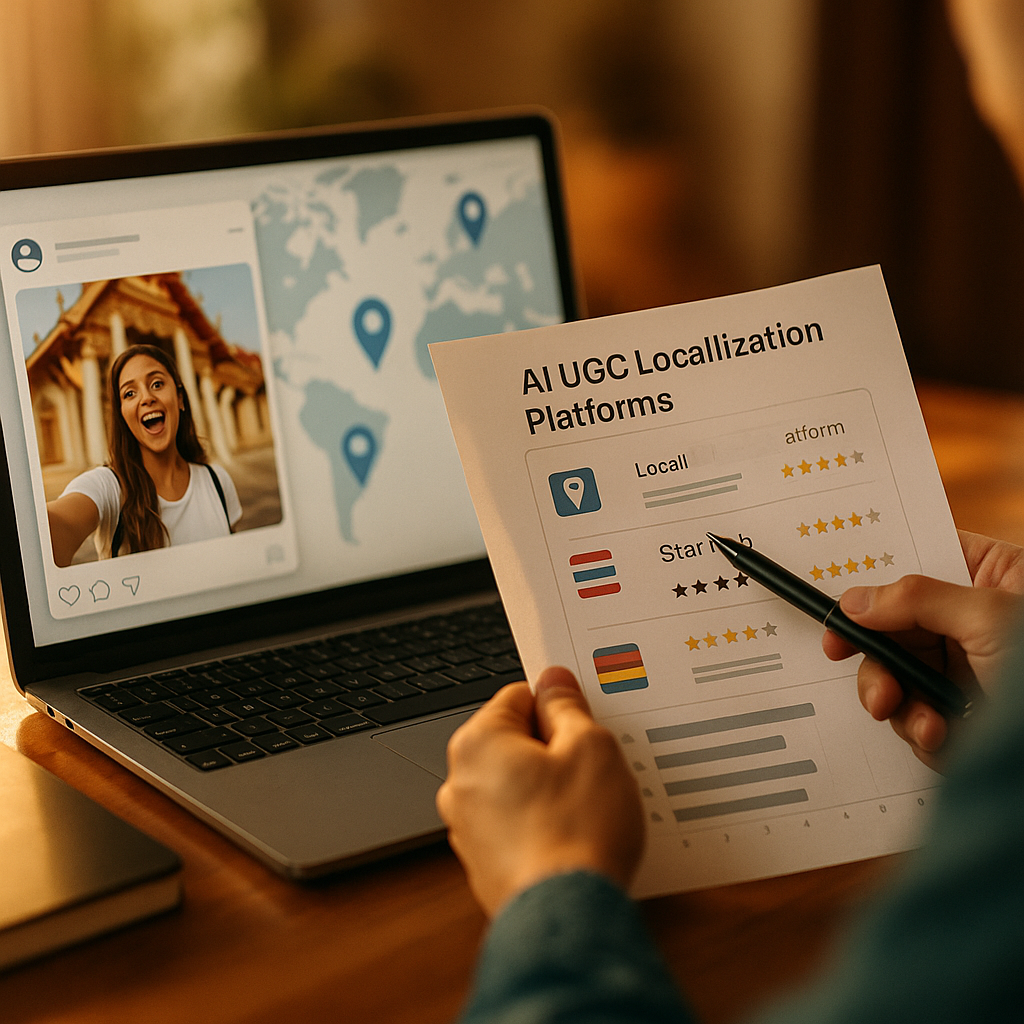
Brands running global influencer programs now spend an average of 34% of their content production budgets adapting existing assets for regional markets. AI-curated UGC localization is changing that math entirely — but only if you know which platform capabilities actually matter.
Why UGC Localization Has Been a Budget Black Hole
Fan-created video is the highest-trust content format in most category verticals right now. Audiences believe other customers more than they believe brands. The problem: a creator in Toronto filming a 60-second product review does nothing for your launch in São Paulo, Jakarta, or Warsaw unless someone localizes it. Traditionally, that meant transcription, translation, re-dubbing or subtitle overlays, cultural review, platform resizing, and legal clearance — repeated for every market, for every piece of content.
At meaningful UGC volume, the operational cost of localization has been prohibitive. Most enterprise brands either ignored regional adaptation entirely, ran separate creator programs in each market (expensive), or accepted a watered-down global version that underperformed everywhere. None of these are good answers.
The real cost of UGC localization isn’t translation — it’s the coordination overhead, the approval cycles, and the latency between content creation and regional deployment. AI platforms that collapse those steps are where the ROI actually lives.
What “AI-Curated UGC Localization” Actually Means
The category name gets stretched by a lot of vendors, so let’s be precise. Genuine AI-curated UGC localization means a platform can ingest a creator-made video, automatically detect and transcribe speech, generate culturally adapted translations (not just literal ones), apply localized subtitles or AI voice dubbing, reformat the asset for regional platform specs, and flag anything that requires human review — all without a production team touching it between steps.
That is a meaningfully different capability set than a platform that automates subtitle export or offers a translation API as a bolt-on. When evaluating vendors, the distinction matters enormously for both cost modeling and compliance risk.
Platforms doing this credibly in the current market include ElevenLabs (for AI voice localization), Synthesia (for AI avatar-driven recreation), and dedicated UGC workflow tools like Billo and Testimonial.to, which have begun integrating localization layers. On the enterprise end, Adobe GenStudio and tools built on top of OpenAI’s multimodal stack are being configured for this exact workflow. Understanding how these differ from one another is foundational — the generative AI platform selection criteria for UGC localization are not the same as for original content creation.
Six Evaluation Criteria That Actually Predict Performance
If you’re building a vendor shortlist, these are the capabilities that separate functional platforms from demo-ware.
1. Translation quality at the register level
Literal translation fails in influencer content because creators speak in register — casual, idiomatic, culturally specific language. The platform’s NLP layer needs to adapt tone, not just words. Ask vendors for side-by-side samples from markets with high linguistic nuance: Brazilian Portuguese vs. European Portuguese, Simplified vs. Traditional Chinese, Mexican vs. Castilian Spanish. If the outputs read like a legal document, keep looking.
2. Cultural context flagging
A UGC clip that works perfectly in the U.S. might include a gesture, a color, a product use case, or a humor frame that is inappropriate or ineffective in another market. The platform should have a cultural sensitivity layer that identifies these moments and either adapts them or queues them for human review. This is where most AI localization tools are still underdeveloped. Build this into your RFP requirements explicitly.
3. Voice fidelity and sync quality for dubbing
AI voice dubbing has improved dramatically. ElevenLabs’ voice cloning can now produce dubbed audio that preserves creator vocal character across languages — a capability that matters for maintaining authenticity, which is the entire value proposition of UGC in the first place. Evaluate lip-sync accuracy for video formats where face is on-screen; sync drift of more than 150ms is perceptible to viewers and degrades trust signals.
4. Rights and consent architecture
This is where most brands underestimate their exposure. When a creator uploads a video to your UGC platform, their consent covers the original content. Dubbing their voice with AI, adapting their likeness, or redistributing a transformed version in new markets may require additional consent under GDPR, the EU AI Act, and an expanding set of state-level U.S. regulations. The platform you choose must have a consent management layer that captures rights for AI transformation at intake. Check the ICO guidelines on AI-generated synthetic media and cross-reference with FTC guidance on disclosure requirements for AI-altered content.
5. Platform-spec output automation
TikTok, Reels, YouTube Shorts, and Pinterest Video all have different aspect ratios, caption burn-in requirements, and file spec expectations. A localization platform that outputs a single master file and requires your team to resize for each destination is not solving your production problem — it’s just moving it downstream. Look for automated output presets per destination platform, ideally with smart crop and reframe logic that keeps the creator’s face in frame during resize. The content supply chain automation question is inseparable from localization at scale.
6. Measurement integration
Localized assets need attribution tags that survive the adaptation process. If your UTM structure or creator tracking pixels get stripped during the AI transformation workflow, you lose the ability to measure regional performance against the original asset. Confirm that the platform maintains metadata integrity through every localization step, and that it can pass structured data to your measurement stack. This connects directly to the broader challenge of AI agent attribution in modern MarTech environments.
The Build vs. Buy vs. Configure Question
Some enterprise brands are building proprietary UGC localization pipelines on top of foundation model APIs — combining Whisper for transcription, GPT-4o for cultural translation, ElevenLabs for dubbing, and custom Python wrappers for output formatting. This approach offers maximum control and often lower per-asset costs at high volume. The downside is engineering overhead, compliance liability, and the fact that you’re assembling a stack rather than operating a product.
Purpose-built platforms trade some flexibility for speed of deployment and built-in compliance features. For most marketing teams, the configured SaaS option delivers faster time-to-value. Where it breaks down is in highly regulated categories (financial services, pharma, alcohol) where the cultural review layer needs to be tightly integrated with legal approval workflows. For those environments, look for platforms with configurable review gates, not just fully automated pipelines. The hybrid human-AI UGC routing model is worth studying before you commit to a fully autonomous setup.
Budget Modeling: What to Expect
Current market pricing for AI UGC localization platforms ranges from roughly $0.40 to $2.20 per localized asset per market, depending on video length, dubbing requirements, and output volume. Compare that against traditional localization agency rates, which routinely run $800 to $3,000 per video per market when you factor in voice talent, studio time, and project management.
At 500 UGC assets adapted for 8 markets, the math becomes decisive. The AI approach at $1.20 per asset per market runs approximately $4,800. The traditional approach at a conservative $1,200 per asset per market runs $4.8 million. That is not a rounding error — it is a different business model for global content distribution. According to Statista, the UGC platform market is projected to exceed $18 billion globally by 2028, and localization capability is increasingly cited as the primary differentiation factor in enterprise contract decisions.
The brands winning in international markets aren’t producing more content — they’re localizing faster. AI-curated UGC localization compresses what used to be a 3-week regional adaptation cycle into hours.
Governance and Brand Safety at Scale
Scaling UGC localization with AI introduces governance risks that don’t exist in manual workflows. An AI system that adapts thousands of assets per month can propagate a mistranslation, an off-brand tone, or a compliance failure at the same velocity it delivers value. You need guardrails baked into the workflow, not bolted on afterward.
Minimum viable governance for AI UGC localization includes: a pre-adaptation brand voice and compliance brief that the AI uses as a constraint layer; market-specific legal review triggers (certain markets, categories, or claim types always route to human review); creator notification when their content is being AI-adapted; and a rollback protocol for assets already distributed. For brands running high-volume programs, the AI governance frameworks used in creator programs translate directly to UGC localization operations.
One additional risk that rarely gets discussed: creator sentiment. Creators who discover their voice has been cloned into a language they didn’t consent to — even with legal consent captured at intake — sometimes react publicly and negatively. Your creator relations team needs a communication protocol that explains what AI adaptation means in plain language, before it happens, not in the terms of service footnotes. Platforms like Sprout Social have documented how creator trust erosion in localization rollouts can undermine the entire UGC program’s authenticity signal.
Before signing any platform contract, also validate their approach against Meta’s branded content policies and TikTok’s AI-generated content disclosure requirements, both of which apply to localized UGC distributed as paid or boosted inventory.
For teams also thinking about how UGC localization connects to broader UGC workflow automation models, the governance infrastructure is largely shared — build it once and apply it across both use cases.
Run a 90-day pilot across two to three markets before committing to enterprise contract terms: use that window to stress-test translation quality, measure regional engagement lift versus non-localized variants, and identify which content categories require consistent human review. The data from that pilot will give you the negotiating leverage and the internal business case to scale confidently.
FAQs
What is AI-curated UGC localization?
AI-curated UGC localization refers to automated platforms that ingest creator-made videos and adapt them for regional audiences — including translation, cultural tone adjustment, voice dubbing or subtitle overlays, and platform-specific reformatting — without requiring manual editing or separate production budgets for each market.
Do brands need additional creator consent for AI dubbing and localization?
Yes, in most jurisdictions. Original UGC consent typically covers the submitted content in its original form. AI voice cloning, likeness adaptation, and cross-market redistribution of transformed content may require explicit additional consent under GDPR, the EU AI Act, and emerging U.S. state regulations. Platforms should have a consent management layer that captures these rights at creator intake.
How much does AI UGC localization cost compared to traditional methods?
AI platform pricing typically ranges from $0.40 to $2.20 per localized asset per market. Traditional agency localization for video content can run $800 to $3,000 per asset per market when voice talent, studio time, and project management are included. For programs with meaningful UGC volume across multiple markets, the cost difference is substantial.
Which platforms currently offer AI UGC localization capabilities?
ElevenLabs provides AI voice dubbing with voice cloning. Synthesia offers AI avatar-driven recreation for localization. Adobe GenStudio and OpenAI-based enterprise stacks are being configured for UGC localization workflows. Billo and Testimonial.to are adding localization layers for SMB use cases. Capabilities vary significantly — always request side-by-side translation and dubbing samples before committing.
What governance controls should brands require from UGC localization platforms?
At minimum: a brand voice and compliance brief used as an AI constraint layer, market-specific legal review triggers for regulated categories, creator notification protocols for AI adaptation, metadata and attribution integrity through the transformation workflow, and a rollback protocol for distributed assets that fail post-launch review.
How do you measure the ROI of localized UGC versus non-localized versions?
Run controlled A/B tests in target markets using identical distribution parameters. Track engagement rate, view-through rate, and conversion metrics separately for localized versus non-localized variants. Ensure your attribution tags survive the AI transformation process so regional performance data rolls up correctly into your measurement stack.
Top Influencer Marketing Agencies
The leading agencies shaping influencer marketing in 2026
Agencies ranked by campaign performance, client diversity, platform expertise, proven ROI, industry recognition, and client satisfaction. Assessed through verified case studies, reviews, and industry consultations.
Moburst

-
2

The Shelf
Boutique Beauty & Lifestyle Influencer AgencyA data-driven boutique agency specializing exclusively in beauty, wellness, and lifestyle influencer campaigns on Instagram and TikTok. Best for brands already focused on the beauty/personal care space that need curated, aesthetic-driven content.Clients: Pepsi, The Honest Company, Hims, Elf Cosmetics, Pure LeafVisit The Shelf → -
3

Audiencly
Niche Gaming & Esports Influencer AgencyA specialized agency focused exclusively on gaming and esports creators on YouTube, Twitch, and TikTok. Ideal if your campaign is 100% gaming-focused — from game launches to hardware and esports events.Clients: Epic Games, NordVPN, Ubisoft, Wargaming, Tencent GamesVisit Audiencly → -
4

Viral Nation
Global Influencer Marketing & Talent AgencyA dual talent management and marketing agency with proprietary brand safety tools and a global creator network spanning nano-influencers to celebrities across all major platforms.Clients: Meta, Activision Blizzard, Energizer, Aston Martin, WalmartVisit Viral Nation → -
5

The Influencer Marketing Factory
TikTok, Instagram & YouTube CampaignsA full-service agency with strong TikTok expertise, offering end-to-end campaign management from influencer discovery through performance reporting with a focus on platform-native content.Clients: Google, Snapchat, Universal Music, Bumble, YelpVisit TIMF → -
6

NeoReach
Enterprise Analytics & Influencer CampaignsAn enterprise-focused agency combining managed campaigns with a powerful self-service data platform for influencer search, audience analytics, and attribution modeling.Clients: Amazon, Airbnb, Netflix, Honda, The New York TimesVisit NeoReach → -
7

Ubiquitous
Creator-First Marketing PlatformA tech-driven platform combining self-service tools with managed campaign options, emphasizing speed and scalability for brands managing multiple influencer relationships.Clients: Lyft, Disney, Target, American Eagle, NetflixVisit Ubiquitous → -
8

Obviously
Scalable Enterprise Influencer CampaignsA tech-enabled agency built for high-volume campaigns, coordinating hundreds of creators simultaneously with end-to-end logistics, content rights management, and product seeding.Clients: Google, Ulta Beauty, Converse, AmazonVisit Obviously →