


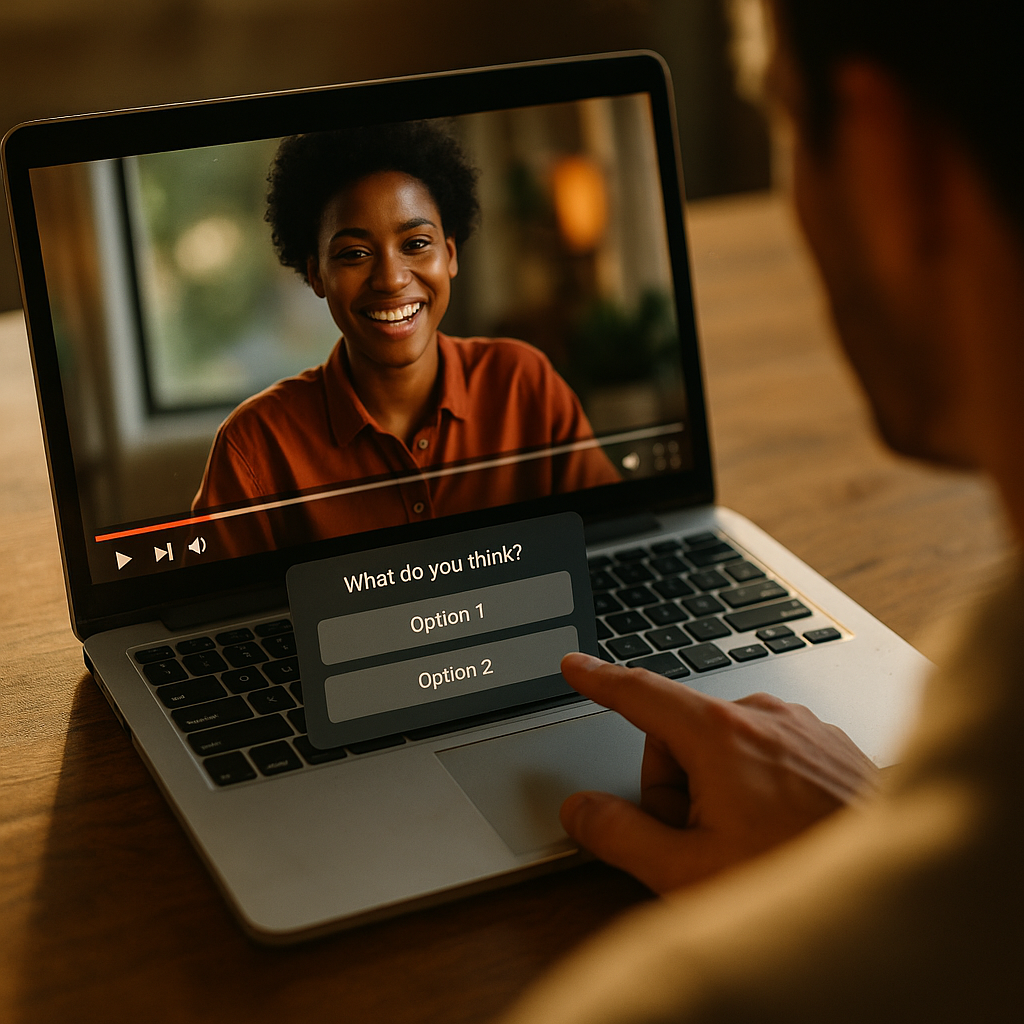
TikTok’s own engagement data shows that videos with interactive stickers, including polls, see meaningfully higher completion rates than static clips. That’s not a marginal lift. It’s a signal that interactive poll-driven video content is quietly becoming one of the highest-ROI formats available to brands running creator programs. So why are so few briefs asking for it?
The Passive Viewing Problem
Most short-form creator content asks nothing of the viewer except attention. Watch, maybe like, scroll away. That’s a one-directional relationship, and it’s increasingly out of step with what platforms reward. TikTok, Instagram, and YouTube Shorts have all built native polling, quiz, and slider stickers directly into their creation tools, precisely because interaction correlates with retention.
Polls flip the dynamic. A viewer who taps a poll option has made a micro-commitment. They’ve stopped scrolling, made a choice, and now feel some investment in the outcome. That’s a completely different psychological posture than passive consumption, and it shows up in the metrics: longer watch time, higher comment rates, and — critically for brands — a data trail you can actually use.
A single tap on a poll sticker converts a passive viewer into a participant with a stake in the outcome. That shift is worth more to completion rates than almost any editing trick.
What Poll-Driven Video Actually Looks Like
This isn’t just slapping a poll sticker onto an existing script and calling it interactive. The formats that perform share a few structural traits:
- The poll sits at a genuine decision point — “Which flavor should I try first?” not a throwaway “yes or no” tacked on at the end.
- The creator visibly responds to results, either live or in a fast-turnaround follow-up video that closes the loop.
- The outcome changes something real — a product choice, a styling direction, a next-episode plot beat. If the poll doesn’t affect anything, viewers clock it as decorative fast.
- It’s built for sound-off viewing, since a huge share of feed consumption happens muted. Text overlays and on-screen poll UI need to carry the narrative alone.
Brands running series-style content have an obvious advantage here. If you’re already structuring drops around cliffhanger-driven episodic formats, a poll is a natural mechanism for letting the audience vote on what happens next. It’s cliffhanger logic with an actual lever the audience can pull.
Why This Matters More Than a Vanity Engagement Metric
Here’s the part that should get a CMO’s attention: poll data is first-party audience intelligence, collected at scale, for free. Every vote is a micro-survey response. Run enough polls across enough creator videos, and you’ve got a live panel telling you which product benefit resonates, which price point feels right, which claim needs more proof before people believe it.
That’s not a small thing in a cookie-deprecated, privacy-tightened advertising environment. eMarketer’s research on first-party data strategy has repeatedly flagged owned engagement signals as one of the few reliable substitutes for third-party targeting data. A poll embedded in a creator video is about as low-friction as first-party data collection gets — no form fill, no email capture, just a tap.
Compare that to the cost of a traditional brand-lift survey or a focus group. Poll-driven creator content gives you directional signal continuously, embedded in content people were going to watch anyway. It won’t replace rigorous market research, but it’s a remarkably cheap early-warning system for messaging that isn’t landing.
Where Poll Mechanics Fit Into Existing Formats
You don’t need a brand-new content pillar to test this. Poll mechanics layer onto formats brands are already running:
- GRWM content: let viewers vote on which product goes on first, or which look the creator should finish with. It solves the “feels scripted” problem plenty of teams are already trying to fix in GRWM brief reinvention work.
- Reaction and split-screen content: poll the audience on their prediction before the reveal, then compare against actual results. This works especially well for split-screen reaction formats that already thrive on suspense.
- Haul and tutorial content: let viewers vote on which item gets the full tutorial treatment in the next video. Useful in Gen Z haul and tutorial formats where audience taste is already the whole premise.
- Before-and-after demos: poll on predicted outcomes before showing the result, which sharpens the payoff and keeps everything anchored in verifiable claims rather than hype.
None of these require reinventing your creator relationships or briefing process from scratch. They require adding one clear instruction to the brief: where does the poll go, and what does the answer change?
The Compliance Angle Nobody Talks About
Polls create a paper trail, and that cuts both ways. On the upside, a documented audience response gives you defensible evidence that a claim resonated honestly rather than through manipulative framing. On the downside, a poorly worded poll question can itself become a misleading claim.
Consider a poll that asks “Did this product work better than you expected?” with only positive-skewed answer options. That’s a leading question dressed up as engagement, and it sits in exactly the gray zone the FTC has scrutinized in endorsement guidance. If your team is already working through functional claims compliance for creator briefs, extend that same rigor to poll question wording. Neutral phrasing, balanced answer options, and disclosure of sponsorship status all still apply. A poll doesn’t get a compliance exemption just because it’s framed as “fun.”
Brands should also loop in disclosure practices from broader before-and-after compliance frameworks — anywhere a poll implies a comparison or outcome, treat it with the same scrutiny as an explicit claim. The FTC’s endorsement guidance doesn’t distinguish between a spoken claim and an implied one embedded in a poll question.
Briefing for Poll-Driven Content: What to Specify
A brief that just says “add a poll” will get you a lazy afterthought sticker. Effective briefs for this format specify:
- Poll placement in the script — ideally within the first 5-8 seconds to catch scroll-happy viewers, or at a clear narrative pivot.
- Answer option wording, reviewed for neutrality and compliance before the creator posts.
- A commitment to close the loop — how and when the creator will reveal results and follow through on the audience’s choice.
- Data handoff terms — who owns the poll result data, and how it gets reported back to the brand. This should be in the contract, not a verbal understanding.
- Fallback messaging if the poll result is inconvenient. If 70% of viewers vote for the discontinued flavor, what does the creator say next?
That last point trips up more programs than you’d expect. Brands love the idea of audience participation right up until the audience picks the “wrong” answer. Build the contingency into the brief up front, not after the poll closes.
Measuring What Actually Moved
Poll engagement rate alone is a vanity metric if you stop there. Tie it to something downstream: did poll participants show higher click-through on the linked product page? Did the follow-up video (the one revealing results) outperform the original in completion rate? Platforms like Sprout Social and native analytics dashboards on TikTok and Instagram can segment this if you’re tracking it deliberately from the start, not retrofitting measurement after the campaign wraps.
Brands running multi-surface campaigns should also check whether poll results transfer cleanly across platforms. A poll run on a TikTok Shop and YouTube brief needs consistent framing so results are comparable, not apples-to-oranges noise you can’t actually act on.
The Real Constraint Is Creative, Not Technical
Every major platform already supports poll stickers natively. The technology isn’t the bottleneck. The bottleneck is creative teams treating polls as a gimmick rather than a structural storytelling device. The best poll-driven videos are written with the poll as a plot point, not bolted on in post-production because someone remembered the feature exists.
That’s a briefing discipline problem, and it’s solvable the same way brands have solved it for other underused formats: write the interaction into the creative brief from day one, give creators a clear rationale for why the poll matters to the story, and hold everyone accountable to following through on results. Programs that treat this as core to scaling briefs without losing authenticity will get more mileage from poll mechanics than those chasing it as a one-off engagement hack.
Start Small, Measure Honestly
Run poll-driven video on one existing format for a single quarter before rolling it into every brief. Track completion rate lift, poll-to-click conversion, and whether creators actually follow through on results — that last data point tells you more about program health than any single engagement number.
FAQs
What is interactive poll-driven video content?
It’s short-form creator video that embeds a native poll, quiz, or slider sticker at a meaningful decision point, then uses the audience’s response to shape a follow-up video or reveal, rather than treating the poll as decoration.
Does adding a poll actually improve completion rates?
Platform engagement data consistently shows interactive stickers correlate with longer watch time and higher retention compared to static video, largely because tapping a poll creates a small psychological commitment to keep watching for the outcome.
Is poll data reliable enough to inform real marketing decisions?
It’s directional, not scientific. Poll results are useful as an early-warning signal for messaging or product interest, but they shouldn’t replace structured market research or statistically representative surveys.
What compliance risks come with polls in sponsored content?
Leading or unbalanced poll questions can function as implied claims, which falls under FTC endorsement guidance. Brands should review poll wording for neutrality with the same rigor applied to spoken product claims.
Which creator content formats work best with poll mechanics?
GRWM videos, split-screen reactions, haul and tutorial content, and episodic series formats all adapt naturally to poll mechanics because they already contain clear decision points the audience can weigh in on.
Who owns the data from creator-run polls?
This should be defined explicitly in the creator contract. Without a data handoff clause, brands often have no formal claim to poll results even though the content was sponsored.
Top Influencer Marketing Agencies
The leading agencies shaping influencer marketing in 2026
Agencies ranked by campaign performance, client diversity, platform expertise, proven ROI, industry recognition, and client satisfaction. Assessed through verified case studies, reviews, and industry consultations.
Moburst

-
2

The Shelf
Boutique Beauty & Lifestyle Influencer AgencyA data-driven boutique agency specializing exclusively in beauty, wellness, and lifestyle influencer campaigns on Instagram and TikTok. Best for brands already focused on the beauty/personal care space that need curated, aesthetic-driven content.Clients: Pepsi, The Honest Company, Hims, Elf Cosmetics, Pure LeafVisit The Shelf → -
3

Audiencly
Niche Gaming & Esports Influencer AgencyA specialized agency focused exclusively on gaming and esports creators on YouTube, Twitch, and TikTok. Ideal if your campaign is 100% gaming-focused — from game launches to hardware and esports events.Clients: Epic Games, NordVPN, Ubisoft, Wargaming, Tencent GamesVisit Audiencly → -
4

Viral Nation
Global Influencer Marketing & Talent AgencyA dual talent management and marketing agency with proprietary brand safety tools and a global creator network spanning nano-influencers to celebrities across all major platforms.Clients: Meta, Activision Blizzard, Energizer, Aston Martin, WalmartVisit Viral Nation → -
5

The Influencer Marketing Factory
TikTok, Instagram & YouTube CampaignsA full-service agency with strong TikTok expertise, offering end-to-end campaign management from influencer discovery through performance reporting with a focus on platform-native content.Clients: Google, Snapchat, Universal Music, Bumble, YelpVisit TIMF → -
6

NeoReach
Enterprise Analytics & Influencer CampaignsAn enterprise-focused agency combining managed campaigns with a powerful self-service data platform for influencer search, audience analytics, and attribution modeling.Clients: Amazon, Airbnb, Netflix, Honda, The New York TimesVisit NeoReach → -
7

Ubiquitous
Creator-First Marketing PlatformA tech-driven platform combining self-service tools with managed campaign options, emphasizing speed and scalability for brands managing multiple influencer relationships.Clients: Lyft, Disney, Target, American Eagle, NetflixVisit Ubiquitous → -
8

Obviously
Scalable Enterprise Influencer CampaignsA tech-enabled agency built for high-volume campaigns, coordinating hundreds of creators simultaneously with end-to-end logistics, content rights management, and product seeding.Clients: Google, Ulta Beauty, Converse, AmazonVisit Obviously →