


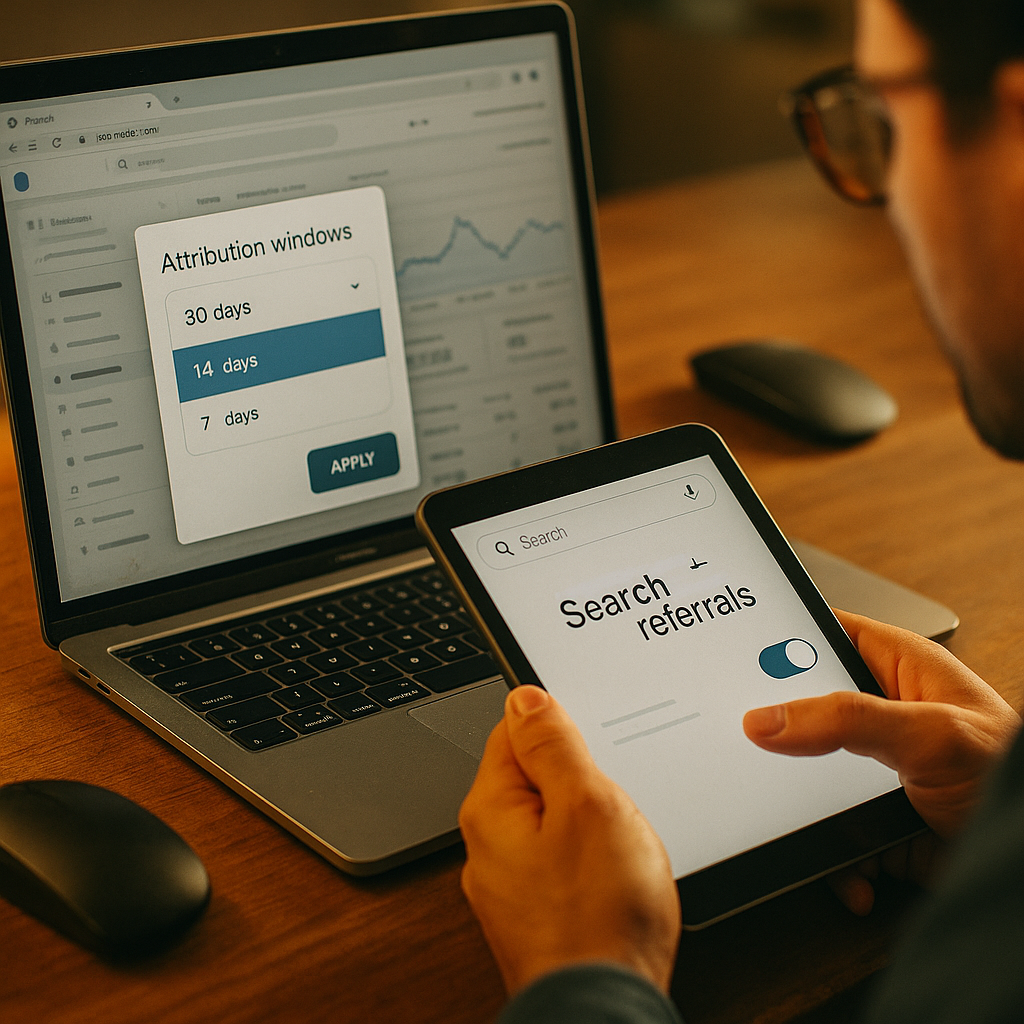
Last quarter, one in five B2B buyers researching software started that journey inside ChatGPT or Perplexity, not Google. Your attribution model probably never saw them coming. If your marketing attribution window still assumes a linear, seven-day click path, you’re crediting the wrong channels and misallocating the wrong budget — right now, today.
This isn’t a minor tracking hiccup. It’s a structural problem with how attribution windows were designed in the first place.
Why the Old Lookback Window Is Breaking
Attribution windows were built for a world of clicks. A user sees an ad, clicks, converts within 7, 30, or 90 days — you assign credit somewhere along that chain. Simple enough, until the click disappears.
Generative search referrals don’t behave like clicks. A user asks Gemini or ChatGPT a question, gets a synthesized answer that cites (or paraphrases) your brand, and may never visit your site at all in that session. They come back later, directly, having already formed a preference. Your analytics platform logs it as “direct traffic,” and your attribution model shrugs.
The referral is invisible, but the influence isn’t. That gap between influence and recorded touch is exactly where attribution windows are failing brands right now.
eMarketer and Statista have both flagged the surge in AI-assisted research behavior among younger, high-intent buyers. The problem is: standard UTM-based tracking captures almost none of it. If your dashboards don’t distinguish AI-referred sessions from generic direct traffic, you’re not measuring your funnel — you’re measuring a fraction of it.
What Counts as a “Generative Search Referral,” Exactly?
Before you can reconfigure a lookback window, define what you’re tracking. There are three distinct patterns worth separating in your data model:
- Direct citation clicks: A user clicks a link inside an AI Overview, Perplexity answer, or ChatGPT response with browsing enabled. These sometimes carry referrer strings, sometimes don’t, depending on the platform.
- Zero-click influence: The user reads a synthesized answer, absorbs the brand mention, and later navigates directly or searches your brand name. No click ever touches your domain during the research phase.
- Assisted-agent conversions: An AI shopping agent (think Amazon’s Rufus or Gemini-powered comparison tools) surfaces your product, and the user completes a purchase inside that agent’s flow rather than your site. Related reading: how Rufus and Gemini surface products in shopping contexts.
Each of these requires a different tracking approach and, critically, a different lookback period. Lumping them together is how attribution reports end up meaningless.
Reconfiguring the Lookback Period: A Practical Framework
Here’s the technical part. Standard attribution lookback windows (typically 7-day click / 1-day view for paid social, 30-90 day for search) were calibrated against observable click behavior. Generative search referral cycles run longer and quieter. You need to extend and segment.
Step 1: Separate Your Windows by Channel Behavior, Not Convention
Don’t apply one universal lookback window across your stack. Instead:
- AI-cited direct clicks: Keep a standard 7-14 day window. These behave similarly to organic search clicks and convert on comparable timelines.
- Zero-click / brand-search recovery: Extend to 30-45 days. Research from generative engines tends to precede a branded search or direct visit by two to six weeks in considered-purchase categories (SaaS, finance, high-ticket retail).
- Agent-assisted conversions: This is the hardest to model. If the agent completes the transaction outside your domain, you may need to rely on platform-reported conversion data rather than your own pixel, which means auditing vendor ROAS claims carefully — see our due diligence checklist for AI ad vendor claims before trusting those numbers at face value.
Step 2: Build a Citation-to-Conversion Lag Report
You can’t reconfigure a window without data on your own lag time. Pull your branded search volume and direct traffic against your LLM citation dashboard and look for correlation spikes. If citation frequency in a given week consistently precedes a branded search bump 20-30 days later, that’s your empirical lookback window — not an industry benchmark, not a guess.
This is tedious work. Nobody enjoys reconciling citation logs against GA4 direct traffic cohorts. But it’s the only way to get a lookback period that reflects your actual buyers rather than a template borrowed from a paid media playbook written in 2021.
Step 3: Adjust Multi-Touch Models to Weight Early-Funnel AI Touches
Most multi-touch attribution (MTA) models under-weight early-funnel touches because they’re temporally distant from conversion. That’s backwards for generative search. The AI-cited mention often is the primary influence event — the direct visit weeks later is just the transactional formality.
Consider a position-based or custom algorithmic model that assigns 30-40% credit to the earliest identifiable AI touch, rather than defaulting to last-click or even-distribution logic. Google’s own guidance on AI-driven search behavior (see Google Support for evolving Search documentation) increasingly treats AI Overviews as a discovery layer, not a conversion layer — your attribution model should mirror that distinction.
If your model still treats every touch as equally recent in intent, you’re systematically undervaluing the channel that’s currently reshaping how buyers form consideration sets.
The Tracking Infrastructure You Actually Need
Reconfiguring windows is pointless without the plumbing to detect AI referrals in the first place. A few technical musts:
- Referrer parsing for AI domains: Chatgpt.com, perplexity.ai, gemini.google.com, and copilot.microsoft.com should be explicitly tagged as a distinct channel grouping in GA4 or your CDP, not lumped into “referral” or “direct.”
- UTM discipline on any AI-surfaced content: Where you control link placement (structured data, llms.txt, brand feeds), append UTMs so returning clicks self-identify.
- Server-side tagging: Client-side pixels increasingly miss AI browser sessions due to stricter privacy defaults in AI-native browsers. Server-side tagging via a tag management layer catches more of this traffic.
- Brand search volume tracking: Pair Search Console branded query data with your citation dashboard to triangulate influence even when no click occurs at all.
None of this is exotic. HubSpot and Sprout Social have both published guidance on adapting analytics stacks for AI-era referral patterns (see HubSpot’s marketing resources and Sprout Social’s platform insights), and the direction is consistent: treat AI referral as its own first-class channel, not a subcategory of organic or direct.
Where Budget Conversations Go Wrong
Here’s the uncomfortable part for anyone managing a paid budget. If your attribution model can’t see AI-influenced conversions, finance sees a channel with no measurable ROI — and cuts it. Meanwhile, your competitor who did reconfigure their lookback windows keeps funding the content and citation strategy that’s quietly winning consideration.
This is the same governance problem showing up across the AI marketing stack. Just as brands need spend guardrails for agentic ad spend and clear caps for agentic media buying, attribution needs its own governance layer. Without one, budget decisions get made on incomplete data, and incomplete data always favors the channels that are easiest to measure, not the ones that are actually working.
Getting content cited in generative search in the first place is its own discipline — worth pairing your attribution overhaul with a look at how brand content actually earns citations, covered in this generative AI search playbook.
A Word on Statistical Confidence
Extended lookback windows introduce noise. The longer your window, the more likely you’re crediting unrelated events. Mitigate this by running confidence thresholds: only extend attribution credit to AI-referral paths where the citation-to-conversion lag pattern holds across a statistically meaningful sample, not a handful of anecdotal cases from your sales team’s favorite closed-won deal.
Marketing leaders navigating this shift are also dealing with a broader skills gap — attribution modeling increasingly requires data science fluency that traditional CMO teams weren’t built around, a shift explored in our piece on the splitting CMO role.
Bottom line: reconfigure your windows in stages, validate with real cohort data, and resist the temptation to extend every lookback period to 90 days just because AI influence feels harder to pin down. Precision beats generosity here.
Next Step
Start with a two-week audit: tag AI-domain referrers separately in your analytics, pull branded search volume against your citation dashboard, and calculate your actual lag time before touching a single attribution setting. Change the window only after the data tells you the real number — not before.
Frequently Asked Questions
What is a marketing attribution window and why does it need to change for AI search?
An attribution window (or lookback period) is the timeframe during which a marketing touchpoint can receive credit for a conversion. Traditional windows were calibrated for click-based journeys. Generative search referrals often produce zero-click influence with longer, quieter lag times, so fixed short windows undercount AI’s actual impact.
How do I track traffic from ChatGPT, Perplexity, or Gemini in Google Analytics?
Explicitly group AI domains (chatgpt.com, perplexity.ai, gemini.google.com, copilot.microsoft.com) as their own channel in GA4 rather than letting them default into “referral” or “direct.” Server-side tagging catches sessions that client-side pixels increasingly miss.
What lookback period should I use for zero-click AI influence?
Most considered-purchase categories show a 30-45 day lag between AI citation activity and a branded search or direct-visit spike. Validate this against your own citation-to-conversion data rather than applying an industry default.
Does extending the attribution window hurt reporting accuracy?
It can, if done without discipline. Longer windows introduce more noise and false attribution. Apply confidence thresholds and only extend credit where the citation-to-conversion pattern holds across a statistically meaningful sample.
Should agent-assisted conversions be tracked differently?
Yes. When an AI shopping agent completes a transaction outside your domain, your own pixel often can’t see it. You’ll need platform-reported conversion data, which should be scrutinized the same way you’d vet any third-party ROAS claim.
FAQs
What is a marketing attribution window and why does it need to change for AI search?
An attribution window (or lookback period) is the timeframe during which a marketing touchpoint can receive credit for a conversion. Traditional windows were calibrated for click-based journeys. Generative search referrals often produce zero-click influence with longer, quieter lag times, so fixed short windows undercount AI’s actual impact.
How do I track traffic from ChatGPT, Perplexity, or Gemini in Google Analytics?
Explicitly group AI domains (chatgpt.com, perplexity.ai, gemini.google.com, copilot.microsoft.com) as their own channel in GA4 rather than letting them default into “referral” or “direct.” Server-side tagging catches sessions that client-side pixels increasingly miss.
What lookback period should I use for zero-click AI influence?
Most considered-purchase categories show a 30-45 day lag between AI citation activity and a branded search or direct-visit spike. Validate this against your own citation-to-conversion data rather than applying an industry default.
Does extending the attribution window hurt reporting accuracy?
It can, if done without discipline. Longer windows introduce more noise and false attribution. Apply confidence thresholds and only extend credit where the citation-to-conversion pattern holds across a statistically meaningful sample.
Should agent-assisted conversions be tracked differently?
Yes. When an AI shopping agent completes a transaction outside your domain, your own pixel often can’t see it. You’ll need platform-reported conversion data, which should be scrutinized the same way you’d vet any third-party ROAS claim.
Top Influencer Marketing Agencies
The leading agencies shaping influencer marketing in 2026
Agencies ranked by campaign performance, client diversity, platform expertise, proven ROI, industry recognition, and client satisfaction. Assessed through verified case studies, reviews, and industry consultations.
Moburst

-
2

The Shelf
Boutique Beauty & Lifestyle Influencer AgencyA data-driven boutique agency specializing exclusively in beauty, wellness, and lifestyle influencer campaigns on Instagram and TikTok. Best for brands already focused on the beauty/personal care space that need curated, aesthetic-driven content.Clients: Pepsi, The Honest Company, Hims, Elf Cosmetics, Pure LeafVisit The Shelf → -
3

Audiencly
Niche Gaming & Esports Influencer AgencyA specialized agency focused exclusively on gaming and esports creators on YouTube, Twitch, and TikTok. Ideal if your campaign is 100% gaming-focused — from game launches to hardware and esports events.Clients: Epic Games, NordVPN, Ubisoft, Wargaming, Tencent GamesVisit Audiencly → -
4

Viral Nation
Global Influencer Marketing & Talent AgencyA dual talent management and marketing agency with proprietary brand safety tools and a global creator network spanning nano-influencers to celebrities across all major platforms.Clients: Meta, Activision Blizzard, Energizer, Aston Martin, WalmartVisit Viral Nation → -
5

The Influencer Marketing Factory
TikTok, Instagram & YouTube CampaignsA full-service agency with strong TikTok expertise, offering end-to-end campaign management from influencer discovery through performance reporting with a focus on platform-native content.Clients: Google, Snapchat, Universal Music, Bumble, YelpVisit TIMF → -
6

NeoReach
Enterprise Analytics & Influencer CampaignsAn enterprise-focused agency combining managed campaigns with a powerful self-service data platform for influencer search, audience analytics, and attribution modeling.Clients: Amazon, Airbnb, Netflix, Honda, The New York TimesVisit NeoReach → -
7

Ubiquitous
Creator-First Marketing PlatformA tech-driven platform combining self-service tools with managed campaign options, emphasizing speed and scalability for brands managing multiple influencer relationships.Clients: Lyft, Disney, Target, American Eagle, NetflixVisit Ubiquitous → -
8

Obviously
Scalable Enterprise Influencer CampaignsA tech-enabled agency built for high-volume campaigns, coordinating hundreds of creators simultaneously with end-to-end logistics, content rights management, and product seeding.Clients: Google, Ulta Beauty, Converse, AmazonVisit Obviously →