


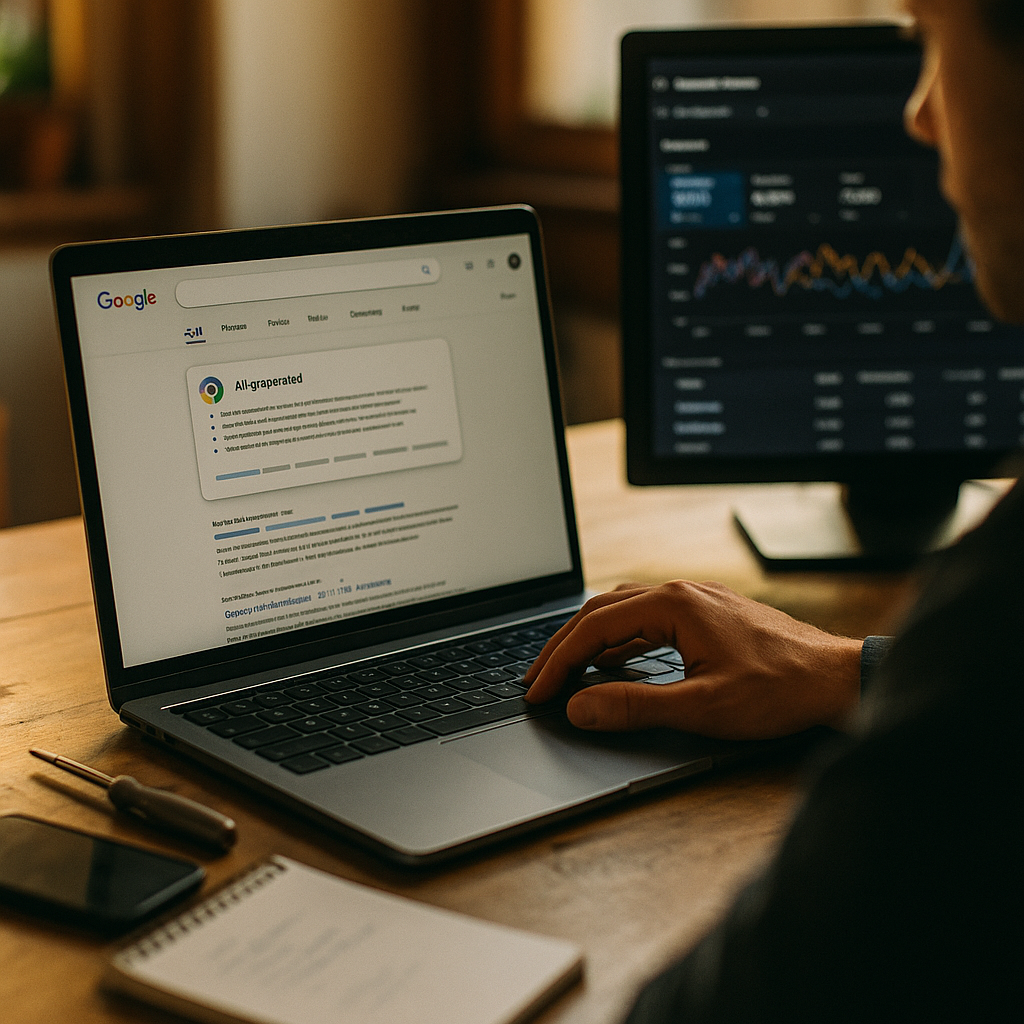
Roughly 60% of Google searches now end without a click — and Google’s May guidance update just told site owners exactly how AI Overviews and AI Mode decide what gets cited anyway. If your technical SEO checklist still reads like it’s optimizing for ten blue links, you’re already behind. Understanding Google’s AI search guidance isn’t optional anymore; it’s the difference between being the cited source and being invisible training data.
Marketers keep asking the wrong question about this update. It’s not “how do we rank higher.” It’s “how do we get retrieved, parsed, and quoted correctly by a system that skips most of your page entirely.” Those are different problems requiring different fixes.
What Actually Changed in the Guidance
Google’s May update consolidated years of scattered signals — structured data recommendations, Core Web Vitals thresholds, crawler documentation — into a more explicit framework for how AI Overviews and AI Mode select, chunk, and attribute content. The headline shift: Google now explicitly ties passage-level retrieval quality to page architecture, not just domain authority.
In plain terms, Google is telling us that AI systems don’t read your page the way a human does, top to bottom. They extract discrete passages, evaluate them against a query’s intent, and stitch together an answer from multiple sources. Your job shifted from “write a good article” to “write an article where every section can stand alone as a citable unit.”
If a single paragraph can’t answer a question completely on its own, an AI system will either skip it or misrepresent it — and you won’t get the citation either way.
This isn’t entirely new territory. It echoes what we covered when generative search marketing met Google’s earlier AI guidance, but the May update goes further on technical specificity: schema requirements, heading hierarchy expectations, and crawler access rules for AI-specific bots.
The Passage-Level Problem Nobody’s Solving
Here’s the uncomfortable truth: most enterprise content teams still write for scroll depth, not extractability. Long intros. Buried answers. “Let’s start with some background” openers that push the actual value three paragraphs down.
AI Overviews don’t wait for your setup. Google’s guidance now recommends front-loading the direct answer within the first 40-60 words of any section addressing a specific query, followed by supporting detail. This isn’t clickbait structure — it’s the opposite. It’s answer-first writing.
Practically, this means:
- Each H2/H3 should pose a question or state a claim that the immediately following paragraph resolves completely.
- Avoid stacking multiple ideas in one paragraph. AI retrieval systems chunk by proximity and semantic coherence, and mixed-idea paragraphs get either truncated or ignored.
- Use lists and tables where comparison or sequence matters — they parse more reliably than prose for structured extraction.
We saw a version of this dynamic play out with local data feeds too. When Google Business listings started feeding AI systems wrong info, it wasn’t a ranking problem — it was a structured data hygiene problem. Same root cause, different surface.
Structured Data Is No Longer Optional Polish
For years, schema markup sat in the “nice to have, our dev team will get to it” bucket. Google’s May guidance effectively ends that debate for any brand competing for AI Overview visibility.
The update specifically calls out FAQPage, HowTo, Product, and Organization schema as high-priority for AI retrieval, not just rich snippet eligibility. Google’s own developer documentation now frames structured data as a machine-readability layer that AI crawlers lean on when passage extraction alone produces ambiguous results.
Translation: schema is now a hedge against misinterpretation. If your product page’s price, availability, and specs live only in styled divs with no markup, an AI system may guess — and guess wrong. That’s a brand risk, not just an SEO gap. It’s the same logic driving product feed standards for the agent economy: machines need explicit, unambiguous data, and prose alone doesn’t cut it.
Crawler Access Rules Deserve a Compliance Review, Not Just a Robots.txt Tweak
Most SEO teams still treat crawler access as a set-it-and-forget-it task. Google’s guidance changes that calculus by distinguishing between traditional Googlebot and its AI-specific crawlers (Google-Extended, among others) more explicitly than before.
Here’s the operational risk: if your robots.txt blocks AI crawlers to protect content from being scraped for training, you may also be blocking the exact retrieval mechanism that lets AI Overviews cite and link back to you. Brands are inadvertently opting themselves out of visibility while trying to protect IP.
This requires a genuine legal-and-marketing conversation, not a unilateral dev decision. Pull in whoever owns content licensing and IP risk. Cross-reference against ongoing disputes — the kind tracked in our AI copyright litigation tracker — before deciding whether blanket blocking is worth the visibility cost. There’s no universal right answer here. A publisher monetizing exclusively through ads has different incentives than a B2B brand chasing top-of-funnel citations.
Core Web Vitals Still Matter, But the Threshold Moved
Page speed didn’t stop mattering just because AI is doing more of the “reading.” If anything, Google’s guidance suggests AI crawlers have tighter timeout tolerances than traditional Googlebot when fetching pages for real-time retrieval in AI Mode conversations.
Sites with Largest Contentful Paint above 2.5 seconds risk timing out of live retrieval windows entirely — not just losing ranking points, but simply not being fetched fast enough to appear in a conversational AI response generated in real time. That’s a harder failure mode than a ranking penalty. You don’t rank lower; you don’t show up at all.
A slow page isn’t just a UX problem anymore — it’s a retrieval eligibility problem for AI Mode’s real-time fetch window.
Run your critical pages through HubSpot’s or Google’s own PageSpeed tooling with this new lens: not “will this hurt my ranking” but “will this page even load in time to be cited.”
Attribution Gets Murkier, and That’s a Measurement Problem for Marketers
Even if you nail the technical requirements, attributing traffic and conversions back to AI Overview citations remains genuinely hard. Google doesn’t pass consistent referral data for AI-driven clicks the way it does for standard organic results, and click-through rates on cited sources vary wildly by query type.
This is where a lot of marketing teams quietly give up and default to “we’ll just track branded search lift.” That’s not good enough for anyone justifying budget to a CFO. We’ve written before about reconfiguring attribution windows for AI search referrals, and the May guidance makes that recalibration more urgent, not less, because it explicitly changes how referral parameters get passed from AI surfaces.
Build a citation-tracking layer alongside your existing analytics stack. Several brands are now running weekly audits similar to the approach outlined in our LLM citation dashboard framework, treating AI visibility as its own KPI rather than folding it into generic organic search reporting. According to eMarketer research trends on search behavior, zero-click and AI-mediated discovery continues climbing, which means the brands measuring this now will have a data advantage over competitors still reporting last year’s metrics.
What This Means for Budget and Team Structure
Here’s the part most technical SEO writeups skip: this guidance has org-chart implications. Passage-level optimization, schema implementation, and crawler governance require closer collaboration between content, dev, and legal than most marketing teams currently have wired up.
If your SEO function still reports up through a generalist content marketing manager with no direct line to engineering resources, you’ll implement this guidance slowly and inconsistently. That’s not a knock on anyone’s competence — it’s an org design problem. Some of the same structural tension shows up in how the CMO role is splitting under the AI skills gap: technical AI literacy is becoming a distinct competency, not a nice-to-have add-on for existing SEO staff.
Budget-wise, expect to reallocate rather than simply add. Dev sprint time for schema and speed fixes, a portion of content ops for rewriting existing high-traffic pages into answer-first structure, and analytics tooling for citation tracking. None of this is glamorous. All of it is now table stakes.
The Takeaway
Audit your top 20 traffic-driving pages this quarter: check answer-first structure, schema completeness, crawler access, and load speed against Google’s May criteria. Fix the highest-traffic offenders first, then build the passage-level habit into your content workflow going forward.
Frequently Asked Questions
Does Google’s May guidance replace traditional SEO best practices?
No. Core fundamentals — quality content, backlinks, site authority — still matter for traditional rankings. The guidance adds a technical layer specific to how AI Overviews and AI Mode retrieve and cite content, which requires additional structural and schema work on top of existing SEO practice.
How do I know if my pages are being cited in AI Overviews?
Google Search Console doesn’t yet provide comprehensive AI Overview citation reporting. Most teams are building manual or semi-automated tracking, running target queries regularly and logging which domains get cited, similar to a weekly LLM citation dashboard approach.
Should we block AI crawlers to protect our content?
It depends on your business model and risk tolerance. Blocking AI-specific crawlers protects content from being used in AI training but can also exclude you from AI Overview citations and referral traffic. This decision should involve legal and content leadership, not just a technical SEO call.
What’s the fastest technical fix for AI search visibility?
Structured data implementation, particularly FAQPage and Organization schema on high-traffic pages, tends to produce the quickest measurable improvement in AI retrieval eligibility, since it removes ambiguity that passage-level extraction alone can’t resolve.
Does page speed really affect whether AI cites a page?
Yes, especially for AI Mode’s real-time conversational retrieval, which appears to have tighter fetch timeouts than standard indexing. Pages that load slowly risk not being fetched at all during a live query, rather than simply ranking lower.
Top Influencer Marketing Agencies
The leading agencies shaping influencer marketing in 2026
Agencies ranked by campaign performance, client diversity, platform expertise, proven ROI, industry recognition, and client satisfaction. Assessed through verified case studies, reviews, and industry consultations.
Moburst

-
2

The Shelf
Boutique Beauty & Lifestyle Influencer AgencyA data-driven boutique agency specializing exclusively in beauty, wellness, and lifestyle influencer campaigns on Instagram and TikTok. Best for brands already focused on the beauty/personal care space that need curated, aesthetic-driven content.Clients: Pepsi, The Honest Company, Hims, Elf Cosmetics, Pure LeafVisit The Shelf → -
3

Audiencly
Niche Gaming & Esports Influencer AgencyA specialized agency focused exclusively on gaming and esports creators on YouTube, Twitch, and TikTok. Ideal if your campaign is 100% gaming-focused — from game launches to hardware and esports events.Clients: Epic Games, NordVPN, Ubisoft, Wargaming, Tencent GamesVisit Audiencly → -
4

Viral Nation
Global Influencer Marketing & Talent AgencyA dual talent management and marketing agency with proprietary brand safety tools and a global creator network spanning nano-influencers to celebrities across all major platforms.Clients: Meta, Activision Blizzard, Energizer, Aston Martin, WalmartVisit Viral Nation → -
5

The Influencer Marketing Factory
TikTok, Instagram & YouTube CampaignsA full-service agency with strong TikTok expertise, offering end-to-end campaign management from influencer discovery through performance reporting with a focus on platform-native content.Clients: Google, Snapchat, Universal Music, Bumble, YelpVisit TIMF → -
6

NeoReach
Enterprise Analytics & Influencer CampaignsAn enterprise-focused agency combining managed campaigns with a powerful self-service data platform for influencer search, audience analytics, and attribution modeling.Clients: Amazon, Airbnb, Netflix, Honda, The New York TimesVisit NeoReach → -
7

Ubiquitous
Creator-First Marketing PlatformA tech-driven platform combining self-service tools with managed campaign options, emphasizing speed and scalability for brands managing multiple influencer relationships.Clients: Lyft, Disney, Target, American Eagle, NetflixVisit Ubiquitous → -
8

Obviously
Scalable Enterprise Influencer CampaignsA tech-enabled agency built for high-volume campaigns, coordinating hundreds of creators simultaneously with end-to-end logistics, content rights management, and product seeding.Clients: Google, Ulta Beauty, Converse, AmazonVisit Obviously →