


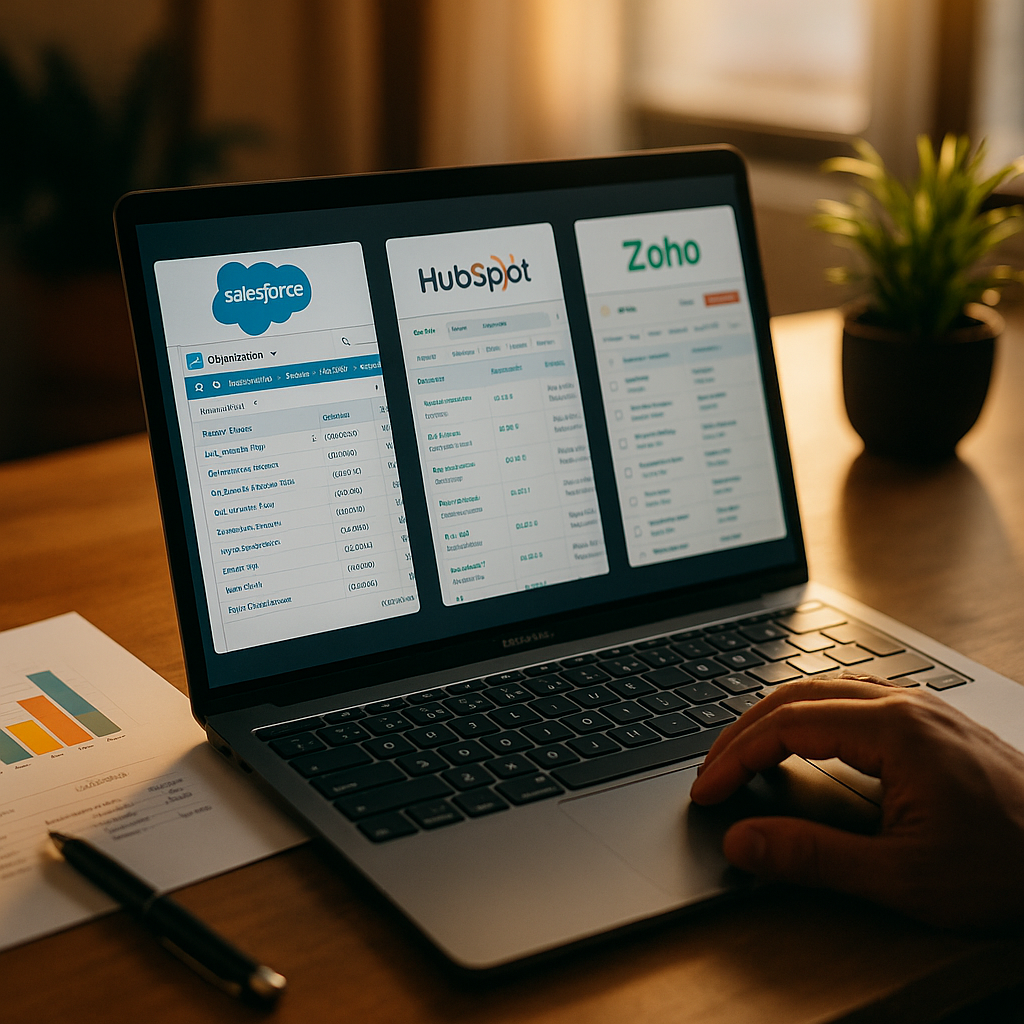
Gartner predicts that by 2028, at least 15% of day-to-day work decisions will be made autonomously by agentic AI. Your CRM vendor already knows this, which is why every renewal call now comes with a slide deck full of “agents.” But agentic readiness in CRM buying isn’t a marketing checkbox — it’s the difference between an AI system that closes deals and one that just adds another chat window to your stack.
Salesforce, HubSpot, and Zoho all claim agentic capability now. Agentforce, Breeze, and Zia+ each promise autonomous task execution, not just suggestions. But “autonomous” means different things depending on which vendor’s demo you’re watching. Before you sign anything, you need a structured way to separate real agentic infrastructure from a rebadged chatbot with a better name.
What “Agentic Readiness” Actually Means Here
Agentic AI isn’t a single feature. It’s an architecture: agents that can perceive context, make decisions within defined guardrails, take multi-step actions across systems, and escalate to humans when confidence is low. A CRM that’s agentic-ready doesn’t just summarize a call. It updates the opportunity stage, drafts the follow-up, checks inventory in a connected ERP, and flags the deal for manager review if the discount exceeds policy — without a human triggering each step.
Most vendors are somewhere between “chatbot with better branding” and “actual agent orchestration layer.” Your job is to figure out which one you’re being sold, and that requires questions no sales deck will answer unprompted.
If a vendor can’t show you an audit log of an agent’s decision path in the demo, assume the “agent” is a scripted workflow wearing a costume.
Questions to Ask Salesforce About Agentforce
Salesforce has leaned hardest into the agentic narrative, and Agentforce is genuinely more mature than most competitors’ offerings. That doesn’t mean it’s plug-and-play for your use case. Push on these specifics:
- What’s the actual data foundation cost? Agentforce runs on Data Cloud, and Data Cloud isn’t free or trivial to implement. Ask for a real implementation timeline and total cost, not the “unlock in minutes” pitch.
- How does it handle multi-object reasoning? Can an agent reason across Opportunity, Case, and a custom object simultaneously, or does it need separate configurations for each?
- What’s the guardrail model? Ask specifically how permission sets, approval limits, and Einstein Trust Layer masking apply to autonomous actions, not just chatbot responses.
- Can we see the audit trail? Every agent action should be logged with the reasoning trace. If Salesforce can’t produce this in a sandbox demo, that’s a governance gap you’ll inherit.
- What happens when the agent is wrong? Ask for a documented escalation path and error-recovery process, not a hand-wave about “human in the loop.”
Salesforce’s strength is depth for enterprises already invested in its ecosystem. The risk is cost creep: Data Cloud consumption, agent conversation credits, and add-on licensing can turn a “included in your plan” pitch into a six-figure surprise. For a deeper breakdown of what to demand contractually, our agentic CRM buying guide covers the clauses procurement teams routinely miss.
Grilling HubSpot on Breeze
HubSpot’s Breeze suite targets mid-market teams who want agentic features without enterprise complexity. That positioning is appealing, but it also means the agentic layer is newer and less battle-tested at scale. Questions worth asking:
- Does Breeze act, or just recommend? HubSpot’s Prospecting Agent and Customer Agent have gotten more autonomous, but confirm whether specific workflows you need (renewal outreach, lead re-engagement, ticket resolution) trigger real actions or just draft suggestions awaiting approval.
- How does it perform outside HubSpot’s native ecosystem? HubSpot agents work beautifully with HubSpot-native tools. Ask pointedly how they behave when your stack includes Stripe, NetSuite, or a custom-built product database.
- What tier unlocks true automation? Breeze features are gated across Starter, Professional, and Enterprise tiers. Get the exact feature-to-tier mapping in writing; sales reps sometimes demo Enterprise capability while quoting Professional pricing.
- How is data quality maintained for agent decisions? Agentic accuracy depends entirely on clean CRM data. Ask what deduplication and enrichment tools are bundled versus sold separately.
HubSpot’s real advantage is speed to value for teams without a dedicated RevOps function. The tradeoff is ecosystem lock-in: the more you rely on Breeze’s native integrations, the harder it becomes to swap out marketing or CS tools later.
Zoho’s Pitch: Agentic AI at a Fraction of the Price
Zoho’s Zia has expanded well past its original “predictive lead scoring” scope, and the company markets Zia+ as agentic across its entire Zoho One suite, not just CRM. That’s an appealing pitch for budget-conscious teams, but breadth isn’t the same as depth. Ask:
- Which agents are actually shipped versus roadmap? Zoho updates its release notes frequently, and some “agentic” features are still in limited beta. Get a firm ship date, not a roadmap slide.
- How does cross-app agent reasoning work? Zoho’s edge is that Zia can theoretically pull context from Zoho Books, Desk, and CRM together. Ask for a live demo of an agent completing a task that spans at least two of those apps.
- What’s the support model for agentic troubleshooting? Zoho’s lower price point often means thinner implementation support. Confirm whether agentic configuration help is included or billed as professional services.
- How transparent is the reasoning? Ask to see how Zia explains a scoring or routing decision. Some SMB-tier tools skip explainability entirely, which becomes a compliance problem the moment an agent makes a customer-facing decision.
Zoho makes sense for lean teams that want agentic features without enterprise pricing, provided you’re realistic about what’s production-ready versus what’s still marketing copy.
The Real Cost of Getting This Wrong
Picking the wrong agentic CRM isn’t just a wasted subscription. It’s a data governance liability. An agent that autonomously updates customer records, sends emails, or adjusts pricing without proper guardrails can create compliance exposure fast, especially under evolving state privacy laws and FTC guidance on automated decision-making disclosed to consumers, as outlined by the Federal Trade Commission.
There’s also the tool sprawl problem. Marketing and sales teams already juggle a dozen AI point solutions; adding an under-baked “agentic” CRM layer on top often duplicates functionality you’re already paying for elsewhere. If your team hasn’t audited existing AI tool overlap recently, our AI tool sprawl audit framework is a useful gut check before adding a new platform.
A CRM agent with no audit trail isn’t automation — it’s a liability with a friendly UI.
Build a Proof-of-Concept Before You Sign
Every vendor will offer a sandbox trial. Insist on testing these specific scenarios during it, not the vendor’s pre-built demo flow:
- Feed the agent a messy, real (anonymized) dataset from your own CRM export. See how it handles duplicates, missing fields, and inconsistent formatting.
- Ask the agent to complete a task requiring three or more steps across two connected apps (e.g., update a deal, trigger a Slack notification, and log a task for a rep).
- Force an error scenario. Give it incomplete data and watch whether it escalates appropriately or guesses.
- Request the decision log for every action taken. If it’s vague or unavailable, that’s your answer about production readiness.
- Time the setup. If “minutes to configure” actually takes your team three weeks of consulting hours, get that in writing before renewal math changes.
This mirrors how eMarketer and other analyst firms recommend evaluating enterprise AI claims generally: test against your own messy data, not the vendor’s curated demo environment. The same logic applies whether you’re vetting a CRM, a governance platform, or an attribution tool.
Where Attribution and Agentic CRM Intersect
One thing often missed in these evaluations: agentic CRM decisions are only as good as the identity and attribution data feeding them. If your CRM agent is deciding which leads to prioritize based on incomplete offline conversion data, it will optimize for the wrong signal, confidently. Teams building out unified attribution should read how CRM attribution connects clicks to offline sales before assuming an agent’s recommendations are trustworthy out of the box. It’s also worth checking whether your CDP or data warehouse setup, covered in our comparison of identity infrastructure options, is even structured to support real-time agentic decisioning.
According to HubSpot’s own research, sales teams using AI-assisted CRM workflows report meaningful time savings on administrative tasks, but the gains concentrate heavily among teams with clean, unified data. Garbage in, confidently automated garbage out.
Next step: Run each vendor’s sandbox through the same messy-data stress test, demand a written audit-trail sample before contract signature, and price the total agentic stack (data layer, credits, add-ons) separately from the base license. If a vendor won’t show you the receipts pre-sale, they won’t produce them post-sale either.
FAQs
What’s the difference between an AI chatbot in a CRM and a true agentic feature?
A chatbot responds to prompts and suggests actions for a human to approve. A true agentic feature takes multi-step actions autonomously within defined guardrails, updates records across connected systems, and escalates to a human only when confidence is low or policy thresholds are hit.
Which CRM is most agentic-ready right now: Salesforce, HubSpot, or Zoho?
Salesforce’s Agentforce currently has the deepest agentic infrastructure, largely because of its Data Cloud foundation, but it comes with higher cost and complexity. HubSpot’s Breeze suits mid-market teams wanting faster time-to-value within HubSpot’s ecosystem. Zoho’s Zia+ offers the broadest low-cost coverage but has more features still maturing toward full production readiness.
What questions should procurement ask before signing an agentic CRM contract?
Ask for the total cost including data platform fees and usage credits, a documented audit trail for agent decisions, the escalation process for errors, and a sandbox test using your own messy data rather than the vendor’s curated demo.
Is agentic AI in CRM a compliance risk?
It can be, if agents take customer-facing actions like pricing changes or communications without explainability or human oversight. Regulatory scrutiny on automated decision-making is increasing, so any agentic CRM feature affecting customers directly should have a clear audit trail and escalation policy.
How long does it typically take to implement agentic CRM features?
It varies widely by vendor and data readiness. Enterprise Salesforce implementations with Data Cloud can take months. HubSpot and Zoho deployments are often faster, sometimes weeks, but full agentic maturity (accurate multi-step reasoning across integrated apps) usually takes longer than the initial “quick setup” pitch suggests.
Top Influencer Marketing Agencies
The leading agencies shaping influencer marketing in 2026
Agencies ranked by campaign performance, client diversity, platform expertise, proven ROI, industry recognition, and client satisfaction. Assessed through verified case studies, reviews, and industry consultations.
Moburst

-
2

The Shelf
Boutique Beauty & Lifestyle Influencer AgencyA data-driven boutique agency specializing exclusively in beauty, wellness, and lifestyle influencer campaigns on Instagram and TikTok. Best for brands already focused on the beauty/personal care space that need curated, aesthetic-driven content.Clients: Pepsi, The Honest Company, Hims, Elf Cosmetics, Pure LeafVisit The Shelf → -
3

Audiencly
Niche Gaming & Esports Influencer AgencyA specialized agency focused exclusively on gaming and esports creators on YouTube, Twitch, and TikTok. Ideal if your campaign is 100% gaming-focused — from game launches to hardware and esports events.Clients: Epic Games, NordVPN, Ubisoft, Wargaming, Tencent GamesVisit Audiencly → -
4

Viral Nation
Global Influencer Marketing & Talent AgencyA dual talent management and marketing agency with proprietary brand safety tools and a global creator network spanning nano-influencers to celebrities across all major platforms.Clients: Meta, Activision Blizzard, Energizer, Aston Martin, WalmartVisit Viral Nation → -
5

The Influencer Marketing Factory
TikTok, Instagram & YouTube CampaignsA full-service agency with strong TikTok expertise, offering end-to-end campaign management from influencer discovery through performance reporting with a focus on platform-native content.Clients: Google, Snapchat, Universal Music, Bumble, YelpVisit TIMF → -
6

NeoReach
Enterprise Analytics & Influencer CampaignsAn enterprise-focused agency combining managed campaigns with a powerful self-service data platform for influencer search, audience analytics, and attribution modeling.Clients: Amazon, Airbnb, Netflix, Honda, The New York TimesVisit NeoReach → -
7

Ubiquitous
Creator-First Marketing PlatformA tech-driven platform combining self-service tools with managed campaign options, emphasizing speed and scalability for brands managing multiple influencer relationships.Clients: Lyft, Disney, Target, American Eagle, NetflixVisit Ubiquitous → -
8

Obviously
Scalable Enterprise Influencer CampaignsA tech-enabled agency built for high-volume campaigns, coordinating hundreds of creators simultaneously with end-to-end logistics, content rights management, and product seeding.Clients: Google, Ulta Beauty, Converse, AmazonVisit Obviously →