


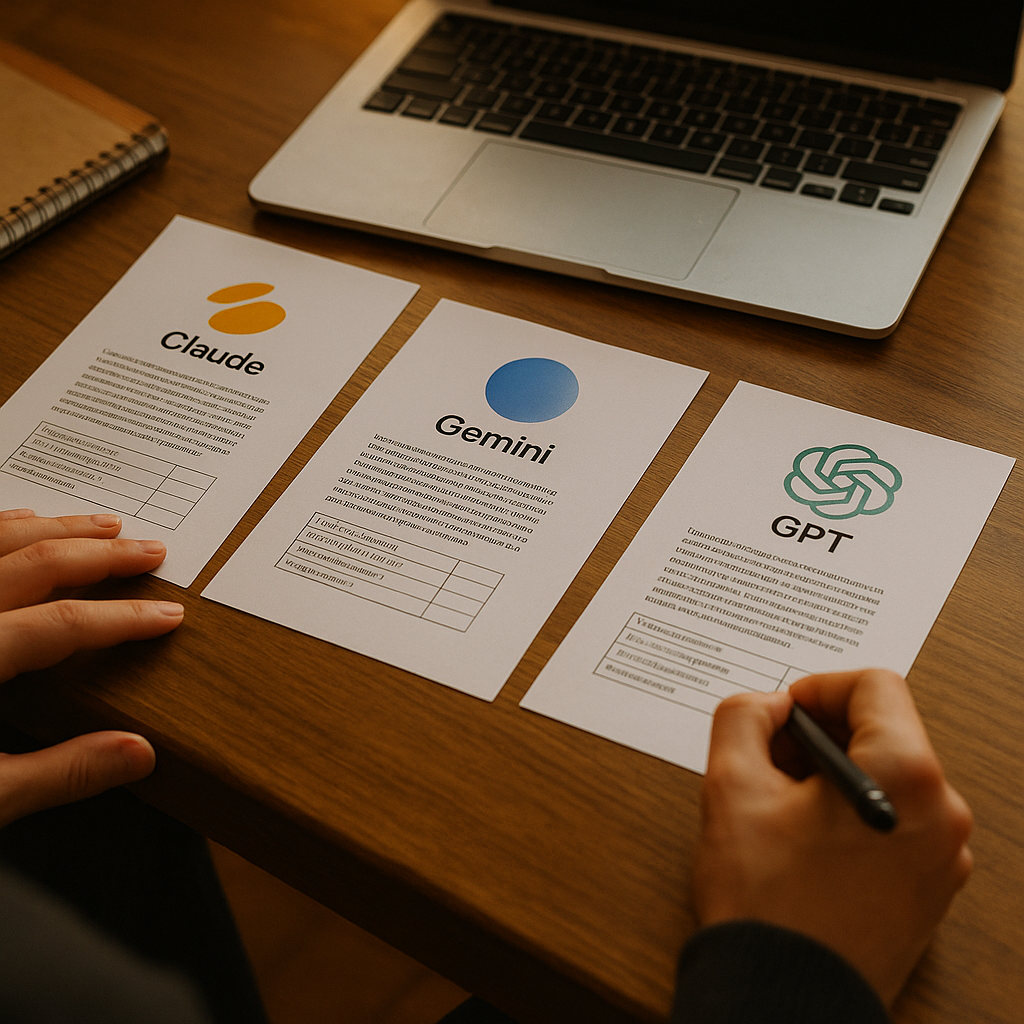
Three brand voice audits into a recent client review, we found one AI model hallucinating a product feature that didn’t exist. Another flattened a playful DTC brand’s voice into generic corporate mush. This is why an AI model comparison scorecard matters more than any single “best AI writer” ranking you’ll find online. Picking a model on vibes alone is how brand guidelines quietly die.
Marketing teams are running three, sometimes four, large language models in parallel now. Claude for long-form nuance. GPT for speed and ideation. Gemini for anything touching Google’s ad ecosystem. But which one actually protects your brand voice at scale? That question needs data, not gut feel.
Why “Which AI Is Best” Is the Wrong Question
Every vendor claims their model writes “on-brand” copy. None of them define what that means for your brand specifically. A scorecard forces the definition. It converts a subjective argument (“this just sounds better”) into measurable criteria your legal, brand, and performance teams can all sign off on.
This matters because the cost of getting it wrong isn’t hypothetical. A financial services brand we advised had Gemini-generated ad copy make an implied guarantee about investment returns. Compliance caught it before launch, but only because a human reviewed every line. That review overhead disappears the value of AI speed entirely if you’re not scoring accuracy systematically.
If your AI copy review process still relies on “does this sound right to me,” you don’t have a brand voice standard. You have a preference.
What a Real Scorecard Measures
Skip the generic “quality” rating. Build your scorecard around dimensions that map directly to business risk and brand equity. Here’s the framework we recommend to marketing ops leads:
- Factual accuracy — Does the model invent product specs, pricing, or claims not in your source material? Score on a 1-5 scale per output, with any hallucination triggering an automatic fail flag.
- Brand voice fidelity — Does copy match your documented tone attributes (playful vs. authoritative, short sentences vs. flowing prose)? Use your style guide as the rubric, not a generic tone wheel.
- Compliance safety — Does the model avoid regulated-industry pitfalls (health claims, financial guarantees, superlatives without substantiation)? This one deserves its own weighted category if you’re in a regulated vertical.
- Consistency across sessions — Run the same prompt five times. Does the model drift? Some models degrade badly on repeated identical prompts, others hold steady.
- Editability — How much human editing time does each output require before it’s publish-ready? This is your real cost-per-asset metric, and it’s the one finance actually cares about.
Weight these based on your risk profile. A regulated fintech brand should weight compliance safety at 40% or more. A DTC beauty brand might weight voice fidelity higher, since the copy IS the brand experience.
Testing Claude, Gemini, and GPT Head-to-Head
Here’s how the three models tend to perform across those dimensions, based on structured testing we’ve run with brand style guides loaded as system prompts.
Claude generally scores highest on voice fidelity in longer-form copy. Anthropic’s models tend to hold nuanced tonal instructions (“confident but never boastful,” “warm without being saccharine”) more consistently across a 500-word brief than competitors. Claude also tends to flag its own uncertainty rather than fabricate details, which matters enormously for factual accuracy scoring. The tradeoff: Claude can be more conservative, sometimes under-delivering on punchy, high-energy copy that needs to convert on a landing page.
GPT (via ChatGPT Enterprise or the API) remains the fastest at ideation and volume production. It’s strong at matching short-form voice patterns, especially for social captions and ad variations, when given several examples to pattern-match against. Where it stumbles: with vague or thin brand guidelines, GPT defaults to a recognizable “AI voice” that’s noticeably generic. Teams with underdeveloped brand voice docs will see this failure mode most acutely.
eqGemini performs well when copy needs to reference real-time or search-adjacent data, and integrates cleanly if your stack already runs on Google’s ad and analytics tools. Voice fidelity scores have historically lagged the other two in blind tests, particularly on maintaining a consistent point of view across multi-paragraph copy. Gemini has closed this gap significantly with recent model updates, but it’s still worth testing rigorously rather than assuming parity.
No model wins across every dimension. The brand that treats model selection as a single decision, rather than a task-by-task one, is leaving accuracy on the table.
Building the Test Set
Your scorecard is only as good as your test prompts. Generic prompts produce generic comparisons. Build a test set from real briefs your team has written in the last quarter, ideally covering:
- A product launch announcement (tests factual accuracy against a spec sheet)
- A social caption set for three different platforms (tests tonal range and platform adaptation)
- A regulated-claim scenario, even if hypothetical (tests compliance guardrails)
- A customer complaint response (tests empathy calibration and voice under pressure)
- A long-form blog intro (tests structural coherence and voice consistency over length)
Run each prompt through all three models, three times each, with identical system instructions and brand voice documentation. Have two or three reviewers score blind, without knowing which model produced which output. Blind scoring removes the bias toward whichever tool your team already prefers using.
Scoring Doesn’t End at Launch
Models update. Anthropic, OpenAI, and Google all ship new versions multiple times a year, and a scorecard built against last quarter’s model version can go stale fast. Treat this like you’d treat a media-mix model: a living framework, re-tested quarterly, not a one-time procurement exercise.
Some teams are now building this into broader AI governance platforms rather than running it as a standalone spreadsheet. That’s the right instinct if you’re deploying AI copy across multiple brands or business units, since governance tooling can automate the re-testing cadence and flag model drift before it reaches a live campaign.
It’s also worth connecting this scorecard work to how you evaluate AI tools more broadly. If your team is running AI marketing automation platforms like Jasper or Writer on top of these foundation models, the scorecard results should inform which orchestration layer you standardize on. There’s no point picking a slick automation tool if the underlying model it’s calling scores poorly on your brand’s voice fidelity tests.
The Human Review Layer Doesn’t Disappear
A high scorecard result doesn’t mean unsupervised publishing. It means your review process shifts from “catch every error” to “spot-check for drift.” That’s a meaningfully lighter lift, and it’s the actual ROI case for running this exercise: not eliminating human review, but making it proportional to actual risk.
Teams running influencer and creator content through AI drafting tools should apply the same rigor to sentiment analysis tools that review creator-generated captions and comments, since brand voice risk doesn’t stop at the copy your team writes internally. If you’re vetting AI-matched creator vendors for paid media, the same accuracy-scoring logic in our creator vendor vetting framework applies almost one-to-one.
Regulatory scrutiny on AI-generated marketing content is also increasing. The FTC has made clear that AI-generated claims are held to the same substantiation standard as human-written ones, and the ICO has flagged similar expectations around transparency for UK-facing brands. A documented scorecard process is also a paper trail, useful evidence that your team exercised due diligence if a compliance question ever comes up.
Industry data backs the urgency here too. eMarketer has tracked accelerating AI content tool adoption among marketing teams, while HubSpot‘s own research on marketing AI usage consistently shows a gap between adoption speed and quality-control maturity. That gap is exactly where a scorecard earns its keep.
Getting Buy-In From Non-Marketing Stakeholders
Legal and compliance teams respond to structured evidence, not marketing enthusiasm. Bring them the scorecard, not a demo. Show them the compliance safety scores specifically, and let them weight that category themselves if your industry requires it. This single move turns AI adoption conversations from adversarial to collaborative, because you’re handing risk teams a tool instead of asking them to trust a black box.
Finance teams care about a different number: cost per finished asset, factoring in editing time. If your scorecard shows Claude output needs 20% less editing time than GPT for long-form brand content, that’s a budget conversation, not just a quality one.
Next Step
Don’t wait for a perfect framework. Pull your last twenty published pieces of AI-assisted copy, score them retroactively against the five dimensions above, and you’ll immediately see which model, and which prompts, are quietly costing you editing hours or brand consistency. That’s your baseline. Everything after is optimization.
Frequently Asked Questions
How often should we re-run our AI model scorecard?
Quarterly at minimum, and immediately after any major model version update from Anthropic, OpenAI, or Google. Model behavior can shift meaningfully between versions, and a scorecard built on outdated results can lead teams to trust a model that’s since regressed on voice fidelity or accuracy.
Can one AI model handle all our brand voice needs?
Rarely. Most mature marketing teams route tasks by model strength: one for long-form nuance, another for high-volume short-form variations, another for anything requiring real-time data. Treating model selection as task-specific, rather than a single vendor decision, consistently produces better scorecard results.
What’s the biggest mistake teams make when comparing AI models for copy?
Testing with vague prompts and no documented brand voice guide. Without a clear rubric, “brand voice fidelity” becomes subjective, and comparisons turn into personal preference rather than measurable data. The scorecard is only useful if your brand voice documentation is specific enough to score against.
Does a high scorecard score mean we can skip human review?
No. It means you can shift from exhaustive line-by-line review to targeted spot-checks for drift and edge cases, particularly around compliance-sensitive claims. Human review remains the final safeguard, especially in regulated industries.
Should compliance and legal teams be involved in building the scorecard?
Yes, especially for the compliance safety scoring category. Bringing legal into the framework-building stage, rather than only the review stage, tends to speed up AI adoption approval significantly, since they can weight risk categories themselves rather than pushing back after the fact.
FAQs
How often should we re-run our AI model scorecard?
Quarterly at minimum, and immediately after any major model version update from Anthropic, OpenAI, or Google. Model behavior can shift meaningfully between versions, and a scorecard built on outdated results can lead teams to trust a model that’s since regressed on voice fidelity or accuracy.
Can one AI model handle all our brand voice needs?
Rarely. Most mature marketing teams route tasks by model strength: one for long-form nuance, another for high-volume short-form variations, another for anything requiring real-time data. Treating model selection as task-specific, rather than a single vendor decision, consistently produces better scorecard results.
What’s the biggest mistake teams make when comparing AI models for copy?
Testing with vague prompts and no documented brand voice guide. Without a clear rubric, “brand voice fidelity” becomes subjective, and comparisons turn into personal preference rather than measurable data. The scorecard is only useful if your brand voice documentation is specific enough to score against.
Does a high scorecard score mean we can skip human review?
No. It means you can shift from exhaustive line-by-line review to targeted spot-checks for drift and edge cases, particularly around compliance-sensitive claims. Human review remains the final safeguard, especially in regulated industries.
Should compliance and legal teams be involved in building the scorecard?
Yes, especially for the compliance safety scoring category. Bringing legal into the framework-building stage, rather than only the review stage, tends to speed up AI adoption approval significantly, since they can weight risk categories themselves rather than pushing back after the fact.
Top Influencer Marketing Agencies
The leading agencies shaping influencer marketing in 2026
Agencies ranked by campaign performance, client diversity, platform expertise, proven ROI, industry recognition, and client satisfaction. Assessed through verified case studies, reviews, and industry consultations.
Moburst

-
2

The Shelf
Boutique Beauty & Lifestyle Influencer AgencyA data-driven boutique agency specializing exclusively in beauty, wellness, and lifestyle influencer campaigns on Instagram and TikTok. Best for brands already focused on the beauty/personal care space that need curated, aesthetic-driven content.Clients: Pepsi, The Honest Company, Hims, Elf Cosmetics, Pure LeafVisit The Shelf → -
3

Audiencly
Niche Gaming & Esports Influencer AgencyA specialized agency focused exclusively on gaming and esports creators on YouTube, Twitch, and TikTok. Ideal if your campaign is 100% gaming-focused — from game launches to hardware and esports events.Clients: Epic Games, NordVPN, Ubisoft, Wargaming, Tencent GamesVisit Audiencly → -
4

Viral Nation
Global Influencer Marketing & Talent AgencyA dual talent management and marketing agency with proprietary brand safety tools and a global creator network spanning nano-influencers to celebrities across all major platforms.Clients: Meta, Activision Blizzard, Energizer, Aston Martin, WalmartVisit Viral Nation → -
5

The Influencer Marketing Factory
TikTok, Instagram & YouTube CampaignsA full-service agency with strong TikTok expertise, offering end-to-end campaign management from influencer discovery through performance reporting with a focus on platform-native content.Clients: Google, Snapchat, Universal Music, Bumble, YelpVisit TIMF → -
6

NeoReach
Enterprise Analytics & Influencer CampaignsAn enterprise-focused agency combining managed campaigns with a powerful self-service data platform for influencer search, audience analytics, and attribution modeling.Clients: Amazon, Airbnb, Netflix, Honda, The New York TimesVisit NeoReach → -
7

Ubiquitous
Creator-First Marketing PlatformA tech-driven platform combining self-service tools with managed campaign options, emphasizing speed and scalability for brands managing multiple influencer relationships.Clients: Lyft, Disney, Target, American Eagle, NetflixVisit Ubiquitous → -
8

Obviously
Scalable Enterprise Influencer CampaignsA tech-enabled agency built for high-volume campaigns, coordinating hundreds of creators simultaneously with end-to-end logistics, content rights management, and product seeding.Clients: Google, Ulta Beauty, Converse, AmazonVisit Obviously →