


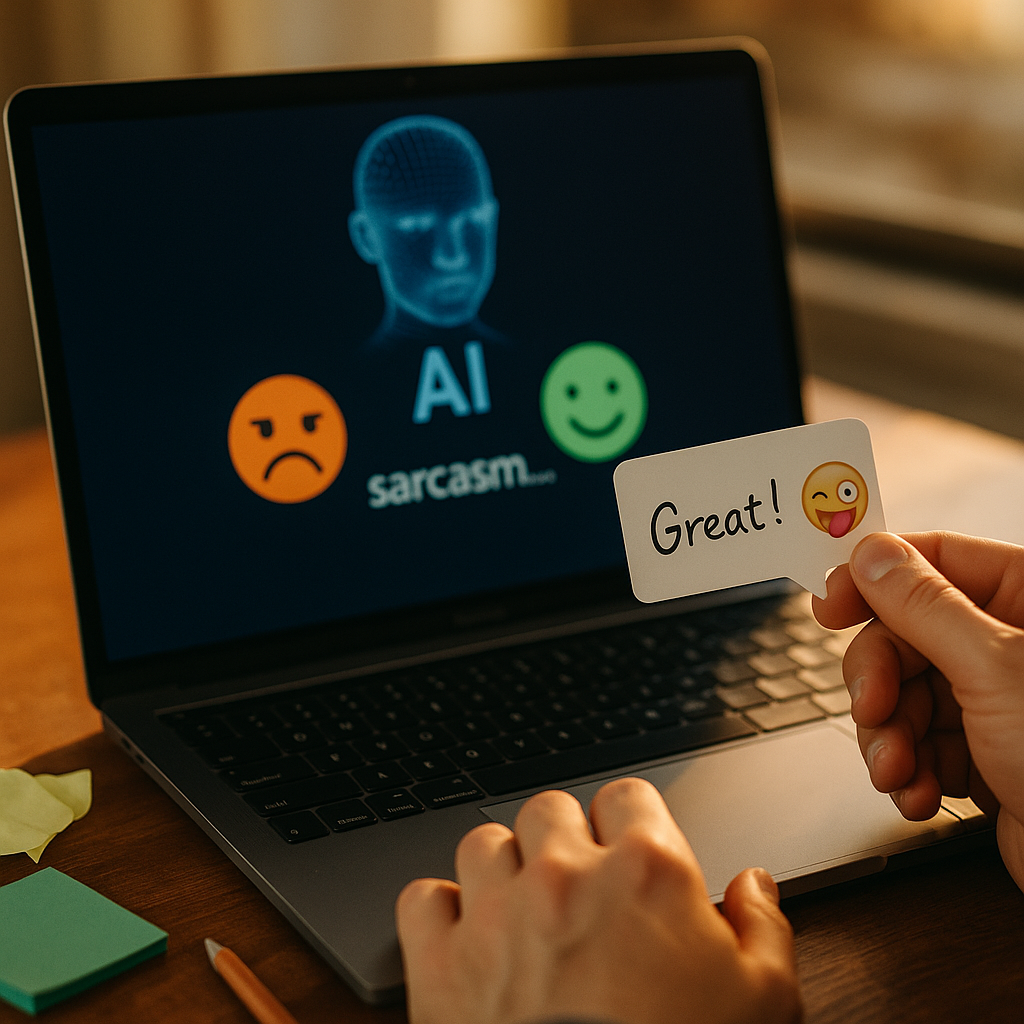
Roughly 40% of sarcastic social posts get misclassified by standard sentiment models, according to research cited across multiple NLP benchmarking studies. If your brand health dashboard is built on one of those models, you’re probably celebrating comments that are actually roasting you. AI-enhanced sentiment analysis has closed some of that gap, but not evenly, and picking the wrong platform means making budget decisions on bad data.
This isn’t an academic problem. It’s a P&L problem. Misread sentiment skews crisis response timing, warps influencer performance scoring, and can quietly convince a CMO that a campaign is “resonating positively” when the comments section is dragging the brand in three different languages.
Why Sarcasm Still Breaks Most Sentiment Models
Sarcasm is contextual. “Wow, love waiting on hold for 40 minutes” is negative to any human, but a keyword-based or shallow ML model sees “love” and logs it positive. Older sentiment tools built on lexicon scoring or first-generation neural nets still stumble here constantly. Large language models improved things by reading surrounding context, tone markers, and conversational history rather than isolated words. But “improved” isn’t “solved.”
Cultural nuance compounds the problem. British sarcasm reads differently than Australian sarcasm. A phrase that’s a compliment in one regional dialect is an insult in another. Emoji sentiment shifts by platform and by age cohort — a skull emoji means “I’m dead laughing” to Gen Z and something entirely different to a literal reading model. Brands running global influencer programs need tools that account for this, not just English-language Twitter training data from five years ago.
Generic sentiment scores without sarcasm and dialect calibration are essentially vanity metrics dressed up as insight — confident, precise, and frequently wrong.
What “AI-Enhanced” Actually Means in This Category
Vendors love the phrase “AI-powered sentiment analysis,” but the underlying architecture varies wildly. Three tiers exist right now:
- Lexicon-plus-ML hybrids: Faster and cheaper, but weak on sarcasm and idiom. Fine for high-volume, low-stakes monitoring.
- Fine-tuned transformer models: Trained on domain-specific data (retail, beauty, finance) with contextual awareness. Better sarcasm detection, moderate cultural range.
- LLM-native analysis with reasoning layers: Uses generative models to actually explain why a mention is negative, flagging tone, irony markers, and cultural context in the output. Slower and pricier, but meaningfully more accurate on edge cases.
Knowing which tier a vendor sits in matters more than their marketing copy. Ask for their sarcasm detection benchmark numbers directly — most serious vendors have them, even if they don’t publish them on the pricing page.
Platform Comparison: How the Major Tools Actually Perform
Here’s where brand teams need to get specific rather than trusting a vendor’s self-reported accuracy claims.
Brandwatch (Cision) continues to lead on breadth. Its Iris AI layer has meaningfully improved contextual sentiment scoring, and its sarcasm flagging is decent for English, Spanish, and French content. Cultural nuance outside those languages remains inconsistent — teams running APAC or MENA campaigns report needing manual QA on a meaningful share of flagged mentions.
Sprinklr invests heavily in its own LLM fine-tuning and performs well in category-specific slang (beauty, gaming, fintech), largely because it trains on client-specific historical data. The tradeoff: it needs volume and time to calibrate per brand before results are trustworthy. Day-one accuracy for a new account is mediocre.
Sprout Social (via Sprout Social’s platform) has closed a lot of ground with its AI-assisted sentiment tagging, particularly for mid-market brands that don’t need enterprise-scale global coverage. Sarcasm detection is solid for North American English but thinner on regional dialect and code-switching, which matters if your audience mixes languages in a single post (common in Latin American and South Asian markets).
Talkwalker (now part of Hootsuite) historically leaned on image and video sentiment as a differentiator, and that visual-context layer actually helps with sarcasm — tone often reveals itself in the accompanying image or meme format, not just text. Cultural nuance coverage is broad across languages but shallower in depth per language compared to Brandwatch.
Meltwater has pushed hard into generative AI summarization, which indirectly improves sentiment accuracy because the model reasons through context rather than scoring word-by-word. Early client feedback suggests strong performance on PR-crisis-style negative sentiment (obvious tonal shifts) but average performance on subtle sarcasm in everyday brand mentions.
None of these platforms is uniformly best. The right pick depends on your market mix, language coverage needs, and how much manual QA capacity your team has to catch the misses.
The Manual QA Layer Nobody Budgets For
Even the strongest LLM-native tools recommend a human review sample, typically 5-10% of flagged mentions, especially around anything crisis-adjacent. Teams that skip this step because “the AI handles it” tend to get burned exactly once, usually during a PR moment when a sarcastic viral post gets misclassified as neutral and nobody escalates it in time.
Build QA into your workflow the same way you’d build in fraud checks or governance review. It’s the same operational logic as running fraud detection on influencer vetting — automation handles volume, humans handle judgment calls.
Sarcasm Detection Benchmarks: What the Data Actually Shows
Independent NLP benchmark testing (much of it published through academic conferences like ACL and EMNLP) consistently shows transformer-based models scoring 15-25 percentage points higher on sarcasm F1 scores than lexicon-based tools. That gap is real and it’s growing as vendors incorporate more conversational training data.
But benchmark performance on curated datasets doesn’t always translate to messy, real-world brand mentions full of typos, memes, and platform-specific slang. A model that scores 88% accuracy on a clean academic dataset might drop to 70% on actual TikTok comments. Always ask vendors for accuracy numbers on live social data, not lab conditions. If they can’t provide it, treat that as a red flag rather than an oversight.
A sentiment tool’s lab benchmark and its real-world TikTok comment accuracy can differ by 15+ points — always ask for the second number, not just the first.
Cultural Nuance Is a Localization Problem, Not Just an NLP One
Here’s an underrated point: cultural nuance detection isn’t purely a model-training issue. It’s an organizational one. Brands running influencer programs across multiple regions often centralize sentiment analysis in one HQ team that doesn’t speak the local language or understand the cultural subtext. Even a perfect AI model produces useless output if nobody on the review team can validate whether the “negative” flag on a Filipino comment thread is actually a form of affectionate teasing.
The fix isn’t more AI. It’s pairing regional review resources with the tool, the same way global brands pair local agency partners with centralized paid media platforms. If you’re evaluating AI-matched creator vendors for international campaigns, ask the same cultural-context question you’re asking of your sentiment tool.
Where This Fits Into Your Broader Stack
Sentiment analysis rarely lives in isolation anymore. It’s increasingly stitched into brand safety workflows, comment moderation systems, and creator performance scoring. If you’re already running comment moderation tools across Reddit, TikTok, and YouTube, check whether your sentiment vendor integrates or duplicates that function. Redundant tools are a real cost problem — worth running through a proper tool sprawl audit before signing another annual contract.
It’s also worth connecting sentiment data to your governance framework. Any platform ingesting brand mentions at scale is processing customer-generated content and, depending on region, personal data. That’s not a legal footnote — regulators are paying attention. The FTC has increased scrutiny on AI claims in marketing tools generally, and UK-facing brands should keep an eye on ICO guidance on automated processing of user-generated content. If your organization already has an AI governance platform in place, loop sentiment tools into that review rather than treating them as a standalone martech purchase.
How to Actually Test a Vendor Before You Buy
Skip the demo-driven sales pitch. Instead:
- Pull 200-300 of your own historical brand mentions, including known sarcastic or ambiguous ones you’ve manually tagged.
- Run them through the vendor’s live trial or sandbox, not a curated demo dataset.
- Score accuracy specifically on the sarcastic and culturally nuanced subset, not the whole batch — that’s where the real differentiation shows up.
- Test across your actual language and regional mix, not just English.
- Ask how the model handles emerging slang and how often it retrains — stale slang recognition ages fast.
This takes a few extra days during procurement. It saves months of misread brand health data later. According to industry data tracked by eMarketer, marketing teams are increasing spend on AI-driven listening tools year over year, which makes vendor accuracy testing a budget-protection exercise, not just a technical nice-to-have.
Sentiment tooling decisions also tend to get lumped in with broader martech consolidation conversations, particularly as brands push toward unified AI marketing operating systems. Worth flagging early if you’re negotiating a bundled contract, since sentiment accuracy shouldn’t be sacrificed for platform convenience.
Next Step
Before renewing or signing a sentiment analysis contract, run your own sarcasm-and-slang test set through the vendor’s live environment — not their demo — and score accuracy on that subset alone. That single test will tell you more than any vendor’s benchmark deck.
FAQs
Which AI sentiment analysis tools are best at detecting sarcasm?
Transformer and LLM-native platforms like Sprinklr and Brandwatch generally outperform lexicon-based tools on sarcasm detection, particularly for English-language content. Accuracy drops for non-English and code-switched text, so always test against your own mention data before committing.
Why do sentiment tools struggle with cultural nuance?
Most models are trained predominantly on English-language, Western-context data. Regional slang, dialect, and culturally specific humor often fall outside that training distribution, causing misclassification even when sarcasm detection is otherwise strong.
How much manual review should brands budget for alongside AI sentiment tools?
Most practitioners recommend manually reviewing 5-10% of flagged mentions, with higher review rates during active campaigns or potential PR situations where misclassification carries real risk.
Does sentiment analysis accuracy differ by platform (TikTok vs Twitter vs Reddit)?
Yes. Comment style, emoji usage, and slang conventions vary significantly by platform, and most vendors’ published accuracy benchmarks don’t break results out by platform. Ask vendors directly for platform-specific performance data.
Is a more expensive sentiment tool always more accurate on sarcasm?
Not necessarily. Price often reflects data volume, integrations, and support tiers more than raw model accuracy. Run a live test on your own data before assuming cost correlates with sarcasm detection quality.
FAQs
Which AI sentiment analysis tools are best at detecting sarcasm?
Transformer and LLM-native platforms like Sprinklr and Brandwatch generally outperform lexicon-based tools on sarcasm detection, particularly for English-language content. Accuracy drops for non-English and code-switched text, so always test against your own mention data before committing.
Why do sentiment tools struggle with cultural nuance?
Most models are trained predominantly on English-language, Western-context data. Regional slang, dialect, and culturally specific humor often fall outside that training distribution, causing misclassification even when sarcasm detection is otherwise strong.
How much manual review should brands budget for alongside AI sentiment tools?
Most practitioners recommend manually reviewing 5-10% of flagged mentions, with higher review rates during active campaigns or potential PR situations where misclassification carries real risk.
Does sentiment analysis accuracy differ by platform (TikTok vs Twitter vs Reddit)?
Yes. Comment style, emoji usage, and slang conventions vary significantly by platform, and most vendors’ published accuracy benchmarks don’t break results out by platform. Ask vendors directly for platform-specific performance data.
Is a more expensive sentiment tool always more accurate on sarcasm?
Not necessarily. Price often reflects data volume, integrations, and support tiers more than raw model accuracy. Run a live test on your own data before assuming cost correlates with sarcasm detection quality.
Top Influencer Marketing Agencies
The leading agencies shaping influencer marketing in 2026
Agencies ranked by campaign performance, client diversity, platform expertise, proven ROI, industry recognition, and client satisfaction. Assessed through verified case studies, reviews, and industry consultations.
Moburst

-
2

The Shelf
Boutique Beauty & Lifestyle Influencer AgencyA data-driven boutique agency specializing exclusively in beauty, wellness, and lifestyle influencer campaigns on Instagram and TikTok. Best for brands already focused on the beauty/personal care space that need curated, aesthetic-driven content.Clients: Pepsi, The Honest Company, Hims, Elf Cosmetics, Pure LeafVisit The Shelf → -
3

Audiencly
Niche Gaming & Esports Influencer AgencyA specialized agency focused exclusively on gaming and esports creators on YouTube, Twitch, and TikTok. Ideal if your campaign is 100% gaming-focused — from game launches to hardware and esports events.Clients: Epic Games, NordVPN, Ubisoft, Wargaming, Tencent GamesVisit Audiencly → -
4

Viral Nation
Global Influencer Marketing & Talent AgencyA dual talent management and marketing agency with proprietary brand safety tools and a global creator network spanning nano-influencers to celebrities across all major platforms.Clients: Meta, Activision Blizzard, Energizer, Aston Martin, WalmartVisit Viral Nation → -
5

The Influencer Marketing Factory
TikTok, Instagram & YouTube CampaignsA full-service agency with strong TikTok expertise, offering end-to-end campaign management from influencer discovery through performance reporting with a focus on platform-native content.Clients: Google, Snapchat, Universal Music, Bumble, YelpVisit TIMF → -
6

NeoReach
Enterprise Analytics & Influencer CampaignsAn enterprise-focused agency combining managed campaigns with a powerful self-service data platform for influencer search, audience analytics, and attribution modeling.Clients: Amazon, Airbnb, Netflix, Honda, The New York TimesVisit NeoReach → -
7

Ubiquitous
Creator-First Marketing PlatformA tech-driven platform combining self-service tools with managed campaign options, emphasizing speed and scalability for brands managing multiple influencer relationships.Clients: Lyft, Disney, Target, American Eagle, NetflixVisit Ubiquitous → -
8

Obviously
Scalable Enterprise Influencer CampaignsA tech-enabled agency built for high-volume campaigns, coordinating hundreds of creators simultaneously with end-to-end logistics, content rights management, and product seeding.Clients: Google, Ulta Beauty, Converse, AmazonVisit Obviously →