


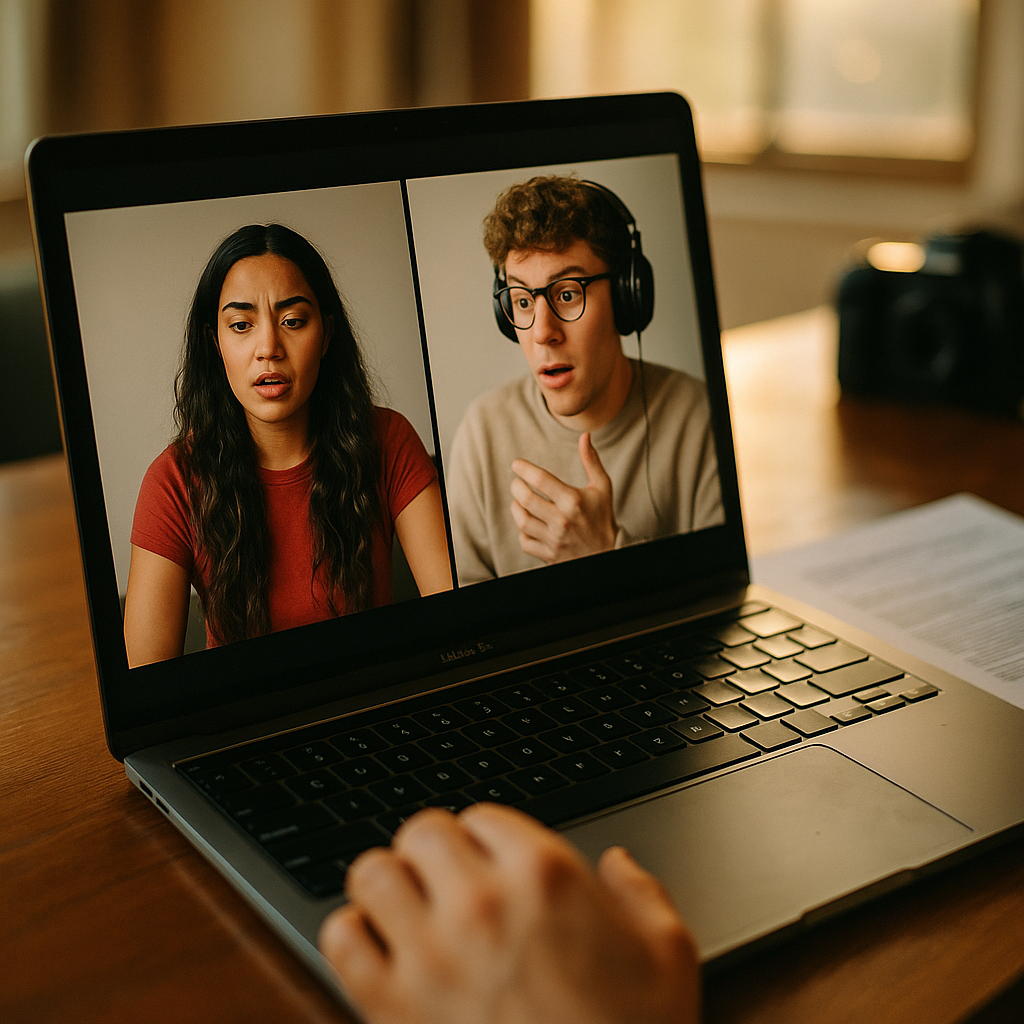
Seventy-three percent of consumers say they trust peer reviews more than brand messaging, according to Statista research on purchase influence. So why do so many brands still film split-screen reaction content that looks like a courtroom deposition? The split-screen reaction format converts because it feels unscripted. The moment legal scrubs out every genuine reaction, it stops converting.
This format sits in a strange spot right now. It’s one of the highest-performing UGC styles on TikTok and Reels, pairing a creator’s real-time face or voice reaction against product footage, a before-and-after clip, or a competitor comparison. But it’s also one of the most exposed formats from a compliance standpoint, because “reaction” implies spontaneity, and spontaneity is exactly what makes legal teams nervous.
Why This Format Keeps Winning (And Keeps Getting Flagged)
Split-screen reactions work because the viewer’s brain reads two things simultaneously: the stimulus and the human response to it. That pairing does something scripted testimonials can’t. It creates a proxy experience. The audience feels the surprise, the disgust, the delight, without having to imagine it themselves.
Performance data backs this up. Creators running split-screen reaction formats against product demos have reported completion rates 15-20% higher than single-frame testimonial videos, based on aggregated agency benchmarking shared across creator platforms. The format is a cousin of the split-test reaction format, but it leans harder into unfiltered emotional response rather than side-by-side product logic.
The problem: unfiltered emotional response is precisely what triggers FTC scrutiny. If a reaction is staged, coached, or edited to imply organic discovery when it was actually a paid, scripted moment, that’s a material misrepresentation. The FTC’s endorsement guidelines don’t care how spontaneous something looks. They care whether it’s true.
A reaction video doesn’t need to be unscripted to be authentic. It needs to be honestly disclosed and genuinely felt — those are two different requirements, and brands routinely confuse them.
The Legal Exposure Nobody’s Briefing Around
Here’s where most brand teams get it wrong: they treat legal review as a post-production filter instead of a pre-production input. By the time compliance sees the cut, the creator has already said something implying a claim (“this literally cured my skin overnight”) that can’t be substantiated, and now you’re choosing between reshoots, cuts that kill the emotional payoff, or shipping something risky.
Three exposure points show up again and again in split-screen reaction content:
- Implied efficacy claims. A genuine gasp reaction to a “before and after” skincare split screen can read as a results guarantee even if the creator never says the word “guarantee.”
- Missing or buried disclosure. Fast-cut reaction formats often bury #ad in a description box instead of on-screen, which the FTC and platforms both flag.
- Comparative claims against named competitors. Reaction shots comparing your product to a rival’s, especially with a visible reaction of shock or disappointment aimed at the competitor, edge into disparagement territory if the comparison isn’t substantiated.
This overlaps heavily with the risk profile covered in before-and-after compliance briefs, since split-screen reactions are frequently just a stylized delivery mechanism for before-and-after claims.
What “Reworked” Actually Means Here
The rework isn’t a new camera trick. It’s a new briefing sequence. Instead of “film your honest reaction, we’ll handle legal after,” the reworked approach front-loads three things: claim boundaries, disclosure placement, and reaction authenticity guardrails, all before the creator hits record.
Think of it as giving the creator a fenced field to run in, rather than a leash. They still improvise. They still react genuinely. But they’re improvising inside boundaries that were legally cleared in advance, not boundaries discovered after the fact in a redline document.
Building the Brief: Claim Boundaries Before Camera Angles
Most creative briefs open with shot composition. Split-screen ones should open with claim inventory. List every statement the creator is legally allowed to make, every comparison that’s substantiated, and every phrase that needs a qualifier (“in a clinical study,” “results may vary,” “my experience”). Hand this to the creator as a “green light / red light” list, not a script.
Then layer in the disclosure requirement explicitly. On-screen text disclosure, spoken disclosure in the first three seconds, or both, depending on platform. TikTok and Meta both have native paid partnership tags — use them, don’t rely solely on caption hashtags. The Meta Business platform and TikTok’s ad tools both support this natively now, so there’s no excuse for burying disclosure in a description field nobody reads.
This mirrors the compliance architecture used in confessional testimonial briefs, where the intimacy of the format creates the same tension between “feels real” and “is verifiably true.”
Direction Without a Script
Directing authentic reactions without scripting them sounds like a contradiction. It isn’t, if you separate content from framing.
Give the creator the actual product experience in real time, on camera, unrehearsed. Don’t tell them what to say. Do tell them what to avoid saying (unsubstantiated superlatives, medical claims, competitor disparagement). Do tell them where the camera needs to be and how long the reaction needs to hold for editing purposes. That’s direction. It’s not scripting the emotion, it’s scripting the frame around the emotion.
Some agencies now run a “pre-reaction” take, an off-camera warm-up where the creator experiences the product first, then a second “on-camera” take captures a more composed but still genuine version of that same reaction. Critics call this staged. Practically, it’s no different from a documentary director asking a subject to repeat a story for a better angle. The reaction is real. The capture is engineered. Both things can be true, and disclosure covers the gap.
Platform Mechanics Matter More Than People Think
Split-screen formats live and die by pacing. TikTok’s algorithm rewards the first two seconds disproportionately, per eMarketer platform behavior research, which means your disclosure and your hook are fighting for the same real estate. The fix most brands miss: put the disclosure in the split-screen frame itself, as a persistent lower-third tag, rather than a title card that disappears after two seconds.
This solves two problems simultaneously. It satisfies FTC “clear and conspicuous” requirements because the disclosure stays visible for the full duration. And it doesn’t eat into your hook window, because it’s not competing for the same screen space as the reaction shot.
A persistent lower-third disclosure tag outperforms a title-card disclosure on both compliance and completion rate, because it never forces the viewer to choose between reading legal text and watching the hook.
Comparison Reactions: The Riskiest Subtype
Not all split-screen reactions are equal risk. A creator reacting to their own product results is lower exposure than a creator reacting to a side-by-side comparison against a named competitor. If you’re running the latter, you need substantiation on file for every comparative claim implied by the reaction, not just the ones spoken aloud. A raised eyebrow at a competitor’s product, cut next to your product’s reveal, implies a claim just as much as a sentence does.
Legal teams sometimes ask brands to blur competitor logos or use generic “Brand X” framing instead. It’s a reasonable compromise, but it kills some of the format’s punch. The better move: pick comparisons you can substantiate with real testing data, and treat the ones you can’t as off-limits at the brief stage, not the edit stage.
This is the same discipline behind the original split-test reaction approach, just applied with tighter guardrails given how much more exposure a live reaction adds versus a static comparison chart.
Where This Fits in a Broader Content System
Split-screen reactions shouldn’t run in isolation. Brands getting the most mileage pair them with other UGC formats to build a fuller trust narrative: a comment-reply series to address objections raised in the reaction video’s comments, or a myth-busting follow-up (see myth-busting video formats) to substantiate the claim the reaction implied but didn’t spell out.
Treat the reaction video as the emotional entry point and everything after it as the substantiation layer. That sequencing does more for both conversion and legal defensibility than trying to cram disclosure, claims, and proof into one 15-second clip.
Track performance the way you’d track any paid format: watch-through rate, comment sentiment, and — critically for this format — the ratio of “is this real” comments to total comments. A high skepticism-comment ratio is an early warning sign that your reaction reads as staged, regardless of whether it legally is.
FAQs
Frequently Asked Questions
Is the split-screen reaction format still effective, or has audience skepticism killed it?
It’s still effective. Skepticism has risen, but so has sophistication in production — audiences reward reactions that feel earned rather than performed, and the format’s structure still outperforms static testimonials on completion rate.
Do I need on-screen disclosure if the creator says “#ad” in the caption?
Caption-only disclosure is risky. FTC guidance calls for disclosure that’s clear and conspicuous within the content itself, not buried below a “see more” fold. On-screen text or a spoken disclosure in the first few seconds is the safer standard.
Can a “real” reaction be filmed more than once and still be compliant?
Yes, as long as the underlying claims and sentiment reflect the creator’s genuine experience. Re-shooting for camera angle or audio quality isn’t the same as scripting a false reaction. The line is honesty of substance, not number of takes.
What’s the biggest legal mistake brands make with this format?
Reviewing for compliance after the video is edited instead of setting claim boundaries before filming. By the time legal sees the cut, reshoots are expensive and the easiest fix is often cutting the most persuasive moment.
How do comparison-style split-screen reactions differ in risk from solo product reactions?
Comparison reactions carry higher exposure because implied claims against a named competitor need the same substantiation as spoken claims. A dismissive facial reaction to a competitor’s product can be read as a disparaging claim even without dialogue.
Visible FAQ Duplicate Removal Note
Start your next split-screen brief with a claim inventory, not a shot list — clear the legal boundaries before the camera rolls, and you’ll never have to choose between an authentic reaction and a compliant one again.
Top Influencer Marketing Agencies
The leading agencies shaping influencer marketing in 2026
Agencies ranked by campaign performance, client diversity, platform expertise, proven ROI, industry recognition, and client satisfaction. Assessed through verified case studies, reviews, and industry consultations.
Moburst

-
2

The Shelf
Boutique Beauty & Lifestyle Influencer AgencyA data-driven boutique agency specializing exclusively in beauty, wellness, and lifestyle influencer campaigns on Instagram and TikTok. Best for brands already focused on the beauty/personal care space that need curated, aesthetic-driven content.Clients: Pepsi, The Honest Company, Hims, Elf Cosmetics, Pure LeafVisit The Shelf → -
3

Audiencly
Niche Gaming & Esports Influencer AgencyA specialized agency focused exclusively on gaming and esports creators on YouTube, Twitch, and TikTok. Ideal if your campaign is 100% gaming-focused — from game launches to hardware and esports events.Clients: Epic Games, NordVPN, Ubisoft, Wargaming, Tencent GamesVisit Audiencly → -
4

Viral Nation
Global Influencer Marketing & Talent AgencyA dual talent management and marketing agency with proprietary brand safety tools and a global creator network spanning nano-influencers to celebrities across all major platforms.Clients: Meta, Activision Blizzard, Energizer, Aston Martin, WalmartVisit Viral Nation → -
5

The Influencer Marketing Factory
TikTok, Instagram & YouTube CampaignsA full-service agency with strong TikTok expertise, offering end-to-end campaign management from influencer discovery through performance reporting with a focus on platform-native content.Clients: Google, Snapchat, Universal Music, Bumble, YelpVisit TIMF → -
6

NeoReach
Enterprise Analytics & Influencer CampaignsAn enterprise-focused agency combining managed campaigns with a powerful self-service data platform for influencer search, audience analytics, and attribution modeling.Clients: Amazon, Airbnb, Netflix, Honda, The New York TimesVisit NeoReach → -
7

Ubiquitous
Creator-First Marketing PlatformA tech-driven platform combining self-service tools with managed campaign options, emphasizing speed and scalability for brands managing multiple influencer relationships.Clients: Lyft, Disney, Target, American Eagle, NetflixVisit Ubiquitous → -
8

Obviously
Scalable Enterprise Influencer CampaignsA tech-enabled agency built for high-volume campaigns, coordinating hundreds of creators simultaneously with end-to-end logistics, content rights management, and product seeding.Clients: Google, Ulta Beauty, Converse, AmazonVisit Obviously →