


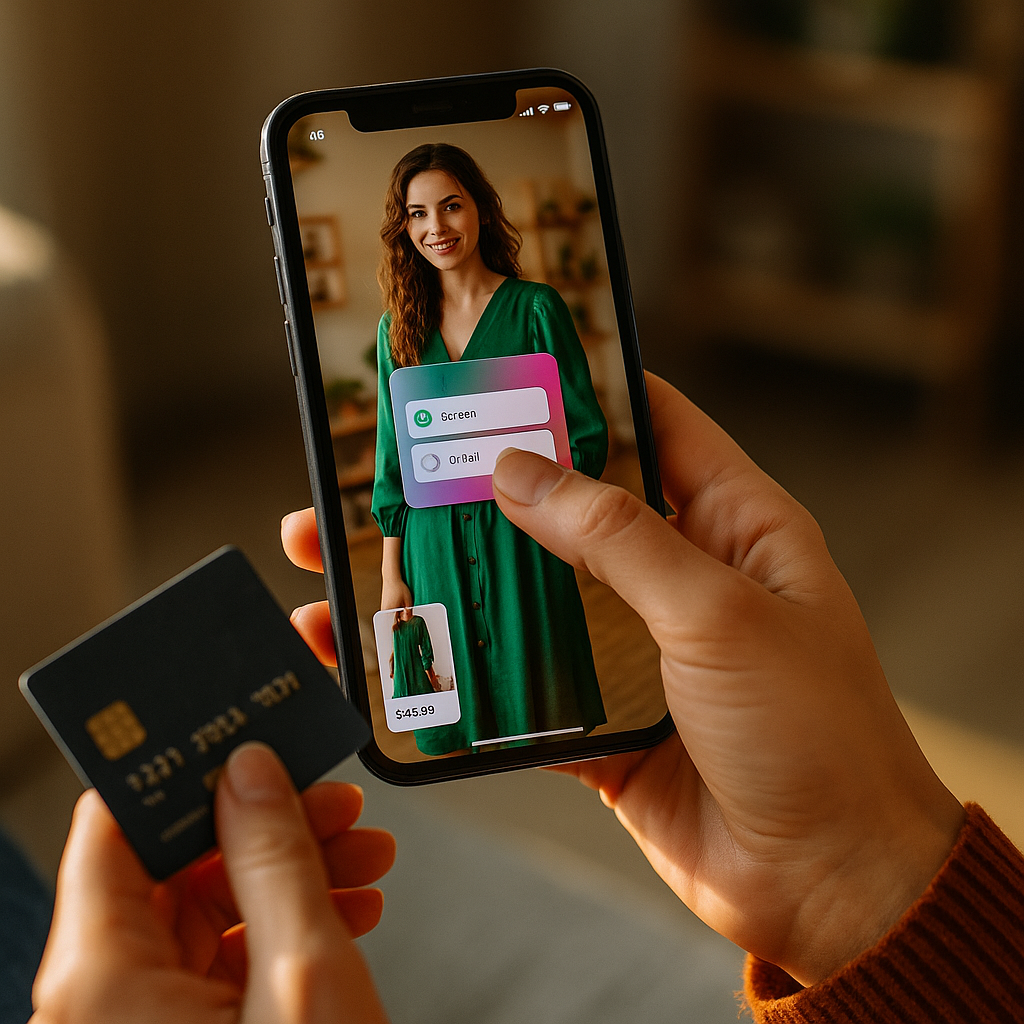
Reels completion rates hover around 50% for most brands, and they’ve been sliding for two years straight. Here’s the uncomfortable question: what if the fix isn’t a better hook or a punchier CTA, but giving the viewer something to do? The poll-driven interactive video format is quietly outperforming static shoppable Reels by turning passive scrollers into active participants, and the completion data backs it up.
Why Passive Viewing Is Losing to Interactive Formats
Think about the last ten Reels you watched. How many did you finish? Probably fewer than half. Viewers have been trained to swipe the second they sense a sales pitch, and shoppable Reels — with their product tags, swipe-up links, and “shop now” stickers — practically announce themselves as ads within the first two seconds.
Polls interrupt that pattern recognition. A sticker asking “Which color would you cop?” isn’t read as a sales cue. It’s read as a question, and questions trigger a different cognitive response than pitches. Viewers pause to think, tap an answer, then stick around to see the result. That micro-commitment is the whole mechanism behind why this format works.
A single tap on a poll sticker is a stronger completion signal than a five-second view, because it requires intent, not just inertia.
This isn’t a new insight dressed up in new packaging, either. Our earlier deep-dive on poll-driven video covered the completion-rate mechanics in detail. What’s new for 2026 is layering that interactivity directly into shoppable formats, where the poll doesn’t just boost watch time — it actively segments purchase intent before a single dollar is spent on retargeting.
What the Format Actually Looks Like
Strip away the jargon and it’s simple. A creator posts a Reel with a native poll sticker embedded mid-video — “Would you wear this to work or weekend only?” — and the two outcomes lead to different product tags or different follow-up content. Brands are running three variations right now:
- Binary choice, single SKU: Poll asks A vs. B (color, size, styling), and the shoppable tag adjusts based on the majority vote or the viewer’s individual tap.
- Poll-to-unlock: The second half of the video, often the best part, stays locked until the viewer votes. This is borrowed from the cliffhanger structures we’ve written about in the TikTok cliffhanger format playbook, except the unlock mechanic is a vote instead of a follow.
- Sequential poll series: A multi-part Reel series where each installment opens with results from the last poll, creating a feedback loop that mirrors the retention tricks in our cliffhanger series guide.
All three share one trait: the poll isn’t decoration. It changes what the viewer sees next, or at minimum, it changes what they believe they’re contributing to. That perceived stake is what separates this from a throwaway “like if you agree” gimmick.
The Completion Math, Explained Plainly
Instagram’s own creator tools documentation confirms that interactive stickers, including polls, increase time spent on Reels and Stories, a pattern Meta’s business platform has leaned into by expanding sticker placement options across formats. TikTok has made a similar bet, building poll and Q&A stickers directly into its native creation tools rather than leaving them to third-party overlays, per TikTok’s advertising resources.
Why does a tap correlate with completion? Three reasons, and they’re worth internalizing before you brief your next campaign:
- Attention re-anchoring. Every scroll-stopping moment resets the viewer’s decision to keep watching. A poll placed at the 40-50% mark of the video re-anchors attention right when drop-off typically spikes.
- Curiosity about the crowd. Once someone votes, they want to see how their answer compares. That’s basic social proof wiring, and it’s the same instinct that makes “see results” text on any poll almost irresistible.
- Sunk cost, lightly applied. A tap costs nothing, but it’s still an action. Viewers who’ve acted are marginally more likely to finish than those who haven’t, mirroring the foot-in-the-door principle marketers have exploited in email and landing page design for years.
None of this is exotic behavioral science. It’s the same psychology HubSpot’s research on interactive content has documented for quizzes and calculators on landing pages, just repackaged for nine-second attention spans.
Where It Fits in a Shoppable Strategy
Shoppable video has a segmentation problem most brands ignore. A single Reel gets tagged with one product, maybe two, and every viewer sees the identical shopping path regardless of what they actually want. Poll-driven layering fixes that without building separate videos for every audience segment.
Picture a beauty brand launching a foundation in five shades. Instead of five separate Reels (expensive, and each one competing with the others for the algorithm’s attention), one Reel runs a poll: “Fair, medium, or deep — vote for your shade family.” Viewers who vote “medium” get routed to a shoppable tag showing the medium-range shades. It’s dynamic personalization inside a single creative asset, something that would have required a full CDN-driven website experience just a few years back.
This pairs naturally with other briefing approaches we’ve covered. If you’re running carousel content for saves, the poll Reel can act as the top-of-funnel driver that pushes undecided viewers toward the more considered carousel format downstream. And if the product itself needs a demonstration, blending poll mechanics with the pacing principles in speed-run tutorial briefs keeps the whole experience under fifteen seconds without sacrificing the interactive moment.
Briefing It Without Sounding Like a Focus Group
Here’s where most brand teams botch it. They write a brief that reads like a survey instrument — “ask the audience their preference on X” — and creators deliver something stiff, transactional, and about as engaging as a customer satisfaction email.
Good poll-driven briefs give creators three things and then get out of the way:
- The decision point, not the script. Tell the creator what choice matters to the brand (size, use-case, flavor, styling) and let them phrase the poll in their own voice.
- A reason the poll matters to the viewer, not just the brand. “Vote so we know what to restock” works. “Vote so we can hit our KPIs” does not, obviously, but you’d be surprised how often briefs accidentally imply the latter.
- Freedom on placement. Mandate that the poll appears in the first two-thirds of the video, but let the creator find the natural pause point. Forced placement is why so many branded polls feel bolted on.
This is the same instinct that separates good and bad execution across nearly every interactive format. Compare it to how we’ve approached briefing for comment-reply video series, where the creator’s job is to make brand-driven content feel like organic conversation. Polls demand the same sleight of hand.
Compliance and Disclosure, Don’t Skip This Part
Interactive elements don’t exempt anyone from disclosure obligations. If a creator is paid to include a poll that drives to a shoppable tag, that’s still a material connection under FTC endorsement guidance, and the disclosure needs to be clear and conspicuous regardless of how playful the poll feels. Brands operating in the UK should also check current guidance from the ICO on data handling, since poll responses can constitute user data depending on how they’re stored and used for retargeting.
There’s a data-collection wrinkle worth flagging to legal before launch. Poll results tied to shoppable tags can start to resemble preference data collection, especially if the brand exports vote counts for segmentation. That’s not inherently a problem, but it does mean the disclosure should cover both the paid partnership and any data use, particularly if you’re retargeting based on poll responses. We’ve seen brands stumble on similar territory in our coverage of confessional testimonial briefs, where the line between organic-feeling content and disclosed commercial activity gets blurry fast.
The moment poll data gets exported for retargeting, it stops being a fun engagement mechanic and starts being a data pipeline that legal needs to sign off on.
Measuring What Actually Matters
Completion rate is the headline metric, but it’s not the only one worth tracking. Pull these four numbers before declaring a poll-driven Reel a win:
- Vote participation rate — what percentage of viewers who saw the poll actually tapped an answer. Anything under 8-10% suggests the poll question wasn’t compelling.
- Post-vote completion rate — of those who voted, how many watched to the end. This isolates the causal effect of participation.
- Shoppable tag click-through by segment — compare click-through rates across the different poll answer paths. This tells you which segment is closer to purchase intent.
- Cost per completed view — run this against your standard shoppable Reels to see if the added production complexity (usually minimal) actually pays off in media efficiency.
Platforms report aggregate engagement data through native analytics, and third-party tools like those tracked by Sprout Social and benchmarked in eMarketer’s social video research can help contextualize whether your lift is competitive or just noise. Don’t trust a single campaign’s numbers. Run at least three poll variations before drawing conclusions about which question format drives the strongest completion lift for your category.
Next step: pick one shoppable Reel already in production, add a single binary poll at the natural midpoint, and route the two answer paths to two shoppable tags. Measure completion and click-through against your last five non-interactive Reels before scaling the format further.
FAQs
Does adding a poll actually hurt shoppable conversion by distracting viewers from the product?
Data so far suggests the opposite. Because the poll routes viewers to a more relevant product tag, click-through often improves rather than declines, since the shopping suggestion matches what the viewer just told you they wanted.
What’s the ideal length for a poll-driven shoppable Reel?
Most brands see the strongest completion lift between twelve and twenty seconds, long enough to establish the poll’s stakes but short enough that the payoff arrives before attention fades.
Do polls work better on TikTok or Instagram Reels?
Both platforms support native poll stickers with comparable engagement mechanics. The bigger variable is audience: TikTok users tend to vote faster and more casually, while Instagram audiences respond better when the poll ties to a tangible product decision.
How many poll options should a shoppable Reel offer?
Stick to two. Binary choices drive higher participation rates than three-or-more option polls, since the cognitive load of deciding stays low enough for a scroll-speed decision.
Does this format require paid promotion to work, or does it perform organically?
It performs well organically because the interactivity itself is a ranking signal on most platforms, but pairing a high-performing organic poll Reel with paid amplification typically extends its reach once you’ve validated the poll question with real audience data.
FAQs
Does adding a poll actually hurt shoppable conversion by distracting viewers from the product?
Data so far suggests the opposite. Because the poll routes viewers to a more relevant product tag, click-through often improves rather than declines, since the shopping suggestion matches what the viewer just told you they wanted.
What’s the ideal length for a poll-driven shoppable Reel?
Most brands see the strongest completion lift between twelve and twenty seconds, long enough to establish the poll’s stakes but short enough that the payoff arrives before attention fades.
Do polls work better on TikTok or Instagram Reels?
Both platforms support native poll stickers with comparable engagement mechanics. The bigger variable is audience: TikTok users tend to vote faster and more casually, while Instagram audiences respond better when the poll ties to a tangible product decision.
How many poll options should a shoppable Reel offer?
Stick to two. Binary choices drive higher participation rates than three-or-more option polls, since the cognitive load of deciding stays low enough for a scroll-speed decision.
Does this format require paid promotion to work, or does it perform organically?
It performs well organically because the interactivity itself is a ranking signal on most platforms, but pairing a high-performing organic poll Reel with paid amplification typically extends its reach once you’ve validated the poll question with real audience data.
Top Influencer Marketing Agencies
The leading agencies shaping influencer marketing in 2026
Agencies ranked by campaign performance, client diversity, platform expertise, proven ROI, industry recognition, and client satisfaction. Assessed through verified case studies, reviews, and industry consultations.
Moburst

-
2

The Shelf
Boutique Beauty & Lifestyle Influencer AgencyA data-driven boutique agency specializing exclusively in beauty, wellness, and lifestyle influencer campaigns on Instagram and TikTok. Best for brands already focused on the beauty/personal care space that need curated, aesthetic-driven content.Clients: Pepsi, The Honest Company, Hims, Elf Cosmetics, Pure LeafVisit The Shelf → -
3

Audiencly
Niche Gaming & Esports Influencer AgencyA specialized agency focused exclusively on gaming and esports creators on YouTube, Twitch, and TikTok. Ideal if your campaign is 100% gaming-focused — from game launches to hardware and esports events.Clients: Epic Games, NordVPN, Ubisoft, Wargaming, Tencent GamesVisit Audiencly → -
4

Viral Nation
Global Influencer Marketing & Talent AgencyA dual talent management and marketing agency with proprietary brand safety tools and a global creator network spanning nano-influencers to celebrities across all major platforms.Clients: Meta, Activision Blizzard, Energizer, Aston Martin, WalmartVisit Viral Nation → -
5

The Influencer Marketing Factory
TikTok, Instagram & YouTube CampaignsA full-service agency with strong TikTok expertise, offering end-to-end campaign management from influencer discovery through performance reporting with a focus on platform-native content.Clients: Google, Snapchat, Universal Music, Bumble, YelpVisit TIMF → -
6

NeoReach
Enterprise Analytics & Influencer CampaignsAn enterprise-focused agency combining managed campaigns with a powerful self-service data platform for influencer search, audience analytics, and attribution modeling.Clients: Amazon, Airbnb, Netflix, Honda, The New York TimesVisit NeoReach → -
7

Ubiquitous
Creator-First Marketing PlatformA tech-driven platform combining self-service tools with managed campaign options, emphasizing speed and scalability for brands managing multiple influencer relationships.Clients: Lyft, Disney, Target, American Eagle, NetflixVisit Ubiquitous → -
8

Obviously
Scalable Enterprise Influencer CampaignsA tech-enabled agency built for high-volume campaigns, coordinating hundreds of creators simultaneously with end-to-end logistics, content rights management, and product seeding.Clients: Google, Ulta Beauty, Converse, AmazonVisit Obviously →