


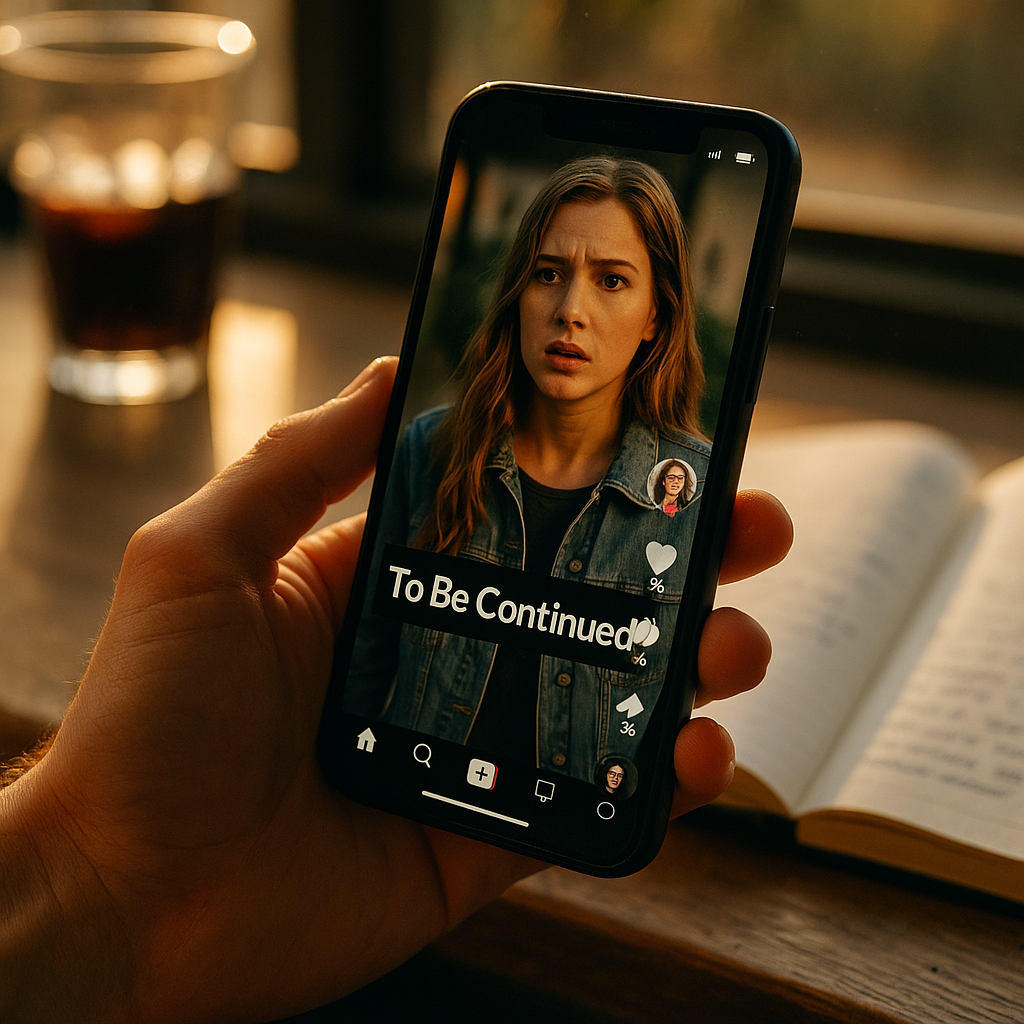
TikTok’s own retention data shows the average viewer drops off within the first three seconds if a hook doesn’t land. So what happens when your entire brief only gets you sixty seconds? You stop trying to tell a whole story and start engineering an open loop. The cliffhanger format isn’t a gimmick borrowed from soap operas — it’s the single most reliable structural tool for turning a one-off branded video into a multi-episode series with compounding reach.
Most brand briefs still treat 60 seconds as a container for a complete pitch: problem, solution, CTA, done. That’s leaving reach on the table. Series built on unresolved tension consistently outperform standalone posts on completion rate and follow-through views, because the platform’s algorithm rewards exactly what cliffhangers produce — return visits, comments demanding part two, and saves for later. This is a structural problem, not a creative one. Solve the structure and the creative takes care of itself.
Why Three Acts Still Work at Six Seconds a Beat
Three-act structure survived from Aristotle to Pixar for a reason: it mirrors how humans process tension and resolution. Compress it into 60 seconds and each “act” might only get 15-20 seconds, but the logic holds. Act one sets a stake. Act two escalates it. Act three should resolve just enough to satisfy, while deliberately withholding the piece that sends viewers to episode two.
The mistake brands make is trying to cram a full three-act payoff into every single episode. That kills series potential. Instead, think of each 60-second video as act one and two of its own arc, with act three deferred to the next post in the series. You’re not writing six sitcoms. You’re writing one serialized script, chopped at the exact moment tension peaks.
The strongest TikTok series don’t resolve conflict at the end of an episode — they relocate it to the beginning of the next one.
This is the same instinct behind our earlier breakdown on building cliffhanger-driven TikTok series, but the operational question brand teams keep asking is more specific: where exactly do you cut, and how do you brief that cut so a creator doesn’t just… end the video wherever feels natural?
Mapping the Arc Before You Write a Single Line
Before any script gets written, map the full arc across the intended episode count — usually three to five for a branded series. Know your ending before you shoot your beginning. This sounds obvious, but the number of campaigns that discover the payoff mid-production is genuinely alarming.
- Episode 1 — Inciting incident: Introduce the stake in the first 3 seconds. This is your hook, and it needs a question the viewer can’t shake.
- Episode 2 — Escalation: Raise the stakes or complicate the premise. New information should reframe what viewers thought they understood in episode one.
- Episode 3 — False resolution: Deliver a partial answer that feels satisfying but plants a new question.
- Episode 4/Final — Payoff: Resolve the arc and land the CTA, product tie-in, or offer.
Notice the CTA sits at the end, not scattered throughout. That’s deliberate. Cliffhanger series convert better on the final beat precisely because attention has compounded across episodes rather than being split within one.
The Anatomy of the Cut: Where to Stop Talking
Here’s the part most briefs get wrong: the cliffhanger isn’t a line of dialogue, it’s a withheld piece of information at the exact point of maximum curiosity. Cutting too early feels like a glitch. Cutting too late gives away the resolution and kills the reason to return.
A useful rule from serialized TV writing translates well here: cut on the question, not the answer. If your creator just revealed a surprising result, cut before they explain why. If a product demo hits an unexpected snag, cut before the fix. The viewer’s brain does the rest — that’s the Zeigarnik effect at work, the same psychological itch that makes an unfinished task harder to forget than a finished one.
Practically, this means your script document needs an explicit “cut point” annotation, not just a runtime marker. Creators working off vague briefs will naturally round out a thought because that’s good storytelling instinct — and it’s exactly wrong for this format. Be blunt in the brief: “End here. Do not resolve. Do not add a wrap-up line.”
If your creator’s outro feels emotionally complete, you’ve already lost the second episode.
Pacing the 60 Seconds: A Beat-by-Beat Template
Brands running paid amplification behind organic series (increasingly common as TikTok’s ad platform leans into Spark Ads for creator content) need consistent pacing across episodes so retention curves are comparable. A workable template:
- 0-3 seconds: Hook — visual or verbal disruption tied to the stake.
- 4-15 seconds: Setup — establish context fast, no throat-clearing.
- 16-40 seconds: Escalation — complication, twist, or new stake.
- 41-55 seconds: Peak tension — the moment right before resolution.
- 56-60 seconds: The cut — cliffhanger line, freeze frame, or “part 2” text overlay.
That last four seconds carry disproportionate weight. Data from eMarketer on short-form video consumption patterns consistently shows the final seconds of a clip determine whether a viewer taps the creator’s profile — which is exactly the behavior a series needs to seed episode two discovery, especially for accounts without huge follower bases yet.
Comment Sections Are Your Writers’ Room
This is where cliffhanger series diverge from traditional TV and actually get more powerful. You don’t have to guess what resolution audiences want — they’ll tell you in the comments within hours of episode one going live. Smart brand teams treat that comment section as live audience research and adjust episode two’s script accordingly, within reason.
This overlaps meaningfully with the logic behind comment-reply video series: the audience’s questions become your next script’s spine. For a cliffhanger arc specifically, watch for comments that reveal what viewers think the resolution will be. If most predict correctly, you may want to add a twist. If they’re wildly off, lean into the reveal as planned — you’ve validated the tension worked.
One caution: don’t let comment mining slow production so much that you miss the retention window. Series lose momentum fast if there’s a multi-week gap between episodes. Aim for 48-72 hours between posts while the first episode is still circulating.
Compliance Doesn’t Take a Break Because the Story Isn’t Over
Serialized structure creates a specific disclosure risk: if the paid partnership disclosure only appears in episode one, and episode three gets discovered independently by the algorithm (which happens constantly), you’ve got an undisclosed ad running wild. Every single episode needs its own disclosure, full stop, regardless of whether it’s a “part 2 of 4” post.
The FTC’s endorsement guidance doesn’t carve out exceptions for serialized content, and platform-level disclosure tools (TikTok’s branded content toggle, for instance) need to be applied episode by episode, not just once at series launch. This is the same operational discipline covered in our piece on launch sequences that stay compliant — sequential content multiplies your disclosure touchpoints, it doesn’t reduce them.
Build a compliance checklist into your episode template document. It should live right next to the cut-point annotation, not in a separate legal doc nobody opens until something goes wrong.
Casting for Serialized Delivery
Not every creator can hold a cliffhanger. Some default to resolving everything because that’s what feels like “good content” to them — tidy, complete, shareable in isolation. When casting for a series, ask creators directly how they’d end an episode mid-tension. Their answer tells you more about series fit than their engagement rate does.
This is similar to the vetting process outlined in our guide on vertical drama briefs, where narrative discipline matters more than raw follower count. A creator with 40K followers who nails a cliffhanger delivery will outperform a 400K creator who can’t resist tying a bow on every video.
Measuring What Actually Matters
Standard view counts and average watch time tell you almost nothing about whether your cliffhanger structure is working. The metrics that matter for serialized retention:
- Episode-to-episode follow-through rate: what percentage of episode one viewers also watched episode two within 72 hours.
- Profile visit rate from final-frame CTAs: did the cliffhanger actually drive profile taps.
- Completion rate delta across episodes: completion should climb as the series progresses if tension is escalating properly.
- Comment sentiment specificity: vague “love this” comments versus specific predictions and demands for resolution — the latter signals real narrative investment.
Most brand analytics dashboards, including native TikTok analytics, won’t surface episode-to-episode follow-through automatically. You’ll need to tag content manually or work with your agency to build a lightweight tracking sheet. It’s tedious. It’s also the only way to know if your three-act structure is actually retaining anyone or just producing four disconnected videos that happen to share a hashtag.
Get the structure right and the format compounds: each episode becomes a distribution engine for the next, audience investment builds instead of resetting, and your CTA lands on a viewer who’s actually been paying attention for days, not seconds.
Frequently Asked Questions
How many episodes should a TikTok cliffhanger series run?
Three to five episodes is the sweet spot for most brand campaigns. Fewer than three doesn’t build enough narrative investment to matter; more than five risks audience fatigue and production strain before the payoff lands.
Do cliffhanger series work for product demos, or just storytelling content?
They work well for demos when the “cliffhanger” is a result or outcome rather than a plot twist — for example, cutting right before a before-and-after reveal. Pair this with insights from before-and-after briefs for compliant execution.
How long should you wait between episodes?
48 to 72 hours is generally ideal. Long enough for episode one to circulate and gather comments, short enough that audience momentum doesn’t fade.
Does each episode need its own paid partnership disclosure?
Yes. FTC guidance and platform policy both require disclosure on every piece of sponsored content, regardless of whether it’s part of a series. There are no exceptions for serialized formats.
What’s the biggest mistake brands make with this format?
Resolving too much within a single episode. If the ending feels emotionally or narratively complete, viewers have no reason to seek out the next installment.
Visible FAQ
Frequently Asked Questions
How many episodes should a TikTok cliffhanger series run?
Three to five episodes is the sweet spot for most brand campaigns. Fewer than three doesn’t build enough narrative investment to matter; more than five risks audience fatigue and production strain before the payoff lands.
Do cliffhanger series work for product demos, or just storytelling content?
They work well for demos when the “cliffhanger” is a result or outcome rather than a plot twist — for example, cutting right before a before-and-after reveal.
How long should you wait between episodes?
48 to 72 hours is generally ideal. Long enough for episode one to circulate and gather comments, short enough that audience momentum doesn’t fade.
Does each episode need its own paid partnership disclosure?
Yes. FTC guidance and platform policy both require disclosure on every piece of sponsored content, regardless of whether it’s part of a series. There are no exceptions for serialized formats.
What’s the biggest mistake brands make with this format?
Resolving too much within a single episode. If the ending feels emotionally or narratively complete, viewers have no reason to seek out the next installment.
Next step: pick one live campaign, map its full episode arc on paper before writing a single script, and mark the exact cut-point for episode one. If you can’t articulate what question the cut leaves unanswered, you don’t have a cliffhanger yet — you have an incomplete video.
Top Influencer Marketing Agencies
The leading agencies shaping influencer marketing in 2026
Agencies ranked by campaign performance, client diversity, platform expertise, proven ROI, industry recognition, and client satisfaction. Assessed through verified case studies, reviews, and industry consultations.
Moburst

-
2

The Shelf
Boutique Beauty & Lifestyle Influencer AgencyA data-driven boutique agency specializing exclusively in beauty, wellness, and lifestyle influencer campaigns on Instagram and TikTok. Best for brands already focused on the beauty/personal care space that need curated, aesthetic-driven content.Clients: Pepsi, The Honest Company, Hims, Elf Cosmetics, Pure LeafVisit The Shelf → -
3

Audiencly
Niche Gaming & Esports Influencer AgencyA specialized agency focused exclusively on gaming and esports creators on YouTube, Twitch, and TikTok. Ideal if your campaign is 100% gaming-focused — from game launches to hardware and esports events.Clients: Epic Games, NordVPN, Ubisoft, Wargaming, Tencent GamesVisit Audiencly → -
4

Viral Nation
Global Influencer Marketing & Talent AgencyA dual talent management and marketing agency with proprietary brand safety tools and a global creator network spanning nano-influencers to celebrities across all major platforms.Clients: Meta, Activision Blizzard, Energizer, Aston Martin, WalmartVisit Viral Nation → -
5

The Influencer Marketing Factory
TikTok, Instagram & YouTube CampaignsA full-service agency with strong TikTok expertise, offering end-to-end campaign management from influencer discovery through performance reporting with a focus on platform-native content.Clients: Google, Snapchat, Universal Music, Bumble, YelpVisit TIMF → -
6

NeoReach
Enterprise Analytics & Influencer CampaignsAn enterprise-focused agency combining managed campaigns with a powerful self-service data platform for influencer search, audience analytics, and attribution modeling.Clients: Amazon, Airbnb, Netflix, Honda, The New York TimesVisit NeoReach → -
7

Ubiquitous
Creator-First Marketing PlatformA tech-driven platform combining self-service tools with managed campaign options, emphasizing speed and scalability for brands managing multiple influencer relationships.Clients: Lyft, Disney, Target, American Eagle, NetflixVisit Ubiquitous → -
8

Obviously
Scalable Enterprise Influencer CampaignsA tech-enabled agency built for high-volume campaigns, coordinating hundreds of creators simultaneously with end-to-end logistics, content rights management, and product seeding.Clients: Google, Ulta Beauty, Converse, AmazonVisit Obviously →