


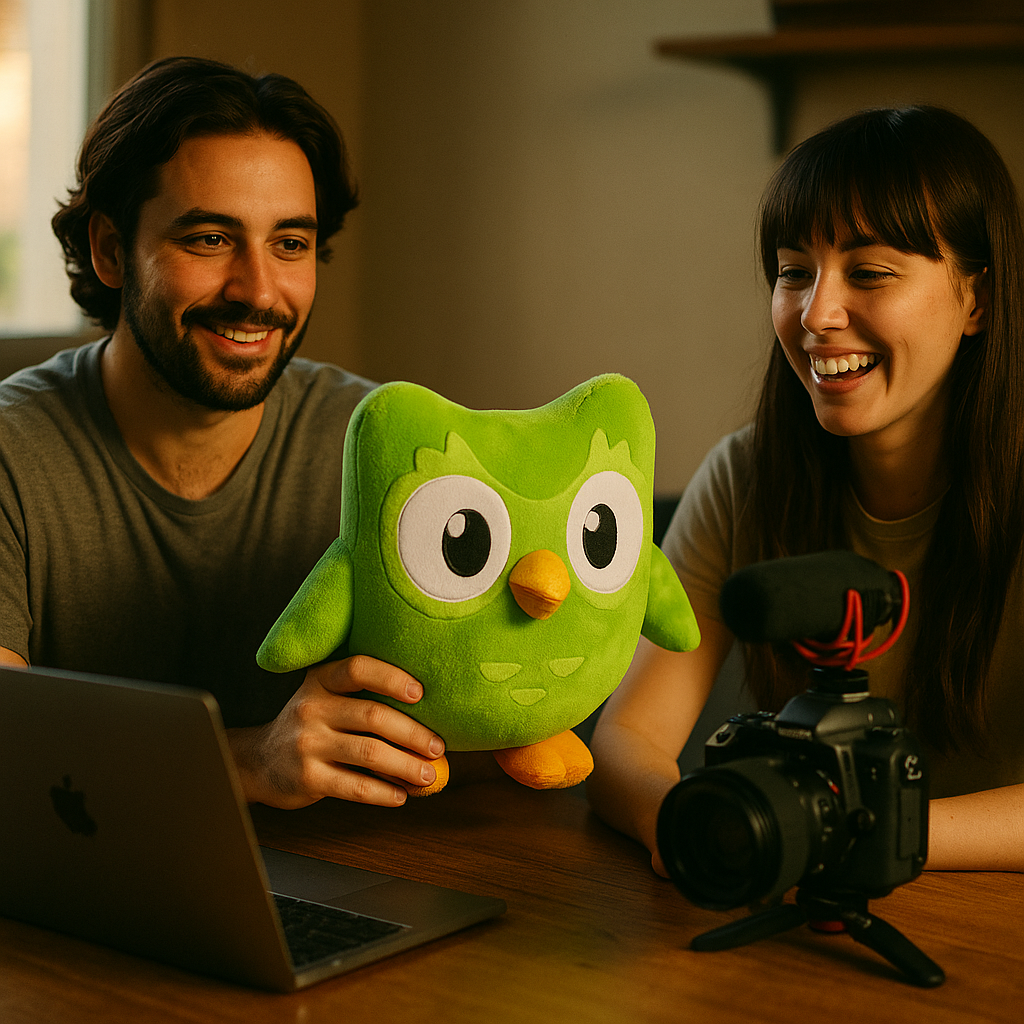
Duolingo doesn’t buy attention. It rents relevance from creators who already have it — then lets the owl show up like it belongs there. The result of one such YouTube creator partnership push: a documented ROAS lift that most app marketers would kill for, achieved by matching a chaotic mascot to a surprisingly narrow creator niche. Here’s how the math actually worked.
The Setup: Why a Mascot Needed Creators at All
By the time this campaign launched, Duolingo’s owl was already a cultural fixture. Zero-paid-media TikTok stunts had turned Duo into a meme factory, chasing users into gyms, weddings, and Twitter beefs with Elon Musk. We covered that arc in detail in our breakdown of the TikTok owl strategy. But TikTok virality and YouTube conversion are different sports.
TikTok built the owl’s fame. YouTube needed to convert that fame into subscriptions, specifically paid-tier upgrades among adults with actual language-learning intent — not teenagers laughing at a bird threatening violence over missed lessons.
That’s a harder audience to reach with a joke. So Duolingo’s growth team didn’t scale the meme. They narrowed it.
The Niche Bet: Language Creators, Not Comedy Creators
Instead of running the owl through broad-reach comedy or lifestyle YouTubers, Duolingo’s team concentrated spend on a tight roster of niche language-learning creators — polyglot channels, immersion-method tutors, and creators documenting their own fluency journeys in Spanish, Japanese, and Korean specifically.
This is a smaller audience by definition. Most of these channels sit in the 50K–500K subscriber range, nowhere near mass-reach territory. But the intent-match is nearly perfect: someone watching a video titled “Why Duolingo Streaks Don’t Actually Build Fluency” is already primed to consider the product, positively or critically.
The lift didn’t come from more impressions. It came from swapping generic reach for creators whose entire audience was already shopping for a language app.
Duolingo let these creators be critical, too. Several sponsored segments included honest caveats — “Duolingo won’t make you fluent alone” — before pivoting to how it fits into a broader study stack. That candor is exactly why the CTR held up. Viewers trust creators who don’t sound like walking ad copy, a pattern we’ve also seen work in single-creator ROI plays that beat roster-based spending.
Matching the Owl Persona to the Right Creator Tone
Here’s the part most brands get wrong when they license a mascot to creators: they treat the mascot as a logo, not a character with rules of engagement.
Duolingo’s brand team reportedly briefed creators on where the owl’s “menace” humor could show up organically (thumbnails, cold opens, mid-roll gags) versus where it needed to disappear entirely (actual product walkthroughs, pricing discussions, feature comparisons). This wasn’t creative control for control’s sake. It was persona segmentation by funnel stage.
- Top-of-funnel moments: owl chaos, memes, streak-shaming bits that matched existing TikTok equity.
- Mid-funnel moments: owl as a lighthearted brand cameo, present but not distracting from the creator’s actual teaching content.
- Bottom-of-funnel moments: owl mostly absent, replaced by the creator’s genuine assessment of the app’s course structure and pricing tiers.
That structure matters because niche language-learning audiences skew analytical. They’re comparing Duolingo against Babbel, Pimsleur, and immersion apps in the same video. A poorly timed joke at the pricing comparison moment kills conversion intent instantly.
The ROAS Numbers, and Why They’re Believable
Public disclosures on exact spend and returns are limited, since Duolingo doesn’t break out creator-level ROAS in earnings calls. But directionally, the signals are strong: Duolingo’s paid subscriber base and bookings have both climbed sharply in recent reporting periods, and the company has repeatedly credited organic and creator-driven channels over traditional performance media as the efficiency lever. Third-party estimates from marketing analytics firms tracking app-install campaigns have placed influencer-sourced installs at a meaningfully lower cost-per-install than paid social for language-learning apps specifically, a category where trust and perceived credibility drive conversion more than most verticals.
The mechanism behind the lift is straightforward once you see it: niche creator audiences convert at higher rates because they arrive pre-qualified. A general entertainment audience clicking a Duolingo ad is cold. A polyglot-channel subscriber watching a sponsored segment is already three steps into the consideration journey. Duolingo just needed to not blow it with tone-deaf creative.
Attribution modeling for the creator program leaned on branded search lift and promo-code tracking rather than last-click, giving Duolingo a fuller read on assisted conversions across YouTube, TikTok, and organic search.
That’s an important operational detail for any brand trying to replicate this. If you’re measuring creator ROAS purely on last-click codes, you’re undercounting. Most language-app buyers watch a video, close the tab, think about it for a week, then search the brand name directly or download without ever clicking the video description link.
What This Means for Brands Without a Beloved Mascot
Not every brand has an owl with cultural cachet. Fair point. But the transferable lesson isn’t “get a mascot.” It’s “match persona intensity to audience intent, funnel stage by funnel stage.”
Rare Beauty did something structurally similar with its creator cohort approach, prioritizing genuine product fit over celebrity wattage — a strategy we unpacked in this cohort strategy case study. Liquid Death took the opposite persona extreme — full absurdism, all the time — and it still worked because the brand voice never wavered inside creator content, as detailed in our analysis of its creator strategy.
The common thread: brand voice consistency plus audience-fit precision. Duolingo just happens to have the loudest voice in the room.
Operational Takeaways for Marketing Teams
- Segment creators by funnel intent, not just follower count. Duolingo’s niche language creators outperformed broader comedy channels on conversion despite smaller audiences, echoing findings we’ve covered around creator discovery based on interest over follower count.
- Brief mascots and brand characters with funnel-stage rules, not blanket creative freedom or blanket restriction.
- Let creators keep critical framing. Sponsored honesty converts better than scripted praise, particularly in education and utility categories where trust is the entire sale.
- Model attribution beyond last-click. Branded search lift and promo tracking capture the deferred-conversion behavior typical of considered purchases.
- Treat YouTube and TikTok as separate jobs. One builds fame, the other builds qualified pipeline. Don’t run the same brief on both.
None of this works without genuine performance measurement discipline, the kind of structured content supply chain thinking Unilever has applied to real-time signal strategy, covered in our piece on content supply chain and real-time signals. Duolingo’s creator program isn’t magic. It’s disciplined segmentation wearing a costume.
For brands benchmarking their own influencer spend against category norms, tools like Sprout Social’s influencer reporting suite and eMarketer’s creator economy forecasts are useful starting points, alongside HubSpot’s attribution modeling guides for multi-touch campaigns. Platform-side, TikTok’s ad platform documentation and Meta’s business resources are worth cross-referencing when building comparable cross-platform attribution frameworks, since Duolingo’s own reporting blends organic and paid signals across both.
Frequently Asked Questions
What made Duolingo’s YouTube creator strategy different from its TikTok approach?
TikTok content leaned entirely organic and comedic, built for reach and cultural buzz. The YouTube creator program targeted niche language-learning channels specifically to reach higher-intent audiences further along the consideration journey, prioritizing conversion over virality.
Why did Duolingo choose niche creators over larger, broad-reach YouTubers?
Niche language-learning creators deliver pre-qualified audiences already comparing language apps. That intent match produces stronger conversion rates than broad entertainment reach, even with smaller subscriber counts.
How did Duolingo measure ROAS if last-click attribution wasn’t reliable?
The program reportedly leaned on branded search lift and promo-code tracking to capture delayed conversions, since many viewers research a product after watching before eventually converting through organic search or direct download.
Can smaller brands without a recognizable mascot replicate this model?
Yes. The transferable principle is funnel-stage persona matching, briefing creators differently depending on whether content targets awareness, consideration, or decision-stage audiences, not the mascot itself.
What’s the biggest mistake brands make when licensing a brand character to creators?
Treating the character as a static logo rather than a tone that needs contextual rules. Comedic or chaotic brand personas often need to recede during pricing or feature-comparison moments to avoid undermining conversion intent.
The next move for any team watching this from the sidelines: audit your own creator roster for intent-match, not reach, and rebuild your attribution model before you scale spend, not after.
Top Influencer Marketing Agencies
The leading agencies shaping influencer marketing in 2026
Agencies ranked by campaign performance, client diversity, platform expertise, proven ROI, industry recognition, and client satisfaction. Assessed through verified case studies, reviews, and industry consultations.
Moburst

-
2

The Shelf
Boutique Beauty & Lifestyle Influencer AgencyA data-driven boutique agency specializing exclusively in beauty, wellness, and lifestyle influencer campaigns on Instagram and TikTok. Best for brands already focused on the beauty/personal care space that need curated, aesthetic-driven content.Clients: Pepsi, The Honest Company, Hims, Elf Cosmetics, Pure LeafVisit The Shelf → -
3

Audiencly
Niche Gaming & Esports Influencer AgencyA specialized agency focused exclusively on gaming and esports creators on YouTube, Twitch, and TikTok. Ideal if your campaign is 100% gaming-focused — from game launches to hardware and esports events.Clients: Epic Games, NordVPN, Ubisoft, Wargaming, Tencent GamesVisit Audiencly → -
4

Viral Nation
Global Influencer Marketing & Talent AgencyA dual talent management and marketing agency with proprietary brand safety tools and a global creator network spanning nano-influencers to celebrities across all major platforms.Clients: Meta, Activision Blizzard, Energizer, Aston Martin, WalmartVisit Viral Nation → -
5

The Influencer Marketing Factory
TikTok, Instagram & YouTube CampaignsA full-service agency with strong TikTok expertise, offering end-to-end campaign management from influencer discovery through performance reporting with a focus on platform-native content.Clients: Google, Snapchat, Universal Music, Bumble, YelpVisit TIMF → -
6

NeoReach
Enterprise Analytics & Influencer CampaignsAn enterprise-focused agency combining managed campaigns with a powerful self-service data platform for influencer search, audience analytics, and attribution modeling.Clients: Amazon, Airbnb, Netflix, Honda, The New York TimesVisit NeoReach → -
7

Ubiquitous
Creator-First Marketing PlatformA tech-driven platform combining self-service tools with managed campaign options, emphasizing speed and scalability for brands managing multiple influencer relationships.Clients: Lyft, Disney, Target, American Eagle, NetflixVisit Ubiquitous → -
8

Obviously
Scalable Enterprise Influencer CampaignsA tech-enabled agency built for high-volume campaigns, coordinating hundreds of creators simultaneously with end-to-end logistics, content rights management, and product seeding.Clients: Google, Ulta Beauty, Converse, AmazonVisit Obviously →