


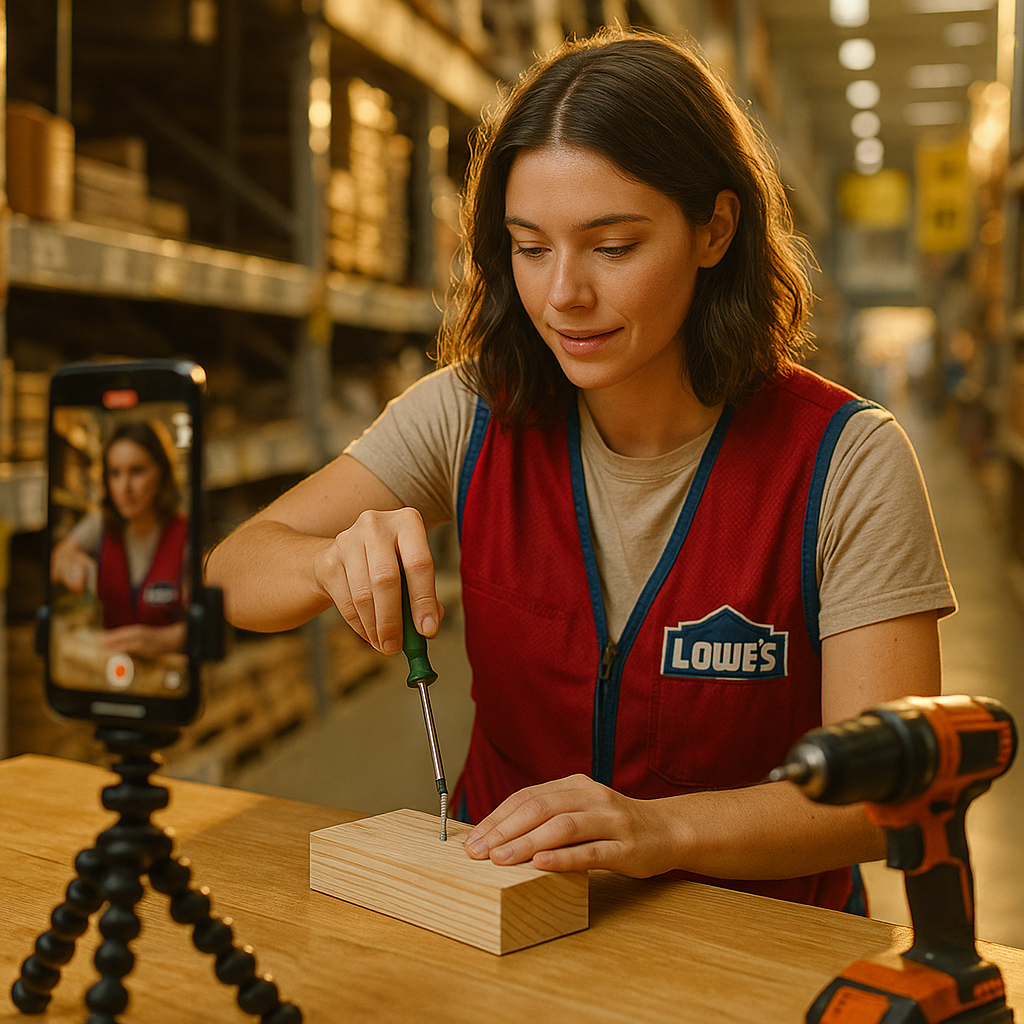
Home improvement retail has a data problem: shoppers watch a thousand DIY videos before they buy a single stud finder. Lowe’s decided to close that gap. Its creator-led DIY series didn’t just rack up views — it drove a documented lift in in-store project purchases, giving brand teams a rare, receipts-backed case study for influencer attribution in retail.
That’s the part most retail marketers skip past. Everyone talks about engagement rates. Almost nobody can tie a creator video to a basket of lumber, paint, and hardware purchased three days later at a physical register. Lowe’s did the work to connect those dots, and the results are worth dissecting.
Why Home Improvement Needed a Different Creator Playbook
Home improvement is not impulse retail. Nobody buys a circular saw because a creator looked cute holding one. Purchase cycles are longer, research is heavier, and the fear of screwing up a project (literally) is a real conversion barrier. That’s precisely why generic sponsored posts underperform in this category — they don’t address the anxiety that stalls the purchase.
Lowe’s leaned into project-based storytelling instead. Rather than one-off sponsored posts, the retailer built a recurring creator series structured around complete DIY projects: a patio makeover, a small-space garden bed, a weekend bathroom refresh. Each episode followed a real project from material list to finished result, with creators sourcing everything from Lowe’s stores.
This mirrors a pattern showing up across retail broadly. American Eagle’s TikTok strategy for in-store lift proved that creator content built around a specific, trackable action — not just brand awareness — is what moves foot traffic. Lowe’s applied the same logic to a much higher-consideration category.
The Format: Long-Form Utility Over Viral Gimmicks
Most retail creator campaigns chase short-form virality. Lowe’s series went the other direction. Episodes ran 8-15 minutes on YouTube, with 60-90 second cutdowns for Instagram Reels and TikTok pointing viewers back to the full project breakdown.
Why does that matter for measurement? Because longer format content generates a clearer, more attributable path: viewer watches project, viewer sees materials list, viewer searches or visits store for those exact items. Short-form virality is great for reach. It’s terrible for attribution unless you build the tracking layer underneath it.
- Each video included an itemized project materials list with approximate in-store pricing.
- Creators used Lowe’s MyLowe’s Rewards linkage and unique project codes redeemable in-store and online.
- Store associates in test markets were briefed on the campaign so they could recognize and assist “project code” shoppers.
That last point is easy to overlook, but it’s the operational detail that separates a real case study from a vanity metrics exercise. Retail media only works when the store floor is looped into the digital campaign, not treated as a separate channel.
Lowe’s found that shoppers who arrived with a specific creator-sourced project in mind spent measurably more per visit than average project shoppers — the content wasn’t just building awareness, it was pre-selling the basket.
How They Actually Measured In-Store Lift
This is the question every brand strategist should be asking: how do you attribute a physical store purchase to a piece of online content, without relying on shaky self-reported surveys?
Lowe’s combined a few methods rather than betting on one:
- Project code redemption tracking — unique codes tied to each creator series episode, scannable at checkout or entered online, giving a hard attribution floor.
- Geo-lift testing — comparing purchase velocity for featured project categories (patio, garden, small bath) in markets with heavy campaign media weight against matched control markets with none.
- Loyalty data overlay — cross-referencing MyLowe’s Rewards purchase histories against campaign exposure and video engagement data.
- Search and store-locator spikes — tracking correlation between video publish dates and localized search volume for featured products and “near me” store queries.
None of these methods alone would be bulletproof. Project codes undercount casual shoppers who saw the video but didn’t bother entering a code. Geo-lift testing can be muddied by seasonality and weather (a real variable in home improvement). But stacked together, they gave Lowe’s a defensible, multi-signal case for lift rather than a single fragile metric.
This is the same layered-attribution logic behind AI-driven CRM attribution models gaining traction across retail marketing — no single data point tells the whole story, but triangulation does.
The Numbers That Made Finance Pay Attention
Retail marketers don’t get budget renewed on views. They get it renewed on basket size and category lift. Reported outcomes from the campaign period showed featured project categories outperforming their prior-period baseline by a double-digit percentage in test markets, with average transaction size for “project code” shoppers coming in meaningfully higher than typical project-category purchases.
That’s the number that matters to a CFO: not reach, not watch time, but incremental basket value tied directly to a trackable content-to-purchase path.
Compare that to the broader industry benchmark. Retail media and influencer attribution studies from eMarketer consistently show that most brands still struggle to connect influencer spend to offline sales with any precision. Lowe’s approach is notable specifically because it treated attribution infrastructure as part of the creative brief, not an afterthought bolted on after launch.
Creator Selection: Skill Credibility Over Follower Count
Lowe’s didn’t cast based on subscriber tiers. It cast based on demonstrable project competence — creators who’d built an audience specifically because they could tile a backsplash correctly or frame a raised garden bed without it collapsing by August. Trust in this category is earned through visible skill, not personality.
This aligns with a broader shift Unilever’s creator discovery approach also demonstrated: interest and category credibility outperform raw follower count when the purchase decision requires real confidence, not just impulse.
The creator roster mixed macro home-improvement names with regional micro-creators who had hyperlocal audiences near test markets — useful for both the geo-lift testing and for driving foot traffic to specific stores rather than the category broadly.
What Went Wrong (Because Something Always Does)
Not every episode performed evenly. Bathroom refresh content underperformed patio and garden content, likely because bathroom projects involve plumbing and permits, raising the perceived difficulty ceiling and slowing the path to purchase. Lowe’s response wasn’t to cut the format — it was to add a “pro-assist” layer, pointing viewers toward in-store installation services rather than pure DIY, converting a stalled DIY intent into a services-plus-materials sale instead.
That pivot is a useful lesson on its own: when creator content surfaces a purchase barrier, the fix is sometimes a service offer, not a better video.
There was also a measurement gap worth naming honestly. Project code redemption rates lagged behind estimated video-influenced purchases based on the geo-lift data, meaning a chunk of attributable lift never showed up in the “clean” tracking mechanism. Brands running similar campaigns should expect this gap and build a triangulated measurement stack from day one rather than trusting a single code or link.
What Other Retail Brands Should Steal From This
The transferable parts of this case study aren’t specific to hardware and lumber. Any considered-purchase retail category — furniture, appliances, automotive parts, even higher-end beauty tools — can apply the same structure.
- Build content around complete projects or use cases, not isolated product mentions.
- Bake attribution mechanics (codes, loyalty linkage, geo-testing) into the campaign brief before a single video is filmed.
- Brief store staff on active campaigns so digital and physical experiences reinforce each other.
- Select creators for category credibility, not follower count, when the purchase requires buyer confidence.
- Treat underperforming content as a diagnostic signal, not a failure — it often reveals a purchase-path barrier worth solving commercially.
Retailers running loyalty programs have a particular advantage here. If you’re not overlaying creator campaign exposure against loyalty purchase data yet, you’re leaving attribution accuracy on the table — something brands like Macy’s heritage brand modernization strategy have also had to reckon with while trying to prove creator ROI to skeptical finance teams.
Retail-specific platforms and analytics tools continue to mature here too — worth checking current attribution capabilities through resources like HubSpot or Sprout Social if you’re building a similar measurement stack internally.
The Takeaway
Lowe’s case study proves something simple but underexploited: creator content built around complete projects, backed by real in-store attribution infrastructure, can move basket size, not just brand sentiment. If your influencer program still measures success in views and comments, you’re missing the more defensible metric sitting right at the register.
FAQs
What made Lowe’s creator-led DIY series different from typical retail influencer campaigns?
Lowe’s structured content around complete, multi-step projects rather than single product mentions, and built attribution mechanics — project codes, loyalty data overlay, geo-lift testing — directly into the campaign design instead of adding measurement after launch.
How did Lowe’s measure in-store purchase lift from online creator content?
The retailer combined unique project code redemptions, geo-lift testing against matched control markets, MyLowe’s Rewards loyalty data overlays, and localized search spike tracking to build a triangulated, multi-signal attribution model rather than relying on one metric.
Why do home improvement brands need a different creator strategy than fashion or beauty brands?
Home improvement purchases involve longer consideration cycles and higher perceived risk of failure, so content needs to build buyer confidence through demonstrated skill and complete project walkthroughs rather than short, aspirational, impulse-driven formats.
Can smaller retailers replicate this kind of attribution model without Lowe’s budget?
Yes, at a smaller scale — unique promo codes, loyalty program linkage, and simple pre/post sales comparisons in campaign versus non-campaign markets can approximate the same triangulated approach without enterprise-level geo-lift testing infrastructure.
What is the biggest measurement risk in creator-to-store attribution campaigns?
Under-tracking is common: project or promo codes typically capture only a fraction of actual influenced purchases, since many shoppers see the content but forget or skip entering the code at checkout, so brands should expect and account for that gap.
Top Influencer Marketing Agencies
The leading agencies shaping influencer marketing in 2026
Agencies ranked by campaign performance, client diversity, platform expertise, proven ROI, industry recognition, and client satisfaction. Assessed through verified case studies, reviews, and industry consultations.
Moburst

-
2

The Shelf
Boutique Beauty & Lifestyle Influencer AgencyA data-driven boutique agency specializing exclusively in beauty, wellness, and lifestyle influencer campaigns on Instagram and TikTok. Best for brands already focused on the beauty/personal care space that need curated, aesthetic-driven content.Clients: Pepsi, The Honest Company, Hims, Elf Cosmetics, Pure LeafVisit The Shelf → -
3

Audiencly
Niche Gaming & Esports Influencer AgencyA specialized agency focused exclusively on gaming and esports creators on YouTube, Twitch, and TikTok. Ideal if your campaign is 100% gaming-focused — from game launches to hardware and esports events.Clients: Epic Games, NordVPN, Ubisoft, Wargaming, Tencent GamesVisit Audiencly → -
4

Viral Nation
Global Influencer Marketing & Talent AgencyA dual talent management and marketing agency with proprietary brand safety tools and a global creator network spanning nano-influencers to celebrities across all major platforms.Clients: Meta, Activision Blizzard, Energizer, Aston Martin, WalmartVisit Viral Nation → -
5

The Influencer Marketing Factory
TikTok, Instagram & YouTube CampaignsA full-service agency with strong TikTok expertise, offering end-to-end campaign management from influencer discovery through performance reporting with a focus on platform-native content.Clients: Google, Snapchat, Universal Music, Bumble, YelpVisit TIMF → -
6

NeoReach
Enterprise Analytics & Influencer CampaignsAn enterprise-focused agency combining managed campaigns with a powerful self-service data platform for influencer search, audience analytics, and attribution modeling.Clients: Amazon, Airbnb, Netflix, Honda, The New York TimesVisit NeoReach → -
7

Ubiquitous
Creator-First Marketing PlatformA tech-driven platform combining self-service tools with managed campaign options, emphasizing speed and scalability for brands managing multiple influencer relationships.Clients: Lyft, Disney, Target, American Eagle, NetflixVisit Ubiquitous → -
8

Obviously
Scalable Enterprise Influencer CampaignsA tech-enabled agency built for high-volume campaigns, coordinating hundreds of creators simultaneously with end-to-end logistics, content rights management, and product seeding.Clients: Google, Ulta Beauty, Converse, AmazonVisit Obviously →