


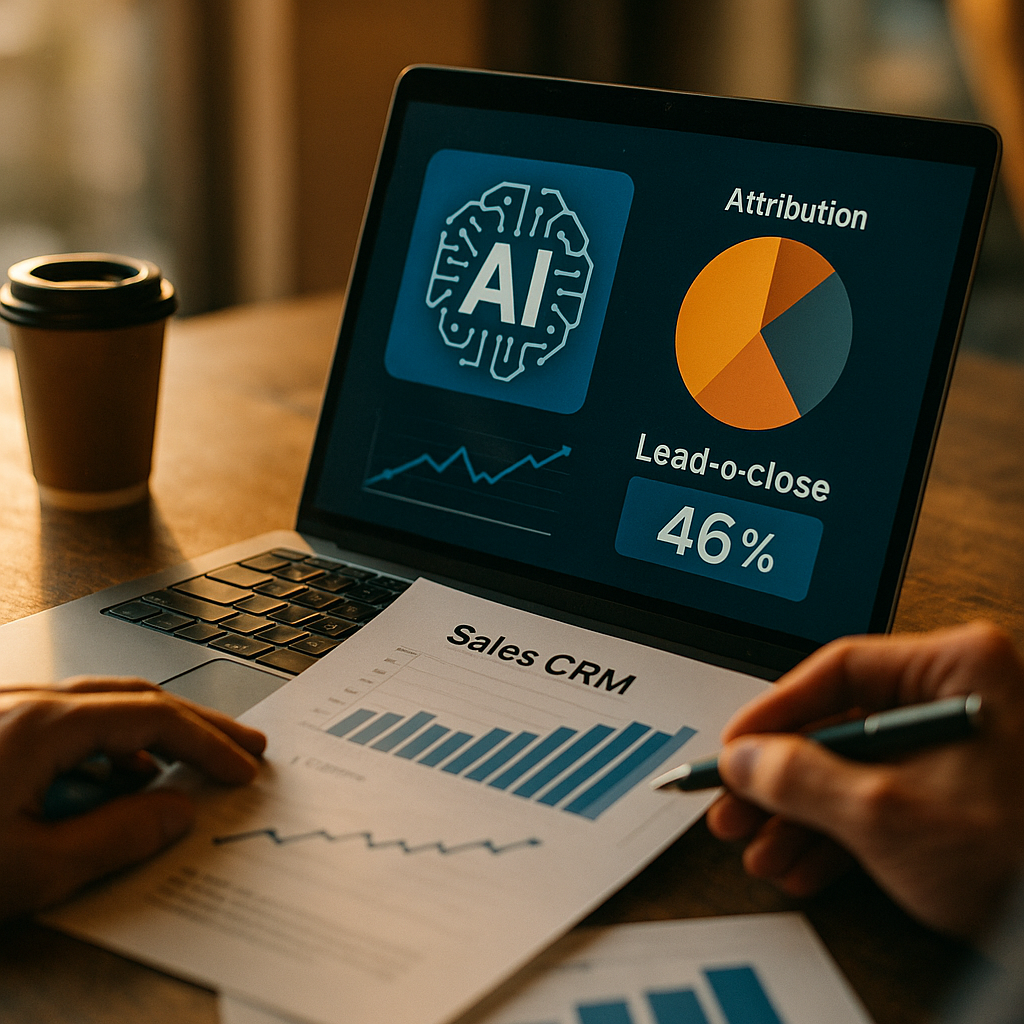
A 46 Percent Lead-to-Close Lift Is Not a Fluke — It’s a System
Automotive dealers running AI-driven CRM attribution are closing nearly half again as many leads as their baseline, while appointment booking rates have climbed 25 to 35 percent. If you sell anything with a long consideration cycle — luxury travel, financial products, home improvement, elective healthcare — these numbers are your roadmap.
The mechanics behind automotive’s gains are surprisingly transferable. The category has the right conditions: high transaction value, multi-touch research journeys, offline conversion events, and a buyer who visits multiple touchpoints before signing anything. Sound familiar? It should. Those conditions describe most high-consideration categories that brand strategists are wrestling with right now.
Why Automotive Became the Attribution Lab
Dealerships were forced into analytical rigor by margin compression. When gross profit per vehicle dropped and digital advertising costs climbed, operators had no choice but to understand exactly which touchpoints were producing appointments and which were burning budget. That pressure created an unintentional R&D environment for AI attribution.
Platforms like HubSpot and automotive-specific CRMs like VinSolutions started layering machine learning models onto lead records, scoring signals across email opens, website revisits, inventory page dwell time, chat transcripts, and call recordings. The AI wasn’t just predicting close probability — it was surfacing the optimal next action for each lead at each moment. The result: sales teams stopped treating every lead equally and started allocating effort to the right contacts at the right time.
That shift from equal treatment to intelligent prioritization is the core mechanism behind the 46 percent lift. It’s not magic. It’s sequencing.
The 46% lead-to-close lift in automotive didn’t come from generating more leads — it came from dramatically improving how existing leads were worked. That distinction changes everything about how you budget for attribution infrastructure.
The Four Mechanics That Drove the Numbers
Strip away the vendor marketing and automotive’s AI attribution gains break down into four repeatable mechanics:
- Intent scoring across non-linear journeys: A buyer who revisits the same vehicle configuration page three times in five days is signaling something. AI models trained on closed deals learn to weight these micro-behaviors. Static lead scoring based on form fills misses this entirely.
- Automated but personalized follow-up cadences: The system identifies the right channel (SMS, email, or phone) and the right timing based on historical engagement patterns for that lead profile — not a one-size-fits-all drip sequence.
- Offline event ingestion: When a prospect walks the lot, sits in a vehicle, or calls the finance desk, that data feeds back into the CRM score. This closed-loop between physical and digital behavior is where most non-automotive brands are still losing signal.
- Sales rep prioritization queues: Rather than a flat lead list, reps see a dynamically ranked queue. High-intent leads surface to the top automatically. The appointment booking lift comes largely from this: reps call the right people faster.
Every one of these mechanics is category-agnostic. The implementation details change; the logic doesn’t.
What High-Consideration Categories Are Missing Right Now
Let’s be direct. Most luxury travel brands, financial services firms, and home improvement retailers are still running attribution models that were designed for e-commerce. Last-click or even multi-touch linear models flatten the complexity of a 60-day consideration journey into a tidy spreadsheet that rewards the last ad someone saw before converting. That’s not attribution — that’s coincidence counting.
Elective healthcare practices (think cosmetic dentistry, LASIK, fertility clinics) have the same problem. A patient may watch a dozen YouTube testimonials, visit a clinic’s website four times, open six emails, and then call from a billboard they drove past. The billboard gets the credit. The nurture sequence that kept them warm for three months gets nothing.
AI-driven CRM attribution fixes this by modeling contribution across the full journey, not just the last step. Vendors like Salesforce (with Einstein) and Dynamics 365 are increasingly accessible for mid-market operators, not just enterprise teams. The barrier is integration discipline, not technology cost.
The parallel to creator-driven attribution is worth noting here. When Ulta Beauty mapped creator touchpoints to in-store conversion, they faced identical challenges: multi-session journeys, offline endpoints, and attribution models that couldn’t handle the gap between content discovery and purchase. Their solution — connecting TikTok Shop attribution to CRM data — is essentially the same closed-loop discipline automotive has been building for years.
Building the Playbook for Your Category
If you’re a VP of Marketing at a luxury real estate group, a private wealth management firm, or a regional medical group, here’s how to adapt the automotive playbook specifically:
Step 1: Audit your current lead data for behavioral signals you’re ignoring. Most CRMs capture form submissions and email opens. Few capture scroll depth, return visits, content type engagement, or time-on-page by asset. Before you layer AI on top of your CRM, ensure you’re feeding it rich enough inputs. Garbage in, garbage out applies here harder than anywhere.
Step 2: Map your offline conversion moments and build ingestion pipelines for them. In automotive it’s the lot visit and the test drive. In elective healthcare it’s the consultation call. In financial services it’s the advisor meeting. Define these moments, build the data capture (even manual CRM logging counts initially), and connect them to your digital record.
Step 3: Implement lead scoring that weights recency and behavioral pattern, not just demographic fit. A contact who perfectly matches your ICP but hasn’t engaged in 45 days is less valuable than a slightly off-profile contact who has visited your pricing page twice this week. AI models learn this. Rules-based scoring systems don’t.
Step 4: Redesign your follow-up sequences around AI-recommended next actions, not fixed drip calendars. This is where the appointment booking lift actually lives. Fixed drips treat every lead the same on the same timeline. Dynamic cadences, driven by predicted intent, compress the booking window dramatically.
Brands like Marriott have begun applying similar logic to hospitality discovery — connecting AI search insights to high-intent content that bridges the research-to-booking gap. The attribution architecture is the same even if the product is different.
The Data Infrastructure Question Nobody Wants to Answer
Here’s the uncomfortable part. Most of these improvements require unified customer data infrastructure that many mid-market brands simply don’t have. Automotive dealers got there because CRM vendors built automotive-specific integrations. Your category probably hasn’t been prioritized in the same way yet.
The practical answer is to start with a customer data platform (CDP) layer. Tools like Twilio Segment or Tealium allow you to unify web, CRM, advertising, and offline event data before it hits your attribution model. Without this unification, even the best AI scoring model is working with a partial picture.
Compliance matters here too, especially in financial services and healthcare. Any AI-driven CRM system handling personally identifiable information needs to operate within clear consent frameworks. Reviewing your obligations under applicable privacy regulations should happen before you build, not after. The FTC’s guidance on AI and data practices is a reasonable starting reference for U.S. operators.
The brands that will win the next phase of high-consideration marketing aren’t the ones with the biggest media budgets — they’re the ones that connect the most data signals to the most precise next-action logic at the individual lead level.
Zillow’s high-intent content strategy offers a useful parallel: they structured content specifically to capture buyers at the moment of maximum research intensity. Connecting that high-intent content approach to a CRM attribution layer is exactly the combination that produces automotive-style lift numbers in adjacent categories.
ROI Expectations: What to Model Before You Pitch Internally
Before you take this to your CFO, model conservatively. Automotive’s 46 percent lead-to-close lift was measured in a high-frequency transaction environment where dealers process hundreds of leads monthly. Smaller lead volumes mean smaller absolute lift, even if percentage gains hold.
A more honest internal pitch for a financial services or luxury home brand might target a 20 to 30 percent improvement in appointment set rate and a 15 to 25 percent improvement in qualified pipeline velocity. That’s still transformative when your average deal size runs into five or six figures. And the infrastructure investment — typically a CDP integration, CRM configuration, and model training cost — amortizes quickly at those transaction values.
Benchmark against Salesforce’s State of Sales research, which consistently shows AI-assisted selling lifting quota attainment by 15 to 20 percent across industries. Use that as your floor, not your ceiling.
For context on how creator and content attribution layers can amplify these systems, look at how AI ad creative standards are being used to connect content performance signals back into CRM-level decision making. The convergence of creator data and CRM intelligence is where the next efficiency gains will come from.
Your immediate next step: Audit the last 90 days of leads that did not convert and identify whether behavioral signals (repeat visits, specific content engagement, inquiry types) were present but not acted on. That gap quantifies your current attribution loss — and becomes your business case.
Frequently Asked Questions
What is AI-driven CRM attribution and how does it differ from traditional lead scoring?
AI-driven CRM attribution uses machine learning models to analyze behavioral signals across the full customer journey — web visits, email interactions, call data, and offline events — to assign dynamic scores and recommend next actions. Traditional lead scoring uses static rules based on demographic or firmographic criteria. The key difference is adaptability: AI models continuously retrain on closed deal data, so they improve over time and reflect actual buying behavior rather than assumed intent.
How did automotive dealers specifically achieve the 46 percent lead-to-close lift?
The lift came primarily from sales rep prioritization and dynamic follow-up cadences. AI scoring surfaced the highest-intent leads to the top of sales queues, ensuring faster and more relevant outreach. Simultaneously, follow-up sequences were personalized by channel and timing based on each lead’s engagement pattern, rather than following a fixed drip schedule. This combination compressed the sales cycle and improved conversion at the appointment-setting stage.
Which high-consideration categories benefit most from this approach?
Any category with a long research cycle, high transaction value, multiple decision-makers, and offline conversion moments is a strong candidate. This includes luxury real estate, financial advisory services, elective healthcare, private education, hospitality, and high-end home improvement. These categories share the core conditions that made automotive attribution improvements so significant: complex multi-touch journeys that static attribution models can’t accurately represent.
What data infrastructure do you need before implementing AI CRM attribution?
At minimum, you need a CRM that captures behavioral event data (not just form fills), a mechanism to ingest offline conversion moments, and ideally a customer data platform (CDP) to unify signals from web, advertising, and CRM sources. Tools like Twilio Segment or Tealium can serve this unification function. Without unified data inputs, AI scoring models will produce unreliable outputs regardless of model sophistication.
What are realistic ROI timelines for non-automotive brands adopting this approach?
Most implementations see measurable improvement in lead prioritization within 60 to 90 days, once data pipelines are connected. Meaningful lift in appointment booking rates typically appears within a single sales quarter. Full model optimization, where the AI has trained on enough closed deals to make accurate predictions, generally takes six to twelve months depending on lead volume. Brands with lower monthly lead counts should expect longer optimization windows but similar eventual performance improvements.
Top Influencer Marketing Agencies
The leading agencies shaping influencer marketing in 2026
Agencies ranked by campaign performance, client diversity, platform expertise, proven ROI, industry recognition, and client satisfaction. Assessed through verified case studies, reviews, and industry consultations.
Moburst

-
2

The Shelf
Boutique Beauty & Lifestyle Influencer AgencyA data-driven boutique agency specializing exclusively in beauty, wellness, and lifestyle influencer campaigns on Instagram and TikTok. Best for brands already focused on the beauty/personal care space that need curated, aesthetic-driven content.Clients: Pepsi, The Honest Company, Hims, Elf Cosmetics, Pure LeafVisit The Shelf → -
3

Audiencly
Niche Gaming & Esports Influencer AgencyA specialized agency focused exclusively on gaming and esports creators on YouTube, Twitch, and TikTok. Ideal if your campaign is 100% gaming-focused — from game launches to hardware and esports events.Clients: Epic Games, NordVPN, Ubisoft, Wargaming, Tencent GamesVisit Audiencly → -
4

Viral Nation
Global Influencer Marketing & Talent AgencyA dual talent management and marketing agency with proprietary brand safety tools and a global creator network spanning nano-influencers to celebrities across all major platforms.Clients: Meta, Activision Blizzard, Energizer, Aston Martin, WalmartVisit Viral Nation → -
5

The Influencer Marketing Factory
TikTok, Instagram & YouTube CampaignsA full-service agency with strong TikTok expertise, offering end-to-end campaign management from influencer discovery through performance reporting with a focus on platform-native content.Clients: Google, Snapchat, Universal Music, Bumble, YelpVisit TIMF → -
6

NeoReach
Enterprise Analytics & Influencer CampaignsAn enterprise-focused agency combining managed campaigns with a powerful self-service data platform for influencer search, audience analytics, and attribution modeling.Clients: Amazon, Airbnb, Netflix, Honda, The New York TimesVisit NeoReach → -
7

Ubiquitous
Creator-First Marketing PlatformA tech-driven platform combining self-service tools with managed campaign options, emphasizing speed and scalability for brands managing multiple influencer relationships.Clients: Lyft, Disney, Target, American Eagle, NetflixVisit Ubiquitous → -
8

Obviously
Scalable Enterprise Influencer CampaignsA tech-enabled agency built for high-volume campaigns, coordinating hundreds of creators simultaneously with end-to-end logistics, content rights management, and product seeding.Clients: Google, Ulta Beauty, Converse, AmazonVisit Obviously →