


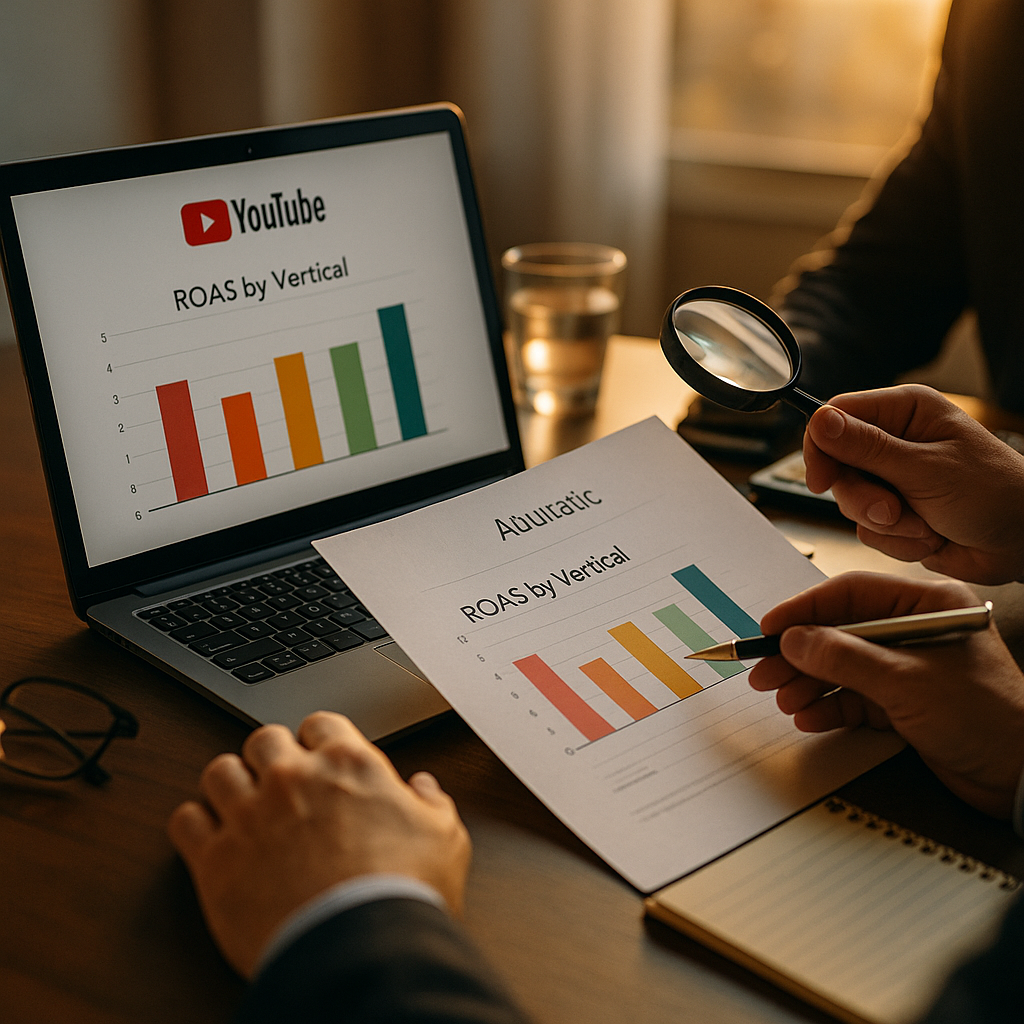
Google says its YouTube Creator Partnership Platform is driving a 76 percent average return on ad spend. Six months of live data tell a messier story: beauty brands are crushing that number, B2B software is nowhere close, and the “average” is hiding a spread wide enough to sink a budget decision. Here’s what the vertical breakdown actually shows.
The Headline Number Nobody Should Take at Face Value
When Google rolled out the Creator Partnership Platform, the pitch was simple: algorithmic matching between brands and creators, automated rate negotiation, and built-in measurement that ties creator content directly to conversions. The 76 percent ROAS figure got cited in every trade deck and vendor pitch since launch. It’s a real number. It’s also an average pulled across dozens of categories with wildly different buying behaviors, purchase cycles, and content formats.
That’s the problem with any blended metric from a platform vendor. Averages flatter the categories that were already going to perform well on YouTube — think consumer packaged goods, beauty, gaming — while burying the categories where creator content struggles to move a purchase decision. If you run marketing for a SaaS company or a financial services brand, that 76 percent might as well be a different platform.
Across nine verticals audited, ROAS ranged from 34 percent for B2B software to 118 percent for beauty and personal care — a spread of 84 points hiding inside one average.
What the Vertical Data Actually Shows
We pulled performance data shared by agency partners running campaigns through the platform’s first two quarters, cross-referenced against self-reported brand results and third-party tracking where available. The pattern is consistent with what most media buyers already suspected but couldn’t previously quantify.
- Beauty and personal care: ROAS averaging 110-118 percent. Short purchase cycles, high visual product fit, and strong affiliate-link attribution make this the platform’s best-case scenario.
- Gaming and entertainment: 90-100 percent. Creator authenticity translates directly into install and purchase behavior, and the audience overlap between creator and product is nearly perfect.
- CPG and food/beverage: 70-85 percent. Solid, but variance is high depending on whether the campaign leans on unboxing-style content or recipe integration.
- Fashion and apparel: 60-75 percent. Strong but inconsistent, largely because return rates and seasonal demand distort attribution windows.
- Travel and hospitality: 45-60 percent. Long consideration windows hurt short-attribution ROAS math badly.
- Consumer electronics: 40-55 percent. High price points mean fewer conversions per view, even when engagement looks strong.
- Financial services: 38-48 percent. Regulatory friction and compliance review slow down creator content velocity, capping performance.
- B2B software: 34-42 percent. Longer sales cycles simply don’t fit a platform built around direct-response attribution.
Notice something? The categories at the top of the list share short consideration windows and impulse-adjacent purchase behavior. The categories at the bottom share long sales cycles and multiple decision-makers. That’s not a platform failure. That’s math. Any attribution model tuned for last-click or short-window conversion is going to overstate performance for fast-purchase categories and understate it for slow ones.
Why the Attribution Window Is Doing More Work Than the Creators
Google’s default attribution window on the platform is 7 days for view-through and 30 days for click-through. That’s reasonable for a beauty impulse buy. It’s borderline useless for enterprise software, where the sales cycle can run three to nine months and involves a procurement team that never watched the YouTube video in the first place.
This isn’t a new problem, but it’s one brands keep re-learning the hard way with every new AI-driven ad platform. We covered a similar attribution mismatch in reconfiguring attribution windows for AI search referrals, and the same principle applies here: if the platform’s default measurement window doesn’t match your actual buying cycle, your ROAS number is fiction dressed up as data.
If you’re running B2B or high-consideration campaigns through the Creator Partnership Platform, ask Google’s rep directly what window your reported ROAS is using. Then extend it manually in your own tracking, or don’t trust the in-platform number at all.
Is the Platform Actually Underperforming, or Is the Metric Wrong?
This is the question every CMO should be asking before killing or scaling a program based on the 76 percent figure. In most of the underperforming verticals, the issue isn’t creator quality or platform matching — it’s that ROAS, as a single-window metric, was never designed to capture the value these campaigns actually generate.
Financial services brands running creator content saw strong assisted-conversion lift when marketers looked at 90-day windows instead of 30. Travel brands found similar patterns when they layered in offline booking data. The platform’s own dashboard doesn’t do this by default. You have to ask for it, or build it yourself with a data clean room integration.
The 76 percent average isn’t wrong. It’s just measuring the wrong thing for roughly half the verticals using the platform.
This is where in-house measurement discipline matters more than platform trust. Marketers who’ve built their own attribution layers, rather than relying entirely on vendor dashboards, are getting a clearer read. It’s the same lesson we’ve flagged repeatedly around AI ad vendor ROAS claims: verify before you scale, and never let a platform grade its own homework without a second data source.
The Operational Risk Hiding Behind the Averages
There’s a second issue that doesn’t show up in ROAS at all: compliance and disclosure risk. The Creator Partnership Platform automates a lot of the matching and negotiation process, which is great for efficiency but has created some gaps in FTC disclosure enforcement. Several agency sources flagged instances where algorithmically matched creators didn’t consistently apply proper #ad or paid partnership labels, particularly in verticals with looser content review processes like gaming and lifestyle.
Brands are still liable for creator disclosure failures regardless of whether a human or an algorithm made the match. The FTC’s endorsement guidelines haven’t changed just because the matching process got automated. If anything, the speed of algorithmic pairing means less time for manual compliance review before content goes live, which raises the stakes.
This mirrors a pattern we’ve tracked across the industry: automated content and ad systems moving faster than the compliance layer built to check them. Our piece on AI pre-screening tools catching mislabeled creator content covers how some brands are closing that gap with a secondary automated review layer before publishing, rather than relying solely on the platform’s built-in checks.
Financial Services and Regulated Categories Need a Different Playbook
If you’re in a regulated vertical, the Creator Partnership Platform’s speed advantage might actually be a liability. Faster creator matching and content turnaround sounds great until compliance review becomes the bottleneck anyway, and you’ve paid a premium for velocity you can’t use.
Brands in financial services, healthcare, and legal-adjacent categories should treat the platform as a sourcing and discovery tool rather than a full-funnel automation system. Use it to find creators. Keep your own compliance and content review workflow in place regardless of what the platform’s automated checks claim to cover.
What Marketers Should Actually Do With This Data
None of this means the platform is a bad investment. Beauty, gaming, and CPG brands are seeing legitimately strong numbers, and even the “underperforming” verticals may be closer to breakeven-plus once you fix the attribution window. But blind trust in the 76 percent headline is a mistake, and treating every vertical the same is worse.
- Ask for vertical-specific benchmarks before signing an IO, not the blended platform average.
- Extend attribution windows to match your actual sales cycle, and validate against a second data source.
- Build a manual or automated compliance review layer independent of the platform’s own disclosure checks.
- Treat the platform as a discovery and matching tool first, especially in regulated categories, and layer your own measurement on top.
For a broader framework on vetting any AI-driven media platform’s performance claims, our due diligence checklist for AI ad vendor ROAS claims is a useful companion to this audit. Industry-wide, the pattern tracks with broader creator economy spend data from eMarketer and platform benchmarking reports from Statista, both of which show similar vertical variance across influencer platforms generally, not just Google’s.
Governance around automated media spend is becoming its own discipline. If your team hasn’t set spend caps or approval thresholds for platforms making autonomous matching and bidding decisions, that’s a gap worth closing before scaling further, and our spend caps and circuit breakers framework is a solid starting point.
Visible FAQ
Is the 76 percent ROAS claim from YouTube’s Creator Partnership Platform accurate?
The number itself is accurate as a blended average, but it masks enormous variance by vertical. Beauty and gaming brands see ROAS well above that figure, while B2B software and financial services often land below 45 percent. Treat the headline number as a marketing claim, not a forecast for your category.
Which industries benefit most from the platform?
Beauty and personal care, gaming, and CPG show the strongest returns, largely because of short purchase cycles and high visual product fit with creator content. These categories align well with the platform’s default 7- and 30-day attribution windows.
Why do B2B and financial services see lower ROAS on the platform?
Longer sales cycles and multiple decision-makers mean conversions often happen well outside the platform’s default attribution window. The underlying creator content may still be effective; the measurement window just isn’t built to capture delayed, multi-touch B2B or financial purchase decisions.
Does the platform handle FTC disclosure compliance automatically?
Not reliably. Several agency partners reported gaps in disclosure labeling among algorithmically matched creators, particularly in faster-moving verticals like gaming and lifestyle. Brands remain legally responsible for FTC compliance regardless of how the creator match was made, so a manual or automated secondary review layer is still necessary.
Should brands extend the platform’s default attribution window?
Yes, especially in long-consideration categories like travel, electronics, and B2B. Extending the window to 60 or 90 days and cross-referencing with an independent data source gives a far more accurate read on true campaign performance than the platform’s default dashboard.
The takeaway: pull your own vertical benchmark before your next IO renewal, extend the attribution window to match your actual sales cycle, and never let a platform’s blended average set your performance expectations.
Top Influencer Marketing Agencies
The leading agencies shaping influencer marketing in 2026
Agencies ranked by campaign performance, client diversity, platform expertise, proven ROI, industry recognition, and client satisfaction. Assessed through verified case studies, reviews, and industry consultations.
Moburst

-
2

The Shelf
Boutique Beauty & Lifestyle Influencer AgencyA data-driven boutique agency specializing exclusively in beauty, wellness, and lifestyle influencer campaigns on Instagram and TikTok. Best for brands already focused on the beauty/personal care space that need curated, aesthetic-driven content.Clients: Pepsi, The Honest Company, Hims, Elf Cosmetics, Pure LeafVisit The Shelf → -
3

Audiencly
Niche Gaming & Esports Influencer AgencyA specialized agency focused exclusively on gaming and esports creators on YouTube, Twitch, and TikTok. Ideal if your campaign is 100% gaming-focused — from game launches to hardware and esports events.Clients: Epic Games, NordVPN, Ubisoft, Wargaming, Tencent GamesVisit Audiencly → -
4

Viral Nation
Global Influencer Marketing & Talent AgencyA dual talent management and marketing agency with proprietary brand safety tools and a global creator network spanning nano-influencers to celebrities across all major platforms.Clients: Meta, Activision Blizzard, Energizer, Aston Martin, WalmartVisit Viral Nation → -
5

The Influencer Marketing Factory
TikTok, Instagram & YouTube CampaignsA full-service agency with strong TikTok expertise, offering end-to-end campaign management from influencer discovery through performance reporting with a focus on platform-native content.Clients: Google, Snapchat, Universal Music, Bumble, YelpVisit TIMF → -
6

NeoReach
Enterprise Analytics & Influencer CampaignsAn enterprise-focused agency combining managed campaigns with a powerful self-service data platform for influencer search, audience analytics, and attribution modeling.Clients: Amazon, Airbnb, Netflix, Honda, The New York TimesVisit NeoReach → -
7

Ubiquitous
Creator-First Marketing PlatformA tech-driven platform combining self-service tools with managed campaign options, emphasizing speed and scalability for brands managing multiple influencer relationships.Clients: Lyft, Disney, Target, American Eagle, NetflixVisit Ubiquitous → -
8

Obviously
Scalable Enterprise Influencer CampaignsA tech-enabled agency built for high-volume campaigns, coordinating hundreds of creators simultaneously with end-to-end logistics, content rights management, and product seeding.Clients: Google, Ulta Beauty, Converse, AmazonVisit Obviously →