


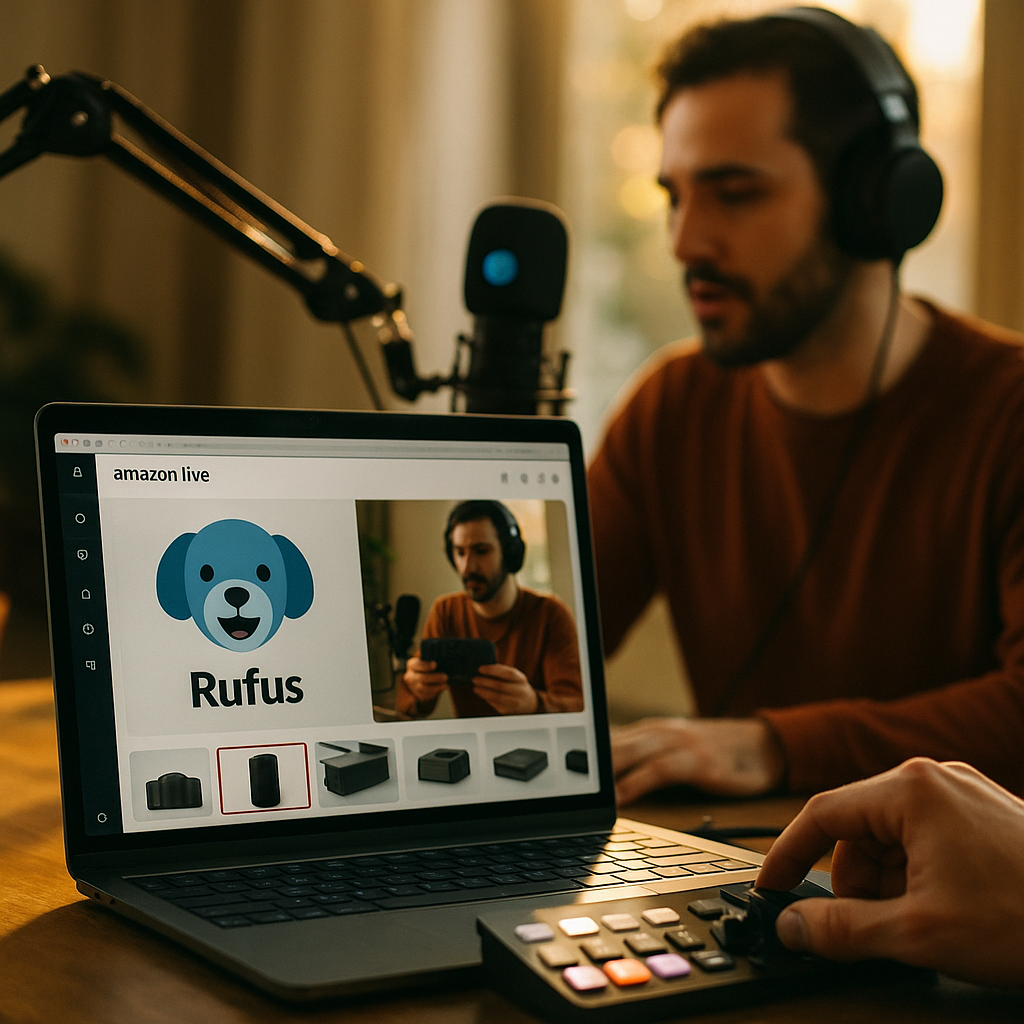
Amazon’s Rufus AI now influences an estimated one in five product searches on the platform, and that number is climbing fast. If your Amazon Live strategy still treats livestreams as standalone events instead of inputs into Rufus’s recommendation engine, you’re already behind. The playbook has changed. Cadence, not just content, is now the lever that determines whether Rufus surfaces your stream at all.
Rufus Changed the Discovery Math
Rufus isn’t a chatbot bolted onto the search bar. It’s a generative layer sitting between shopper intent and product listings, and increasingly, between shoppers and livestream content. When someone asks Rufus “what’s a good gift for a runner,” it doesn’t just pull static listings — it can surface creator livestreams, clips, and Amazon Live sessions that match the query’s context and timing.
That’s a fundamental shift. Historically, Amazon Live success depended on scheduling around traffic peaks: lunch breaks, evenings, Prime Day windows. Now there’s a second variable — whether Rufus’s model has enough signal from your stream history to confidently recommend you in a conversational answer. A single well-produced stream isn’t enough. Rufus rewards pattern recognition, and patterns require repetition.
Brands running sporadic, one-off Amazon Live streams are seeing discovery impressions drop even when watch time per session stays flat — Rufus simply has less data to work with.
Why Cadence Now Outranks Production Value
Ask any brand manager who ran Amazon Live in its earlier form: production quality used to be the differentiator. Good lighting, a confident host, a tight script. Those things still matter, but they’re table stakes now. What separates winning programs in this update is predictable, recurring scheduling that trains Rufus’s discovery model on your catalog-to-stream relationship.
Think of it like SEO crawl frequency. Search engines index sites that publish consistently more reliably than ones that post once a quarter. Rufus behaves similarly with livestream inventory. A cadence of three or more sessions per week, tied to consistent product categories, appears to generate stronger association strength between your ASINs and the conversational queries Rufus is fielding.
This mirrors what we’ve already seen play out on organic livestream commerce elsewhere — platforms increasingly reward frequency and topical consistency over one-off spectacle.
The Three Cadence Tiers Brands Should Be Running
Not every brand needs daily streaming. But the update effectively forces a tiering decision. Here’s how mid-to-senior teams should think about it heading into the next planning cycle:
- Anchor tier (3-5x weekly): Core hero SKUs streamed on a fixed schedule, same creator or host rotation, same time blocks. This is what feeds Rufus the strongest training signal.
- Support tier (1-2x weekly): Secondary category or seasonal products, less rigid timing, used to test new creators or angles without disrupting the anchor pattern.
- Event tier (as needed): Prime Day, launches, flash sales — high production, short bursts. These still work, but only build sustained discovery lift if layered on top of an existing anchor cadence, not run in isolation.
Brands skipping the anchor tier and jumping straight to event-tier spikes are the ones reporting flat or declining Rufus-driven impressions this cycle.
What Rufus Actually Pulls From a Stream
It’s worth getting specific about the inputs. Rufus’s product discovery model appears to weight a handful of signals from Amazon Live sessions: spoken product attributes (host mentions of size, ingredients, use case), on-screen tagging accuracy, viewer questions answered in real time, and post-stream conversion within a short attribution window. It’s less about vanity metrics like concurrent viewers and more about whether the stream generates clean, structured product signal.
That means scripting matters differently now. Hosts who ad-lib vague enthusiasm (“this is amazing, you guys need this”) give Rufus almost nothing to work with. Hosts who repeat specific attributes — material, dimensions, compatibility, use case — build a richer semantic footprint that Rufus can match against natural-language shopper queries.
This is a good moment to revisit how briefs are written for livestream hosts. If your brand already tightened creator briefs in response to algorithm shifts elsewhere, apply the same discipline here — the logic isn’t far off from rebuilding briefs around algorithmic targeting on other platforms.
Scheduling Around Query Patterns, Not Just Traffic Peaks
The old scheduling logic — stream when eyeballs are highest — still applies, but it’s now secondary to a newer question: when are shoppers asking Rufus about your category? Amazon’s own creator dashboards have started surfacing query-volume data by category and daypart, and brands running consumables or gifting categories are finding that Rufus query spikes don’t always align with traditional traffic peaks. Gifting queries, for instance, cluster heavily in the 48 hours before major shopping events, well before checkout traffic actually spikes.
Brands that shift a portion of their anchor-tier streams to match query timing, rather than pure traffic timing, are reporting better Rufus citation rates. It’s a subtle recalibration, but it compounds over a quarter.
Compliance and Attribution Risk Nobody’s Talking About Yet
Here’s the part brand and legal teams need to get ahead of. As Rufus increasingly surfaces livestream clips inside AI-generated answers, attribution and disclosure rules get murkier. If Rufus pulls a 15-second clip from a paid creator stream and presents it as part of a conversational recommendation, does existing sponsorship disclosure still satisfy FTC expectations? Amazon hasn’t published definitive guidance, and the FTC’s endorsement guidance predates this kind of AI-mediated surfacing entirely.
The safe move: bake disclosure language directly into the spoken script and on-screen supers at the start of every anchor-tier stream, not just in the video description. If Rufus clips mid-stream, the disclosure needs to travel with the clip, not sit buried in metadata.
Treat every Amazon Live session as if it could be excerpted out of context by an AI layer — because increasingly, it will be.
This isn’t wildly different from governance conversations already happening around agentic ad tools. Teams that have started building approval workflows for agentic ad management should extend that same rigor to livestream content that AI systems can now repackage.
Budgeting for Frequency Without Blowing the Quarter
The obvious objection: three-to-five streams a week sounds expensive. It doesn’t have to be, if you restructure how you allocate creator fees. Instead of paying premium rates for occasional high-production event streams, shift budget toward retainer-style agreements with a smaller bench of creators who stream consistently. Amazon Live creators who commit to recurring slots typically negotiate lower per-session rates in exchange for volume and predictability.
Run the math against your existing Amazon Live shopping spend from last cycle. Most brands find they were already spending enough on quarterly event-tier pushes to fund a full anchor-tier cadence — it was just allocated wrong.
According to eMarketer’s latest retail media forecasts, livestream commerce spend in the U.S. is still a fraction of total retail media budgets compared to markets like China, which suggests there’s room to reallocate rather than simply add net-new spend. That’s a useful data point for the budget conversation with finance.
A Quick Gut Check for Your Current Program
- Are you streaming the same core SKUs on a fixed weekly schedule, or improvising week to week?
- Do your hosts repeat specific product attributes, or lean on generic enthusiasm?
- Is sponsorship disclosure spoken on-camera, or only written in the description?
- Have you checked Rufus query-volume timing for your category against your current stream schedule?
- Is your creator budget structured for recurring retainers, or one-off event fees?
If you answered “improvising” or “generic” to more than one of those, your Rufus discovery footprint is almost certainly underperforming what your production spend should be buying.
Where This Is Heading Next Quarter
Expect Amazon to formalize creator-facing Rufus performance metrics inside the Amazon Live dashboard soon — early signs point to a “discovery score” sitting alongside existing watch-time and conversion metrics. Brands that establish anchor-tier cadences now will have a data advantage once that scoring goes live, the same way early adopters of consistent posting cadences on other platforms outperformed once algorithmic changes formalized what they were already doing intuitively. It’s the same pattern we’ve tracked with TikTok Shop livestream selling, where cadence discipline preceded platform-level scoring changes by months.
Start by locking in one anchor-tier weekly schedule for your top three SKUs this month, script hosts to repeat structured product attributes on camera, and move sponsorship disclosure into the spoken script before Amazon’s discovery scoring goes live and makes the gap impossible to ignore.
FAQs
What is Rufus AI and how does it affect Amazon Live?
Rufus is Amazon’s generative AI shopping assistant. It increasingly surfaces livestream content, including Amazon Live sessions and clips, inside conversational product recommendations, which means stream visibility now depends partly on how well Rufus’s model can associate your streams with shopper queries.
How often should brands run Amazon Live streams to be surfaced by Rufus?
Most brands seeing stronger Rufus-driven discovery run an anchor-tier cadence of three to five streams per week on consistent product categories, supplemented by lower-frequency support streams and occasional high-production event streams.
Does production quality still matter for Amazon Live streams?
Yes, but it’s no longer the primary differentiator. Structured, specific spoken product attributes and consistent scheduling now carry more weight for Rufus’s discovery model than lighting or set design alone.
Are there compliance risks with Rufus surfacing sponsored livestream clips?
Yes. If Rufus excerpts a clip from a paid stream into an AI-generated answer, standard disclosure practices may not travel with that clip. Brands should place spoken and on-screen disclosures early in each stream to reduce risk.
Is livestream commerce spend on Amazon growing?
Retail media and livestream commerce budgets are increasing industry-wide, though U.S. spend still trails markets like China. Brands can often fund a stronger cadence by reallocating existing event-tier budgets rather than requesting new spend.
Top Influencer Marketing Agencies
The leading agencies shaping influencer marketing in 2026
Agencies ranked by campaign performance, client diversity, platform expertise, proven ROI, industry recognition, and client satisfaction. Assessed through verified case studies, reviews, and industry consultations.
Moburst

-
2

The Shelf
Boutique Beauty & Lifestyle Influencer AgencyA data-driven boutique agency specializing exclusively in beauty, wellness, and lifestyle influencer campaigns on Instagram and TikTok. Best for brands already focused on the beauty/personal care space that need curated, aesthetic-driven content.Clients: Pepsi, The Honest Company, Hims, Elf Cosmetics, Pure LeafVisit The Shelf → -
3

Audiencly
Niche Gaming & Esports Influencer AgencyA specialized agency focused exclusively on gaming and esports creators on YouTube, Twitch, and TikTok. Ideal if your campaign is 100% gaming-focused — from game launches to hardware and esports events.Clients: Epic Games, NordVPN, Ubisoft, Wargaming, Tencent GamesVisit Audiencly → -
4

Viral Nation
Global Influencer Marketing & Talent AgencyA dual talent management and marketing agency with proprietary brand safety tools and a global creator network spanning nano-influencers to celebrities across all major platforms.Clients: Meta, Activision Blizzard, Energizer, Aston Martin, WalmartVisit Viral Nation → -
5

The Influencer Marketing Factory
TikTok, Instagram & YouTube CampaignsA full-service agency with strong TikTok expertise, offering end-to-end campaign management from influencer discovery through performance reporting with a focus on platform-native content.Clients: Google, Snapchat, Universal Music, Bumble, YelpVisit TIMF → -
6

NeoReach
Enterprise Analytics & Influencer CampaignsAn enterprise-focused agency combining managed campaigns with a powerful self-service data platform for influencer search, audience analytics, and attribution modeling.Clients: Amazon, Airbnb, Netflix, Honda, The New York TimesVisit NeoReach → -
7

Ubiquitous
Creator-First Marketing PlatformA tech-driven platform combining self-service tools with managed campaign options, emphasizing speed and scalability for brands managing multiple influencer relationships.Clients: Lyft, Disney, Target, American Eagle, NetflixVisit Ubiquitous → -
8

Obviously
Scalable Enterprise Influencer CampaignsA tech-enabled agency built for high-volume campaigns, coordinating hundreds of creators simultaneously with end-to-end logistics, content rights management, and product seeding.Clients: Google, Ulta Beauty, Converse, AmazonVisit Obviously →