


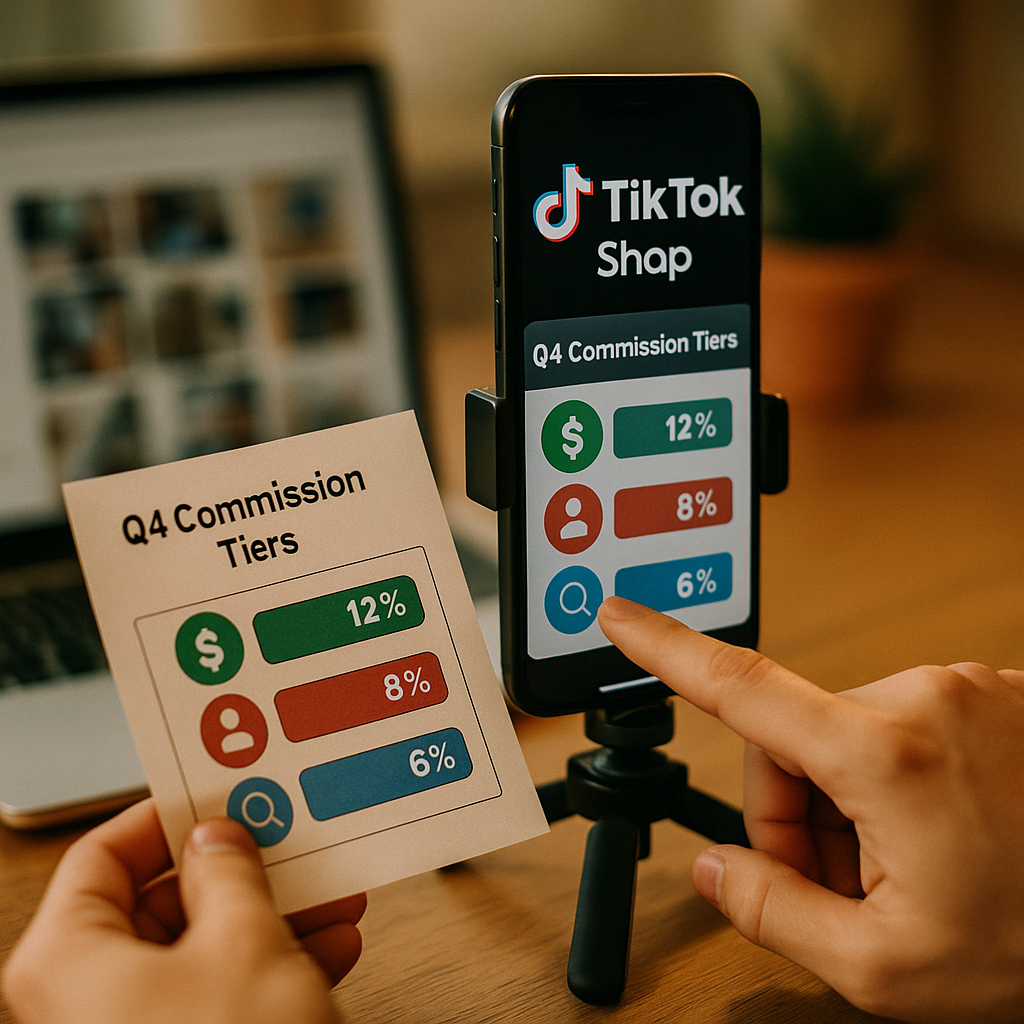
TikTok Shop’s algorithm quietly decides which creators get matched to which products before a single commission rate is set. Most brands still build TikTok Shop Q4 commission tiers around gut instinct and competitor benchmarking. That’s a mistake, and Q4 is the most expensive quarter to make it.
The platform never publishes its full matching logic. But the signals it rewards — content velocity, GMV per video, repeat buyer rate, category affinity — are visible if you know where to look. Brands that structure commission tiers around those signals outperform flat-rate programs by a wide margin during peak shopping weeks.
What “Publisher Match” Actually Means Here
TikTok Shop’s Affiliate Center and Seller Center run on a matching system that pairs products with creators most likely to convert them. Think of it as a recommendation engine, not a directory. Creators don’t just “apply” to your program and start selling. TikTok’s backend scores them against your product listing, your category, and your past performance, then decides how visible your product is inside the Creator Marketplace and the “For You” affiliate feed.
This is the part most brands skip. They treat commission rate as the only lever that attracts creators. In reality, the match score determines whether a creator even sees your product as a recommended opportunity. A generous commission on a product with a poor match score still underperforms a modest commission on a well-matched one.
Commission rate decides whether a creator says yes. Match score decides whether they ever see the offer in the first place.
We’ve covered the baseline mechanics of this before in our piece on commission tiers that attract top creators. Q4 requires a sharper version of that framework, because match signals shift as volume spikes and TikTok tightens its recommendation logic to protect buyer experience during peak load.
Why Q4 Breaks Flat-Rate Commission Structures
Flat 10% or 15% commission across your catalog works fine in a slow month. It falls apart in Q4 for three reasons.
- Category saturation. Every seller in beauty, apparel, and home goods is running holiday promos. TikTok’s matching engine has to prioritize somehow, and it leans on historical conversion signals, not seller intent.
- Creator bandwidth collapse. Top affiliate creators get flooded with brand requests in November and December. They filter aggressively. A flat commission gives them no reason to prioritize your SKU over a competitor’s.
- GMV Max and algorithmic ad spend compete for the same inventory. If your organic affiliate commission doesn’t compete with what a creator earns through Spark Ads or GMV Max amplification, they’ll route their best content elsewhere.
eMarketer has repeatedly flagged social commerce as one of the fastest-growing slices of holiday retail spend, and TikTok Shop specifically has been cited as outpacing broader ecommerce growth rates during Q4 windows. That growth means more competition for creator attention, not less. Check current holiday ecommerce forecasts at eMarketer before finalizing budget allocation.
Building the Tier Structure: A Practical Framework
Structure your commission tiers around three inputs: match score tier, content velocity requirement, and sell-through history. This isn’t theoretical — it mirrors how TikTok’s own Seller Center dashboards segment creator performance internally.
Tier 1: High-Match, Proven Sellers
These are creators TikTok’s system already favors for your category. You’ll spot them by consistently high GMV-per-video numbers and repeat appearance in your Creator Marketplace recommendations. Offer your highest commission here, but tie it to a minimum posting cadence during peak weeks (Black Friday through mid-December). Don’t just pay for the first sale — structure a bonus kicker for creators who cross a GMV threshold within a defined window.
Tier 2: Emerging Match, Unproven Volume
These creators show decent match signals but haven’t generated meaningful GMV yet. This tier is where Q4 volume actually comes from — you can’t scale on Tier 1 alone. Offer a mid-range base commission with a fast-track escalator: hit X units sold in 7 days, jump to the Tier 1 rate for the rest of the quarter. This gives creators a reason to push hard early, when your inventory and ad support are freshest.
Tier 3: Long-Tail and Category Testers
Lower commission, no minimums, but open enrollment. This tier exists to feed the matching algorithm with more data points. TikTok’s system learns faster when more creators test a product, even at low volume. Treat this tier as R&D for Q1 planning, not a Q4 revenue driver.
One nuance brands miss: match signals aren’t static within Q4. A creator who scores well in early November for “gift guide” content may score differently by December when TikTok shifts weighting toward urgency and last-minute shipping messaging. Build in a mid-quarter review point, ideally around December 1, to reassign creators between tiers based on updated performance data rather than locking rates for the full quarter.
Where Livestream Commerce Changes the Math
Livestream sellers operate under a different match logic than short-form video affiliates. TikTok’s live shopping algorithm weighs concurrent viewer retention and real-time conversion rate more heavily than static video engagement. If your Q4 plan includes livestream, your commission tiers need a separate structure — a creator who’s excellent at short-form affiliate content isn’t automatically strong on live.
We broke down the mechanics of this in our livestream selling playbook, and the organic angle specifically in the organic livestream commerce guide. For Q4, the practical takeaway is this: don’t blend livestream and short-form commission into one flat rate. Livestream hosts should be compensated on a base-plus-percentage model, since their content requires scheduling commitment that short-form doesn’t.
Compliance Isn’t Optional at Q4 Volume
Higher commission tiers attract higher scrutiny. FTC disclosure requirements apply regardless of commission structure, and Q4 is exactly when brands get sloppy because everyone’s moving fast. Every tier of your program needs contractual disclosure language baked in, not left to creator discretion.
Review your creator agreements against current FTC endorsement guidance at ftc.gov before Q4 launches, not after a complaint surfaces. If you’re running international creators through TikTok Shop’s cross-border programs, the UK’s advertising standards also apply where relevant — the ICO has been increasingly active on data handling tied to affiliate tracking links.
A commission tier structure that ignores disclosure compliance isn’t a growth strategy. It’s a liability sitting on a spreadsheet.
Measuring Whether Your Tiers Actually Worked
Don’t just track total GMV at quarter’s end. Break performance down by tier and ask three questions:
- Did Tier 1 creators hit their escalator thresholds, or did you overpay for underperformance?
- Did Tier 2 creators actually graduate, or did the fast-track incentive fail to motivate volume?
- Did Tier 3 data justify keeping the category open next quarter, or did it just dilute your commission budget?
Run this analysis against your Seller Center’s Affiliate performance export and TikTok’s Creator Marketplace analytics side by side. The gap between what a creator’s match score predicted and what they actually delivered tells you more about next quarter’s tier design than any single GMV number. HubSpot’s broader guidance on affiliate program benchmarking is a useful sanity check for setting realistic conversion baselines — see HubSpot for general affiliate marketing benchmarks.
It’s also worth cross-referencing creator targeting discipline more broadly. Sloppy targeting isn’t unique to TikTok Shop — our piece on how algorithm shifts expose sloppy creator targeting applies the same logic to Instagram, and the parallels to TikTok Shop’s matching engine are closer than most teams assume.
Next Step
Don’t finalize a single flat commission rate before Black Friday. Build your three-tier structure now, set a December 1 review checkpoint, and let the match score data — not competitor benchmarking — decide where your Q4 budget actually goes.
FAQs
What is a “publisher match signal” on TikTok Shop?
It refers to the internal scoring system TikTok’s Affiliate and Seller Center use to pair products with creators most likely to convert them, based on category affinity, past GMV performance, and content engagement history. TikTok doesn’t publish the exact algorithm, but its effects are visible through Creator Marketplace recommendation patterns.
Should Q4 commission rates be higher across the board?
Not necessarily. Raising every rate uniformly wastes budget on low-match products and creators. A tiered structure that rewards proven sellers and fast-tracks emerging creators typically outperforms a blanket rate increase.
How often should commission tiers be reviewed during Q4?
At minimum once mid-quarter, around early December, since match signals and creator performance shift as shopping urgency changes. Locking a rate structure for the full quarter without a checkpoint leaves budget misallocated during the highest-volume weeks.
Does livestream commerce require a different commission model than short-form affiliate content?
Yes. Livestream hosts are typically evaluated on viewer retention and real-time conversion, not static engagement metrics. A base-plus-percentage model usually fits livestream better than the flat affiliate commission used for short-form video.
What compliance risks come with tiered commission programs?
Higher commissions attract more creator volume, which increases the risk of inconsistent FTC disclosure practices. Contracts should bake in disclosure requirements at every tier rather than relying on creator discretion.
FAQs
What is a “publisher match signal” on TikTok Shop?
It refers to the internal scoring system TikTok’s Affiliate and Seller Center use to pair products with creators most likely to convert them, based on category affinity, past GMV performance, and content engagement history. TikTok doesn’t publish the exact algorithm, but its effects are visible through Creator Marketplace recommendation patterns.
Should Q4 commission rates be higher across the board?
Not necessarily. Raising every rate uniformly wastes budget on low-match products and creators. A tiered structure that rewards proven sellers and fast-tracks emerging creators typically outperforms a blanket rate increase.
How often should commission tiers be reviewed during Q4?
At minimum once mid-quarter, around early December, since match signals and creator performance shift as shopping urgency changes. Locking a rate structure for the full quarter without a checkpoint leaves budget misallocated during the highest-volume weeks.
Does livestream commerce require a different commission model than short-form affiliate content?
Yes. Livestream hosts are typically evaluated on viewer retention and real-time conversion, not static engagement metrics. A base-plus-percentage model usually fits livestream better than the flat affiliate commission used for short-form video.
What compliance risks come with tiered commission programs?
Higher commissions attract more creator volume, which increases the risk of inconsistent FTC disclosure practices. Contracts should bake in disclosure requirements at every tier rather than relying on creator discretion.
Top Influencer Marketing Agencies
The leading agencies shaping influencer marketing in 2026
Agencies ranked by campaign performance, client diversity, platform expertise, proven ROI, industry recognition, and client satisfaction. Assessed through verified case studies, reviews, and industry consultations.
Moburst

-
2

The Shelf
Boutique Beauty & Lifestyle Influencer AgencyA data-driven boutique agency specializing exclusively in beauty, wellness, and lifestyle influencer campaigns on Instagram and TikTok. Best for brands already focused on the beauty/personal care space that need curated, aesthetic-driven content.Clients: Pepsi, The Honest Company, Hims, Elf Cosmetics, Pure LeafVisit The Shelf → -
3

Audiencly
Niche Gaming & Esports Influencer AgencyA specialized agency focused exclusively on gaming and esports creators on YouTube, Twitch, and TikTok. Ideal if your campaign is 100% gaming-focused — from game launches to hardware and esports events.Clients: Epic Games, NordVPN, Ubisoft, Wargaming, Tencent GamesVisit Audiencly → -
4

Viral Nation
Global Influencer Marketing & Talent AgencyA dual talent management and marketing agency with proprietary brand safety tools and a global creator network spanning nano-influencers to celebrities across all major platforms.Clients: Meta, Activision Blizzard, Energizer, Aston Martin, WalmartVisit Viral Nation → -
5

The Influencer Marketing Factory
TikTok, Instagram & YouTube CampaignsA full-service agency with strong TikTok expertise, offering end-to-end campaign management from influencer discovery through performance reporting with a focus on platform-native content.Clients: Google, Snapchat, Universal Music, Bumble, YelpVisit TIMF → -
6

NeoReach
Enterprise Analytics & Influencer CampaignsAn enterprise-focused agency combining managed campaigns with a powerful self-service data platform for influencer search, audience analytics, and attribution modeling.Clients: Amazon, Airbnb, Netflix, Honda, The New York TimesVisit NeoReach → -
7

Ubiquitous
Creator-First Marketing PlatformA tech-driven platform combining self-service tools with managed campaign options, emphasizing speed and scalability for brands managing multiple influencer relationships.Clients: Lyft, Disney, Target, American Eagle, NetflixVisit Ubiquitous → -
8

Obviously
Scalable Enterprise Influencer CampaignsA tech-enabled agency built for high-volume campaigns, coordinating hundreds of creators simultaneously with end-to-end logistics, content rights management, and product seeding.Clients: Google, Ulta Beauty, Converse, AmazonVisit Obviously →