


More than 60% of Google searches now end without a click. Add in ChatGPT, Perplexity, and Gemini answers that synthesize your brand’s entire value proposition without ever sending a visitor your way, and you’ve got a measurement crisis hiding in plain sight. The zero-click search problem isn’t new, but the stakes just changed: brands are now invisible in the exact moment consumers decide what to trust, and traditional attribution has nothing to say about it.
If your dashboards still measure success in sessions and last-click conversions, you’re flying blind on a growing share of your actual influence. Let’s talk about what’s replacing that model, and why every brand strategist needs a proxy attribution framework before next year’s budget review.
Why Zero-Click Search Broke Marketing Measurement
Search used to work like a transaction. You typed a query, got ten blue links, clicked one, and analytics tracked the rest. That chain is snapping. Google’s AI Overviews now appear on a majority of informational queries, and platforms like Perplexity and ChatGPT are built entirely around giving answers, not links.
The result? A user can learn everything they need about your product category, form an opinion about which brand leads it, and never touch your website. No pageview. No pixel fire. No conversion event. Just a quiet shift in preference that happened somewhere you can’t see.
This is different from the “dark social” problem marketers complained about a decade ago. Dark social was about untraceable sharing. Zero-click AI search is about untraceable persuasion. The AI is doing the work your top-of-funnel content used to do, and it’s citing sources, comparing brands, and making recommendations, all without a single referral link.
Zero-click AI search doesn’t just hide traffic, it hides the moment of brand preference formation, which is the thing marketers have spent decades trying to influence.
What “Proxy Attribution” Actually Means Here
Proxy attribution isn’t a single metric. It’s a stitched-together system of indirect signals that approximate what direct attribution used to tell you cleanly. Think of it as triangulation instead of tracking.
In practice, that means combining:
- Share of model: how often your brand appears in AI-generated answers relative to competitors, across a defined set of category queries.
- Citation quality: whether you’re the primary source cited, a secondary mention, or absent entirely.
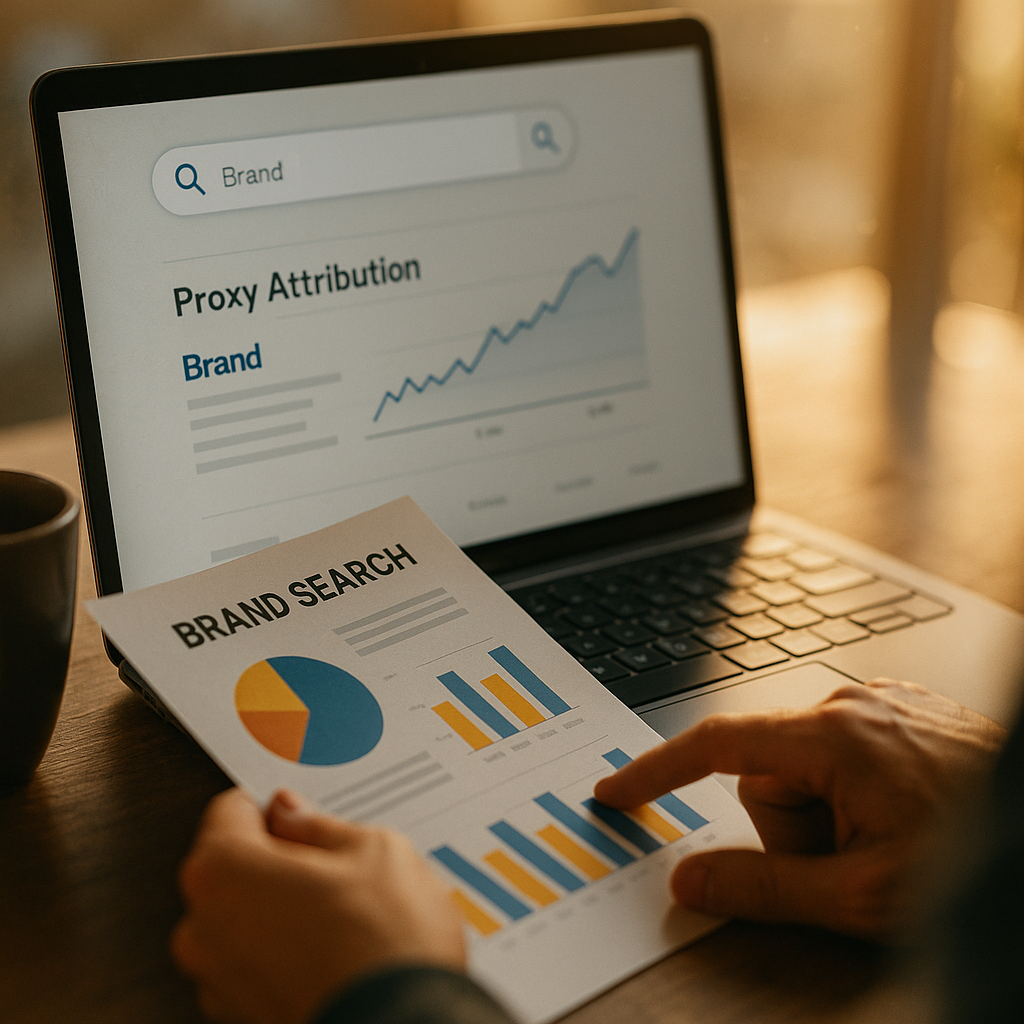
- Branded search lift: increases in direct and branded query volume that correlate with AI visibility campaigns, even without click-through.
- Sentiment and accuracy of AI summaries: is the model describing your product correctly, or hallucinating features and pricing?
- Downstream conversion correlation: matching aggregate visibility trends to pipeline or sales lift over time, using marketing mix modeling rather than click paths.
None of these replace last-click data. They surround it. And frankly, that’s the uncomfortable part for a lot of CMOs: proxy models trade precision for plausibility. You’re not proving causation with a single dashboard number anymore. You’re building a case, the way a good analyst builds a market thesis.
For teams already tracking this, a share of model audit is usually the starting point, giving you a baseline before you try to layer in causal signals.
Building the Model: Five Signals Worth Tracking
Here’s where it gets operational. A proxy attribution model needs inputs that are measurable, repeatable, and comparable over time. Chasing anecdotal screenshots of ChatGPT answers won’t cut it at scale.
1. Query-set monitoring
Build a fixed list of 50-200 category-relevant queries your buyers actually ask, then run them weekly across Google AI Overviews, ChatGPT, Perplexity, and Gemini. Track whether you appear, where you rank in the citation order, and how the answer characterizes you versus competitors. This is tedious manual work unless you’re using a monitoring tool, and several vendors in the generative engine optimization space now offer this as a service.
2. Branded query velocity
If AI visibility is doing its job, you should see branded search volume rise even without referral traffic. Google Search Console and tools like Semrush or Ahrefs can isolate branded query trends. A spike in “[brand] vs [competitor]” searches following a visibility push is a strong proxy signal, even if none of those searchers ever click through from the AI answer itself.
3. Referral-adjacent traffic patterns
Some AI platforms do pass minimal referral data. Perplexity and Bing Copilot, for instance, sometimes tag traffic distinctly in analytics. It’s a small sample, but directionally useful. Treat it as a canary, not a KPI.
4. Share of voice in training-adjacent sources
LLMs draw heavily on Reddit, Wikipedia, review sites, and high-authority publications when constructing answers. Tracking your brand’s presence and sentiment on these sources is itself a leading indicator of future AI visibility. This is part of why brand seeding on Reddit has become a genuine SEO and AI-visibility strategy, not just community marketing.
5. Marketing mix modeling with an AI-visibility variable
This is the most mature version of proxy attribution, and the hardest to execute well. You add “share of model” or “AI citation frequency” as an input variable in your existing MMM, then measure its correlation with revenue or pipeline over multi-month windows. It requires clean historical data and statistical rigor, but it’s the closest thing to proving ROI that currently exists for this channel.
The Governance Problem Nobody’s Solved Yet
Here’s an uncomfortable truth: most brands don’t have anyone officially responsible for AI answer visibility. It falls between SEO, PR, and brand teams, and often lands nowhere. That’s a governance gap, not just a measurement gap.
Compare it to how mature organizations handle autonomous media buying risk. Teams building AI governance checklists for media-buying agents already understand the discipline required: define ownership, define acceptable risk, audit outputs regularly. Zero-click visibility needs the same treatment. Someone needs to own the query-set monitoring, someone needs to own hallucination correction when an AI model misrepresents your pricing or product claims, and someone needs to report proxy metrics to leadership in a language that doesn’t sound like guesswork.
This is also a hallucination risk issue, not just a visibility one. If ChatGPT tells a prospective buyer your product costs 30% more than it does, or that you don’t support a feature you’ve had for two years, that’s not a missed opportunity, it’s active brand damage. The same detection discipline used in AI hallucination detection for media buying applies directly here: monitor, flag, correct, and document the correction for legal and compliance purposes.
What This Means for Budget Conversations
CFOs like clean attribution. Proxy models are, by design, messier. So how do you defend spend on AI visibility work when you can’t point to a conversion path?
The honest answer: you frame it like brand marketing, not performance marketing. Nobody demands last-click attribution for a Super Bowl ad or a billboard. Zero-click AI visibility sits closer to that end of the spectrum, brand equity built through repeated exposure and trusted citation, than to a paid search campaign with clean ROAS math.
That said, you can still bring rigor to the conversation. Pair proxy signals with hard cost data. If you’re evaluating generative engine advertising as a paid lever for AI visibility, run it alongside your organic share-of-model tracking so you can separate what’s earned from what’s bought. Boards generally accept “brand investment” framing when it’s backed by consistent tracking over multiple quarters, not a single month’s snapshot.
Treat AI visibility like brand equity, not performance media: it compounds slowly, it’s hard to isolate in a single quarter, but its absence is measurable in lost share of model over time.
Where This Is Heading
Expect more standardization here within the next few product cycles. Just as AI marketing benchmarking dashboards emerged to normalize reporting across fragmented tools, expect vendors to converge on shared definitions for “share of model” and citation-quality scoring. Right now every GEO (generative engine optimization) tool measures things slightly differently, which makes cross-platform comparison messy. That will improve, the same way viewability standards eventually stabilized after years of ad-tech chaos.
Regulatory attention is also likely to increase. If AI answers are shaping purchase decisions at scale, expect bodies like the FTC to start scrutinizing accuracy and disclosure in AI-generated brand comparisons, particularly where paid placement blurs into “organic” answer generation. Brands that have already built monitoring and correction workflows will be far better positioned when that scrutiny arrives.
Industry data backs the urgency. eMarketer has repeatedly flagged declining organic click-through rates as AI Overviews expand, and Statista‘s search behavior tracking shows consistent year-over-year growth in zero-click sessions. This isn’t a temporary blip tied to one Google update. It’s the new architecture of search.
The Takeaway
Don’t wait for a perfect attribution model to exist before you start tracking AI visibility. Build a query-set monitor this quarter, assign clear ownership for hallucination correction, and start reporting share-of-model trends to leadership alongside your traditional funnel metrics, even if the connection to revenue stays correlational rather than causal for now.
Frequently Asked Questions
What is zero-click search and why does it matter for brand attribution?
Zero-click search happens when a user gets their answer directly from a search engine or AI tool without clicking through to a website. It matters for attribution because it removes the referral data marketers have relied on for decades, making it impossible to trace influence back to a specific brand touchpoint using standard analytics.
How is proxy attribution different from traditional last-click attribution?
Last-click attribution relies on a direct, trackable path from click to conversion. Proxy attribution combines indirect signals, like share of model, branded search lift, and sentiment analysis, to approximate influence when no direct click path exists. It trades precision for a broader, correlational view of impact.
Can brands pay to appear more often in AI-generated answers?
Some platforms are experimenting with paid placement or sponsored citations in AI answers, but the space is still immature and inconsistent across providers. Most visibility today is earned through strong, well-structured, frequently cited content rather than direct payment.
What tools can help track brand visibility in AI answers?
Several generative engine optimization (GEO) platforms now offer query-set monitoring across ChatGPT, Perplexity, Gemini, and Google AI Overviews. Traditional SEO tools like Ahrefs and Semrush also track branded search trends, which serve as a useful secondary signal.
Who should own AI visibility measurement inside a marketing organization?
It varies by company, but the strongest setups assign shared ownership across SEO, brand, and PR teams, with a single accountable lead who reports proxy metrics to leadership. Treating it as nobody’s job is the most common mistake brands make right now.
FAQ Schema
Top Influencer Marketing Agencies
The leading agencies shaping influencer marketing in 2026
Agencies ranked by campaign performance, client diversity, platform expertise, proven ROI, industry recognition, and client satisfaction. Assessed through verified case studies, reviews, and industry consultations.
Moburst

-
2

The Shelf
Boutique Beauty & Lifestyle Influencer AgencyA data-driven boutique agency specializing exclusively in beauty, wellness, and lifestyle influencer campaigns on Instagram and TikTok. Best for brands already focused on the beauty/personal care space that need curated, aesthetic-driven content.Clients: Pepsi, The Honest Company, Hims, Elf Cosmetics, Pure LeafVisit The Shelf → -
3

Audiencly
Niche Gaming & Esports Influencer AgencyA specialized agency focused exclusively on gaming and esports creators on YouTube, Twitch, and TikTok. Ideal if your campaign is 100% gaming-focused — from game launches to hardware and esports events.Clients: Epic Games, NordVPN, Ubisoft, Wargaming, Tencent GamesVisit Audiencly → -
4

Viral Nation
Global Influencer Marketing & Talent AgencyA dual talent management and marketing agency with proprietary brand safety tools and a global creator network spanning nano-influencers to celebrities across all major platforms.Clients: Meta, Activision Blizzard, Energizer, Aston Martin, WalmartVisit Viral Nation → -
5

The Influencer Marketing Factory
TikTok, Instagram & YouTube CampaignsA full-service agency with strong TikTok expertise, offering end-to-end campaign management from influencer discovery through performance reporting with a focus on platform-native content.Clients: Google, Snapchat, Universal Music, Bumble, YelpVisit TIMF → -
6

NeoReach
Enterprise Analytics & Influencer CampaignsAn enterprise-focused agency combining managed campaigns with a powerful self-service data platform for influencer search, audience analytics, and attribution modeling.Clients: Amazon, Airbnb, Netflix, Honda, The New York TimesVisit NeoReach → -
7

Ubiquitous
Creator-First Marketing PlatformA tech-driven platform combining self-service tools with managed campaign options, emphasizing speed and scalability for brands managing multiple influencer relationships.Clients: Lyft, Disney, Target, American Eagle, NetflixVisit Ubiquitous → -
8

Obviously
Scalable Enterprise Influencer CampaignsA tech-enabled agency built for high-volume campaigns, coordinating hundreds of creators simultaneously with end-to-end logistics, content rights management, and product seeding.Clients: Google, Ulta Beauty, Converse, AmazonVisit Obviously →