


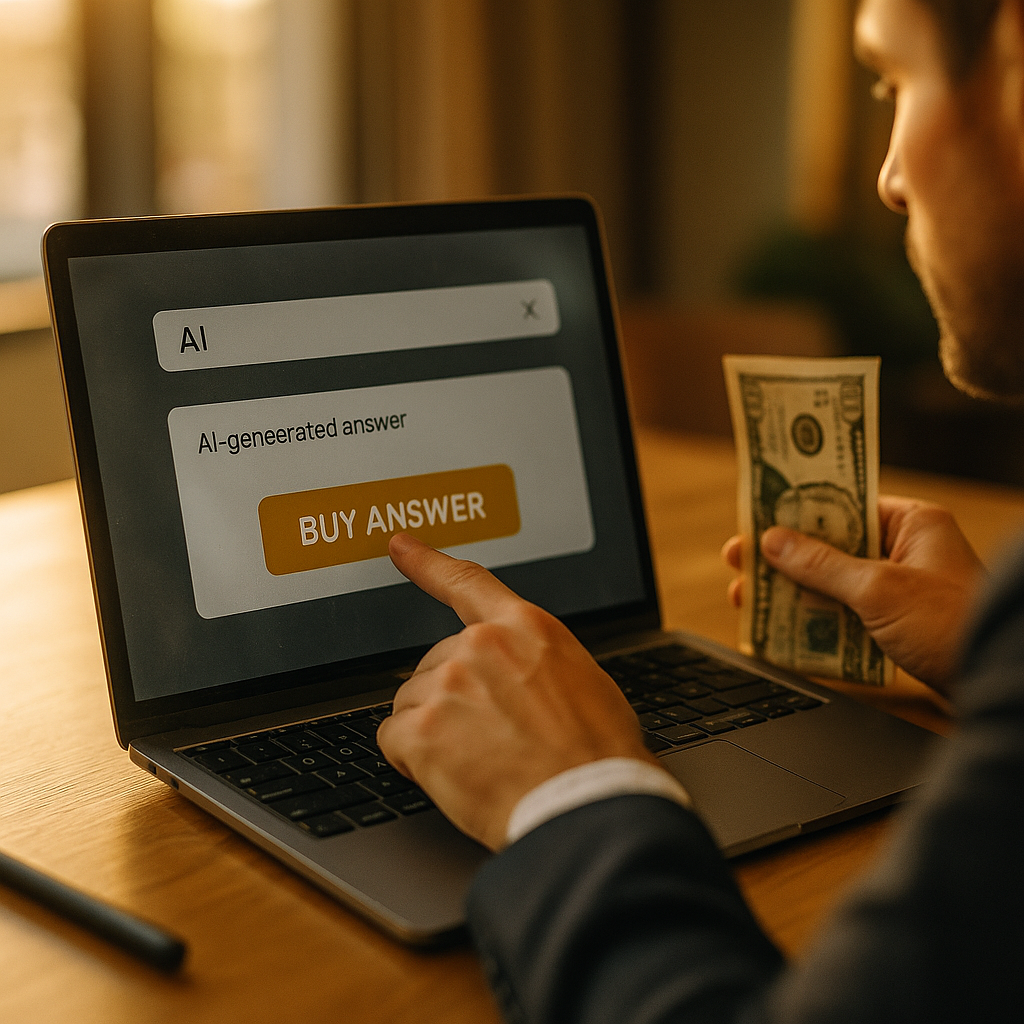
Zero-click search killed half the SEO industry’s business model. Now a startup called Smalk is betting brands will pay to get quoted inside the AI answers that replaced those clicks. Its pitch: generative engine advertising, a paid mechanism for winning placement inside ChatGPT, Perplexity, and Gemini responses. The question every CMO should be asking is whether SEO-style signals can actually buy your way into an LLM’s output, or whether this is optimization theater dressed up as a media buy.
What Smalk Is Actually Selling
Smalk positions itself as an answer-engine optimization layer with a paid tier bolted on. The company’s core claim is that it can influence which brands, products, or sources get surfaced when someone asks an LLM a commercial question, things like “best CRM for a 20-person startup” or “which running shoes are worth the price.” Instead of bidding on keywords, brands feed Smalk structured content, schema markup, and citation-friendly copy that the platform says increases the odds of being pulled into a generated answer.
That’s the SEO-style part. Smalk isn’t buying an ad slot the way you’d buy a Google Ads placement. It’s optimizing inputs, structured data, entity clarity, source authority signals, and then layering a paid acceleration tier that promises faster indexing or higher weighting in the retrieval step some LLMs use before generating a response.
The catch: most consumer-facing LLMs don’t have a formal ad auction for in-answer placement. There’s no equivalent of Google’s AdWords dashboard where you set a max bid and watch your brand appear in a citation. So “generative engine advertising” is more accurately generative engine optimization with a paid rush option, not a guaranteed placement product.
Why Brands Are Even Considering This
Because traffic patterns have already shifted. Search referrals from AI-driven surfaces are growing fast enough that marketing teams are rebuilding attribution models around them, as covered in our piece on reconfiguring attribution windows for AI search referrals. If a meaningful share of purchase research now happens inside a chat window instead of a SERP, brands need a way to influence what that chat window says about them. Ignoring it isn’t a neutral choice; it’s ceding the conversation to whoever the model happens to trust.
There is no confirmed public auction for placement inside ChatGPT or Gemini answers. Any vendor promising guaranteed inclusion is selling probability, not certainty, and brands should price the risk accordingly.
Sprout Social’s own research on social and search behavior shifts has tracked how quickly discovery habits move once a new interface takes hold. Influencer and content marketers watched this happen with TikTok search. Now it’s happening with conversational AI, just faster and with less transparency into ranking logic.
The Mechanics: Retrieval, Not Ranking
Here’s the technical reality Smalk’s pitch glosses over. Most LLM-generated answers that cite sources rely on retrieval-augmented generation, pulling from indexed web content, structured data, or a live search API, then synthesizing a response. That process is closer to how RAG stops AI hallucinations in brand content than it is to a traditional ad auction. There’s no bid, no impression guarantee, no CPM.
What can move the needle is being the kind of source a retrieval system prefers: structured, factually consistent, frequently cited elsewhere, and free of contradictory claims across your own digital footprint. That’s genuinely SEO-adjacent work. Schema markup, consistent NAP data, authoritative backlinks, and clean product feeds all matter. We’ve written about how product feeds for the agent economy are becoming a foundational requirement, not a nice-to-have, precisely because agents and LLMs consume structured data differently than human browsers do.
But “helping a retrieval system trust you” is a different product than “buying placement.” Smalk’s paid tier appears to accelerate the optimization work, faster crawling, priority indexing claims, maybe some direct data partnerships with model providers. It does not appear to guarantee that Gemini will name-drop your brand in response number 4,000,001. Any vendor implying otherwise deserves a hard look at their case studies before you sign a contract.
Where the Model Might Actually Work
Give credit where it’s due: there are scenarios where paid influence over LLM outputs is more plausible than skeptics assume.
- Enterprise LLM partnerships. Some model providers have struck direct data-licensing or content-partnership deals. If Smalk brokers access to those channels, that’s a real, contractually defined placement mechanism, not a black box.
- Retailer and shopping assistants. Amazon’s Rufus and Google’s Gemini-powered shopping surfaces already blend paid and organic signals, as we detailed in our look at how Rufus and Gemini find you through product feeds. These are closer to genuine ad ecosystems than open-domain chat.
- Brand-owned AI experiences. If a company deploys its own fine-tuned or RAG-based assistant, optimizing what it retrieves and surfaces is entirely within the brand’s control. That’s a controlled environment, not a bidding war for third-party model attention.
Notice the pattern: the closer you get to a closed, contractual, first-party system, the more “advertising” makes literal sense. The closer you get to open consumer chat interfaces like ChatGPT’s free tier, the more it’s optimization with a paid rush job, not media buying.
Risk Mitigation: What Compliance and Finance Will Ask
Before any budget moves toward a generative engine advertising vendor, expect three questions from finance and legal.
First: what exactly are we paying for? Get the contract to define placement, citation, or ranking in measurable terms. If the vendor can’t specify a tracked outcome, you’re paying for a service retainer, not a media placement. Compare this to the due diligence standards laid out in our AI ad vendor ROAS claims checklist, which applies just as well here.
Second: how do we measure it? You need a citation-tracking process before you spend a dollar. Our weekly LLM citation dashboard framework is the baseline for this: track brand mentions across model outputs on a recurring schedule, log source attribution where visible, and treat every claim of “increased visibility” as unverified until your own dashboard confirms it.
Third: what’s the compliance exposure? Paid influence over AI-generated content that consumers reasonably believe is neutral or algorithmic touches disclosure law fast. The FTC has already signaled interest in how AI-mediated recommendations intersect with endorsement and advertising disclosure rules. Review the FTC’s endorsement guidance before assuming a “paid visibility boost” inside an AI answer is exempt from disclosure obligations. If a model surfaces your brand because you paid for it and doesn’t disclose that to the user, that’s a liability sitting on your desk, not the vendor’s.
If your citation dashboard shows zero measurable lift after 90 days of a paid generative engine advertising contract, that’s not a slow ramp, that’s a signal to renegotiate or walk.
How This Fits the Broader AI Marketing Stack
Generative engine advertising doesn’t exist in isolation. It sits alongside a fast-growing set of AI-adjacent budget lines: agentic media buying, on-device personalization, LLM interoperability decisions. Marketing teams are already stretched thin figuring out whether to fine-tune or license a marketing LLM, and now there’s another vendor asking for budget against a metric nobody can fully audit yet.
That doesn’t mean skip it. It means sequence it correctly. Get your structured data, schema, and product feed hygiene right first, that’s the unglamorous 80% of the work and it benefits every AI surface, paid or not. Only layer in a paid acceleration vendor once you have a measurement baseline. Otherwise you’re spending against a hypothesis you can’t test.
eMarketer’s ongoing research into AI-driven search and commerce behavior is a good place to sanity-check vendor claims against independent data rather than the vendor’s own case studies. Treat every generative engine advertising pitch deck the way you’d treat a self-reported attribution study: interesting, not sufficient.
FAQs
Frequently Asked Questions
Is generative engine advertising the same as SEO for AI?
Not exactly. SEO for AI, often called answer engine optimization, focuses on structuring content so LLMs are more likely to cite it during retrieval. Generative engine advertising, as Smalk frames it, adds a paid acceleration layer on top of that optimization work. It’s SEO-adjacent, but it isn’t a guaranteed ad placement in the way search or social ads are.
Can brands actually buy placement inside ChatGPT or Gemini answers?
There’s no confirmed, publicly documented ad auction for in-answer placement in consumer-facing LLMs like ChatGPT’s free tier. Some retail and shopping-assistant surfaces blend paid and organic signals more explicitly. Outside of direct data partnerships with model providers, most “placement” claims are really optimization and indexing services, not guaranteed media buys.
How do I measure whether a generative engine advertising vendor is working?
Build a recurring citation-tracking process before signing any contract. Query target LLMs regularly with realistic customer prompts, log whether and how your brand appears, and compare results against a pre-campaign baseline. Without that dashboard, you have no way to verify a vendor’s visibility claims.
What compliance risks come with paying for AI answer visibility?
Disclosure law is the main exposure. If a paid arrangement influences what an LLM surfaces and that influence isn’t disclosed to the end user, it can raise the same issues as undisclosed sponsored content under FTC endorsement guidance. Legal review before launch is not optional.
What should brands prioritize before spending on this category?
Clean structured data, consistent schema markup, accurate product feeds, and a citation-monitoring baseline. These fundamentals improve visibility across every AI surface, paid or organic, and they cost far less than a speculative ad contract with unclear placement guarantees.
Before you sign anything, run one test: ask five realistic customer questions across ChatGPT, Perplexity, and Gemini, and log whether your brand shows up at all. If the answer is no, fix your structured data first. Pay for acceleration only after you have a baseline worth accelerating.
Top Influencer Marketing Agencies
The leading agencies shaping influencer marketing in 2026
Agencies ranked by campaign performance, client diversity, platform expertise, proven ROI, industry recognition, and client satisfaction. Assessed through verified case studies, reviews, and industry consultations.
Moburst

-
2

The Shelf
Boutique Beauty & Lifestyle Influencer AgencyA data-driven boutique agency specializing exclusively in beauty, wellness, and lifestyle influencer campaigns on Instagram and TikTok. Best for brands already focused on the beauty/personal care space that need curated, aesthetic-driven content.Clients: Pepsi, The Honest Company, Hims, Elf Cosmetics, Pure LeafVisit The Shelf → -
3

Audiencly
Niche Gaming & Esports Influencer AgencyA specialized agency focused exclusively on gaming and esports creators on YouTube, Twitch, and TikTok. Ideal if your campaign is 100% gaming-focused — from game launches to hardware and esports events.Clients: Epic Games, NordVPN, Ubisoft, Wargaming, Tencent GamesVisit Audiencly → -
4

Viral Nation
Global Influencer Marketing & Talent AgencyA dual talent management and marketing agency with proprietary brand safety tools and a global creator network spanning nano-influencers to celebrities across all major platforms.Clients: Meta, Activision Blizzard, Energizer, Aston Martin, WalmartVisit Viral Nation → -
5

The Influencer Marketing Factory
TikTok, Instagram & YouTube CampaignsA full-service agency with strong TikTok expertise, offering end-to-end campaign management from influencer discovery through performance reporting with a focus on platform-native content.Clients: Google, Snapchat, Universal Music, Bumble, YelpVisit TIMF → -
6

NeoReach
Enterprise Analytics & Influencer CampaignsAn enterprise-focused agency combining managed campaigns with a powerful self-service data platform for influencer search, audience analytics, and attribution modeling.Clients: Amazon, Airbnb, Netflix, Honda, The New York TimesVisit NeoReach → -
7

Ubiquitous
Creator-First Marketing PlatformA tech-driven platform combining self-service tools with managed campaign options, emphasizing speed and scalability for brands managing multiple influencer relationships.Clients: Lyft, Disney, Target, American Eagle, NetflixVisit Ubiquitous → -
8

Obviously
Scalable Enterprise Influencer CampaignsA tech-enabled agency built for high-volume campaigns, coordinating hundreds of creators simultaneously with end-to-end logistics, content rights management, and product seeding.Clients: Google, Ulta Beauty, Converse, AmazonVisit Obviously →