


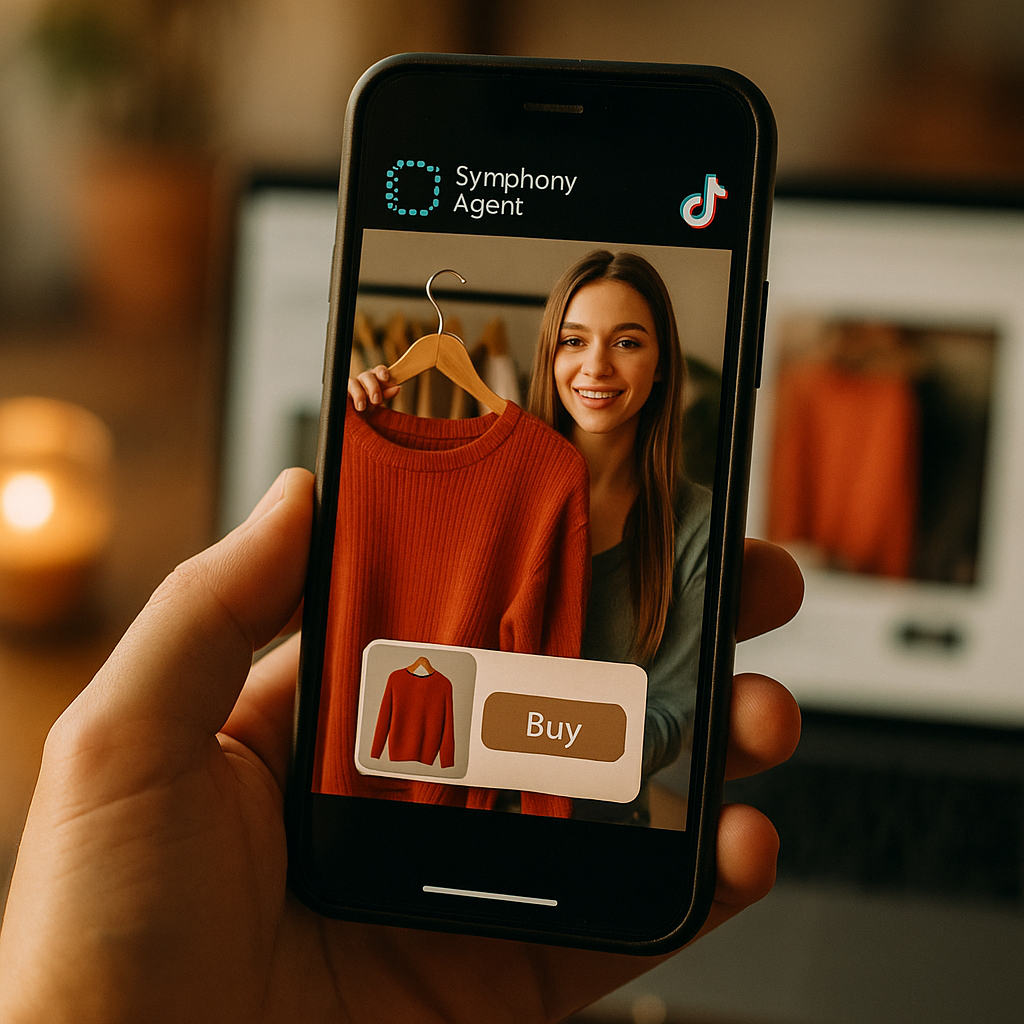
TikTok now claims its Symphony AI suite can turn a single brand video into dozens of shoppable ad variants in minutes. Sounds efficient. But every media buyer who’s tested it has the same question: what’s actually happening under the hood, and how much should you trust the output before it touches paid budget? The TikTok Symphony agent is less a magic button than a pipeline of discrete AI models stitched together, and understanding that pipeline is the difference between scaling smart and scaling sloppy.
What Symphony Actually Is, In Plain Terms
TikTok Symphony launched as an umbrella brand for TikTok’s generative AI ad tools, covering script generation, avatar creation, video editing, and — most relevant here — automated conversion of existing brand assets into shoppable formats tied to TikTok Shop. The “agent” piece refers to the orchestration layer that chains these models together without a human clicking through each step manually.
Think of it as a production assembly line. Raw footage goes in one end. Product tags, CTA overlays, catalog links, and multiple aspect-ratio cuts come out the other. TikTok’s own documentation on TikTok Ads positions this as a way to cut creative production time for performance campaigns, particularly for brands running TikTok Shop.
The Pipeline, Step by Step
Here’s roughly what happens when you feed Symphony a source video:
- Ingestion and scene detection: The model breaks the source video into scenes and flags moments where a product appears clearly on screen, using object detection trained on TikTok Shop catalog imagery.
- Product matching: Symphony cross-references detected objects against your connected product catalog (via TikTok Shop or a linked feed) to auto-tag SKUs at the frame level.
- Shoppable overlay generation: Once products are matched, the system inserts sticker-style product cards, pricing, and “Shop Now” CTAs, timed to appear when the product is visually salient rather than at fixed intervals.
- Variant generation: The agent produces multiple cuts — different lengths, different hooks, sometimes different voiceover pacing — optimized for TikTok’s various placements (In-Feed, TopView, Shop tab).
- Auto-captioning and localization: Text overlays and spoken captions get generated and, in multi-market accounts, translated.
None of this is conceptually new. It’s the same logic behind dynamic creative optimization tools that have existed in programmatic display for years. What’s different is the object-level product tagging happening automatically against a live commerce catalog, not a static banner template.
The real innovation isn’t the video editing — it’s that Symphony treats your catalog feed as a live input to creative generation, not a separate step handled by a different team.
Where This Gets Genuinely Useful for Media Buyers
If you’re running TikTok Shop campaigns at any scale, manual product tagging across dozens of video variants is brutal. eMarketer has repeatedly flagged creative production bottlenecks as one of the top constraints on social commerce scaling — see eMarketer’s ongoing coverage of retail media and social commerce trends. Symphony’s core value is removing that bottleneck.
Practically, this matters most in three scenarios:
- Live shopping clip repurposing. Brands running TikTok Shop LIVE sessions can feed recorded streams into Symphony and get shoppable cutdowns without a video editor manually re-tagging products scene by scene.
- UGC-at-scale programs. If you’re running dozens of creator videos through paid amplification, Symphony can standardize shoppable tagging across creative sourced from different creators, which otherwise arrives with wildly inconsistent production quality.
- Rapid catalog testing. For DTC brands testing which SKUs resonate in video format, Symphony lets you generate shoppable variants against multiple products from one source video, rather than reshooting for each SKU.
The efficiency case is real. The risk case is where most media buyers stop paying attention too early.
Where the Automation Breaks
Object detection is not the same as brand judgment. Symphony will tag a product because it’s visually present, not because it’s the product you want to push that week. If your promo video happens to show three products in frame and you’re only running a discount on one, expect the agent to tag all three unless you manually constrain the catalog feed at the campaign level.
There’s also a review-lag problem. Auto-generated shoppable overlays need human QA before launch, especially for regulated categories (health, finance-adjacent products, anything with claims). TikTok’s ad policies still hold the advertiser liable for what appears in the shoppable card, not the AI that generated it. That liability gap is exactly the kind of governance issue covered in our comparison of AI ad governance across platforms, and it applies just as much to Symphony’s shoppable outputs as it does to Meta’s Advantage+ or Amazon’s generative ad tools.
A few other friction points worth knowing before you brief your team:
- Auto-generated captions frequently mis-transcribe brand names and product SKUs, particularly for non-English markets.
- Variant generation sometimes produces near-duplicate cuts that count against your creative fatigue budget without adding real testing value.
- Catalog sync delays mean a product pulled from inventory can still show as shoppable in a live ad for a short window — a real compliance risk for FTC disclosure and inventory-accuracy rules under FTC guidance on advertising claims.
Attribution: The Part TikTok Doesn’t Emphasize Enough
Here’s the question every performance buyer should be asking: when a Symphony-generated shoppable ad drives a sale, how confident are you in the attribution path? TikTok Shop’s native reporting tends to credit the ad unit generously, and Symphony variants inherit whatever attribution logic sits underneath the standard TikTok Shop ad product. That means the usual caveats about last-touch bias and platform self-reporting apply, just wrapped in a shinier creative wrapper.
If you’re running Symphony output alongside other paid channels, you need incrementality testing that isn’t dependent on TikTok’s own pixel and catalog data. This is where third-party measurement earns its keep. Teams evaluating whether their current stack can handle this are better served checking frameworks like our breakdown of incrementality testing platforms rather than trusting in-platform dashboards alone.
It’s also worth cross-referencing Symphony campaign performance against your broader media mix model, particularly if you’re shifting budget from static creative to AI-generated shoppable variants. Our guide to evaluating AI-powered media mix modeling covers exactly this kind of cross-channel sanity check, and it’s a useful exercise before you commit meaningful spend to Symphony-generated creative at scale.
A Practical Rollout Checklist
Before you hand Symphony your full video library, run this sequence:
- Audit your catalog feed first. Symphony’s product matching is only as accurate as the feed it references. Clean SKU titles, correct pricing, and current inventory status before generating a single ad.
- Test on low-stakes SKUs. Run initial batches on products where a tagging error costs you little, not your hero product during a launch window.
- Build a human QA gate. Every auto-generated shoppable variant should get a compliance and brand-safety look before it goes live, not after.
- Track creative fatigue separately. Because Symphony can generate variants quickly, teams sometimes mistake volume for testing rigor. Tag each variant with a hypothesis, not just a version number.
- Reconcile attribution weekly, not monthly. Shoppable ad attribution moves fast; monthly reconciliation misses real-time inventory or tagging errors that could be draining budget.
Media buyers running multi-platform creative pipelines should also think about how Symphony output fits into broader automation. If your team is already juggling AI briefing tools, check how they compare using our AI creator brief generator evaluation framework — the same governance questions about override controls and human-in-the-loop review apply directly to Symphony’s output.
Cost and Scale Considerations
TikTok has not published a standardized rate card for Symphony’s compute cost; it’s currently bundled into standard ad spend for most accounts rather than billed separately, though that could shift as adoption grows. What’s clear from early adopters interviewed across the industry is that the labor savings on video editing and tagging are real — some brands report cutting creative production time by more than half for TikTok Shop campaigns specifically. Sprout Social’s ongoing research into social commerce trends backs up the broader industry shift toward AI-assisted creative at scale, even if platform-specific numbers stay proprietary.
The bigger cost isn’t compute. It’s the QA headcount you still need to keep in the loop, and most media buying teams underestimate that when they pitch Symphony internally as a “reduce headcount” tool rather than a “reallocate headcount toward review” tool.
So Is It Worth Adopting Now?
Yes, with guardrails. If you’re already running TikTok Shop at scale, Symphony’s shoppable conversion pipeline solves a real production bottleneck. If you’re a smaller advertiser dabbling in TikTok Shop, the automation gains may not yet outweigh the QA overhead required to catch tagging errors and compliance gaps.
Either way, don’t treat Symphony’s output as launch-ready by default. Treat it as a fast first draft that still needs a trained eye, a clean catalog feed, and an attribution model that isn’t solely dependent on TikTok’s own reporting.
FAQs
What is TikTok Symphony used for?
TikTok Symphony is TikTok’s generative AI suite for ad creative, covering script writing, AI avatars, video editing, and automated conversion of brand videos into shoppable ad formats tied to TikTok Shop.
How does Symphony turn a video into a shoppable ad?
Symphony detects products in video scenes, matches them against your connected product catalog, inserts shoppable overlays and CTAs at relevant moments, and generates multiple format variants automatically.
Does Symphony replace the need for human creative review?
No. Auto-generated shoppable tags can misfire, especially with multiple products in frame or outdated catalog feeds, so a human QA step before launch remains necessary for compliance and brand safety.
Is Symphony-generated ad performance attributed accurately?
Symphony inherits TikTok Shop’s native attribution logic, which carries the same self-reporting bias as other in-platform metrics. Buyers should validate results with independent incrementality testing rather than relying solely on TikTok’s dashboards.
Does using Symphony cost extra on top of ad spend?
TikTok currently bundles Symphony’s generation tools into standard ad spend for most accounts rather than charging separately, though this could change as the tool scales and adoption grows.
FAQs
What is TikTok Symphony used for?
TikTok Symphony is TikTok’s generative AI suite for ad creative, covering script writing, AI avatars, video editing, and automated conversion of brand videos into shoppable ad formats tied to TikTok Shop.
How does Symphony turn a video into a shoppable ad?
Symphony detects products in video scenes, matches them against your connected product catalog, inserts shoppable overlays and CTAs at relevant moments, and generates multiple format variants automatically.
Does Symphony replace the need for human creative review?
No. Auto-generated shoppable tags can misfire, especially with multiple products in frame or outdated catalog feeds, so a human QA step before launch remains necessary for compliance and brand safety.
Is Symphony-generated ad performance attributed accurately?
Symphony inherits TikTok Shop’s native attribution logic, which carries the same self-reporting bias as other in-platform metrics. Buyers should validate results with independent incrementality testing rather than relying solely on TikTok’s dashboards.
Does using Symphony cost extra on top of ad spend?
TikTok currently bundles Symphony’s generation tools into standard ad spend for most accounts rather than charging separately, though this could change as the tool scales and adoption grows.
Top Influencer Marketing Agencies
The leading agencies shaping influencer marketing in 2026
Agencies ranked by campaign performance, client diversity, platform expertise, proven ROI, industry recognition, and client satisfaction. Assessed through verified case studies, reviews, and industry consultations.
Moburst

-
2

The Shelf
Boutique Beauty & Lifestyle Influencer AgencyA data-driven boutique agency specializing exclusively in beauty, wellness, and lifestyle influencer campaigns on Instagram and TikTok. Best for brands already focused on the beauty/personal care space that need curated, aesthetic-driven content.Clients: Pepsi, The Honest Company, Hims, Elf Cosmetics, Pure LeafVisit The Shelf → -
3

Audiencly
Niche Gaming & Esports Influencer AgencyA specialized agency focused exclusively on gaming and esports creators on YouTube, Twitch, and TikTok. Ideal if your campaign is 100% gaming-focused — from game launches to hardware and esports events.Clients: Epic Games, NordVPN, Ubisoft, Wargaming, Tencent GamesVisit Audiencly → -
4

Viral Nation
Global Influencer Marketing & Talent AgencyA dual talent management and marketing agency with proprietary brand safety tools and a global creator network spanning nano-influencers to celebrities across all major platforms.Clients: Meta, Activision Blizzard, Energizer, Aston Martin, WalmartVisit Viral Nation → -
5

The Influencer Marketing Factory
TikTok, Instagram & YouTube CampaignsA full-service agency with strong TikTok expertise, offering end-to-end campaign management from influencer discovery through performance reporting with a focus on platform-native content.Clients: Google, Snapchat, Universal Music, Bumble, YelpVisit TIMF → -
6

NeoReach
Enterprise Analytics & Influencer CampaignsAn enterprise-focused agency combining managed campaigns with a powerful self-service data platform for influencer search, audience analytics, and attribution modeling.Clients: Amazon, Airbnb, Netflix, Honda, The New York TimesVisit NeoReach → -
7

Ubiquitous
Creator-First Marketing PlatformA tech-driven platform combining self-service tools with managed campaign options, emphasizing speed and scalability for brands managing multiple influencer relationships.Clients: Lyft, Disney, Target, American Eagle, NetflixVisit Ubiquitous → -
8

Obviously
Scalable Enterprise Influencer CampaignsA tech-enabled agency built for high-volume campaigns, coordinating hundreds of creators simultaneously with end-to-end logistics, content rights management, and product seeding.Clients: Google, Ulta Beauty, Converse, AmazonVisit Obviously →