


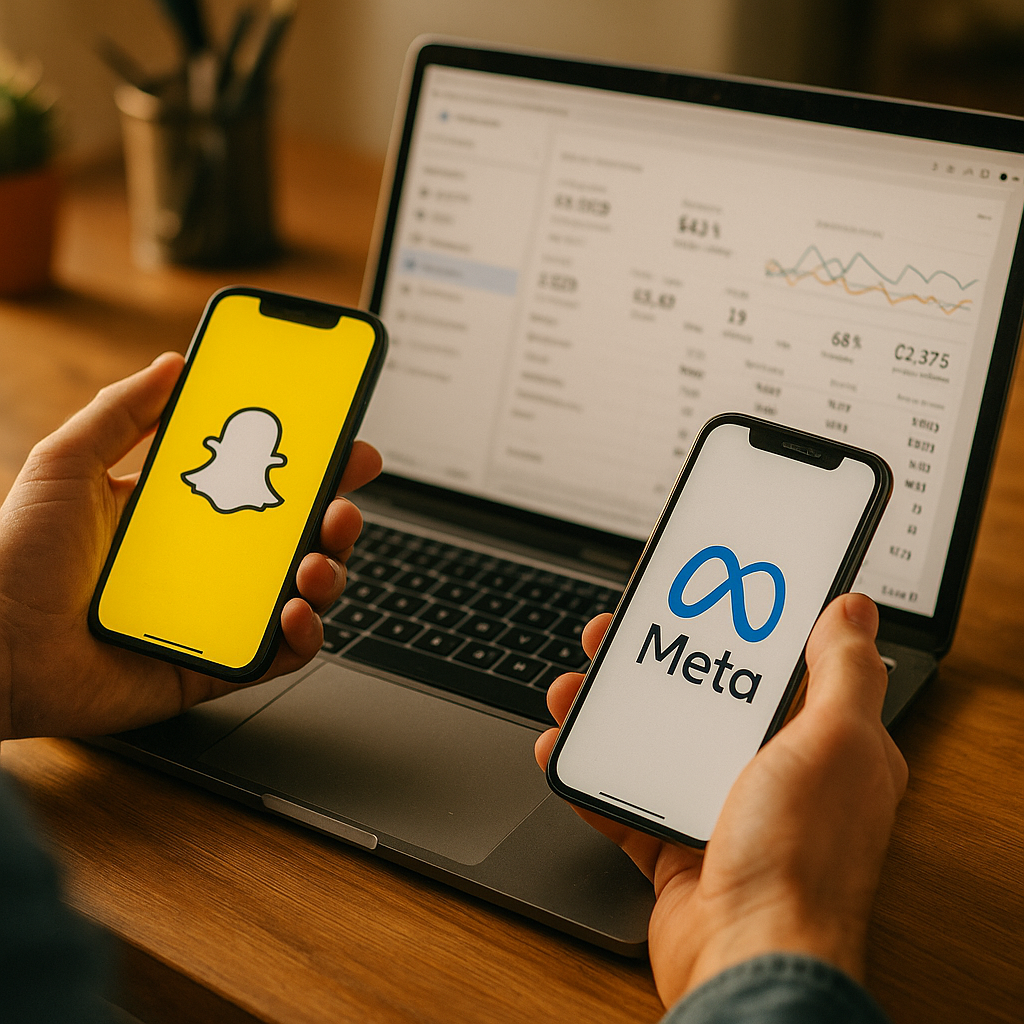
Snapchat just quietly launched something that should worry every media buyer who thought “automated advertising” meant Meta and TikTok alone. The Snapchat AI ad suite now lets brands type a business goal into a chat interface and get a fully built campaign back, targeting, creative direction, and budget allocation included. The question isn’t whether this works. It’s whether you can trust it with real spend.
Snap calls it Smart Assistant, and it’s the platform’s most aggressive move yet toward agentic campaign creation. For brand marketers already running Meta Advantage+ or TikTok’s Symphony tools, this is another automation layer to evaluate, another black box to audit before the CFO asks why performance dipped.
What Snap’s Smart Assistant Actually Does
Smart Assistant sits inside Snapchat Ads Manager as a conversational layer. Instead of manually selecting objectives, audiences, and placements, you describe what you want: “Drive app installs among 18-24 year-olds in urban markets under a $15 CPA.” The system interprets that prompt, drafts a campaign structure, recommends creative formats (AR lenses, Collection ads, Snap Ads), and sets initial bid strategy.
It’s goal-to-campaign automation in the literal sense. You state the outcome, the assistant reverse-engineers the setup. Snap has been signaling this direction for a while, layering machine learning into its Advantage+-style “Advanced Targeting” and now wrapping it in natural language.
Three things make this different from a standard campaign wizard:
- Dynamic creative pairing: The assistant suggests which AR lens or video format historically performs best for the stated goal, pulling from Snap’s own performance data across similar advertisers.
- Budget pacing suggestions: It recommends daily spend caps based on predicted delivery, not just historical CPMs.
- Iterative refinement: You can converse with it mid-campaign, asking it to shift toward a different KPI without rebuilding from scratch.
That last point is the real differentiator. Meta Advantage+ optimizes within a locked campaign structure. Snap’s assistant lets you renegotiate the goal conversationally, then it rebuilds targeting logic on the fly.
Meta Advantage+, the Incumbent Benchmark
Meta Advantage+ has been the default comparison point for automated campaign building since its expansion beyond shopping ads. It uses machine learning to handle audience expansion, placement selection, and creative optimization across the Meta family, Facebook, Instagram, and now Threads inventory.
The difference in philosophy is stark. Advantage+ is largely a “trust the algorithm, reduce your inputs” model. You upload creative assets, set a budget and objective, and Meta’s system handles the rest with minimal ongoing intervention. It’s less conversational, more “set it and let the machine work.”
Advertisers report mixed but generally positive results. Meta’s own advertiser resources position Advantage+ as reducing manual campaign structuring time significantly, and third-party benchmarking from eMarketer has tracked steady adoption growth among mid-market advertisers specifically because it cuts labor without requiring a data science team.
The core distinction isn’t which platform’s AI is smarter. It’s whether you want a conversational co-pilot you can redirect mid-flight, or a closed-loop system you configure once and largely leave alone.
Head-to-Head: Where the Two Platforms Diverge
Let’s get specific, because “AI automation” as a category is vague enough to hide meaningful operational differences.
Input method. Snap’s Smart Assistant is prompt-based and iterative. Meta Advantage+ is form-based with algorithmic optimization happening after launch, not during setup. If your team is used to writing creative briefs, Snap’s interface will feel more natural. If your team wants minimal setup friction, Advantage+’s streamlined wizard wins.
Creative involvement. Snap’s assistant actively recommends specific creative formats, AR lenses in particular, tailored to the platform’s native strengths. Meta expects you to supply the creative and lets its system decide which combinations of assets perform best across placements, a process closer to what TikTok’s Symphony agent does with video assets on that platform.
Mid-campaign flexibility. This is Snap’s biggest claimed advantage. You can converse with Smart Assistant to pivot objectives without rebuilding the campaign shell. Advantage+ campaigns generally require a restart or a new campaign object to shift core objectives meaningfully, which matters if your team pivots strategy often (and whose doesn’t, these days?).
Transparency into decisions. Neither platform hands you a full decision log by default. Snap’s assistant offers plain-language rationale for its recommendations within the chat thread, which is a small but real transparency win over Advantage+’s more opaque backend adjustments. Still, “plain language explanation” isn’t the same as an auditable decision trail, and brand compliance teams should treat both with equal scrutiny. For a broader look at how platforms differ on this front, see our comparison of AI ad governance across Meta, TikTok, and Amazon.
Why This Matters for Budget Owners, Not Just Ops Teams
Here’s the uncomfortable truth: automation tools like these shift decision-making authority away from the media buyer and toward the platform’s model. That’s fine when it works. It’s a liability when it doesn’t, and you can’t explain to a CMO why $40,000 got allocated to an underperforming audience segment because “the assistant recommended it.”
Snap reports early advertiser testing showing meaningful reductions in campaign setup time, though independent, platform-neutral benchmarking on Smart Assistant’s actual ROAS lift is still thin. That’s normal for a new tool. It’s also exactly why brands should pilot cautiously rather than migrate wholesale.
Before shifting real budget into Smart Assistant, run the same due-diligence questions you’d apply to any new automated ad product. Our AI ad platform ROAS claims checklist is a useful starting framework, particularly the sections on isolating platform-attributed lift from seasonal or creative-driven lift.
The Attribution Problem Nobody’s Solved
Both Snap and Meta’s automated systems make it harder to know which specific input, audience, creative, or bid strategy, drove results. When the AI is choosing everything simultaneously, isolating cause and effect gets murky fast.
This isn’t unique to Snapchat. It’s the same challenge showing up across autonomous programmatic buying generally: efficiency gains often come paired with reduced attribution clarity. If your team relies on multi-touch attribution or incrementality testing, factor that into your pilot design from day one, not after you’ve already spent the quarter’s discretionary budget.
Teams running incrementality tests alongside these automated tools should also revisit their measurement stack. If you’re still relying purely on platform-reported ROAS, cross-reference with an independent method, something we cover in depth in our incrementality testing comparison.
Practical Guidance for Rolling This Out
If you’re considering testing Snap’s Smart Assistant this quarter, a few operational guardrails will save you headaches:
- Start with a capped test budget, ideally under 10% of your Snapchat allocation, and run it parallel to a manually-structured control campaign.
- Document every prompt you give the assistant. Treat prompts like campaign briefs, versioned and stored, so you can reconstruct decision logic later if performance questions arise.
- Set hard budget ceilings outside the assistant’s control. Don’t let conversational pacing suggestions override your finance team’s spend caps.
- Compare against Advantage+ in parallel if you run cross-platform budgets. A side-by-side test over a 4-6 week window gives you real comparative data rather than anecdotal impressions.
- Loop in compliance early, particularly if your industry has regulatory ad requirements. Automated targeting decisions can inadvertently touch protected categories, a risk regulators including the FTC have flagged repeatedly in guidance around algorithmic ad targeting.
None of this is about resisting automation. It’s about not letting operational convenience quietly erode the oversight your brand needs to defend its media spend in a quarterly review.
Frequently Asked Questions
FAQs
What is Snapchat’s Smart Assistant and how does it differ from standard campaign setup?
Smart Assistant is a conversational AI layer within Snapchat Ads Manager that builds full campaigns, targeting, creative recommendations, and budget pacing, from a plain-language description of your business goal. Standard setup requires manually selecting each of those elements individually.
Is Snapchat’s Smart Assistant similar to Meta Advantage+?
Both automate significant parts of campaign building using machine learning, but the approach differs. Smart Assistant uses a conversational, iterative interface where you can adjust goals mid-campaign. Meta Advantage+ relies on a form-based setup with optimization happening algorithmically after launch, with less mid-flight conversational control.
Can I switch campaign goals mid-flight with Snap’s Smart Assistant?
Yes, this is one of its core differentiators. You can converse with the assistant to shift objectives without fully rebuilding the campaign structure, whereas Meta Advantage+ generally requires more manual restructuring for major objective changes.
Does using AI campaign automation reduce attribution accuracy?
It can. When targeting, creative selection, and bidding all happen simultaneously through an automated system, isolating which specific input drove results becomes harder. Brands relying on multi-touch attribution or incrementality testing should run independent measurement alongside platform-reported metrics.
Should brands fully replace manual campaign building with these AI tools?
Not immediately. Best practice is piloting with a capped budget alongside a manually-structured control campaign, documenting prompts and decisions, and maintaining independent budget ceilings before scaling AI-driven campaigns to a larger share of spend.
The real decision isn’t Snap versus Meta. It’s whether your team has the measurement discipline to run either one without losing sight of what’s actually driving results. Pilot small, document everything, and let the data, not the demo, decide your next budget shift.
Top Influencer Marketing Agencies
The leading agencies shaping influencer marketing in 2026
Agencies ranked by campaign performance, client diversity, platform expertise, proven ROI, industry recognition, and client satisfaction. Assessed through verified case studies, reviews, and industry consultations.
Moburst

-
2

The Shelf
Boutique Beauty & Lifestyle Influencer AgencyA data-driven boutique agency specializing exclusively in beauty, wellness, and lifestyle influencer campaigns on Instagram and TikTok. Best for brands already focused on the beauty/personal care space that need curated, aesthetic-driven content.Clients: Pepsi, The Honest Company, Hims, Elf Cosmetics, Pure LeafVisit The Shelf → -
3

Audiencly
Niche Gaming & Esports Influencer AgencyA specialized agency focused exclusively on gaming and esports creators on YouTube, Twitch, and TikTok. Ideal if your campaign is 100% gaming-focused — from game launches to hardware and esports events.Clients: Epic Games, NordVPN, Ubisoft, Wargaming, Tencent GamesVisit Audiencly → -
4

Viral Nation
Global Influencer Marketing & Talent AgencyA dual talent management and marketing agency with proprietary brand safety tools and a global creator network spanning nano-influencers to celebrities across all major platforms.Clients: Meta, Activision Blizzard, Energizer, Aston Martin, WalmartVisit Viral Nation → -
5

The Influencer Marketing Factory
TikTok, Instagram & YouTube CampaignsA full-service agency with strong TikTok expertise, offering end-to-end campaign management from influencer discovery through performance reporting with a focus on platform-native content.Clients: Google, Snapchat, Universal Music, Bumble, YelpVisit TIMF → -
6

NeoReach
Enterprise Analytics & Influencer CampaignsAn enterprise-focused agency combining managed campaigns with a powerful self-service data platform for influencer search, audience analytics, and attribution modeling.Clients: Amazon, Airbnb, Netflix, Honda, The New York TimesVisit NeoReach → -
7

Ubiquitous
Creator-First Marketing PlatformA tech-driven platform combining self-service tools with managed campaign options, emphasizing speed and scalability for brands managing multiple influencer relationships.Clients: Lyft, Disney, Target, American Eagle, NetflixVisit Ubiquitous → -
8

Obviously
Scalable Enterprise Influencer CampaignsA tech-enabled agency built for high-volume campaigns, coordinating hundreds of creators simultaneously with end-to-end logistics, content rights management, and product seeding.Clients: Google, Ulta Beauty, Converse, AmazonVisit Obviously →