


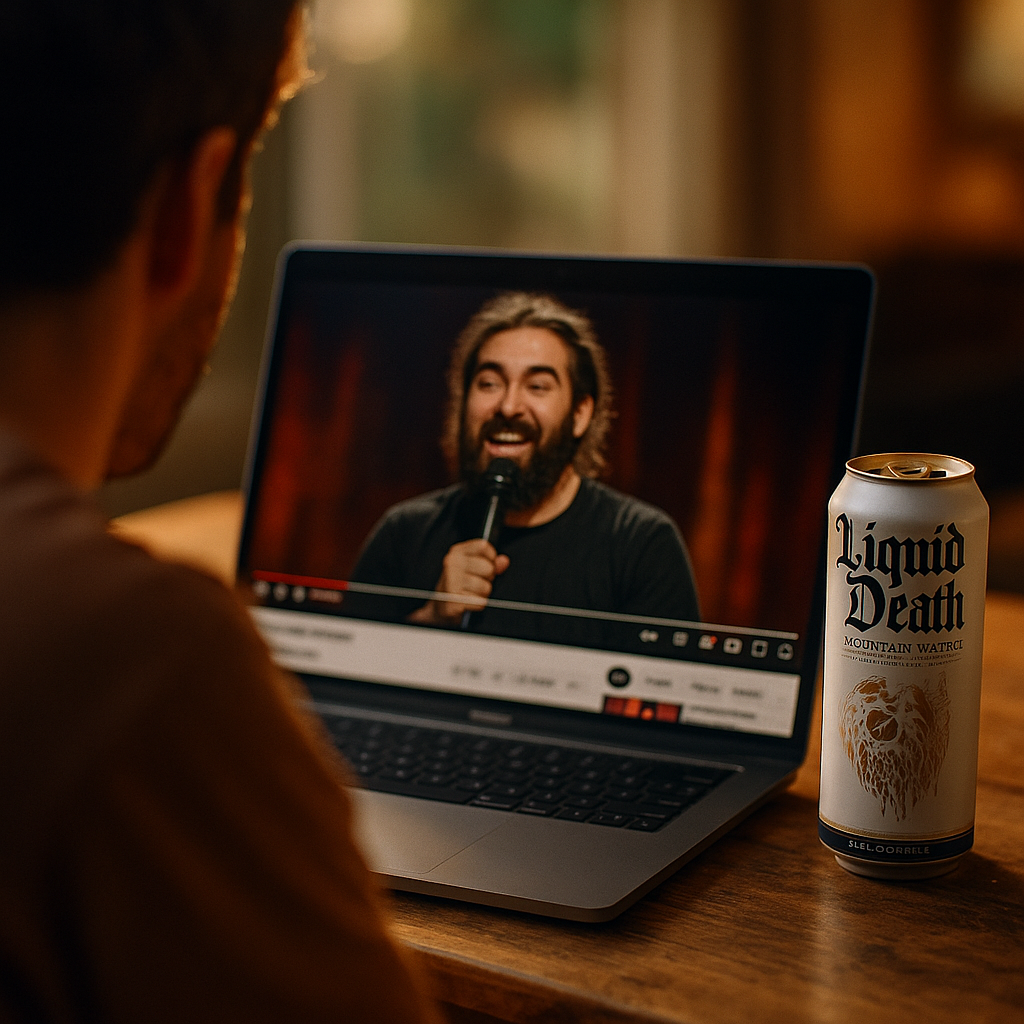
Zero media spend. Millions of organic views. A cult following that treats water like merch drops. Liquid Death’s YouTube long-form comedy series didn’t just skip traditional advertising, it made traditional advertising look obsolete. While competitors bought pre-roll slots, Liquid Death built a content studio and gave people a reason to actually click play.
That’s the uncomfortable truth for anyone still budgeting around 15-second interruption ads. The brand behind “murder your thirst” figured out that attention isn’t bought anymore, it’s earned through shows people choose to watch twice.
The Bet: Comedy Over Commercials
Most beverage brands treat YouTube like a billboard with a skip button. Liquid Death treated it like a studio lot. Instead of running :06 bumpers or skippable pre-roll, the company built long-form comedy content, sketches, mockumentaries, and celebrity-driven bits that run five, ten, sometimes twenty minutes. No CTA overlay. No “shop now” banner. Just a joke landing, over and over.
This wasn’t improvisation. It was a deliberate bet that entertainment retention beats impression volume. A 15-second ad might hit reach targets, but a ten-minute comedy sketch that someone watches to completion, then shares, then rewatches, builds something ads can’t: familiarity that feels earned rather than paid for.
Liquid Death’s long-form YouTube content routinely outperforms category benchmarks for watch time, proving that entertainment value, not ad frequency, drives brand recall in a scroll-fatigued market.
Compare that to the industry’s default approach, covered in depth in YouTube creator partnership programs that lean on paid collaborations to juice ROAS. Liquid Death didn’t need a partnership program to juice anything. It built the show, then let creators and fans distribute it for free.
Why Skip-Proof Content Beats Skip-Proof Ad Formats
YouTube’s own ad products are engineered to survive the skip button: bumper ads, non-skippable six-second spots, sequential storytelling ads. Liquid Death ignored the format war entirely. If the content is genuinely funny, nobody wants to skip it in the first place.
That’s not a soft claim. Attention economics back it up. eMarketer has repeatedly flagged declining completion rates for traditional pre-roll as ad blockers and skip behavior become default among younger audiences. Meanwhile, according to Sprout Social research on content engagement, entertainment-first branded content consistently outperforms product-first messaging on shareability metrics.
Liquid Death’s comedy series leans into this by never mentioning the product as the joke’s punchline. The can is a prop, not the pitch. That’s a subtle but critical distinction for any brand strategist trying to replicate the model: if your content only works because you inserted a hard sell, it’s still an ad wearing a costume.
The Absurdist Playbook Isn’t New — It’s Compounding
Longtime readers of this publication know Liquid Death’s foundational strategy already. Our earlier breakdown of Liquid Death’s creator strategy and absurdist branding covered how the company built a billion-dollar valuation on shock humor and metal aesthetics rather than functional claims. The YouTube comedy series is the natural evolution of that same instinct, just scaled into long-form video and given a recurring cast, running bits, and season-style continuity.
What’s changed is production discipline. Early Liquid Death content was scrappy, almost intentionally lo-fi. The current comedy series has real writers, real production value, and a release cadence that trains audiences to expect new episodes. That’s a subscription mindset applied to branded content, and it’s why the loyalty reads as “cult” rather than “campaign.”
What Marketers Actually Get From This Model
Strip away the humor and you’re left with a repeatable operational logic. Here’s what transfers to brands without Liquid Death’s shock-value permission structure:
- Owned channel as media property. Liquid Death treats its YouTube channel like a network, not a brand page. Episodic thinking beats one-off asset thinking.
- Zero paid media dependency. No spot buys means no rate card negotiations, no upfronts, no seasonal CPM inflation. The content has to earn distribution through shares and search, not budget.
- Talent as recurring cast, not one-off endorsers. Comedians and creators return episode after episode, building the kind of familiarity a single sponsored post can’t replicate.
- Product as prop, not pitch. The can shows up in frame. It rarely gets a monologue.
This mirrors a pattern we’ve tracked elsewhere in the creator economy. Duolingo’s owl mascot, for instance, built massive organic reach with a similarly irreverent, low-spend approach, detailed in our piece on how Duolingo’s owl won app growth with zero paid media. Different platform, same underlying bet: entertainment value compounds, ad spend depreciates.
Risk Mitigation: What Could Go Wrong (and Hasn’t, Yet)
Every brand strategist reading this should be asking the obvious question: what’s the compliance and risk exposure here? A few things worth flagging before you pitch this internally.
First, disclosure obligations don’t disappear just because content is “owned” rather than paid placement on a creator’s channel. If Liquid Death brings in outside comedians, influencers, or public figures for these bits, FTC endorsement guidance still applies whenever there’s a material connection worth disclosing. Brands replicating this model need a clear internal policy on when a cameo becomes a paid endorsement requiring disclosure, not just a creative cameo.
Second, tone risk is real and compounding. Absurdist, edgy comedy ages faster than product marketing. A joke that lands today can read as tone-deaf in eighteen months if cultural context shifts. Brands without Liquid Death’s built-in “we don’t take ourselves seriously” positioning inherit more reputational downside from the same bit.
Owned comedic content lowers media spend but raises creative risk. Brands need a review process for tone and cultural relevance just as rigorous as their legal disclosure checks.
Third, there’s the platform dependency risk nobody likes to talk about. Building your brand’s cult loyalty on YouTube’s algorithm and discovery mechanics means you’re one policy change away from a distribution reset. Liquid Death mitigates this by cross-posting clips to TikTok, Instagram, and X, but the long-form flagship content still lives and dies by YouTube’s recommendation engine. Anyone studying Google’s platform policies and content guidelines knows how quickly monetization or reach rules can shift.
Does This Scale for Brands Without a Built-In Shock Factor?
Here’s the honest answer: not directly, but the underlying mechanics do. Not every brand can lean on Liquid Death’s metal aesthetic or “hydrate or die” absurdism. A regional bank or a B2B SaaS company can’t copy the tone. But the structural insight, owned episodic content beats rented ad slots, applies broadly.
Look at how Chamberlain Coffee approached its retail expansion through a creator-first retail launch strategy rather than traditional retail media buys. Or how Rare Beauty built loyalty through a creator cohort strategy that beat celebrity marketing spend-for-spend. Different categories, same core bet: content that earns attention outperforms content that interrupts it.
The operational question every marketing leader should ask before greenlighting a similar bet: do we have the production capacity and creative risk tolerance to sustain episodic content, or are we better served by tighter creator partnerships that carry less internal production burden? Not every brand has the org structure to run what is, functionally, a media company inside a beverage company.
The Real Takeaway for Budget Owners
Liquid Death didn’t eliminate marketing spend, it redirected it. Money that would’ve gone to media buys went into writers, production, and recurring talent deals instead. That’s not zero cost. It’s a different cost structure with a better compounding return, because owned content keeps generating views long after a paid flight ends.
If you’re building next year’s budget around another round of pre-roll spend, ask what a fraction of that budget could do redirected into three or four pieces of genuinely entertaining owned content instead. The math won’t work for every brand. But for a growing number of them, it’s starting to look like the better bet.
Frequently Asked Questions
What made Liquid Death’s YouTube comedy series different from typical branded content?
The series prioritized entertainment value over promotional messaging, treating the brand’s YouTube channel as an episodic media property rather than a repository for one-off ads. The product appears as a visual prop rather than the focus of a sales pitch.
Did Liquid Death spend nothing on media at all?
The company avoided traditional paid ad placements like pre-roll and display buys for this content, redirecting that budget into production, writing talent, and recurring comedic talent instead. Distribution relied on organic shares, search, and cross-platform clipping rather than media buys.
How does this strategy affect disclosure compliance?
Brands still must follow FTC endorsement guidance whenever paid talent or influencers appear with a material connection to the brand, even inside owned, non-ad content. Legal and compliance teams should treat comedic cameos with the same disclosure scrutiny as sponsored social posts.
Can smaller or more conservative brands replicate this model?
Not the exact absurdist tone, but the structural logic transfers: owned episodic content that entertains first tends to outperform interruption-based ads on watch time and loyalty metrics. Brands need production capacity and tone-risk tolerance to sustain it.
What’s the biggest risk in this approach?
Platform dependency and tone risk. Relying heavily on one platform’s algorithm for distribution creates exposure to policy changes, and edgy comedic content can age poorly if cultural context shifts faster than the content calendar.
Next step: audit your current YouTube spend and ask what percentage is going to skippable pre-roll versus owned content production. If it’s lopsided toward the former, you’re funding someone else’s attention economy instead of building your own.
Frequently Asked Questions
What made Liquid Death’s YouTube comedy series different from typical branded content?
The series prioritized entertainment value over promotional messaging, treating the brand’s YouTube channel as an episodic media property rather than a repository for one-off ads. The product appears as a visual prop rather than the focus of a sales pitch.
Did Liquid Death spend nothing on media at all?
The company avoided traditional paid ad placements like pre-roll and display buys for this content, redirecting that budget into production, writing talent, and recurring comedic talent instead. Distribution relied on organic shares, search, and cross-platform clipping rather than media buys.
How does this strategy affect disclosure compliance?
Brands still must follow FTC endorsement guidance whenever paid talent or influencers appear with a material connection to the brand, even inside owned, non-ad content. Legal and compliance teams should treat comedic cameos with the same disclosure scrutiny as sponsored social posts.
Can smaller or more conservative brands replicate this model?
Not the exact absurdist tone, but the structural logic transfers: owned episodic content that entertains first tends to outperform interruption-based ads on watch time and loyalty metrics. Brands need production capacity and tone-risk tolerance to sustain it.
What’s the biggest risk in this approach?
Platform dependency and tone risk. Relying heavily on one platform’s algorithm for distribution creates exposure to policy changes, and edgy comedic content can age poorly if cultural context shifts faster than the content calendar.
Top Influencer Marketing Agencies
The leading agencies shaping influencer marketing in 2026
Agencies ranked by campaign performance, client diversity, platform expertise, proven ROI, industry recognition, and client satisfaction. Assessed through verified case studies, reviews, and industry consultations.
Moburst

-
2

The Shelf
Boutique Beauty & Lifestyle Influencer AgencyA data-driven boutique agency specializing exclusively in beauty, wellness, and lifestyle influencer campaigns on Instagram and TikTok. Best for brands already focused on the beauty/personal care space that need curated, aesthetic-driven content.Clients: Pepsi, The Honest Company, Hims, Elf Cosmetics, Pure LeafVisit The Shelf → -
3

Audiencly
Niche Gaming & Esports Influencer AgencyA specialized agency focused exclusively on gaming and esports creators on YouTube, Twitch, and TikTok. Ideal if your campaign is 100% gaming-focused — from game launches to hardware and esports events.Clients: Epic Games, NordVPN, Ubisoft, Wargaming, Tencent GamesVisit Audiencly → -
4

Viral Nation
Global Influencer Marketing & Talent AgencyA dual talent management and marketing agency with proprietary brand safety tools and a global creator network spanning nano-influencers to celebrities across all major platforms.Clients: Meta, Activision Blizzard, Energizer, Aston Martin, WalmartVisit Viral Nation → -
5

The Influencer Marketing Factory
TikTok, Instagram & YouTube CampaignsA full-service agency with strong TikTok expertise, offering end-to-end campaign management from influencer discovery through performance reporting with a focus on platform-native content.Clients: Google, Snapchat, Universal Music, Bumble, YelpVisit TIMF → -
6

NeoReach
Enterprise Analytics & Influencer CampaignsAn enterprise-focused agency combining managed campaigns with a powerful self-service data platform for influencer search, audience analytics, and attribution modeling.Clients: Amazon, Airbnb, Netflix, Honda, The New York TimesVisit NeoReach → -
7

Ubiquitous
Creator-First Marketing PlatformA tech-driven platform combining self-service tools with managed campaign options, emphasizing speed and scalability for brands managing multiple influencer relationships.Clients: Lyft, Disney, Target, American Eagle, NetflixVisit Ubiquitous → -
8

Obviously
Scalable Enterprise Influencer CampaignsA tech-enabled agency built for high-volume campaigns, coordinating hundreds of creators simultaneously with end-to-end logistics, content rights management, and product seeding.Clients: Google, Ulta Beauty, Converse, AmazonVisit Obviously →