


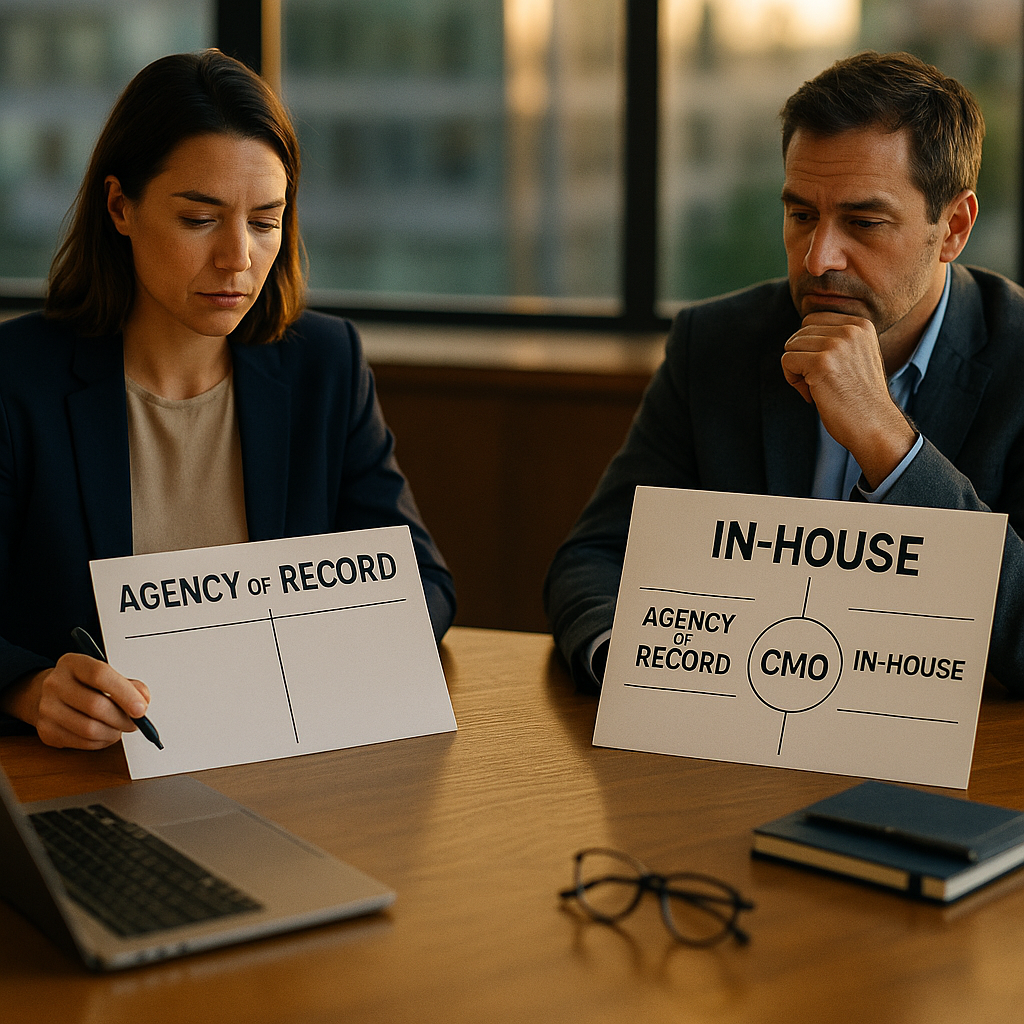
Seventy-three percent of CMOs say their creator budget grew last year, yet fewer than a third can name who actually owns the program end to end. That gap is exactly why the agency of record versus in-house debate keeps landing on board agendas. Get the framework wrong, and you’re rebuilding it again in eighteen months.
This isn’t a staffing question. It’s a governance question dressed up as an org chart decision, and boards are starting to treat it that way.
Why This Decision Finally Reached the Boardroom
Five years ago, nobody asked a board to approve a creator agency contract. Influencer budgets lived inside social media line items, small enough to escape scrutiny. That era is over. Creator spend now rivals paid search in many consumer categories, and eMarketer’s creator economy tracking shows the category growing faster than nearly every other marketing line.
Once spend crosses a materiality threshold, finance wants structure. Boards want risk controls. And CMOs get asked a question they often can’t answer cleanly: who is accountable when a creator program underperforms, or worse, when a creator posts something that triggers a compliance or brand safety issue?
That accountability vacuum is the real reason this decision belongs at board level. Not because creator marketing is glamorous, but because it’s now big enough to break things.
A creator program without a single accountable owner isn’t lean, it’s exposed. Boards don’t fund exposure; they fund frameworks that manage it.
The Three Models CMOs Are Actually Choosing Between
Strip away the vendor pitch decks and there are really three structural options on the table.
- Full agency of record (AOR): One external partner owns strategy, sourcing, contracting, and reporting across the entire creator program.
- Fully in-house: A dedicated internal team handles everything, often built around a creator marketing lead reporting into the CMO.
- Hybrid: Internal team owns strategy and brand safety; external partners execute sourcing, negotiation, and campaign operations at scale.
Most large enterprises land somewhere on the hybrid spectrum, but the board case has to be explicit about which model you’re proposing and why. Vague “we’ll figure it out as we go” pitches don’t survive a finance committee. For a deeper look at how the hybrid model actually gets structured day to day, see structuring creator teams that scale.
Build the Case on Cost, Not Just Capability
Boards don’t fund capability stories. They fund cost-and-risk stories with numbers attached. Here’s the comparison framework that tends to land.
Cost structure. An AOR typically runs 15-20% agency fee on top of media and creator fees, but it bundles negotiation leverage, legal review, and platform relationships you’d otherwise have to build from scratch. In-house teams cost less per campaign once scaled, but the ramp-up period is expensive and slow: recruiting, tooling, and creator relationship-building can take 12-18 months before output matches an established agency’s baseline.
Model both scenarios over a three-year horizon, not one fiscal year. Boards have been burned by first-year in-house pitches that look cheap until year two hiring costs materialize. The zero-based creator budget model approach works well here because it forces you to justify every dollar in both scenarios rather than assuming last year’s allocation carries forward.
Speed to market. Agencies with existing creator networks can activate campaigns in days. In-house teams building relationships from zero often need weeks just to source vetted creators in a new vertical. If your category moves fast (beauty, gaming, fintech), that lag has real opportunity cost.
Institutional knowledge. This is where in-house wins decisively. Agency account teams turn over. Your internal team retains brand voice nuance, past creator performance data, and relationship history that doesn’t walk out the door every 18 months when the agency reassigns your account.
Risk Mitigation: The Argument That Actually Moves Board Votes
Here’s what gets a board’s attention faster than any cost slide: liability exposure. Creator programs touch FTC disclosure rules, platform policy violations, contract IP disputes, and increasingly, data privacy questions tied to first-party audience data creators collect on branded campaigns.
An AOR with dedicated legal and compliance infrastructure can absorb some of that risk, particularly around FTC disclosure enforcement, which has intensified scrutiny on undisclosed brand partnerships. In-house teams need to build that compliance muscle themselves, which is exactly why governance documentation matters regardless of which model you pick. The creator economy governance charter framework is worth building into your board deck as an appendix, because it shows you’ve thought through ownership before a crisis forces the question.
Ask your board this directly: if a creator partnership triggered a data protection complaint tomorrow, who would own the response? If the honest answer is “we’re not sure,” that’s your opening line for the AOR case. If you already have documented escalation paths and legal review built into your internal process, that’s your opening line for staying in-house.
What CFOs Actually Ask When This Hits Their Desk
CFOs don’t care about creator relationships or brand voice consistency. They care about three things: predictable cost, measurable return, and downside protection. Frame your board case around those, not around marketing craft.
Bring hard attribution data. If you can’t show how creator spend maps to revenue, the entire pitch weakens regardless of which structural model you’re proposing. The creator spend measurement methodologies that prove sales lift are non-negotiable prerequisites here, not nice-to-haves. Same goes for building a creator economy ROI case CFOs actually trust: get that foundation solid before you walk into the AOR-versus-in-house conversation, because otherwise the CFO will just ask “why are we scaling either model when we can’t prove the last one worked?”
The AOR-versus-in-house question is really a proxy fight. What the board is actually asking is: can you prove this spend works, and can you control what happens when it doesn’t?
Expect pushback on headcount too. If your case leans in-house, CFOs will scrutinize every proposed hire against a comparable agency line item. Have the org design ready before the meeting, not sketched on a whiteboard during it. The org structure that scales resource is a useful reference point for what a defensible internal team actually looks like at maturity, rather than at launch.
The Hybrid Middle Ground Most Boards End Up Approving
In practice, pure-play pitches rarely win outright. Boards tend to approve hybrid structures: a lean internal team (often three to six people) owning strategy, brand safety, and measurement, paired with one or two specialized agency partners handling sourcing and execution at volume.
This works because it splits the risk. Internal ownership keeps institutional knowledge and compliance accountability close to the CMO. External partners absorb the scaling burden and bring network breadth no in-house team can replicate quickly. It also tends to be the easier sell financially, since you’re not asking the board to fund a full build-out or hand over full control to a vendor in one motion.
If you’re building toward this model, sequence it. Don’t try to stand up the internal team and terminate agency relationships simultaneously. A phased 90-day transition, similar to the approach outlined in the roadmap to AI-assisted creator governance, gives you a template for staging the handoff without a coverage gap that leaves campaigns unmanaged mid-quarter.
Building the Actual Board Deck
Keep it to five sections: current state and spend trajectory, the risk exposure under status quo, the three-model cost comparison, your recommended structure with a phased timeline, and the measurement plan that proves it worked within two quarters. Boards approve frameworks with built-in accountability checkpoints, not open-ended budget requests.
Include a kill criteria slide. If the model you propose hasn’t hit defined performance thresholds within two quarters, what’s the fallback? Boards respect a CMO who’s already thought about failure modes. It’s the single fastest way to build credibility in a room full of people whose job is to find the flaw in your plan before it costs the company money.
One more thing worth naming explicitly: this decision doesn’t happen in isolation from your broader marketing governance structure. If you’re also weighing an executive-level creator leadership hire, sequence that conversation before, not after, the AOR decision. The person in that seat should be the one presenting the framework, not inheriting someone else’s structure six months later.
Next Step
Don’t bring your board a binary choice. Bring a phased hybrid model with named accountability, a three-year cost comparison, and a two-quarter proof point built in. That’s the version boards actually approve.
Frequently Asked Questions
What’s the biggest mistake CMOs make when pitching agency of record versus in-house to a board?
Presenting it as a binary choice without a cost model spanning multiple years. Boards get suspicious of first-year comparisons because in-house ramp-up costs are often underestimated, while agency fee structures look deceptively simple until scope creep sets in.
How long does it typically take to transition from agency-led to in-house creator management?
Most successful transitions take 12 to 18 months to reach performance parity with an established agency partner. Rushing this timeline is the most common reason hybrid models fail and boards lose confidence in the internal team.
Should compliance and legal risk be the primary argument in the board case?
It should be one of three pillars, alongside cost and measurable ROI. Risk alone won’t secure budget, but ignoring it is the fastest way to lose board trust if a creator partnership issue surfaces later.
What creator program metrics do CFOs actually want to see before approving a structural change?
Sales lift attribution, cost per acquisition compared to other channels, and a clear breakdown of fixed versus variable spend under each model. Vague engagement metrics rarely move a finance committee.
Is a hybrid model always the safer recommendation?
Not always, but it’s the most commonly approved structure because it distributes risk and doesn’t require the board to fund a full internal build-out or hand total control to an external vendor in one step.
Frequently Asked Questions
What’s the biggest mistake CMOs make when pitching agency of record versus in-house to a board?
Presenting it as a binary choice without a cost model spanning multiple years. Boards get suspicious of first-year comparisons because in-house ramp-up costs are often underestimated, while agency fee structures look deceptively simple until scope creep sets in.
How long does it typically take to transition from agency-led to in-house creator management?
Most successful transitions take 12 to 18 months to reach performance parity with an established agency partner. Rushing this timeline is the most common reason hybrid models fail and boards lose confidence in the internal team.
Should compliance and legal risk be the primary argument in the board case?
It should be one of three pillars, alongside cost and measurable ROI. Risk alone won’t secure budget, but ignoring it is the fastest way to lose board trust if a creator partnership issue surfaces later.
What creator program metrics do CFOs actually want to see before approving a structural change?
Sales lift attribution, cost per acquisition compared to other channels, and a clear breakdown of fixed versus variable spend under each model. Vague engagement metrics rarely move a finance committee.
Is a hybrid model always the safer recommendation?
Not always, but it’s the most commonly approved structure because it distributes risk and doesn’t require the board to fund a full internal build-out or hand total control to an external vendor in one step.
Top Influencer Marketing Agencies
The leading agencies shaping influencer marketing in 2026
Agencies ranked by campaign performance, client diversity, platform expertise, proven ROI, industry recognition, and client satisfaction. Assessed through verified case studies, reviews, and industry consultations.
Moburst

-
2

The Shelf
Boutique Beauty & Lifestyle Influencer AgencyA data-driven boutique agency specializing exclusively in beauty, wellness, and lifestyle influencer campaigns on Instagram and TikTok. Best for brands already focused on the beauty/personal care space that need curated, aesthetic-driven content.Clients: Pepsi, The Honest Company, Hims, Elf Cosmetics, Pure LeafVisit The Shelf → -
3

Audiencly
Niche Gaming & Esports Influencer AgencyA specialized agency focused exclusively on gaming and esports creators on YouTube, Twitch, and TikTok. Ideal if your campaign is 100% gaming-focused — from game launches to hardware and esports events.Clients: Epic Games, NordVPN, Ubisoft, Wargaming, Tencent GamesVisit Audiencly → -
4

Viral Nation
Global Influencer Marketing & Talent AgencyA dual talent management and marketing agency with proprietary brand safety tools and a global creator network spanning nano-influencers to celebrities across all major platforms.Clients: Meta, Activision Blizzard, Energizer, Aston Martin, WalmartVisit Viral Nation → -
5

The Influencer Marketing Factory
TikTok, Instagram & YouTube CampaignsA full-service agency with strong TikTok expertise, offering end-to-end campaign management from influencer discovery through performance reporting with a focus on platform-native content.Clients: Google, Snapchat, Universal Music, Bumble, YelpVisit TIMF → -
6

NeoReach
Enterprise Analytics & Influencer CampaignsAn enterprise-focused agency combining managed campaigns with a powerful self-service data platform for influencer search, audience analytics, and attribution modeling.Clients: Amazon, Airbnb, Netflix, Honda, The New York TimesVisit NeoReach → -
7

Ubiquitous
Creator-First Marketing PlatformA tech-driven platform combining self-service tools with managed campaign options, emphasizing speed and scalability for brands managing multiple influencer relationships.Clients: Lyft, Disney, Target, American Eagle, NetflixVisit Ubiquitous → -
8

Obviously
Scalable Enterprise Influencer CampaignsA tech-enabled agency built for high-volume campaigns, coordinating hundreds of creators simultaneously with end-to-end logistics, content rights management, and product seeding.Clients: Google, Ulta Beauty, Converse, AmazonVisit Obviously →