


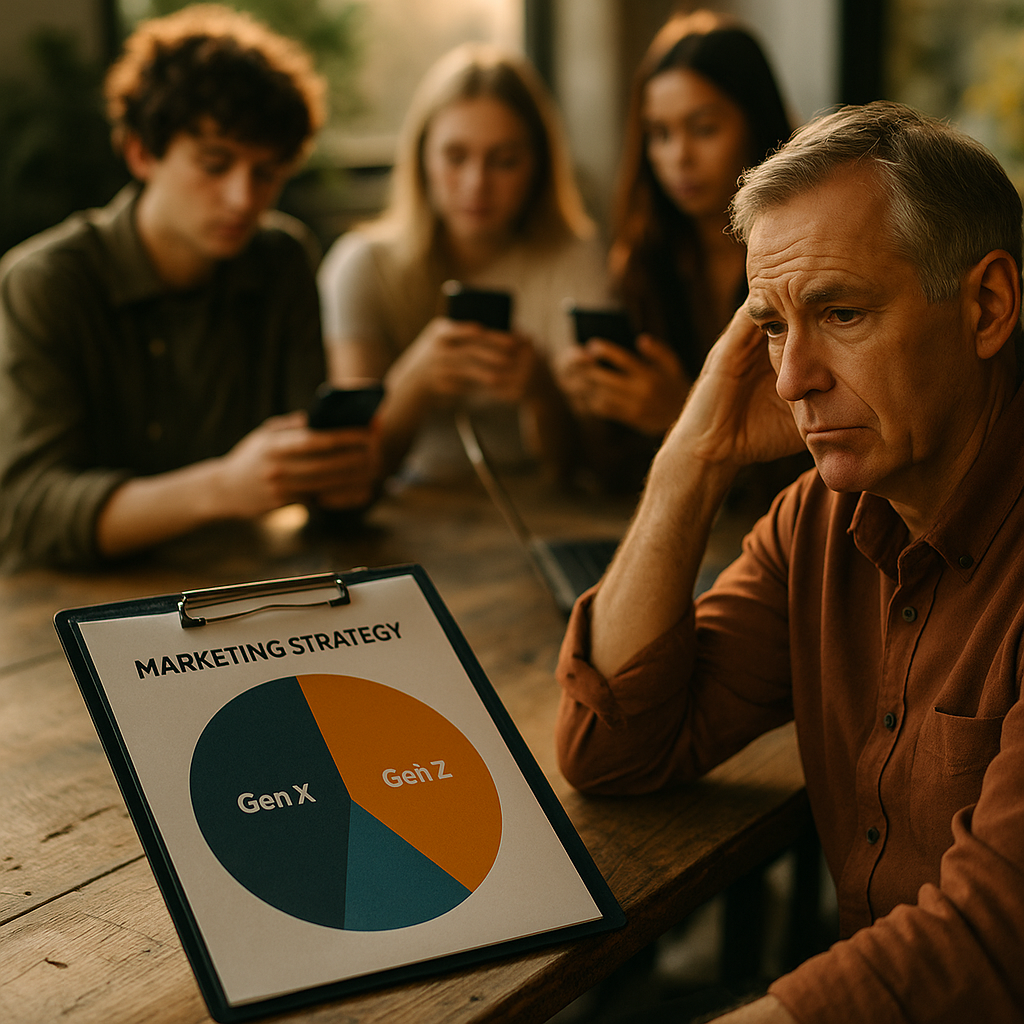
Gen X controls more discretionary income than any generation targeted by influencer marketing today, and almost nobody is chasing it. This generation, roughly ages 46 to 61, holds an outsized share of U.S. wealth, runs households at peak earning years, and still gets treated like a rounding error in brand media plans. Call it the marketing industry’s most expensive blind spot.
Ask ten CMOs who their “core demo” is and you’ll hear Gen Z or millennials nine times out of ten. Ask them why, and the answers get vague fast. Gen X is the demographic marketers forgot how to see, not because the spending isn’t there, but because the platforms and metrics brands lean on were never built to capture it.
The Numbers Nobody’s Budgeting Around
Start with the basics. Gen X represents roughly a fifth of the U.S. population but disproportionately holds senior leadership roles, owns homes outright or with significant equity, and is entering the biggest inheritance window in American history. Federal Reserve data has repeatedly shown Gen X households sitting on substantial net worth gains over the past decade, even as headlines fixate on millennial wealth anxiety and Gen Z’s TikTok-driven spending habits.
This is the generation funding college tuitions, renovating homes, managing aging parents’ care, and making the majority of household purchasing decisions for both their kids and themselves. They’re not scrolling for validation. They’re scrolling to decide what to buy, and they have the means to buy it.
Gen X media consumption doesn’t match Gen X spending capacity — and that mismatch is exactly why brands keep underinvesting in a generation that’s actually paying.
Compare that to where ad dollars actually go. eMarketer’s ad spend trackers consistently show youth-skewing platforms like TikTok and Instagram Reels absorbing the lion’s share of new social budget growth, while Facebook, where Gen X still spends meaningful time, gets treated as a legacy line item rather than a growth channel.
Why Brands Keep Skipping This Cohort
Part of it is cultural bias. Marketing teams skew young, and young teams build strategies around platforms and creators they personally understand. Part of it is measurement laziness: Gen Z engagement is loud, visible, and easy to screenshot for a board deck. Gen X engagement is quieter. They don’t duet a video or comment “no because this is literally me.” They add to cart, forward the link to a spouse, and buy.
There’s also a lingering, unspoken assumption that Gen X isn’t “influenceable” — that they’re too skeptical, too set in their brand loyalties, too old for creator-driven discovery. That assumption is aging worse than the generation it’s describing. Pew Research and multiple industry surveys have shown Gen X adoption of platforms like Facebook, YouTube, and even TikTok climbing steadily, often outpacing what brands assume in their planning documents.
This connects to a broader pattern covered in our look at post-growth consumers: brands keep optimizing for the loudest demographic instead of the most liquid one. Loud and lucrative are not the same thing, and 2026 budgets built on that confusion are leaving real revenue on the table.
What Gen X Actually Wants From Brands
Gen X grew up on advertising’s golden age of skepticism. They watched brands lie to their parents, then lie to them. They’re not anti-marketing; they’re anti-nonsense. Overpromise, and you lose them permanently. That’s a sharp contrast to younger cohorts who’ve shown more forgiveness for brand missteps if the apology content is good enough.
What works instead:
- Straight-talk creator content — reviews, comparisons, and demonstrations over aspirational lifestyle content.
- Trust signals from peers, not celebrities. Micro and mid-tier creators in the 35-55 age range convert better with this audience than 24-year-old lifestyle influencers ever will.
- Value-forward messaging that respects their intelligence instead of talking down to them.
- Consistency over novelty. Gen X doesn’t need a new brand voice every quarter. They need to trust the one you’ve already built.
This dovetails with findings from Edelman’s trust research on creators versus executives: audiences across age groups trust individual voices more than corporate ones, but Gen X applies that trust filter more rigorously. They’ll follow a creator’s recommendation, but they’ll also fact-check it first.
The Channel Mismatch Is the Real Problem
Here’s where it gets tactical. Gen X isn’t absent from social media, they’re just concentrated on platforms brands have quietly deprioritized. Facebook remains a genuine commerce and community engine for this cohort. YouTube, especially long-form and how-to content, sees strong Gen X watch time. Even LinkedIn, largely dismissed as a B2B-only channel, is where a huge share of Gen X professionals actually spend consideration-stage time researching brands, tools, and services.
Meanwhile, brand media plans keep chasing Reels and TikTok trends built for an audience that, frankly, spends less per household. That’s not a knock on Gen Z, it’s a math problem. If your creator budget is 80% allocated to platforms where your highest-net-worth customers barely show up, you’re not doing influencer marketing. You’re doing brand awareness for an audience that isn’t ready to buy yet.
This is the same structural issue explored in our piece on streaming-commerce bundle fatigue: budgets follow habit and hype, not necessarily where the money actually converts.
What a Gen X-Aware Strategy Looks Like in Practice
This isn’t about abandoning younger audiences. It’s about rebalancing. A few concrete moves brands can make without blowing up existing programs:
- Audit creator partnerships by follower age distribution, not just total reach. Many “lifestyle” creators have a wider age spread among their audience than brands assume, particularly on YouTube and Facebook.
- Shift a portion of test budget toward long-form, trust-building content instead of short-form novelty. Product deep-dives and expert-style reviews perform well with this demo.
- Stop assuming Gen X won’t engage with influencer content. Test it. Run a controlled pilot on Facebook or YouTube with creators who skew 40+ and compare conversion rates against your Gen Z-targeted campaigns. The CAC gap may surprise you.
- Reframe KPIs. If your team is grading Gen X campaigns on comment volume, they’ll always look like underperformers. Grade them on conversion and average order value instead, where this audience typically wins.
That last point matters more than it sounds. Vanity metrics have quietly distorted budget allocation across the industry for years, a problem explored in depth around decision intelligence replacing vanity metrics. Gen X is arguably the clearest casualty of that distortion: a demographic that under-indexes on public engagement but over-indexes on private purchase decisions.
The Compliance Angle Brands Overlook
There’s a risk-mitigation upside here too. Gen X consumers are more likely to scrutinize disclosure practices and sniff out undisclosed sponsorships, partly because many remember a pre-influencer advertising era and hold a baseline skepticism toward paid content. Getting FTC disclosure right isn’t optional with this audience; it’s table stakes for trust. Review your program against current FTC endorsement guidance before scaling any Gen X-targeted creator campaign, and make sure creator contracts specify disclosure language clearly.
Brands operating across multiple regions should also revisit how disclosure and data-use rules vary by market, an issue our AI marketing compliance playbook breaks down in more detail. Gen X audiences in the EU and UK, in particular, tend to be more privacy-conscious, making ICO guidance a useful reference point for any first-party data strategy built around this cohort.
Where the ROI Case Gets Strong
Run the math on customer lifetime value instead of impressions. A Gen X customer with established income, existing homeownership, and fewer life disruptions ahead (compared to a 24-year-old whose spending habits are still forming) often produces a more stable, higher-margin LTV curve. HubSpot’s customer research repeatedly shows that older, higher-income segments tend to have lower price sensitivity and higher repeat-purchase rates in categories like home goods, financial services, health, and travel.
None of this means pulling budget from Gen Z entirely. It means building a genuinely balanced portfolio instead of a portfolio that’s balanced in name only while 90% of the creator spend chases one age bracket.
The Takeaway
Gen X won’t demand your attention the way younger audiences do, but their wallets are already open. Brands that build even one Gen X-specific creator pilot this quarter, measured on conversion and LTV rather than likes, will likely uncover cheaper acquisition costs and higher order values than their current “core demo” campaigns. Start with the channel audit. The rest of the strategy follows from there.
FAQs
Why do brands underinvest in Gen X despite their spending power?
Marketing teams skew younger and tend to build strategies around platforms and creators they personally understand. Gen X engagement is also quieter and less visible in social metrics, making the demographic look less active than it actually is, even though purchase behavior tells a different story.
Which platforms actually reach Gen X effectively?
Facebook, YouTube, and increasingly LinkedIn show the strongest Gen X engagement. Long-form and how-to content performs particularly well, since this audience favors depth and practical value over short-form novelty.
Do influencer partnerships work for a Gen X audience?
Yes, but the approach differs. Straight-talk reviews, comparisons, and peer-level creators in their 30s to 50s tend to outperform aspirational lifestyle content or celebrity endorsements with this group.
How should brands measure Gen X campaign performance?
Prioritize conversion rate, average order value, and customer lifetime value over comment volume or shares. Gen X tends to underperform on public engagement metrics while overperforming on actual purchase behavior.
What compliance issues matter most when targeting Gen X?
Clear FTC-compliant sponsorship disclosure is critical, since this generation is more likely to scrutinize paid content. Brands operating internationally should also review regional privacy and advertising rules before launching campaigns targeting this cohort.
Top Influencer Marketing Agencies
The leading agencies shaping influencer marketing in 2026
Agencies ranked by campaign performance, client diversity, platform expertise, proven ROI, industry recognition, and client satisfaction. Assessed through verified case studies, reviews, and industry consultations.
Moburst

-
2

The Shelf
Boutique Beauty & Lifestyle Influencer AgencyA data-driven boutique agency specializing exclusively in beauty, wellness, and lifestyle influencer campaigns on Instagram and TikTok. Best for brands already focused on the beauty/personal care space that need curated, aesthetic-driven content.Clients: Pepsi, The Honest Company, Hims, Elf Cosmetics, Pure LeafVisit The Shelf → -
3

Audiencly
Niche Gaming & Esports Influencer AgencyA specialized agency focused exclusively on gaming and esports creators on YouTube, Twitch, and TikTok. Ideal if your campaign is 100% gaming-focused — from game launches to hardware and esports events.Clients: Epic Games, NordVPN, Ubisoft, Wargaming, Tencent GamesVisit Audiencly → -
4

Viral Nation
Global Influencer Marketing & Talent AgencyA dual talent management and marketing agency with proprietary brand safety tools and a global creator network spanning nano-influencers to celebrities across all major platforms.Clients: Meta, Activision Blizzard, Energizer, Aston Martin, WalmartVisit Viral Nation → -
5

The Influencer Marketing Factory
TikTok, Instagram & YouTube CampaignsA full-service agency with strong TikTok expertise, offering end-to-end campaign management from influencer discovery through performance reporting with a focus on platform-native content.Clients: Google, Snapchat, Universal Music, Bumble, YelpVisit TIMF → -
6

NeoReach
Enterprise Analytics & Influencer CampaignsAn enterprise-focused agency combining managed campaigns with a powerful self-service data platform for influencer search, audience analytics, and attribution modeling.Clients: Amazon, Airbnb, Netflix, Honda, The New York TimesVisit NeoReach → -
7

Ubiquitous
Creator-First Marketing PlatformA tech-driven platform combining self-service tools with managed campaign options, emphasizing speed and scalability for brands managing multiple influencer relationships.Clients: Lyft, Disney, Target, American Eagle, NetflixVisit Ubiquitous → -
8

Obviously
Scalable Enterprise Influencer CampaignsA tech-enabled agency built for high-volume campaigns, coordinating hundreds of creators simultaneously with end-to-end logistics, content rights management, and product seeding.Clients: Google, Ulta Beauty, Converse, AmazonVisit Obviously →