


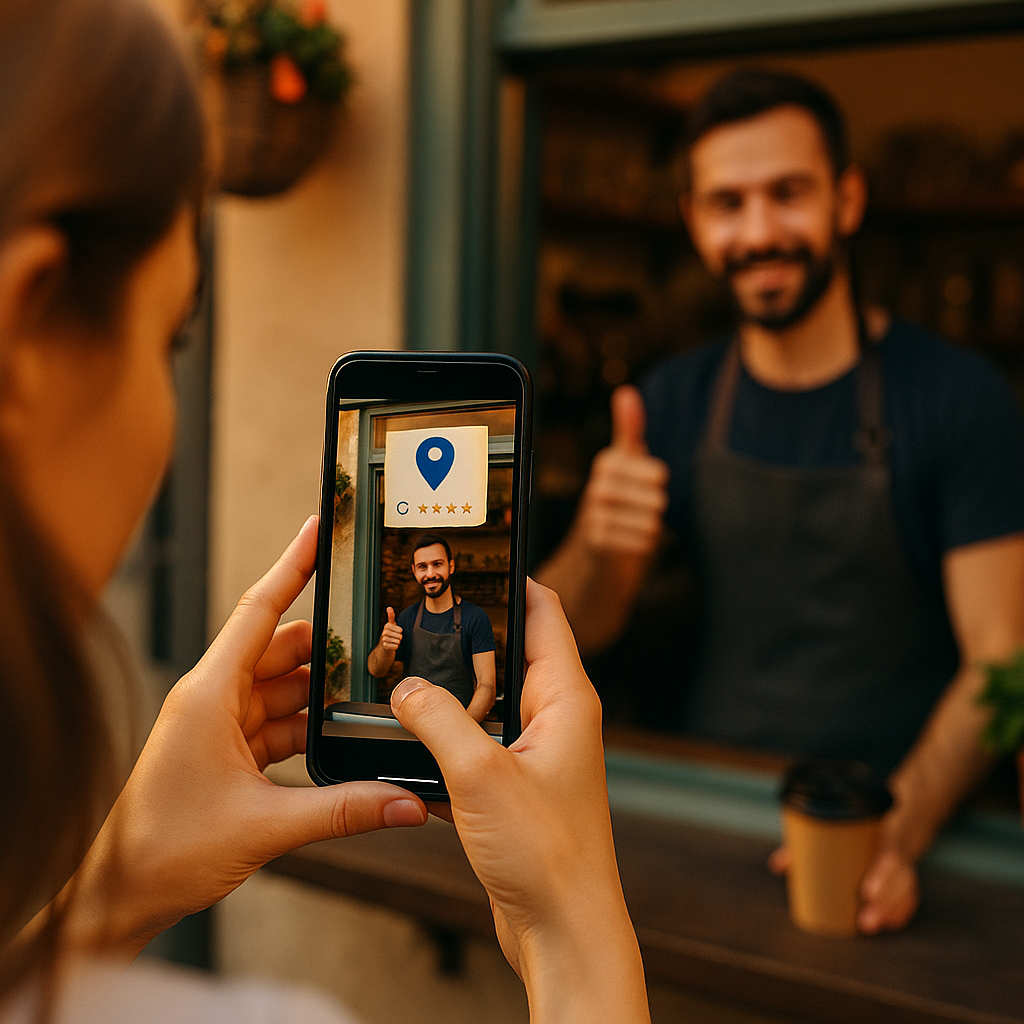
Google’s AI Overviews now cite local businesses using signals that didn’t exist three years ago, and most Google Business Profile strategies are still stuck optimizing for a search experience that no longer runs the show. If your Google Business Profile playbook doesn’t account for creator UGC, you’re invisible to the AI systems increasingly deciding which local businesses get recommended at all.
This isn’t a theoretical problem. Google’s AI Overviews and the Gemini-powered local search experience now pull from a wider signal set than star ratings and review text. Photos, video, mentions across the web, and the freshness of that content all factor into whether a business shows up when someone asks an AI assistant “best coffee shop near me that’s good for working.” Creator content, done right, feeds that machine. Done wrong, it’s just noise sitting in your listing’s photo tab.
Why Map Listings Became an AI Search Battleground
Local search used to be a fairly mechanical game: claim your listing, collect reviews, keep your hours updated, win. That game hasn’t disappeared, but a second layer has stacked on top of it. Google now generates AI-driven summaries for local queries, and those summaries synthesize information from your Business Profile, third-party review sites, and — increasingly — visual and video content associated with your location.
Think about what changed. Search behavior shifted toward conversational, intent-rich queries (“where can I get a quiet spot to work with good wifi and decent oat milk lattes”) that a static list of five-star ratings can’t answer well. AI Overviews need context. Creator UGC, especially short-form video showing real people interacting with a real location, gives Google’s models exactly the kind of contextual signal that text reviews alone can’t provide.
A Business Profile with recent, geotagged creator video content is functionally a richer dataset for AI search than one with only text reviews — and Google’s systems are built to reward richer data.
Local brands that treat their Google Business Profile as a set-and-forget directory listing are ceding this ground to competitors who understand that Maps is now a content platform, not a phone book.
What Counts as UGC in a Local Search Context
Not all creator content belongs in a Business Profile, and dumping every TikTok video into your photo gallery isn’t a strategy. UGC that actually moves the needle for local AI visibility tends to share a few traits:
- Location-specific detail. Video or photos that show interior layout, signage, product in hand, or service in action — not generic brand lifestyle content.
- Recency. Google’s local ranking systems weight freshness heavily. Content from six months ago carries less signal than something posted this week.
- Attribution and context. Captions, alt text, and geotags that reinforce what the business is and where it operates.
- Natural language cues. Creator captions that mention specific menu items, services, or neighborhood context mirror the conversational phrasing AI Overviews are built to match against.
A single well-shot creator video of someone ordering at your counter and describing the vibe does more for AI search visibility than twenty stock-style interior photos. It’s the difference between a database entry and a story an algorithm can actually parse.
The Integration Playbook: Getting Creator Content Into the Profile Itself
Here’s where most local marketing teams stall out. They run a creator campaign, get great content, post it on Instagram and TikTok, and never touch the Business Profile at all. That’s a wasted opportunity — Google Business Profile has multiple native surfaces built for exactly this content.
Photos and videos tab
Upload creator-shot video directly, not just brand-produced assets. Google explicitly supports video uploads to Business Profiles, and video content gets disproportionate engagement in the Maps interface compared to static photos. Request usage rights from creators specifically for this purpose in your contract — don’t assume a UGC agreement for social automatically covers Business Profile use.
Posts and updates
Google Posts function like a mini feed attached to your listing. Repurposing a 15-second creator clip into a Post, paired with a caption using natural local-intent language (“stop by for the seasonal menu locals are talking about”), keeps the profile active and gives AI systems fresh, contextual text to pair with visual content.
Review responses that reference UGC
When a customer review mentions something a creator also covered — a specific dish, a specific staff member, a specific product — respond to the review referencing that detail. This creates topical reinforcement across multiple content types tied to the same location, which is exactly the kind of corroborating signal AI summarization models are trained to trust.
Q&A and attributes
Underused, but valuable. If creator content repeatedly highlights something like “great for solo work” or “wheelchair accessible entrance,” make sure the corresponding attribute is filled out on the profile. Consistency between what creators say and what your structured data says matters more than either alone.
This same logic — matching platform-native structured signals with creator narrative — shows up across other channels too. The Nextdoor local business creator strategy for multi-location retailers follows a similar principle: hyperlocal platforms reward specificity, not polish.
Sourcing Creators for Map-Ready Content
You don’t need a national influencer with 500K followers for this. In fact, macro-influencer content often performs worse for local AI search because it reads as generic and lacks the granular location detail Google’s systems favor. What works better:
- Micro and nano creators within a 10-15 mile radius who already have an established local following and posting cadence.
- Regular customers with modest followings incentivized through loyalty perks rather than flat fees — cheaper, and often more authentic-reading content.
- Local food, lifestyle, or niche-interest creators whose audience overlaps with your actual foot traffic, not just demographic lookalikes.
Briefing matters enormously here. A generic “come film something at our store” brief produces generic content that won’t help your AI search visibility at all. Borrow structure from other UGC brief frameworks — the discipline in the Amazon Inspire brief template for stopping wasted UGC budget applies just as well here: specify the exact shots, the exact language, and the exact use rights you need before a creator ever shows up.
The brands winning local AI Overview placements aren’t paying for reach. They’re paying for specificity — content that names streets, dishes, and staff, not just vibes.
Compliance and Disclosure: Don’t Skip This Part
Local marketing teams sometimes treat UGC disclosure as a social media problem, not a Business Profile problem. That’s a mistake. If a creator was compensated, given free product, or received any material benefit for content that ends up on your Google Business Profile, FTC disclosure guidance still applies regardless of where the content lives. The FTC’s endorsement guidance doesn’t carve out an exception for map listings.
Practical compliance steps:
- Require disclosure language in the original creator post, even if you plan to repurpose the content elsewhere.
- Keep a record of compensation terms for every piece of UGC uploaded to your profile — this matters if a dispute or audit arises.
- Avoid stripping disclosure hashtags or captions when repurposing content into Google Posts.
This is also a good moment to audit your broader creator contract templates. If you’re running paid UGC programs across multiple platforms, disclosure consistency protects you legally and keeps brand risk contained regardless of where the content surfaces.
Measuring Whether It’s Actually Working
ROI on this is admittedly harder to track than a paid social campaign with clean attribution. But there are proxy metrics worth watching monthly:
- Profile views and “discovery search” percentage in Google Business Profile Insights — a rising share of discovery (versus direct/branded) searches suggests improved AI and organic visibility.
- Photo and video view counts compared before and after creator content uploads.
- Appearance in AI Overview snapshots for relevant local queries — manually check this monthly using incognito searches from a location near your business.
- Call and direction-request volume segmented by time period around content refreshes.
Data from eMarketer and Statista both point to continued growth in “near me” and AI-assisted local search behavior, which means the businesses building this muscle now compound their advantage every quarter they stay ahead of competitors still treating Maps as static.
If you’re already running structured UGC programs on platforms like Amazon or TikTok Shop, the operational lift here is smaller than it looks. The Rufus AI changes to Amazon Live piece covers a parallel shift — AI-driven discovery layers rewarding fresh, specific content over static listings — and the same content discipline transfers directly to Google Business Profile management.
Frequently Asked Questions
FAQs
Does uploading creator UGC to Google Business Profile actually affect AI Overview visibility?
Google hasn’t published an exact ranking formula, but AI Overviews draw on structured and unstructured signals across a business’s profile, including photos, videos, posts, and reviews. Fresh, specific creator content strengthens that dataset and improves the odds of inclusion in AI-generated local summaries.
What’s the difference between brand-produced photos and creator UGC for local SEO purposes?
Brand photography tends to be polished and generic, while creator UGC typically includes contextual details, natural language captions, and real interaction with the space or product. AI systems weight specificity and authenticity signals, which creator content usually provides more effectively than staged brand imagery.
How often should local businesses refresh UGC on their Business Profile?
Aim for at least biweekly updates through Posts or new photo/video uploads. Google’s local algorithms favor active, recently updated profiles, and stale listings lose ground to competitors posting fresh content weekly.
Do creators need to disclose paid partnerships even if content only appears on Google Maps?
Yes. FTC endorsement guidelines apply regardless of platform. If compensation, free product, or any material benefit was exchanged, disclosure requirements apply to the original content and any repurposed version, including uploads to a Business Profile.
Should small local businesses use micro-influencers or everyday customers for Business Profile UGC?
Everyday customers and hyperlocal micro-creators often outperform larger influencers for this specific use case. Their content tends to be more specific to the location and reads as more credible to both users and AI summarization systems.
Start with one location, one creator, and one Google Post this week — measure discovery search lift over 30 days before scaling the program across your full footprint.
Top Influencer Marketing Agencies
The leading agencies shaping influencer marketing in 2026
Agencies ranked by campaign performance, client diversity, platform expertise, proven ROI, industry recognition, and client satisfaction. Assessed through verified case studies, reviews, and industry consultations.
Moburst

-
2

The Shelf
Boutique Beauty & Lifestyle Influencer AgencyA data-driven boutique agency specializing exclusively in beauty, wellness, and lifestyle influencer campaigns on Instagram and TikTok. Best for brands already focused on the beauty/personal care space that need curated, aesthetic-driven content.Clients: Pepsi, The Honest Company, Hims, Elf Cosmetics, Pure LeafVisit The Shelf → -
3

Audiencly
Niche Gaming & Esports Influencer AgencyA specialized agency focused exclusively on gaming and esports creators on YouTube, Twitch, and TikTok. Ideal if your campaign is 100% gaming-focused — from game launches to hardware and esports events.Clients: Epic Games, NordVPN, Ubisoft, Wargaming, Tencent GamesVisit Audiencly → -
4

Viral Nation
Global Influencer Marketing & Talent AgencyA dual talent management and marketing agency with proprietary brand safety tools and a global creator network spanning nano-influencers to celebrities across all major platforms.Clients: Meta, Activision Blizzard, Energizer, Aston Martin, WalmartVisit Viral Nation → -
5

The Influencer Marketing Factory
TikTok, Instagram & YouTube CampaignsA full-service agency with strong TikTok expertise, offering end-to-end campaign management from influencer discovery through performance reporting with a focus on platform-native content.Clients: Google, Snapchat, Universal Music, Bumble, YelpVisit TIMF → -
6

NeoReach
Enterprise Analytics & Influencer CampaignsAn enterprise-focused agency combining managed campaigns with a powerful self-service data platform for influencer search, audience analytics, and attribution modeling.Clients: Amazon, Airbnb, Netflix, Honda, The New York TimesVisit NeoReach → -
7

Ubiquitous
Creator-First Marketing PlatformA tech-driven platform combining self-service tools with managed campaign options, emphasizing speed and scalability for brands managing multiple influencer relationships.Clients: Lyft, Disney, Target, American Eagle, NetflixVisit Ubiquitous → -
8

Obviously
Scalable Enterprise Influencer CampaignsA tech-enabled agency built for high-volume campaigns, coordinating hundreds of creators simultaneously with end-to-end logistics, content rights management, and product seeding.Clients: Google, Ulta Beauty, Converse, AmazonVisit Obviously →