


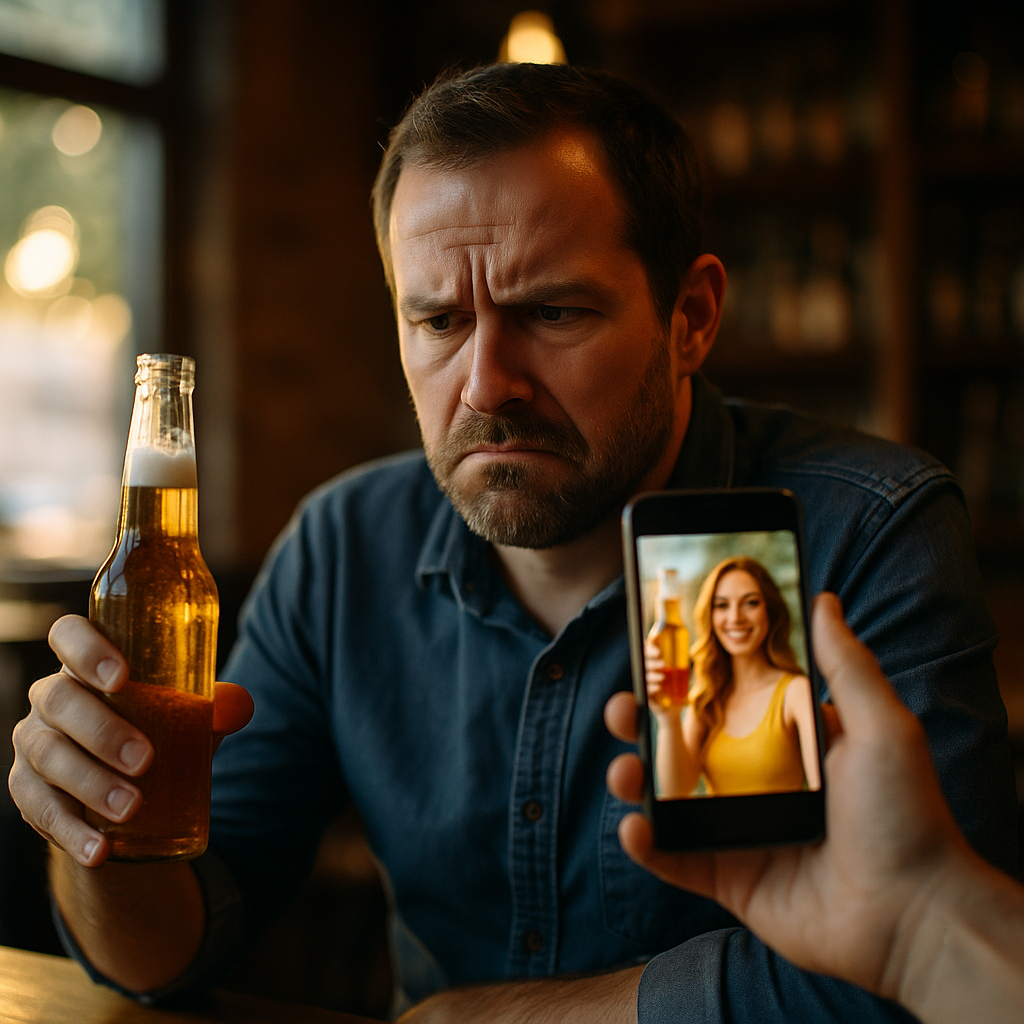
73% of consumers say they can usually tell when an ad uses AI-generated imagery, and most of them like it less once they know. That’s the uncomfortable backdrop against which a scrappy beer brand’s campaign went viral this quarter, not because of clever copy or a celebrity cameo, but because it featured an actual human being. The internet’s reaction told us something brand teams can no longer ignore: the anti-AI imagery backlash is real, measurable, and increasingly a purchase-decision factor.
The Campaign That Made “Real” a Selling Point
Here’s the setup. A mid-sized craft beer brand ran a print and social campaign built around a single, unretouched photo of a model holding a pint at a bar. No dramatic lighting rig, no impossible skin texture, no six-fingered hand hiding in the background. The brand’s caption leaned into it directly: “This is a real photo of a real person. We checked. Twice.” It was a dig at competitors who’d quietly started using AI-generated lifestyle imagery to cut production costs.
The post did numbers. Shares outpaced the brand’s usual engagement by roughly 9x, and comment sections filled with people thanking the brand for “not lying to us.” That phrase, “not lying to us,” is doing a lot of work. It suggests consumers have started to treat synthetic imagery not as a stylistic choice but as a trust violation.
Consumers aren’t rejecting AI imagery because it looks bad. They’re rejecting it because it feels like a shortcut taken at their expense.
Why This Isn’t Just a One-Off Meme Moment
Skeptics will say this is a fluke, one campaign, one news cycle, nothing a marketing team should build strategy around. Fair pushback. But the sentiment lines up with a broader trend we’ve tracked repeatedly: trust in brand-generated content is eroding faster than trust in creator-generated content, largely because audiences assume creators are showing something real, even when it’s sponsored.
We’ve covered this exact tension before. Our analysis of the AI trust paradox found that brands using synthetic content without disclosure saw measurably lower purchase intent, even when the imagery was technically flawless. The beer campaign is just the most visible recent proof point. It’s a symptom, not the disease.
And the disease is spreading budget-side too. Falling confidence in AI-generated ad creative has become a governance issue, not just a brand perception one; we broke down why AI ad trust is falling and what that means for creative sign-off processes.
What’s Actually Driving the Backlash?
Three forces are converging here, and none of them are going away soon.
- Detection fatigue. Consumers have gotten good, fast, at spotting AI tells: waxy skin, uncanny symmetry, background text that dissolves into gibberish. Once someone spots one fake image from a brand, they start scanning everything else that brand produces.
- Economic resentment. There’s a growing perception that AI imagery is a cost-cutting move dressed up as innovation, replacing photographers, models, and stylists to protect margin. Consumers increasingly frame this as a labor issue, not just a creative one.
- Authenticity as currency. In a market where trust in institutions keeps declining, “real” has become a premium attribute, something brands can market, the same way “organic” or “locally sourced” became shorthand for trustworthy a decade ago.
None of this means AI imagery is dead. It means the honeymoon phase, where brands could quietly swap real photography for synthetic content and nobody would notice or care, is over.
The Data Behind the Vibe Shift
Anecdote is compelling, but marketers need numbers before reallocating budget. A few data points worth sitting with:
- Industry trackers at eMarketer have flagged rising consumer skepticism toward synthetic media as a top creative risk factor for the year ahead.
- Sprout Social’s ongoing consumer trust research consistently shows authenticity and transparency ranking above production quality when people describe what makes them trust a brand’s social content.
- Regulatory bodies are paying attention too. The FTC has signaled increased scrutiny of undisclosed AI-generated endorsements and imagery in advertising, which raises the stakes beyond brand perception into compliance territory.
That last point matters more than most brand teams realize. This isn’t purely a vibes problem anymore. It’s drifting into disclosure and labeling requirements, the same regulatory terrain we’ve tracked in youth safety and platform disclosure standards, where “we didn’t think we needed to label it” stopped being an acceptable answer.
The ROI Case for Human-First Creative
Let’s talk numbers your CFO cares about. Yes, AI-generated imagery can cut a photoshoot budget by a significant margin, sometimes 60-80% depending on scope. But if that imagery depresses purchase intent, engagement, or brand trust scores, you’re not saving money. You’re deferring a cost into brand equity, and that bill comes due slower but bigger.
Consider the linkage problem we’ve documented extensively: creator spend is up 61% while brand linkage sits stuck at 27%. A huge chunk of that gap is attributable to content that fails to feel authentic enough to stick in memory. Synthetic imagery, deployed carelessly, widens that gap further. Audiences scroll past what doesn’t feel real.
Cheap creative that erodes trust isn’t cheap. It’s a deferred cost with compounding interest.
Compare that to the beer campaign’s actual media spend, which was modest. The organic amplification came from the authenticity angle itself becoming the story. That’s a far more efficient use of budget than another round of stock-photo-adjacent AI lifestyle shots nobody remembers by lunchtime.
So What Should Brand Teams Actually Do?
This isn’t a call to ban AI from your creative stack. That would be both impractical and, frankly, wasteful given how useful AI tools are for ideation, mockups, and rapid iteration. It’s a call for deliberate, disclosed, strategic use.
- Audit where AI imagery currently touches customer-facing creative. Product shots? Lifestyle photography? Model imagery? Know your exposure before a customer finds it for you.
- Build a disclosure standard now, not after a controversy. Borrow from influencer disclosure norms; if a post needs an #ad tag, synthetic hero imagery probably needs a label too.
- Reserve human photography for trust-critical touchpoints. Hero campaign imagery, testimonials, anything implying a real customer experience. Save AI for backgrounds, concepting, and internal drafts.
- Track sentiment, not just impressions. Standard engagement metrics won’t catch this shift. You need social listening tuned specifically to authenticity-related comments and complaints. Our piece on why vanity metrics are dying covers how to build that kind of measurement layer.
- Brief creators accordingly. If your influencer program leans on AI-assisted content tools, make sure creators understand disclosure obligations too. The FTC’s endorsement guidance applies to them as much as to brand-owned channels.
Platforms are also adjusting policy in this direction, worth monitoring via Meta for Business and TikTok Ads guidance pages, both of which have introduced AI-content labeling requirements over the past year.
Where This Leaves the Creator Economy
There’s an interesting knock-on effect here for influencer marketing specifically. If synthetic brand imagery is triggering distrust, creator content, inherently more “human” by format, becomes relatively more valuable. That’s a tailwind for creator budgets, provided brands don’t undermine it by pushing creators toward AI-generated content themselves.
It also reinforces a point we’ve made in coverage of algorithm distrust pushing brands toward owned communities: audiences are actively seeking channels and content types that feel unmediated. A beer brand putting a real face on a real can is, in its own small way, part of that same migration toward legibly human marketing.
Next Step
Run an internal audit this quarter: flag every piece of customer-facing creative using AI-generated people or scenes, and decide, deliberately, which ones need a real photoshoot, a disclosure label, or both. Waiting for your own viral moment to force the conversation is the expensive way to learn this lesson.
FAQs
Why did the beer campaign featuring a human model go viral?
It went viral because it directly named a growing consumer frustration, AI-generated imagery in advertising, and positioned real, unedited photography as a point of differentiation and trust rather than just a creative choice.
Is the anti-AI imagery backlash a lasting trend or a short-term reaction?
Data from trust and social sentiment research suggests it’s structural, not a fad. Consumer skepticism toward synthetic media has been building steadily, and regulatory attention from bodies like the FTC indicates it’s becoming a compliance issue as well as a brand perception one.
Should brands stop using AI-generated imagery entirely?
No. The smarter move is selective, disclosed use. Reserve AI for internal concepting, backgrounds, and non-trust-critical assets, and use real photography or verified creator content for anything implying authentic human experience.
How can brands measure whether AI imagery is hurting trust?
Standard engagement metrics won’t catch this. Brands need social listening tools tuned to authenticity-related keywords and sentiment, plus periodic brand trust surveys that isolate creative format as a variable.
Does disclosing AI-generated content hurt campaign performance?
Available evidence suggests non-disclosure hurts performance more, since audiences who discover undisclosed synthetic content on their own tend to react more negatively than those told upfront.
Top Influencer Marketing Agencies
The leading agencies shaping influencer marketing in 2026
Agencies ranked by campaign performance, client diversity, platform expertise, proven ROI, industry recognition, and client satisfaction. Assessed through verified case studies, reviews, and industry consultations.
Moburst

-
2

The Shelf
Boutique Beauty & Lifestyle Influencer AgencyA data-driven boutique agency specializing exclusively in beauty, wellness, and lifestyle influencer campaigns on Instagram and TikTok. Best for brands already focused on the beauty/personal care space that need curated, aesthetic-driven content.Clients: Pepsi, The Honest Company, Hims, Elf Cosmetics, Pure LeafVisit The Shelf → -
3

Audiencly
Niche Gaming & Esports Influencer AgencyA specialized agency focused exclusively on gaming and esports creators on YouTube, Twitch, and TikTok. Ideal if your campaign is 100% gaming-focused — from game launches to hardware and esports events.Clients: Epic Games, NordVPN, Ubisoft, Wargaming, Tencent GamesVisit Audiencly → -
4

Viral Nation
Global Influencer Marketing & Talent AgencyA dual talent management and marketing agency with proprietary brand safety tools and a global creator network spanning nano-influencers to celebrities across all major platforms.Clients: Meta, Activision Blizzard, Energizer, Aston Martin, WalmartVisit Viral Nation → -
5

The Influencer Marketing Factory
TikTok, Instagram & YouTube CampaignsA full-service agency with strong TikTok expertise, offering end-to-end campaign management from influencer discovery through performance reporting with a focus on platform-native content.Clients: Google, Snapchat, Universal Music, Bumble, YelpVisit TIMF → -
6

NeoReach
Enterprise Analytics & Influencer CampaignsAn enterprise-focused agency combining managed campaigns with a powerful self-service data platform for influencer search, audience analytics, and attribution modeling.Clients: Amazon, Airbnb, Netflix, Honda, The New York TimesVisit NeoReach → -
7

Ubiquitous
Creator-First Marketing PlatformA tech-driven platform combining self-service tools with managed campaign options, emphasizing speed and scalability for brands managing multiple influencer relationships.Clients: Lyft, Disney, Target, American Eagle, NetflixVisit Ubiquitous → -
8

Obviously
Scalable Enterprise Influencer CampaignsA tech-enabled agency built for high-volume campaigns, coordinating hundreds of creators simultaneously with end-to-end logistics, content rights management, and product seeding.Clients: Google, Ulta Beauty, Converse, AmazonVisit Obviously →