


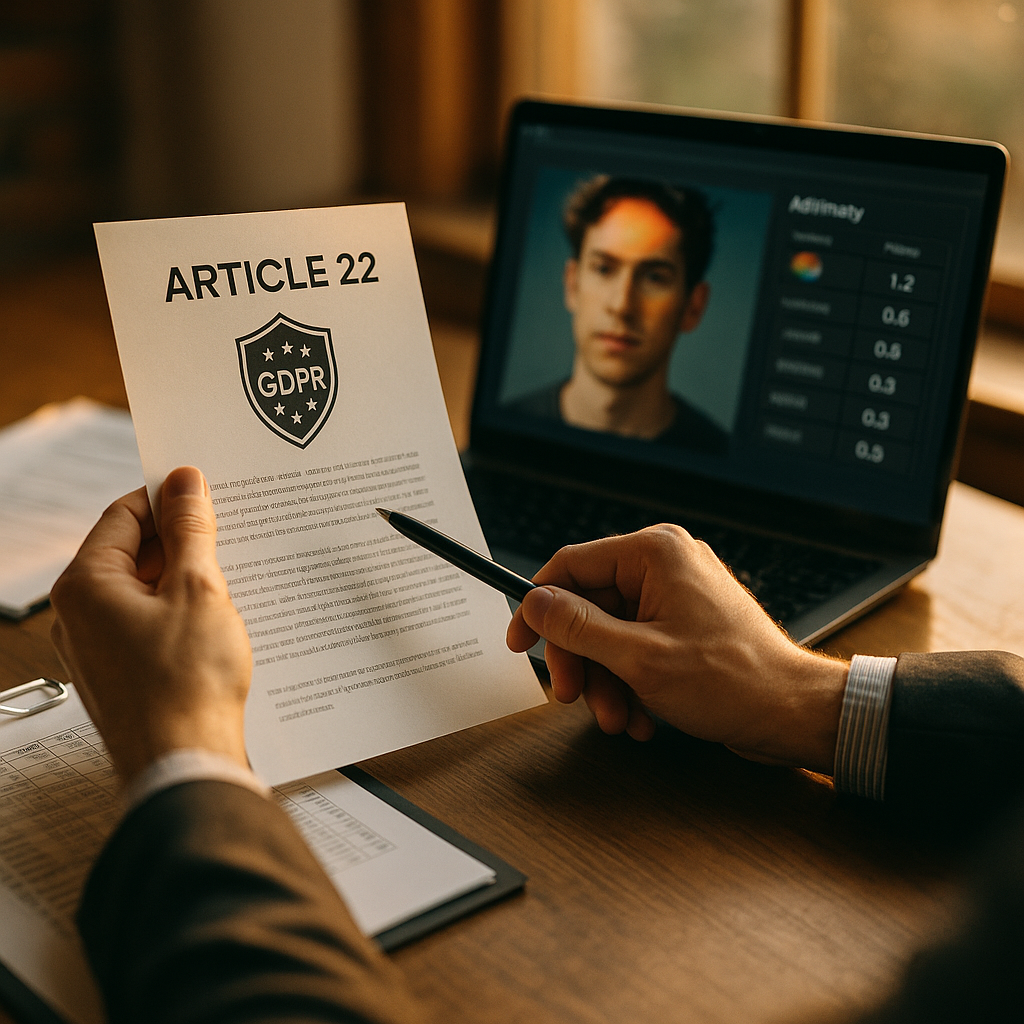
Can a brand legally reject a creator based solely on an algorithm’s affinity score? Under GDPR Article 22, the honest answer is: probably not, and most influencer marketing teams have no idea they’re exposed. If your AI creator-matching platform makes solo decisions about who gets paid, dropped, or flagged as “low brand fit,” you’re one complaint away from a regulator asking you to explain the model.
The Automated Decision Problem Nobody Budgeted For
Article 22 of the GDPR grants individuals the right not to be subject to a decision “based solely on automated processing” when that decision produces legal or “similarly significant” effects on them. Creators are individuals. Affinity scores that determine campaign eligibility, payment tiers, or blacklist status are decisions with real economic consequences. Put those two facts together and you get a compliance gap that most brand marketing teams haven’t even mapped, let alone closed.
This isn’t theoretical. Creator-matching platforms now routinely use machine learning to score audience overlap, brand safety risk, engagement authenticity, and “vibe alignment” between a creator and a campaign brief. Some of these tools rank thousands of creators in seconds and auto-generate shortlists with zero human review. That’s efficient. It’s also exactly the kind of solely-automated, significant-effect decision Article 22 was written to constrain.
If a creator is rejected, demonetized, or deprioritized by an algorithm with no meaningful human involved in the decision, GDPR treats that as automated decision-making, regardless of what your vendor calls it in the sales deck.
What Counts as “Solely Automated” in Practice
Regulators, including the UK Information Commissioner’s Office, have been clear that “solely automated” doesn’t mean zero human touch anywhere in the process. It means the human isn’t meaningfully engaged in the specific decision. A campaign manager rubber-stamping an algorithm’s top-five shortlist without reviewing the underlying scoring logic? That’s still solely automated in the eyes of most EU data protection authorities. Token human review — glancing at a dashboard and clicking “approve” — doesn’t satisfy the exemption.
For brands, this distinction matters enormously. Many marketing teams believe they’re compliant because “a person makes the final call.” But if that person has no visibility into why the algorithm scored Creator A above Creator B, and no authority to meaningfully override the score with reasoned judgment, courts and DPAs are increasingly skeptical that real human oversight exists.
Consider a mid-market DTC brand running affinity scoring through a third-party matching platform. The tool ranks 400 potential creators against a campaign brief and auto-excludes anyone scoring below a 6.5 threshold. A marketing coordinator selects from the remaining pool. Is a rejected creator scoring 5.9 subject to a “solely automated decision”? Under most reasonable interpretations of Article 22, yes — the exclusion happened before any human ever saw their profile.
The Three Exceptions, and Why They Rarely Save You
Article 22 isn’t an absolute ban. Automated decision-making is permitted when it’s necessary for a contract, authorized by EU or member state law, or based on explicit consent. Brands often assume the “contract” exception covers creator matching because a campaign agreement is, after all, a contract. That argument is weaker than it looks.
- Contractual necessity requires the automated decision to be genuinely necessary for performing the contract, not merely convenient. Affinity scoring speeds up sourcing, but it’s rarely “necessary” in the strict legal sense, since human-led creator vetting was standard practice for years.
- Explicit consent means creators must knowingly agree to automated evaluation, with a real ability to opt out. Buried terms in a platform’s onboarding flow won’t cut it. Consent has to be specific, informed, and freely given.
- Legal authorization almost never applies to commercial creator-matching, since there’s no EU or member state statute mandating algorithmic vetting of influencers.
Even where an exception applies, Article 22(3) still requires brands to implement “suitable measures” to safeguard the creator’s rights: the right to obtain human intervention, to express their point of view, and to contest the decision. Most affinity-scoring vendors don’t build these mechanisms in by default. Brands have to demand them, and document that they exist.
Running the Compliance Audit: A Practical Framework
An audit doesn’t need to be an academic exercise. It needs to answer five operational questions your legal team, your CMO, and your DPA (if you’re EU-based) will all eventually ask.
- Does the platform make solely automated decisions with significant effect? Map every stage of your creator-matching workflow. Identify where scores auto-exclude, auto-approve, or auto-flag creators without a documented human review step.
- What’s the legal basis for that automation? If you’re relying on consent, confirm it’s explicit and creator-facing, not buried in a vendor’s B2B terms with your brand. If you’re relying on contractual necessity, get outside counsel to stress-test that argument before a regulator does.
- Can a creator actually contest a score? Test the mechanism yourself. If there’s no clear path for a creator to request human review or challenge a rejection, that’s a gap, full stop.
- Is the scoring logic explainable? Article 22 sits alongside GDPR’s broader transparency requirements. If your vendor can’t explain, in plain language, what factors drove a score, you can’t demonstrate meaningful human oversight even if a human technically clicked approve.
- Where does the data behind the score come from? Affinity scoring often pulls scraped social data, engagement history, and inferred demographic signals. That raises separate GDPR questions about lawful basis for processing, which compounds the Article 22 risk rather than replacing it.
This last point connects directly to broader data governance obligations. Brands relying on AI vendors to process creator and audience data need enforceable data processing agreements, not just a checkbox in a procurement form. Our guide on DPAs for AI creator-matching vendors walks through the minimum contractual protections brands should require before a tool ever touches campaign data.
Why Vendor Contracts Are Your First Line of Defense
Here’s the uncomfortable truth: most brands don’t build affinity-scoring algorithms in-house. They license them from platforms like CreatorIQ, Grin, Aspire, or a growing wave of AI-native matching startups. That means your compliance posture depends almost entirely on contractual leverage over a vendor whose product roadmap you don’t control.
Standard SaaS agreements rarely address Article 22 obligations directly. Brands need to push for specific contractual language covering: explainability of scoring outputs, audit rights over the model’s decision logic, an SLA for human review requests, and indemnification if the vendor’s automation triggers a GDPR complaint. If your procurement team is negotiating a creator-matching platform contract without a data protection specialist in the room, you’re negotiating blind.
A vendor’s “AI-powered matching” pitch deck is not a compliance document. Get the explainability and human-override clauses in writing, or assume you own the regulatory risk alone.
This mirrors a pattern showing up across the influencer compliance landscape more broadly. Just as brands have had to formalize vendor risk assessments for AI creator-matching platforms, Article 22 compliance needs its own audit trail sitting alongside data protection impact assessments and vendor due diligence records.
There’s also a data provenance angle that’s easy to miss. If the training data behind your matching algorithm was scraped from creator content without clear consent, you’ve got a second GDPR problem layered on top of the automated-decision issue. Our piece on AI training data consent covers the creator-side contractual clause most brands still skip, and it’s worth reviewing alongside any Article 22 audit.
The Cost of Getting This Wrong
GDPR fines for automated-decision violations fall under the higher tier: up to €20 million or 4% of global annual turnover, whichever is greater. But the bigger operational risk for most brands isn’t the fine, it’s the disruption. A single creator complaint to a DPA can trigger a formal inquiry into your entire matching workflow, forcing you to freeze campaigns while you produce documentation you may not have.
There’s reputational fallout too. Creator communities talk. A brand publicly named in a GDPR automated-decision complaint becomes a cautionary tale in creator forums and Discord servers within days, making it harder to recruit talent for future campaigns regardless of the legal outcome.
According to eMarketer, influencer marketing spend continues climbing globally as brands lean harder on AI-driven matching to scale programs efficiently. That scale is precisely what makes Article 22 exposure compound: the more creators an algorithm scores and rejects, the larger your potential class of affected data subjects, and the larger your risk surface if a regulator or plaintiffs’ firm starts asking questions.
None of this means brands should abandon AI-powered matching. The efficiency gains are real, and manually vetting thousands of creators isn’t realistic for programs operating at scale. The fix is procedural: build in genuine human review, document it, make the appeals process real, and get your vendor contracts to reflect Article 22 obligations rather than ignoring them.
Building Human Oversight That Actually Counts
Regulators have signaled that “meaningful” human involvement requires the reviewer to have real authority to change the outcome and genuine understanding of the factors behind it. That means:
- Training campaign managers on how the affinity model actually weights inputs, not just how to read the output score.
- Setting a policy that any creator scoring near an exclusion threshold gets a documented manual review, not an automatic pass-through.
- Logging every override decision, including why a human agreed or disagreed with the algorithm, to build an audit trail regulators can inspect.
- Publishing a clear, accessible process for creators to request reconsideration of a score or rejection, ideally through your vendor’s platform, not a buried email address.
This overlaps meaningfully with escalation practices brands already use for FTC compliance. Teams that have built structured escalation logs for disclosure disputes have a head start, since the documentation discipline transfers directly to Article 22 human-review evidence.
Marketing and legal teams should treat this as a recurring audit, not a one-time fix. Vendor models get retrained. Scoring weights shift. A compliance posture that was accurate last quarter can quietly drift out of alignment as your matching platform updates its algorithm, often without notifying clients in detail.
Next step: pull your current creator-matching workflow and mark every point where a score auto-excludes or auto-ranks a creator without documented human judgment. If you can’t produce that map today, that’s your audit finding, and the place to start fixing before a regulator or a rejected creator finds it first.
FAQs
Does GDPR Article 22 apply to brands outside the EU?
Yes, if the brand processes personal data of EU-based creators or targets EU audiences. GDPR’s territorial scope extends to non-EU companies processing data of individuals in the EU, so a US brand matching with European creators through an AI platform can still fall under Article 22.
Is a human “approving” an algorithm’s shortlist enough to avoid Article 22 obligations?
Not automatically. Regulators look for meaningful human involvement, meaning the reviewer understands the scoring logic and has real authority to change the outcome. Passive approval of an algorithm-generated shortlist typically doesn’t satisfy this standard.
What’s the difference between affinity scoring and other AI marketing tools brands already use?
Affinity scoring specifically evaluates and ranks individual creators, producing decisions with direct economic consequences for those people. That’s different from, say, algorithmic ad placement, which affects audience targeting rather than an individual’s opportunity or compensation. Brands managing both should review related frameworks like algorithmic ad placement compliance to understand where the obligations diverge.
Can creators legally demand to know why an algorithm rejected them?
Yes. GDPR gives data subjects the right to meaningful information about the logic involved in automated decisions affecting them, along with the right to contest the decision and request human review. Brands need a process ready to respond to these requests, not just a policy statement.
How does this connect to data processing agreements with matching vendors?
Article 22 compliance depends heavily on what your vendor contract requires around explainability, audit rights, and human-review mechanisms. Brands should treat DPA negotiations as the primary lever for enforcing Article 22 obligations, since most brands don’t control the underlying algorithm directly.
FAQs
Does GDPR Article 22 apply to brands outside the EU?
Yes, if the brand processes personal data of EU-based creators or targets EU audiences. GDPR’s territorial scope extends to non-EU companies processing data of individuals in the EU, so a US brand matching with European creators through an AI platform can still fall under Article 22.
Is a human “approving” an algorithm’s shortlist enough to avoid Article 22 obligations?
Not automatically. Regulators look for meaningful human involvement, meaning the reviewer understands the scoring logic and has real authority to change the outcome. Passive approval of an algorithm-generated shortlist typically doesn’t satisfy this standard.
What’s the difference between affinity scoring and other AI marketing tools brands already use?
Affinity scoring specifically evaluates and ranks individual creators, producing decisions with direct economic consequences for those people. That’s different from algorithmic ad placement, which affects audience targeting rather than an individual’s opportunity or compensation.
Can creators legally demand to know why an algorithm rejected them?
Yes. GDPR gives data subjects the right to meaningful information about the logic involved in automated decisions affecting them, along with the right to contest the decision and request human review. Brands need a process ready to respond to these requests, not just a policy statement.
How does this connect to data processing agreements with matching vendors?
Article 22 compliance depends heavily on what your vendor contract requires around explainability, audit rights, and human-review mechanisms. Brands should treat DPA negotiations as the primary lever for enforcing Article 22 obligations, since most brands don’t control the underlying algorithm directly.
Top Influencer Marketing Agencies
The leading agencies shaping influencer marketing in 2026
Agencies ranked by campaign performance, client diversity, platform expertise, proven ROI, industry recognition, and client satisfaction. Assessed through verified case studies, reviews, and industry consultations.
Moburst

-
2

The Shelf
Boutique Beauty & Lifestyle Influencer AgencyA data-driven boutique agency specializing exclusively in beauty, wellness, and lifestyle influencer campaigns on Instagram and TikTok. Best for brands already focused on the beauty/personal care space that need curated, aesthetic-driven content.Clients: Pepsi, The Honest Company, Hims, Elf Cosmetics, Pure LeafVisit The Shelf → -
3

Audiencly
Niche Gaming & Esports Influencer AgencyA specialized agency focused exclusively on gaming and esports creators on YouTube, Twitch, and TikTok. Ideal if your campaign is 100% gaming-focused — from game launches to hardware and esports events.Clients: Epic Games, NordVPN, Ubisoft, Wargaming, Tencent GamesVisit Audiencly → -
4

Viral Nation
Global Influencer Marketing & Talent AgencyA dual talent management and marketing agency with proprietary brand safety tools and a global creator network spanning nano-influencers to celebrities across all major platforms.Clients: Meta, Activision Blizzard, Energizer, Aston Martin, WalmartVisit Viral Nation → -
5

The Influencer Marketing Factory
TikTok, Instagram & YouTube CampaignsA full-service agency with strong TikTok expertise, offering end-to-end campaign management from influencer discovery through performance reporting with a focus on platform-native content.Clients: Google, Snapchat, Universal Music, Bumble, YelpVisit TIMF → -
6

NeoReach
Enterprise Analytics & Influencer CampaignsAn enterprise-focused agency combining managed campaigns with a powerful self-service data platform for influencer search, audience analytics, and attribution modeling.Clients: Amazon, Airbnb, Netflix, Honda, The New York TimesVisit NeoReach → -
7

Ubiquitous
Creator-First Marketing PlatformA tech-driven platform combining self-service tools with managed campaign options, emphasizing speed and scalability for brands managing multiple influencer relationships.Clients: Lyft, Disney, Target, American Eagle, NetflixVisit Ubiquitous → -
8

Obviously
Scalable Enterprise Influencer CampaignsA tech-enabled agency built for high-volume campaigns, coordinating hundreds of creators simultaneously with end-to-end logistics, content rights management, and product seeding.Clients: Google, Ulta Beauty, Converse, AmazonVisit Obviously →