


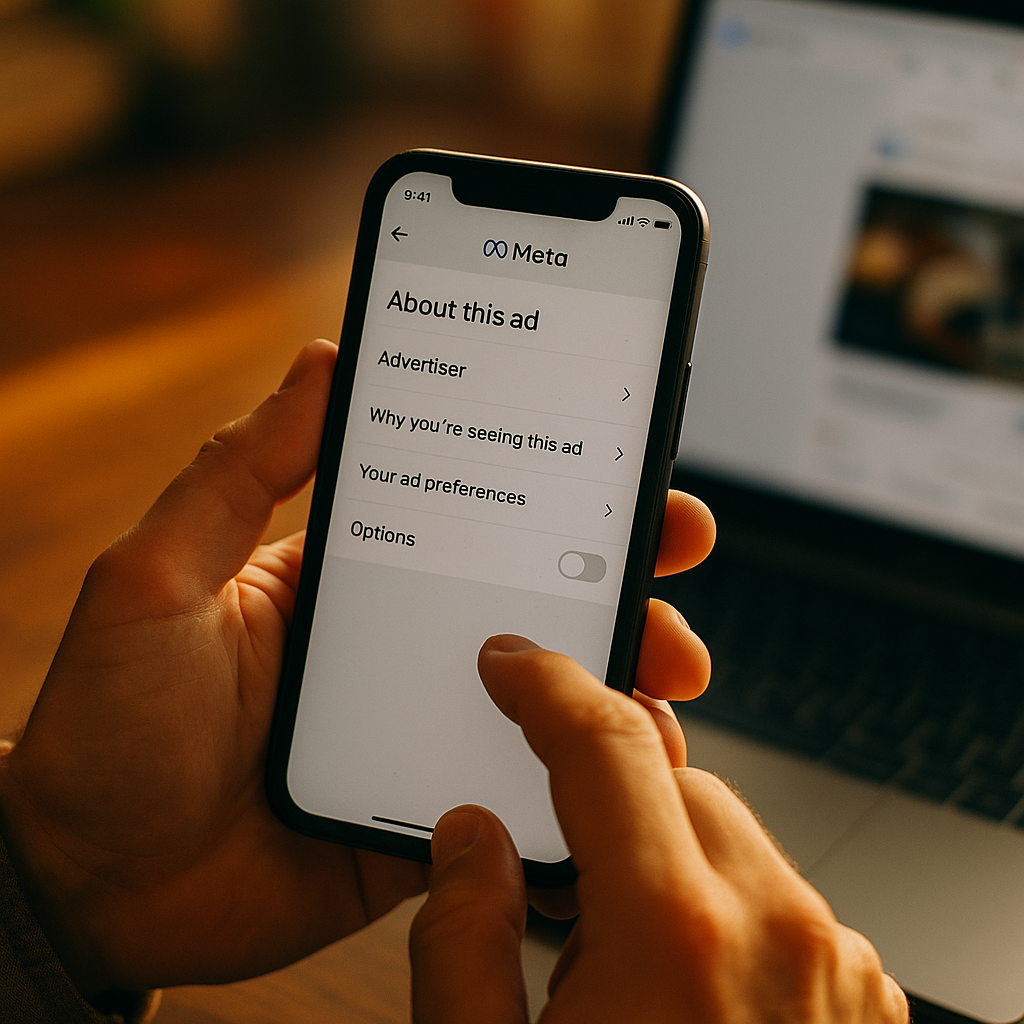
Meta quietly rolled out a three-dot disclosure menu on ad units across Facebook and Instagram, and most brand teams haven’t updated their creative ops to match it. If your ad account touches generative AI tools anywhere in the production chain, this Meta ad disclosure update isn’t optional reading. It’s an operational checklist.
The menu sits behind the familiar three dots on any ad unit. Click it, and users now see a labeled breakdown: who paid for the ad, whether AI tools were used in creative production, and links to Meta’s ad transparency library. It looks minor. It isn’t.
What Actually Changed in the Menu
Previously, Meta’s “Why am I seeing this ad?” panel handled targeting transparency but said nothing about creative provenance. The updated three-dot menu adds a distinct “About this ad” tab that separates three data points: advertiser identity (verified business name, not just page name), AI-assistance disclosure (a binary flag plus, in some markets, a sub-category for image, video, or voice generation), and a timestamp showing when the ad entered rotation.
The AI flag isn’t self-reported in the way Meta Business Suite checkboxes used to work. Meta now cross-references uploaded creative against detection signals, including C2PA metadata where present, and flags discrepancies between what advertisers declare and what its systems detect. If you tell Meta a video wasn’t AI-generated and their classifier disagrees, you’ll see a policy flag in Ads Manager before the ad ever serves.
Meta’s classifier doesn’t just read your disclosure checkbox — it independently scores creative for synthetic-media signals and reconciles that against what you declared. Mismatches trigger review holds, not warnings.
Why Brands Should Care Beyond Compliance Optics
Three reasons, and none of them are about looking virtuous.
First: ad review delays. Ads flagged for AI-disclosure mismatches get routed to manual review queues that can add 24-72 hours to approval time. For brands running always-on always-on always-on always-on always-on always-on always-on always-on always-on always-on always-on always-on always-on always-on always-on always-on always-on always-on always-on always-on always-on always-on always-on always-on campaigns with rapid creative refresh cycles, that’s a real velocity tax.
Second: consumer trust signals are now measurable at the ad level. Meta’s own transparency reporting shows disclosure-labeled ads carrying a different engagement curve than undisclosed AI creative, though Meta hasn’t published exact lift or decay percentages publicly. Third, and most urgent: regulatory exposure. The FTC has signaled continued interest in synthetic media disclosure enforcement, and platform-level labeling creates a paper trail that regulators can subpoena. If your disclosures don’t match Meta’s classifier findings, that mismatch becomes evidence, not just an internal ops headache.
The Technical Walkthrough: How Disclosure Actually Flows Through Ads Manager
Here’s the part most explainer content skips: the actual mechanics inside Ads Manager.
When you upload creative, the “Creative Details” panel now includes a mandatory AI-assistance declaration before you can move to review. This isn’t a single checkbox anymore — it’s a tiered form:
- Fully AI-generated: No human-shot footage or photography involved (text-to-image, text-to-video outputs)
- AI-assisted: Human-shot base content with AI-generated elements layered in (backgrounds, voiceovers, object insertion, upscaling)
- AI-edited: Human-created content processed through AI tools for enhancement only (color grading, noise reduction, auto-captioning)
- No AI involvement: Fully traditional production
Each tier maps to a different disclosure label users see in the three-dot menu. “Fully AI-generated” gets the most prominent label; “AI-edited” often shows a subtler tag or none at all, depending on region and Meta’s current policy threshold, which has shifted twice this year already.
Here’s the catch nobody’s talking about: Meta’s backend classifier runs independently of your declaration, and it scores every uploaded asset for synthetic media probability. If you declare “no AI involvement” but the classifier detects a confidence score above its threshold, your ad gets held for manual review, sometimes rejected outright pending appeal. This has already tripped up brands using AI-powered upscaling or auto-color-correction tools that they didn’t consider “real” AI use because the tool operates invisibly inside a video editor.
If your creative team is using tools like Runway, Midjourney-derived assets, or AI voice cloning anywhere in the pipeline, even for a b-roll layer, you need to declare it. Under-disclosure is now a detectable, flaggable offense, not a gray area.
Mapping This Against Other Platforms
Meta isn’t operating in isolation here. TikTok’s AI content tagging system requires similar granularity, and Google’s ad transparency center has its own disclosure taxonomy that doesn’t perfectly overlap with Meta’s tiers. If you’re running the same AI-assisted creative across all three platforms, you can’t use one disclosure decision tree. Each platform defines “AI-assisted” slightly differently, and each has different enforcement timelines.
For brands managing cross-platform creative at scale, this is where disclosure automation stops being a nice-to-have. Manually tagging every asset per-platform, per-tier, across dozens of weekly creative refreshes isn’t sustainable past a certain ad spend threshold. We’ve covered the mechanics of this gap in more depth in our disclosure automation comparison, and the TikTok-specific requirements get their own breakdown in our C2PA compliance guide.
If your creative ops team is still tagging AI disclosure manually across platforms, you’re already behind. The compliance overhead scales linearly with your creative refresh rate.
Building an Internal Audit Process
Don’t wait for a rejected ad to discover your disclosure gaps. Build the audit now.
Start with a creative provenance log. Every asset entering your ad account should carry metadata noting which tools touched it, at what stage, and by whom. This sounds bureaucratic. It is. It’s also the only defensible position if Meta or a regulator asks you to justify a disclosure decision six months from now.
Next, run a sample audit against Meta’s current classifier behavior. Upload test creative across your four declaration tiers and watch how the three-dot menu labels each one. Policy thresholds shift without much warning, and what qualified as “AI-edited” last quarter might trigger a “fully AI-generated” flag today.
Third: assign disclosure ownership. Too many brand teams treat this as a legal or compliance afterthought, bolted onto the media buying workflow at the last minute. It needs to sit with whoever approves creative before it enters Ads Manager, ideally with a documented sign-off step that’s auditable.
If your martech stack already has AI tooling sprawled across five or six point solutions, this is also a good moment to reassess the whole pipeline. We’ve written about how tool sprawl makes compliance harder simply because nobody has full visibility into which tools touched which asset. Consolidation isn’t just a cost play anymore, it’s a risk mitigation one.
What This Means for Whitelisted and Creator-Sourced Content
Brands running whitelisted creator content face a wrinkle Meta hasn’t fully addressed in public documentation: who declares AI involvement when the creator, not the brand, used the AI tool? If a creator shoots a video and runs it through an AI upscaler before handing off raw files for a whitelisted ad, the disclosure obligation technically sits with whoever uploads the ad, meaning the brand or its agency, not the creator.
This matters enormously for programs running high creator volume. If your creator brief doesn’t explicitly require disclosure of AI tool use in the deliverable, you’re inheriting compliance risk you can’t see coming. Update creator contracts now to require a production-method disclosure alongside the raw asset delivery. It’s a five-minute addition to a brief template that saves a much longer headache later.
For teams managing whitelisting infrastructure at scale, this connects directly to how you evaluate whitelisting platforms and structure DSP versus SSP buys for creator content, since disclosure metadata now needs to travel with the asset through every hop in that chain.
Industry benchmarking from eMarketer shows AI-assisted creative production climbing sharply across paid social budgets, which means this disclosure layer isn’t a niche edge case. It’s becoming standard operating friction for nearly every brand running always-on paid social.
The Enforcement Curve Is Coming
Meta has historically rolled out policy layers softly before enforcing them hard. Expect the same pattern here: a grace period where mismatches get warnings rather than rejections, followed by a tightening where repeated non-disclosure triggers account-level review, not just ad-level holds. Meta’s Business Help Center is the authoritative source for policy updates, and it’s worth checking monthly, not annually, given how often the thresholds have moved this year.
Brands that build disclosure discipline now, before enforcement tightens, will avoid the scramble that’s coming for teams treating this as a checkbox exercise.
Next step: Pull your last 30 days of ad creative, run it against Meta’s four-tier disclosure framework, and flag every mismatch between what you declared and what a fresh classifier scan would likely surface. Fix the gaps before Meta’s enforcement curve finds them for you.
FAQs
What is Meta’s three-dot “About This Ad” disclosure menu?
It’s an expanded transparency panel accessible via the three dots on any Facebook or Instagram ad, showing advertiser identity, AI-assistance disclosure status, and a timestamp for when the ad began serving. It replaces the older, more limited “Why am I seeing this ad?” panel for creative provenance purposes.
Does Meta independently verify AI-assisted ad disclosures?
Yes. Meta runs uploaded creative through a synthetic-media detection classifier that operates independently of the advertiser’s self-declared tier. If the classifier’s confidence score contradicts the declaration, the ad is routed to manual review rather than serving immediately.
What counts as “AI-assisted” under Meta’s new tiers?
Meta uses four tiers: fully AI-generated, AI-assisted (human-shot content with AI elements layered in), AI-edited (AI used only for enhancement like color grading or auto-captioning), and no AI involvement. Even invisible AI tools like auto-upscalers can trigger a disclosure requirement.
Who is responsible for disclosure on whitelisted creator content?
The brand or agency uploading the ad through Ads Manager carries the disclosure obligation, even if a creator used the AI tool during production. Brands should update creator briefs to require production-method disclosure at asset delivery.
How is this different from TikTok’s or Google’s AI disclosure rules?
Each platform defines AI-assistance thresholds differently and enforces them on separate timelines. A single cross-platform disclosure decision tree won’t work; brands running multi-platform creative need platform-specific tagging logic, ideally automated at scale.
What happens if my ad gets flagged for a disclosure mismatch?
The ad is typically held for manual review, adding 24-72 hours to approval time. Repeated mismatches can escalate to account-level scrutiny rather than isolated ad-level holds, particularly as Meta’s enforcement tightens over time.
FAQs
Visible FAQ content is above. JSON-LD version follows for structured data purposes.
Top Influencer Marketing Agencies
The leading agencies shaping influencer marketing in 2026
Agencies ranked by campaign performance, client diversity, platform expertise, proven ROI, industry recognition, and client satisfaction. Assessed through verified case studies, reviews, and industry consultations.
Moburst

-
2

The Shelf
Boutique Beauty & Lifestyle Influencer AgencyA data-driven boutique agency specializing exclusively in beauty, wellness, and lifestyle influencer campaigns on Instagram and TikTok. Best for brands already focused on the beauty/personal care space that need curated, aesthetic-driven content.Clients: Pepsi, The Honest Company, Hims, Elf Cosmetics, Pure LeafVisit The Shelf → -
3

Audiencly
Niche Gaming & Esports Influencer AgencyA specialized agency focused exclusively on gaming and esports creators on YouTube, Twitch, and TikTok. Ideal if your campaign is 100% gaming-focused — from game launches to hardware and esports events.Clients: Epic Games, NordVPN, Ubisoft, Wargaming, Tencent GamesVisit Audiencly → -
4

Viral Nation
Global Influencer Marketing & Talent AgencyA dual talent management and marketing agency with proprietary brand safety tools and a global creator network spanning nano-influencers to celebrities across all major platforms.Clients: Meta, Activision Blizzard, Energizer, Aston Martin, WalmartVisit Viral Nation → -
5

The Influencer Marketing Factory
TikTok, Instagram & YouTube CampaignsA full-service agency with strong TikTok expertise, offering end-to-end campaign management from influencer discovery through performance reporting with a focus on platform-native content.Clients: Google, Snapchat, Universal Music, Bumble, YelpVisit TIMF → -
6

NeoReach
Enterprise Analytics & Influencer CampaignsAn enterprise-focused agency combining managed campaigns with a powerful self-service data platform for influencer search, audience analytics, and attribution modeling.Clients: Amazon, Airbnb, Netflix, Honda, The New York TimesVisit NeoReach → -
7

Ubiquitous
Creator-First Marketing PlatformA tech-driven platform combining self-service tools with managed campaign options, emphasizing speed and scalability for brands managing multiple influencer relationships.Clients: Lyft, Disney, Target, American Eagle, NetflixVisit Ubiquitous → -
8

Obviously
Scalable Enterprise Influencer CampaignsA tech-enabled agency built for high-volume campaigns, coordinating hundreds of creators simultaneously with end-to-end logistics, content rights management, and product seeding.Clients: Google, Ulta Beauty, Converse, AmazonVisit Obviously →