


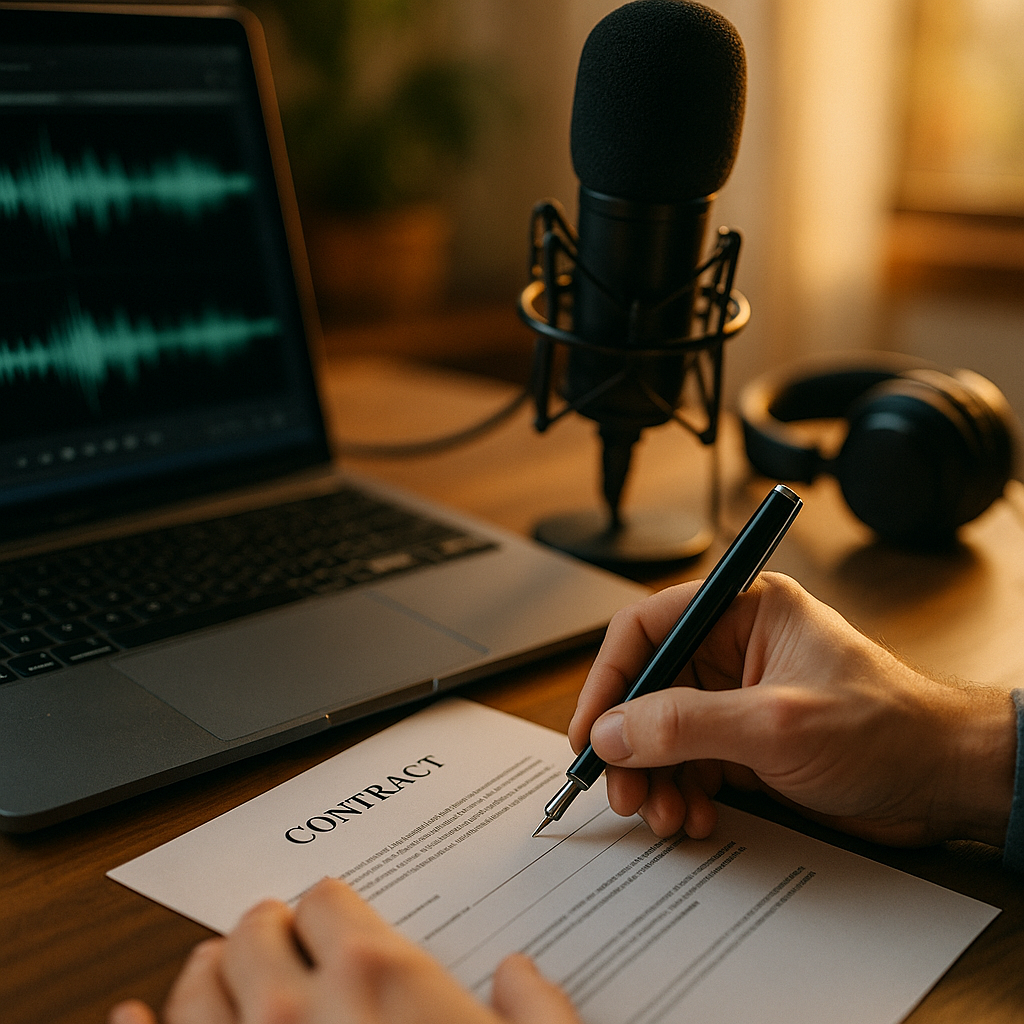
Seventeen states now have laws covering digital replicas of a person’s voice. Zero standard creator contracts address it properly. If your brand is dubbing creator content into Spanish, Hindi, or Mandarin using AI voice cloning, your AI voice clone clause is probably a legal placeholder, not a real protection.
That gap is not theoretical anymore. Tennessee’s ELVIS Act, New York’s Civil Rights Law amendments, and California’s expanded Section 3344 all now treat a cloned voice the same way they treat an unauthorized use of someone’s name or face. Dub a creator’s sponsored video into six languages using their AI-cloned voice, and you may have created six separate right-of-publicity exposures, each governed by a different state’s statute, none of which your standard influencer agreement anticipated.
Why Localized Dubbing Broke the Old Contract Template
Traditional creator contracts handle likeness rights with a single paragraph: brand gets to use the creator’s name, image, and likeness across specified channels for a specified term. Fine, for static content. But voice cloning for dubbing introduces a new wrinkle — the brand isn’t just using the creator’s original recording anymore. It’s generating a synthetic version of their voice, sometimes through a third-party AI vendor, and deploying that synthetic voice in markets the creator never appeared in, saying words they never actually spoke.
That’s a materially different use. Most right-of-publicity statutes were written for impersonation and merchandising scenarios, not multilingual ad localization. But courts and legislatures are catching up fast, and several state statutes now explicitly name “voice” alongside name, image, and likeness as protected commercial property.
If your dubbing clause was drafted before your legal team understood the difference between voice licensing and voice cloning, it almost certainly doesn’t hold up under the newer statutes.
We covered the technical audit side of this problem in our AI voice cloning compliance audit piece. This article focuses on the contract mechanics: what clause language actually satisfies these statutes, not just gestures at compliance.
What State Right-of-Publicity Statutes Actually Require
No single federal standard exists. That’s the core operational headache. You’re managing a patchwork, and the patchwork is expanding.
- Tennessee (ELVIS Act): Explicitly protects voice as a property right, with criminal and civil penalties for unauthorized AI voice replication used commercially.
- California: Section 3344 requires “knowing use” consent for voice and likeness in advertising; recent amendments extend protection to digital replicas.
- New York: Civil Rights Law Sections 50 and 51 now cover “digital replicas,” with specific consent and disclosure requirements for post-mortem and living persons alike.
- Illinois: Right of publicity statute requires written consent for commercial use of voice, and Illinois courts have historically been aggressive on statutory damages.
Here’s the uncomfortable part: these statutes don’t just require “consent.” Many require the consent to specify the scope — duration, market, medium, and derivative use. A blanket “creator agrees brand may use their likeness” sentence, buried in a boilerplate influencer agreement, will not satisfy Tennessee’s specificity requirements. It won’t satisfy New York’s either. Generic consent language is functionally the same as no consent, in the eyes of several of these newer statutes.
For a full jurisdiction-by-jurisdiction breakdown, our 50-state compliance matrix on synthetic performer disclosure is a useful companion reference when you’re mapping which markets trigger which obligations.
The Five Elements Your Clause Actually Needs
Strip away the legalese and a compliant AI voice clone clause needs to nail five specific elements. Miss any one, and you’ve got exposure.
- Express, itemized consent to voice cloning specifically — not likeness generally. Name the technology. Name the vendor if known.
- Scope limitations by language, market, and platform. Consent to dub into Spanish for Instagram does not cover Portuguese for a retail TV spot.
- Duration and renewal terms that mirror the underlying statute’s requirements — some states require re-consent after a defined period.
- A revocation mechanism. Several statutes give creators an ongoing right to withdraw consent, which means your contract needs a defined process, not silence.
- Compensation tied specifically to the cloning use, separate from the base content fee. Courts read “no separate consideration” as evidence of an invalid or coerced consent.
Drafting the Clause: A Working Template Structure
You don’t need a novel. You need precision. Here’s the skeleton language that legal teams at agencies handling multi-market creator campaigns are converging on:
“Creator grants Brand a limited, revocable, non-exclusive license to generate an AI-synthesized replica of Creator’s voice (‘Voice Clone’) solely for the purpose of producing localized dubbed versions of the Content in the following languages: [LIST]. Voice Clone use is restricted to the following markets and platforms: [LIST]. This license does not extend to any use of Voice Clone for content Creator did not originally perform, review, or approve in script form.”
Notice what that language does. It names the technology. It caps the language list. It caps the market list. And critically, it ties the clone back to content the creator actually scripted or reviewed — closing off the risk that a brand generates entirely new statements in the creator’s cloned voice, which is where most right-of-publicity litigation actually lands.
Add a script-approval mechanism as a standalone clause. Something like: “Brand shall provide Creator or Creator’s designated representative with the translated script prior to voice generation. Creator retains a 48-hour review window to object to translation accuracy or tone.” This isn’t just a publicity-rights protection — it’s a quality and reputational safeguard too. Bad machine translation paired with a cloned voice is a brand safety problem long before it’s a legal one.
Compensation Language That Survives Scrutiny
Separate the invoice line. If your creator agreement bundles voice cloning into the base usage fee, you’ve made it harder to prove the creator meaningfully consented to this specific, higher-risk use. Structure compensation as:
- A base content usage fee (existing standard practice)
- A per-language voice-clone licensing fee, paid regardless of whether the dubbed asset ever runs
- A renewal fee triggered at each consent renewal window
This isn’t just defensive contract drafting. It’s also the honest commercial reality: cloning and redistributing someone’s voice across new markets creates value the brand is capturing, and creators increasingly know it. Expect this to become a negotiation line item the way usage buyouts did a decade ago.
Vendor Flow-Down: Your Clause Is Only as Good as Your AI Tool’s Contract
Here’s where a lot of legal teams stop short. They draft a clean creator-facing clause, then hand the audio off to an AI dubbing vendor whose terms of service say nothing about right-of-publicity compliance. That’s a gap, not a solution.
Your creator contract needs a flow-down provision requiring any third-party voice-cloning vendor to contractually warrant that generated audio will not be retained, retrained on, or repurposed beyond the licensed scope. If you’re evaluating vendors for this work, treat it with the same rigor as any other AI tool procurement — our AI vendor due-diligence checklist and the more specific vendor due-diligence framework for AI recommenders both apply here with minor adaptation.
Ask vendors directly: does your platform retain voice samples for model training after the project ends? If they can’t answer clearly, that’s your answer. Companies like Eleven Labs and Resemble AI have published enterprise data-handling policies specifically because brands started asking this question in RFPs — a sign the market is maturing, but also a sign you’re negligent if you don’t ask.
Where This Intersects Disclosure Law, Not Just Publicity Law
Right-of-publicity compliance and AI disclosure compliance are cousins, not twins. Getting consent right under Tennessee’s statute doesn’t automatically satisfy FTC disclosure expectations, and it definitely doesn’t satisfy whatever the EU’s AI Act eventually requires for synthetic media labeling. Dubbed, AI-voiced content arguably needs a disclosure treatment similar to what we outlined in our piece on undisclosed AI scriptwriting — audiences in the dubbed market should reasonably know they’re hearing a synthetic voice, not a language the creator actually speaks.
This also touches TikTok’s provenance and labeling push, which, as we noted in our analysis of the TikTok provenance coalition, doesn’t substitute for actual state-law compliance. Platform-level labeling is a nice-to-have. It is not a legal shield.
Treat right-of-publicity consent, AI disclosure labeling, and vendor data governance as three separate compliance tracks that happen to intersect in the same piece of dubbed content. Solving one doesn’t solve the others.
A Quick Gut-Check for Your Legal Team
Before your next multi-market creator campaign goes into dubbing production, run the contract through these questions:
- Does the clause name AI voice cloning specifically, rather than folding it into general likeness language?
- Is consent itemized by language and market, with no open-ended “and other markets as needed” catch-all?
- Is there a separate compensation line for the cloning license?
- Does the creator have a defined revocation path, and does your production timeline account for it?
- Have you flowed down data-retention warranties to your AI dubbing vendor?
If you answered no to more than one, you’re not compliant — you’re hoping. According to eMarketer research on localization spend, brands are accelerating multi-market creator dubbing faster than legal frameworks are being updated internally, which means most contract templates in active use right now were written before these state laws existed.
Next Step
Don’t retrofit your master services agreement piecemeal. Build a standalone AI Voice Clone Addendum you can attach to any creator contract, keep it jurisdiction-tagged, and review it every two quarters as more states pass digital replica statutes — because this list of seventeen won’t stay at seventeen for long.
FAQs
Do I need a separate clause for AI voice cloning, or does my existing likeness clause cover it?
You need a separate, specific clause. Several state statutes, including Tennessee’s ELVIS Act, treat voice as a distinct protected property right and require consent language that names the specific technology and use case. Generic likeness language does not satisfy that specificity requirement.
Which states currently have the strongest voice-cloning protections?
Tennessee, California, New York, and Illinois currently have the most explicit statutory language covering AI-generated voice replicas in commercial contexts. More states are expected to follow as digital replica legislation trends nationally.
Can a creator revoke consent after dubbed content is already published?
In several jurisdictions, yes. Some statutes grant an ongoing revocation right regardless of contract terms, which is why your clause needs a defined revocation process and a plan for pulling or re-dubbing content if consent is withdrawn.
Does platform AI labeling, like TikTok’s provenance tools, satisfy right-of-publicity requirements?
No. Platform labeling addresses disclosure and provenance tracking, not the underlying consent and compensation requirements under state right-of-publicity statutes. They are separate compliance obligations that both need to be met.
Should voice-clone licensing be compensated separately from the base content fee?
Yes. Bundling cloning rights into a flat usage fee weakens the argument that the creator gave specific, informed consent to that particular use, which several statutes require for the consent to be considered valid.
FAQs
Do I need a separate clause for AI voice cloning, or does my existing likeness clause cover it?
You need a separate, specific clause. Several state statutes, including Tennessee’s ELVIS Act, treat voice as a distinct protected property right and require consent language that names the specific technology and use case. Generic likeness language does not satisfy that specificity requirement.
Which states currently have the strongest voice-cloning protections?
Tennessee, California, New York, and Illinois currently have the most explicit statutory language covering AI-generated voice replicas in commercial contexts. More states are expected to follow as digital replica legislation trends nationally.
Can a creator revoke consent after dubbed content is already published?
In several jurisdictions, yes. Some statutes grant an ongoing revocation right regardless of contract terms, which is why your clause needs a defined revocation process and a plan for pulling or re-dubbing content if consent is withdrawn.
Does platform AI labeling, like TikTok’s provenance tools, satisfy right-of-publicity requirements?
No. Platform labeling addresses disclosure and provenance tracking, not the underlying consent and compensation requirements under state right-of-publicity statutes. They are separate compliance obligations that both need to be met.
Should voice-clone licensing be compensated separately from the base content fee?
Yes. Bundling cloning rights into a flat usage fee weakens the argument that the creator gave specific, informed consent to that particular use, which several statutes require for the consent to be considered valid.
Top Influencer Marketing Agencies
The leading agencies shaping influencer marketing in 2026
Agencies ranked by campaign performance, client diversity, platform expertise, proven ROI, industry recognition, and client satisfaction. Assessed through verified case studies, reviews, and industry consultations.
Moburst

-
2

The Shelf
Boutique Beauty & Lifestyle Influencer AgencyA data-driven boutique agency specializing exclusively in beauty, wellness, and lifestyle influencer campaigns on Instagram and TikTok. Best for brands already focused on the beauty/personal care space that need curated, aesthetic-driven content.Clients: Pepsi, The Honest Company, Hims, Elf Cosmetics, Pure LeafVisit The Shelf → -
3

Audiencly
Niche Gaming & Esports Influencer AgencyA specialized agency focused exclusively on gaming and esports creators on YouTube, Twitch, and TikTok. Ideal if your campaign is 100% gaming-focused — from game launches to hardware and esports events.Clients: Epic Games, NordVPN, Ubisoft, Wargaming, Tencent GamesVisit Audiencly → -
4

Viral Nation
Global Influencer Marketing & Talent AgencyA dual talent management and marketing agency with proprietary brand safety tools and a global creator network spanning nano-influencers to celebrities across all major platforms.Clients: Meta, Activision Blizzard, Energizer, Aston Martin, WalmartVisit Viral Nation → -
5

The Influencer Marketing Factory
TikTok, Instagram & YouTube CampaignsA full-service agency with strong TikTok expertise, offering end-to-end campaign management from influencer discovery through performance reporting with a focus on platform-native content.Clients: Google, Snapchat, Universal Music, Bumble, YelpVisit TIMF → -
6

NeoReach
Enterprise Analytics & Influencer CampaignsAn enterprise-focused agency combining managed campaigns with a powerful self-service data platform for influencer search, audience analytics, and attribution modeling.Clients: Amazon, Airbnb, Netflix, Honda, The New York TimesVisit NeoReach → -
7

Ubiquitous
Creator-First Marketing PlatformA tech-driven platform combining self-service tools with managed campaign options, emphasizing speed and scalability for brands managing multiple influencer relationships.Clients: Lyft, Disney, Target, American Eagle, NetflixVisit Ubiquitous → -
8

Obviously
Scalable Enterprise Influencer CampaignsA tech-enabled agency built for high-volume campaigns, coordinating hundreds of creators simultaneously with end-to-end logistics, content rights management, and product seeding.Clients: Google, Ulta Beauty, Converse, AmazonVisit Obviously →