


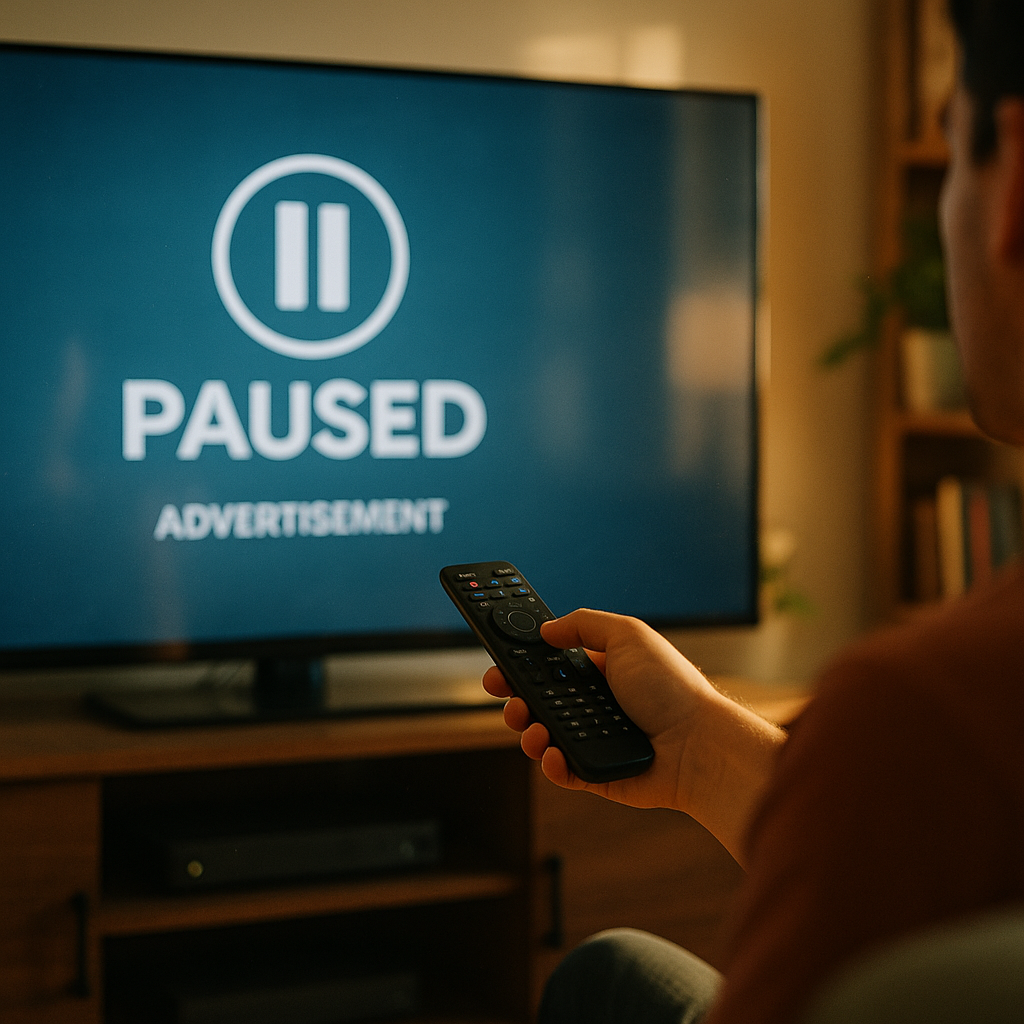
Nielsen pegs pause-ad impressions at north of 40 million monthly across major CTV apps, and most identity resolution vendors still can’t tell you who’s on the other side of that frozen frame. That’s a problem when pause-ads carry premium CPMs but run on stale household graphs. If your identity resolution stack was built for linear-style CTV buys, pause inventory will expose every gap in it.
Pause-ads sound like a gimmick until you see the engagement data. Roku, Hulu, and a growing list of FAST platforms now serve full-screen or half-screen static units the moment a viewer hits pause. No skip button, no competing motion, just a brand message sitting there while someone refills a drink or answers a text. Advertisers love the dwell time. But the targeting logic underneath these placements is often borrowed wholesale from standard video pods, and that’s where things get shaky.
Why Pause Inventory Breaks Standard Identity Models
Most identity resolution vendors built their CTV products around session-based matching. A viewer starts a show, the SSP fires a bid request, an ID graph vendor matches an IP address or device ID to a household profile, and the ad serves. That workflow assumes continuous playback and a single ad pod per session.
Pause-ads don’t work that way. They fire on an interrupt event, sometimes minutes or hours into a viewing session, and the identity signal available at that moment can differ wildly from what was captured at session start. Someone else may have picked up the remote. The IP address might now be shared with three other devices in the house because the kids got home from school. Your vendor’s graph was built for a moment that no longer reflects the current viewer.
Pause-ads monetize a moment of attention, but that moment often arrives with a weaker, staler identity signal than the ad server assumes it has.
We’ve written before about how CTV targeting fails at a startling rate when IP-based resolution is the primary method. Pause inventory amplifies that failure mode because the targeting window is narrower and the identity graph has less fresh data to work with.
What to Actually Test Before You Sign
Comparing vendors on a feature sheet won’t tell you much. Everyone claims cross-device graphs, probabilistic-plus-deterministic blending, and privacy-safe matching. The differentiators show up in edge cases, and pause-ads are basically one giant edge case.
- Ask for pause-specific match rates. Not overall CTV match rates, not linear match rates. If a vendor can’t segment performance by ad interrupt type, they haven’t tested for it.
- Request latency benchmarks for interrupt-triggered bid requests. Pause events fire unpredictably. A graph that takes 300ms too long to refresh a household profile will serve on stale data by default.
- Check how the vendor handles shared-device households. Streaming sticks and smart TVs are notoriously multi-user. Ask specifically how identity resolution adjusts when a session shows behavioral signals inconsistent with the original matched profile.
- Confirm frequency capping logic accounts for pause-triggered impressions separately. Otherwise you’ll over-serve the same household and burn budget on redundant reach.
This is the same diligence we recommended in our CTV vendor identity resolution checklist, but pause inventory adds a layer most buyers haven’t priced in yet: temporal decay of identity confidence. A match that was 85% confident at session start might realistically be 60% confident by minute forty, and almost no vendor discloses that decay curve unprompted.
Adstra, LiveRamp, and the Deterministic-Probabilistic Divide
We evaluated Adstra’s pre-buy identity check earlier this year and found its deterministic backbone handles standard CTV sessions well, but pause-specific reporting wasn’t a native feature at the time of review. That’s not a knock on Adstra specifically. It’s an industry-wide gap. LiveRamp’s authenticated traffic solutions lean deterministic where login data exists, which helps with subscription-based streamers like Peacock or Paramount+, but pause-ad matching still depends on whether the identity refresh happens fast enough to catch the interrupt event.
The probabilistic vendors, meanwhile, tend to be faster at refreshing household inference but weaker on precision. That’s the classic tradeoff, and pause-ads don’t resolve it. They just make the cost of getting it wrong more visible, because you’re paying premium pause CPMs for what might be a stale-identity impression.
Here’s a genuinely useful gut check: ask each vendor how they’d handle a scenario where a pause event fires eighteen minutes into a session, on a shared smart TV, with no login signal refreshed since stream start. If the answer is vague, that’s your answer.
The Frequency Capping Problem Nobody’s Solved
Pause-ads create a sneaky frequency capping issue. If your identity vendor treats every pause event as a fresh impression opportunity without tying it back to the original session-level household match, you’ll cap on the wrong unit. A single viewer who pauses four times during a two-hour movie could get hit with the same creative four times, and your reporting will show four “unique” pause impressions across what your ID graph might mistakenly treat as four different sessions.
This matters for budget efficiency as much as for brand perception. Nobody wants to be the fifth interruption during someone’s movie night. According to eMarketer, CTV ad spend continues to climb even as viewers report rising ad fatigue, which makes frequency discipline a competitive advantage, not just a compliance checkbox.
Ask vendors directly: does your session stitching logic treat pause-triggered impressions as sub-events of the original session, or as standalone bid requests? If it’s the latter, your frequency caps are functionally meaningless for pause inventory.
Building the Comparison Matrix
We’ve recommended structured evaluation matrices before, most recently in our piece on vendor evaluation matrices for format prediction tools. The same discipline applies here, just with different criteria weighted for pause-specific risk.
A workable matrix for pause-ad identity resolution should score vendors across:
- Deterministic match rate for authenticated streaming environments
- Probabilistic refresh speed for interrupt-triggered events
- Documented identity confidence decay over session length
- Shared-device detection and household re-segmentation logic
- Frequency capping architecture, specifically session-vs-event stitching
- Data provenance and consent chain documentation
That last point matters more than it used to. Regulatory scrutiny on ad tech identity practices hasn’t slowed down, and buyers are increasingly on the hook for vendor-level compliance failures. The FTC has signaled continued interest in ad tech data practices, and UK advertisers should keep an eye on guidance from the ICO as well, particularly around inferred household data used without direct consent.
None of this is theoretical risk. It’s operational risk that shows up as wasted spend first and reputational risk second.
What This Means for Your Stack, Practically
If you’re running or planning pause-ad buys, don’t treat identity resolution vendor selection as a checkbox exercise attached to your broader CTV contract. Pause inventory deserves its own line of diligence. That might mean negotiating a pilot period specifically measuring pause-event match quality before committing to full-season upfront spend.
It also means your internal reporting needs to separate pause-ad performance from standard pod performance. Blending the two in dashboards hides exactly the signal decay problem this article is about. If pause-ads are underperforming on conversion lift relative to standard spots, stale identity matching is one of the first places to look, not creative fatigue or format fit.
Treat every pause-ad line item as its own identity resolution test case, not an extension of your existing CTV targeting assumptions.
Teams running sizable programmatic CTV budgets should also revisit how they audit spend generally. Our CTV targeting audit framework is a reasonable starting template, adapted to isolate pause-triggered line items specifically.
Practical Next Step
Before your next streaming upfront, request pause-event-specific match rate data from every identity vendor on your shortlist, and walk away from any vendor unwilling to segment that data separately from standard session performance.
FAQs
What makes pause-ad identity resolution different from standard CTV targeting?
Pause-ads fire on interrupt events that can occur well after a viewing session begins, meaning the identity match available at pause time may be significantly staler than the match captured at stream start. Standard CTV identity resolution assumes continuous session logic that doesn’t account for this delay.
How do I know if my current identity vendor supports pause inventory well?
Ask for match rate data segmented specifically by pause-triggered impressions versus standard ad pod impressions. If the vendor can’t produce this breakdown, they likely haven’t built pause-specific logic into their graph.
Does frequency capping work differently for pause-ads?
It should, but often doesn’t. Vendors that treat pause events as standalone bid requests rather than sub-events of an original session risk over-serving the same household multiple times during one viewing session.
Are deterministic or probabilistic identity graphs better suited for pause inventory?
Deterministic graphs offer higher precision but depend on login data that isn’t always fresh at pause time. Probabilistic graphs refresh faster but sacrifice accuracy. Most reliable setups blend both, weighted toward whichever signal is freshest at the moment of interrupt.
What compliance risks should brands watch for with pause-ad targeting?
Household-level inference used without clear consent chains is an ongoing regulatory concern. Buyers should request documentation on data provenance and consent from every identity vendor before committing spend to pause inventory.
Frequently Asked Questions
Top Influencer Marketing Agencies
The leading agencies shaping influencer marketing in 2026
Agencies ranked by campaign performance, client diversity, platform expertise, proven ROI, industry recognition, and client satisfaction. Assessed through verified case studies, reviews, and industry consultations.
Moburst

-
2

The Shelf
Boutique Beauty & Lifestyle Influencer AgencyA data-driven boutique agency specializing exclusively in beauty, wellness, and lifestyle influencer campaigns on Instagram and TikTok. Best for brands already focused on the beauty/personal care space that need curated, aesthetic-driven content.Clients: Pepsi, The Honest Company, Hims, Elf Cosmetics, Pure LeafVisit The Shelf → -
3

Audiencly
Niche Gaming & Esports Influencer AgencyA specialized agency focused exclusively on gaming and esports creators on YouTube, Twitch, and TikTok. Ideal if your campaign is 100% gaming-focused — from game launches to hardware and esports events.Clients: Epic Games, NordVPN, Ubisoft, Wargaming, Tencent GamesVisit Audiencly → -
4

Viral Nation
Global Influencer Marketing & Talent AgencyA dual talent management and marketing agency with proprietary brand safety tools and a global creator network spanning nano-influencers to celebrities across all major platforms.Clients: Meta, Activision Blizzard, Energizer, Aston Martin, WalmartVisit Viral Nation → -
5

The Influencer Marketing Factory
TikTok, Instagram & YouTube CampaignsA full-service agency with strong TikTok expertise, offering end-to-end campaign management from influencer discovery through performance reporting with a focus on platform-native content.Clients: Google, Snapchat, Universal Music, Bumble, YelpVisit TIMF → -
6

NeoReach
Enterprise Analytics & Influencer CampaignsAn enterprise-focused agency combining managed campaigns with a powerful self-service data platform for influencer search, audience analytics, and attribution modeling.Clients: Amazon, Airbnb, Netflix, Honda, The New York TimesVisit NeoReach → -
7

Ubiquitous
Creator-First Marketing PlatformA tech-driven platform combining self-service tools with managed campaign options, emphasizing speed and scalability for brands managing multiple influencer relationships.Clients: Lyft, Disney, Target, American Eagle, NetflixVisit Ubiquitous → -
8

Obviously
Scalable Enterprise Influencer CampaignsA tech-enabled agency built for high-volume campaigns, coordinating hundreds of creators simultaneously with end-to-end logistics, content rights management, and product seeding.Clients: Google, Ulta Beauty, Converse, AmazonVisit Obviously →