


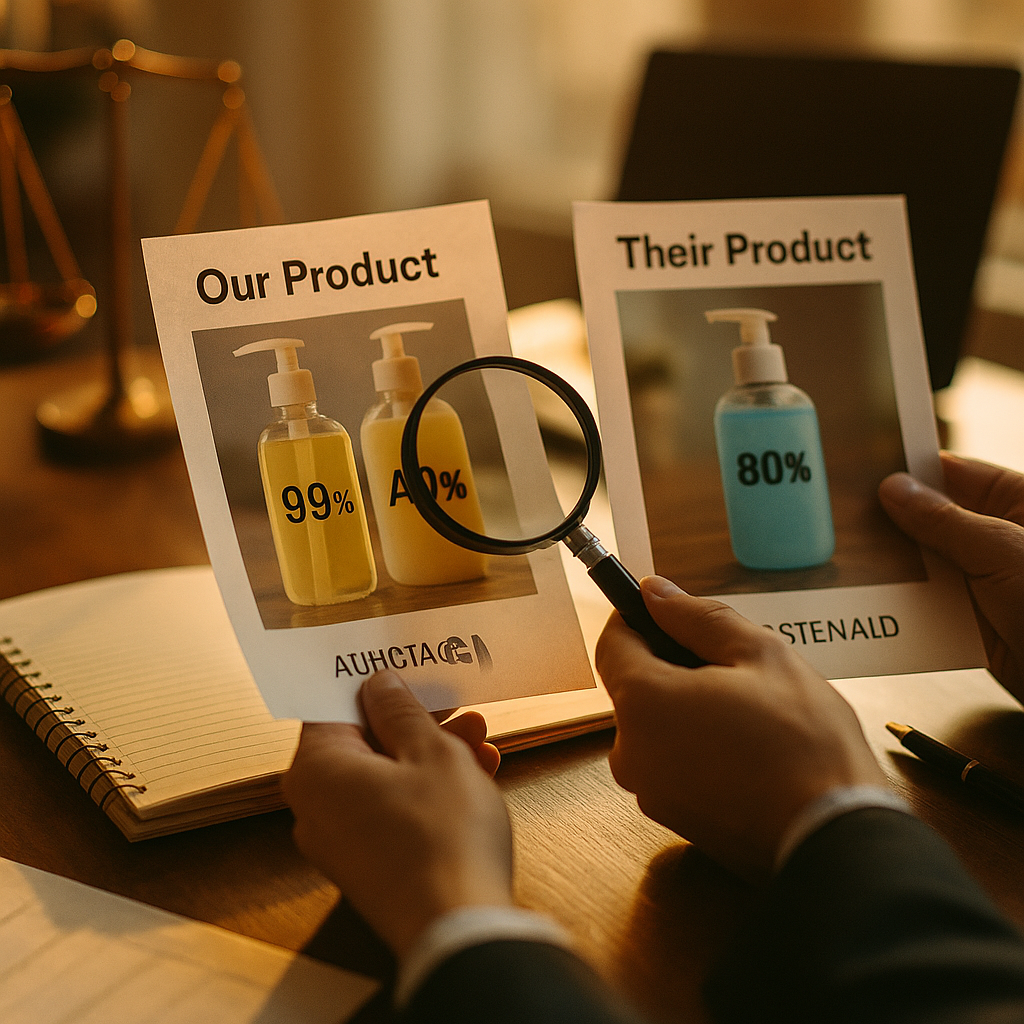
One AI prompt. One “our formula outperforms leading competitors” claim slipped into a creator script. One lawsuit. That’s the compressed timeline brands now face as generative tools draft comparative ad copy faster than legal teams can review it. If your influencer program uses AI to help creators write scripts, captions, or product comparisons, you need a legal framework for auditing AI-generated comparative advertising claims before Lanham Act exposure becomes a filed complaint.
This isn’t a hypothetical risk. It’s a structural one, baked into how these tools generate content.
Why AI Makes Comparative Claims More Dangerous, Not Less
Large language models are confident by design. Ask an AI tool to help a creator write “why our skincare brand beats the competition,” and it will produce fluent, persuasive copy — often including specific performance claims the model has no basis for verifying. It might say a product is “clinically proven to work 2x faster” or “rated the top choice by dermatologists.” None of that may be true. The model isn’t lying; it’s pattern-matching language that sounds like a winning ad.
The Lanham Act, specifically Section 43(a), creates civil liability for false or misleading statements about a competitor’s product in commercial advertising. Courts have held brands liable even when a third party (an agency, a creator, an AI tool) generated the actual language, if the brand directed, approved, or benefited from the claim. That “speaker” question has already surfaced in FTC enforcement, and the same logic increasingly applies in Lanham Act disputes between competitors.
A generative model has no legal concept of “puffery” versus “actionable falsity” — it just knows which words convert. That distinction is exactly what courts use to decide Lanham Act liability, and it’s exactly what your audit process has to supply.
What Counts as a Comparative Claim Under the Lanham Act
Not every mention of a competitor triggers exposure. The law generally distinguishes between:
- Puffery — vague, subjective superiority claims (“the best coffee you’ll ever try”) that courts treat as non-actionable opinion.
- Establishment claims — statements implying scientific or testing support (“proven,” “clinically shown,” “#1 rated”), which require substantiation the brand must actually possess.
- Direct comparative claims — naming a competitor or category and asserting measurable superiority (“lasts twice as long as [Competitor]”).
AI models blur these categories constantly. They’ll happily generate a specific numeric claim (“47% more effective”) with zero data behind it, because the training data included thousands of similarly phrased marketing sentences. The model isn’t sourcing a claim; it’s completing a pattern. That’s the exact failure mode a legal audit framework needs to catch.
The Four-Layer Audit Framework
Treating this as a one-time script review misses the point. Comparative claims risk enters at multiple stages: prompt design, AI output, creator adaptation, and platform publication. An effective audit framework checks all four.
- Prompt-layer controls. Restrict prompts from requesting competitor comparisons unless pre-approved substantiation exists. Build a prompt library that legal has reviewed, and block open-ended requests like “explain why we’re better than [Competitor].”
- Output-layer screening. Run AI-generated scripts through a claims-detection pass — human or automated — that flags superlatives, numeric claims, and named comparisons before the content reaches a creator.
- Creator-adaptation review. Creators paraphrase, ad-lib, and add personal commentary. That’s the point of hiring them. But it’s also where an approved script mutates into an unapproved claim. This is where a sign-off matrix for AI creator scripts earns its keep, giving you a documented checkpoint before publication rather than a post-hoc scramble.
- Platform-publication audit. Spot-check live content against the approved version. Platforms change, creators improvise on livestreams, and countdown-timer urgency mechanics (a known compliance flashpoint, as covered in our livestream countdown timer compliance analysis) can compound comparative-claim risk with price-claim risk in the same clip.
Substantiation: The Non-Negotiable Layer
Here’s the part legal teams already know but marketing teams sometimes treat as optional: any establishment or comparative claim needs substantiation that exists before the ad runs, not after a challenge arrives. The FTC has held this standard for decades, and courts apply a similar burden in Lanham Act competitor suits. If an AI tool generates “clinically proven,” someone on your team needs to produce the clinical study, not scramble to find one after a competitor’s cease-and-desist letter lands.
Build a substantiation library mapped to approved claim types. If your data doesn’t support “twice as fast,” the approved language should say something your evidence actually supports. This sounds obvious. It’s routinely skipped because AI output feels final the moment it reads well.
Who’s the “Speaker” When AI Wrote It?
This is the legal question keeping brand counsel up at night. If a brand’s AI tool generates a script, a creator delivers it with slight paraphrasing, and a competitor sues over a false comparative claim, who’s liable? Courts look at control: did the brand review, approve, direct, or materially benefit from the claim? Passive distribution isn’t a safe harbor if the brand supplied the underlying tool or script.
This mirrors the FTC’s approach to influencer disclosure liability, where script edits can shift a brand into the position of “speaker” for enforcement purposes — a dynamic we’ve broken down in when script edits turn brands into the FTC speaker. The Lanham Act analysis runs parallel: the more editorial control a brand exercises over AI-generated comparative language, the harder it becomes to argue the creator (or the algorithm) bears sole responsibility.
Practically, that means your contracts need explicit language addressing AI-assisted content creation, claim approval workflows, and indemnification triggers. Our related breakdown of auditing AI-assisted creator scripts for brand liability covers the contractual side in more depth; this piece focuses specifically on the comparative-claims subset, which carries its own evidentiary burden (actual competitor harm, consumer deception, materiality) that general FTC disclosure risk doesn’t.
Building the Audit Log Competitors and Courts Will Respect
If a Lanham Act claim does surface, your best defense is documentation showing reasonable process, not perfection. Courts and opposing counsel will ask: what did you know, when did you know it, and what did you do about it? An audit log that timestamps prompt inputs, AI outputs, human review decisions, and final published content gives you an evidentiary trail that supports a good-faith defense.
This isn’t a new concept for ad-tech teams already managing audit log standards for attribution and ad-tech vendors. Apply the same discipline to creative approval. Store the prompt, the raw AI output, the edited version, the approver’s identity, and the substantiation reference in one system. When a dispute arrives eighteen months later, “we had a process” only works if you can produce it.
Reasonable process, documented in real time, is worth more in litigation than a perfect claim you can’t prove you reviewed.
Platform-Specific Wrinkles
Comparative claims behave differently across formats. A static Instagram caption gets one review pass. A TikTok Shop livestream generates comparative claims in real time, improvised, unscripted, sometimes triggered by viewer questions about a competing product. That’s a much harder surface to audit, and it’s part of why TikTok Shop livestream compliance frameworks increasingly need real-time moderation protocols, not just pre-publication review.
Retail media adds another layer. If your comparative claims appear in Amazon and Walmart-hosted creator content, platform policies on comparative advertising interact with Lanham Act exposure, and retailers can pull listings faster than courts can rule. Audit for platform policy violations alongside legal exposure; they’re not the same risk, but they compound.
What This Means for Budget and Vendor Selection
If you’re evaluating AI script-generation vendors, ask directly: does the tool flag comparative language for review? Can it cite the source of any numeric claim it generates? Most current generative tools can’t, which means the burden sits entirely on your internal audit layer. Build that cost into your program budget now. A single Lanham Act suit, even one that settles quickly, costs more in legal fees and creator-relationship damage than a year of dedicated compliance review would have.
Recent industry data from eMarketer shows AI-assisted content creation adoption accelerating across creator programs, while Statista tracking of influencer marketing spend shows budgets scaling well past traditional review capacity. Legal review teams are not scaling at the same rate. That gap is exactly where comparative-claims risk lives.
Practical Next Steps
Start with an inventory: pull every AI-assisted creator script from the last quarter and flag anything mentioning a competitor by name, category, or implied comparison (“unlike other brands”). Cross-reference each flagged claim against your substantiation library. If you don’t have one, that’s your first build.
- Restrict AI prompts touching comparative language to a pre-approved template set.
- Require human sign-off on any establishment or comparative claim before creator delivery.
- Log prompts, outputs, edits, and approvals in a searchable audit trail.
- Add AI-specific claim warranties and indemnification language to creator contracts.
- Train legal and marketing teams jointly, since neither function alone catches every failure mode.
None of this eliminates risk entirely. It shifts you from reactive scrambling to a documented, defensible process, which is what actually matters when a competitor’s counsel comes calling.
The Real Takeaway
Treat AI-generated comparative claims the way you’d treat any unverified statistic in a press release: assume it’s wrong until your substantiation file proves otherwise. Build the audit checkpoint before the creator hits publish, not after a demand letter arrives.
FAQs
What is the Lanham Act’s relevance to influencer marketing?
Section 43(a) of the Lanham Act creates civil liability for false or misleading comparative advertising claims made in commerce. When creators publish brand-directed comparative claims, generated by AI or otherwise, the brand can face competitor lawsuits even if it didn’t write the exact wording itself.
Can a brand be held liable for a claim an AI tool generated?
Yes, if the brand exercised control over the tool, reviewed or approved the output, or materially benefited from the claim. Courts generally look at editorial control rather than authorship when assigning liability.
What’s the difference between puffery and an actionable comparative claim?
Puffery is vague, subjective opinion (“the best on the market”) that courts don’t treat as legally actionable. Actionable claims are specific, measurable, or imply testing support (“clinically proven,” “40% stronger”), and require substantiation the brand can produce on demand.
How should brands document AI-assisted claim review?
Maintain an audit log capturing the original prompt, raw AI output, human edits, approver identity, and the substantiation source for any factual claim. This log becomes critical evidence if a Lanham Act dispute arises later.
Does this apply to livestream and unscripted creator content?
Yes, and it’s harder to control. Real-time comparative claims made during livestreams or Q&A segments need moderation protocols and creator training, since pre-publication script review doesn’t catch improvised statements.
FAQs
What is the Lanham Act’s relevance to influencer marketing?
Section 43(a) of the Lanham Act creates civil liability for false or misleading comparative advertising claims made in commerce. When creators publish brand-directed comparative claims, generated by AI or otherwise, the brand can face competitor lawsuits even if it didn’t write the exact wording itself.
Can a brand be held liable for a claim an AI tool generated?
Yes, if the brand exercised control over the tool, reviewed or approved the output, or materially benefited from the claim. Courts generally look at editorial control rather than authorship when assigning liability.
What’s the difference between puffery and an actionable comparative claim?
Puffery is vague, subjective opinion (“the best on the market”) that courts don’t treat as legally actionable. Actionable claims are specific, measurable, or imply testing support (“clinically proven,” “40% stronger”), and require substantiation the brand can produce on demand.
How should brands document AI-assisted claim review?
Maintain an audit log capturing the original prompt, raw AI output, human edits, approver identity, and the substantiation source for any factual claim. This log becomes critical evidence if a Lanham Act dispute arises later.
Does this apply to livestream and unscripted creator content?
Yes, and it’s harder to control. Real-time comparative claims made during livestreams or Q&A segments need moderation protocols and creator training, since pre-publication script review doesn’t catch improvised statements.
Top Influencer Marketing Agencies
The leading agencies shaping influencer marketing in 2026
Agencies ranked by campaign performance, client diversity, platform expertise, proven ROI, industry recognition, and client satisfaction. Assessed through verified case studies, reviews, and industry consultations.
Moburst

-
2

The Shelf
Boutique Beauty & Lifestyle Influencer AgencyA data-driven boutique agency specializing exclusively in beauty, wellness, and lifestyle influencer campaigns on Instagram and TikTok. Best for brands already focused on the beauty/personal care space that need curated, aesthetic-driven content.Clients: Pepsi, The Honest Company, Hims, Elf Cosmetics, Pure LeafVisit The Shelf → -
3

Audiencly
Niche Gaming & Esports Influencer AgencyA specialized agency focused exclusively on gaming and esports creators on YouTube, Twitch, and TikTok. Ideal if your campaign is 100% gaming-focused — from game launches to hardware and esports events.Clients: Epic Games, NordVPN, Ubisoft, Wargaming, Tencent GamesVisit Audiencly → -
4

Viral Nation
Global Influencer Marketing & Talent AgencyA dual talent management and marketing agency with proprietary brand safety tools and a global creator network spanning nano-influencers to celebrities across all major platforms.Clients: Meta, Activision Blizzard, Energizer, Aston Martin, WalmartVisit Viral Nation → -
5

The Influencer Marketing Factory
TikTok, Instagram & YouTube CampaignsA full-service agency with strong TikTok expertise, offering end-to-end campaign management from influencer discovery through performance reporting with a focus on platform-native content.Clients: Google, Snapchat, Universal Music, Bumble, YelpVisit TIMF → -
6

NeoReach
Enterprise Analytics & Influencer CampaignsAn enterprise-focused agency combining managed campaigns with a powerful self-service data platform for influencer search, audience analytics, and attribution modeling.Clients: Amazon, Airbnb, Netflix, Honda, The New York TimesVisit NeoReach → -
7

Ubiquitous
Creator-First Marketing PlatformA tech-driven platform combining self-service tools with managed campaign options, emphasizing speed and scalability for brands managing multiple influencer relationships.Clients: Lyft, Disney, Target, American Eagle, NetflixVisit Ubiquitous → -
8

Obviously
Scalable Enterprise Influencer CampaignsA tech-enabled agency built for high-volume campaigns, coordinating hundreds of creators simultaneously with end-to-end logistics, content rights management, and product seeding.Clients: Google, Ulta Beauty, Converse, AmazonVisit Obviously →