


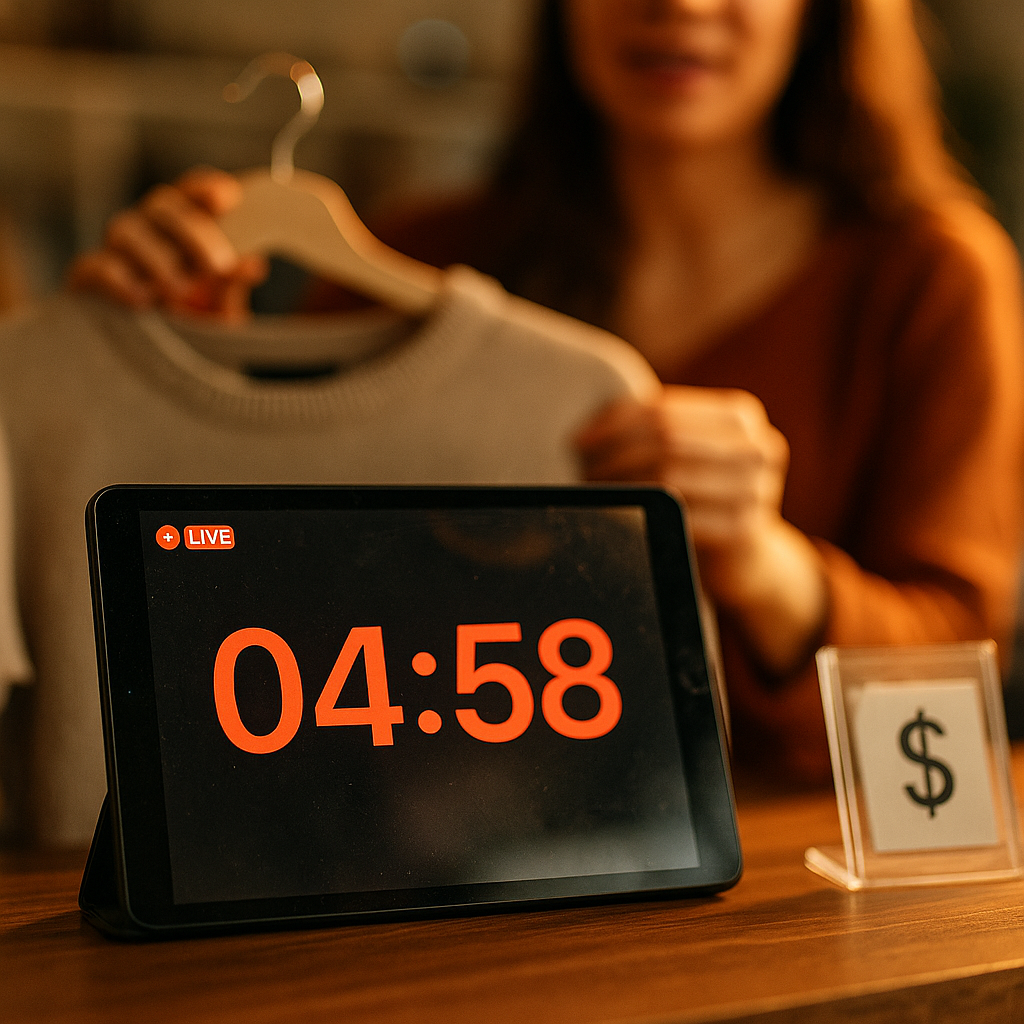
Ninety seconds. That’s roughly how long a TikTok Shop Live countdown banner flashes before a “flash discount” disappears, resets, and reappears an hour later. If that pattern sounds like a compliance problem waiting to happen, you’re reading the room correctly. The FTC livestream price-claim guidance was written for a slower internet, and reconciling it with the countdown mechanics baked into TikTok Shop and Instagram Live Shopping is now one of the messier jobs on a brand compliance team’s plate.
This isn’t a hypothetical. The FTC has spent the last few years sharpening its stance on dark patterns, drip pricing, and manufactured urgency, and livestream commerce sits squarely in the crosshairs. Brands running or sponsoring live shopping events need a working framework now, not after the next enforcement sweep.
Why Countdown Timers Trigger Price-Claim Scrutiny
Countdown timers exist to do one thing: compress decision time. That’s the entire point of live shopping as a format. But the FTC’s guidance on price claims — rooted in longstanding rules against false former-price advertising and reinforced by its more recent work on dark patterns — treats artificial urgency as a potential deception vector, not just a sales tactic.
Here’s the friction. TikTok Shop’s live interface lets hosts trigger a countdown that says “price drops in 2 minutes” or “only 12 left at this price.” Instagram Live Shopping has similar limited-time badge mechanics tied to product pins. Neither platform requires the host to substantiate that the price will actually change, that inventory is actually scarce, or that the “discount” reflects a real reduction from a bona fide prior price. The mechanic is native to the platform. The substantiation obligation is entirely on the brand and the creator.
A countdown that resets every stream isn’t urgency — it’s a permanent price dressed up as a temporary one, and that’s exactly the pattern the FTC has signaled it will scrutinize.
Consumer Reports and various watchdog groups have flagged recurring “limited time” claims on livestream commerce for years. The FTC’s broader dark-patterns enforcement work (see its published guidance at ftc.gov) makes clear that repeated false urgency claims can constitute an unfair or deceptive practice even without a single consumer complaint. Scale is the aggravating factor. One livestream reaching 40,000 viewers with a fake countdown isn’t a rounding error — it’s a pattern of deception across tens of thousands of impressions.
What “Bona Fide” Actually Means for a Live Discount
The FTC’s traditional test for price claims requires that a “was” price be a genuine, prevailing price offered for a reasonable period, not a number invented to make a markdown look bigger. Translating that test to livestream commerce raises a few uncomfortable questions:
- If a product’s “regular” price only ever appears for the three seconds before a countdown starts, was it ever a real price?
- If the same 20%-off countdown runs on every stream for a month, is it still “limited time” in any meaningful sense?
- If inventory counters shown on-screen don’t match backend inventory data, who’s liable — the platform, the brand, or the host?
None of these questions have been definitively litigated yet. But that’s exactly why brands shouldn’t wait for a consent decree to clarify the rules. The safer posture is to assume the FTC’s existing price-claim framework applies in full to livestream mechanics, and build documentation accordingly.
We’ve covered the mechanics of this problem in detail in our TikTok Shop countdown timer compliance checklist, which breaks down the specific UI elements most likely to draw scrutiny.
The Platform Doesn’t Carry Your Liability
Brand marketers sometimes assume platform-native features come pre-cleared for compliance. They don’t. TikTok Shop and Meta both include boilerplate language in their commerce terms of service noting that sellers are responsible for the accuracy of pricing and promotional claims (see TikTok’s seller policies at ads.tiktok.com and Meta’s commerce guidance at business.meta.com). The platform builds the countdown widget. You own what it says.
This is the same liability-shifting pattern we’ve seen across other creator compliance issues — platform AI labels that don’t satisfy FTC disclosure standards, for instance, or script edits that quietly convert a brand into the “speaker” under FTC rules. If you haven’t already mapped how that logic applies to labeling generally, our piece on platform labels and FTC disclosure gaps is a useful companion read. The pattern repeats: native platform tooling optimizes for engagement, not legal defensibility, and the compliance gap lands on whoever signed the insertion order.
Building a Reconciliation Framework That Actually Holds Up
So what does a defensible livestream pricing program actually look like? Based on how legal teams at retail and DTC brands are approaching this, five elements matter most.
- Price history logging. Every SKU featured in a live shopping event needs a timestamped price history — ideally pulled automatically from your commerce platform, not manually reconstructed after a complaint. If a “was” price wasn’t the prevailing price for a reasonable window (most legal teams use 30 days as a rough internal benchmark, though the FTC doesn’t mandate a fixed number), don’t let a host claim it.
- Inventory counter accuracy. If a countdown shows “8 left,” backend inventory should actually show something close to 8. Automate this feed. Don’t let hosts eyeball a number.
- Script pre-clearance for urgency language. “Selling out fast” and “price goes up in 60 seconds” are claims, not filler. Treat them the way you’d treat any other testable ad copy.
- Recurring-promotion flags. If the same discount countdown has run more than a handful of times in a month, flag it for legal review. Repetition is the pattern regulators notice first.
- Audit-ready recording retention. Livestreams disappear. Screen-record every commerce livestream and retain it alongside pricing data for at least the length of your standard record-retention policy.
None of this is exotic. It’s the same discipline brands already apply to traditional retail advertising — it just hasn’t caught up to livestream yet. Our creator compliance dashboard framework covers how to operationalize this kind of flagging at scale, which matters once you’re running live shopping across multiple creators and multiple platforms simultaneously.
Where TikTok Shop and Instagram Diverge
The two platforms aren’t identical, and treating them as interchangeable is a mistake.
TikTok Shop’s countdown mechanics are more aggressive by design — the platform’s entire live commerce model leans into scarcity and urgency as core engagement drivers, and its seller tools make it easy to trigger flash-price events with minimal friction. That means higher volume of potentially non-compliant claims, but also more platform-side data (inventory counters, price logs) that a brand can pull for substantiation if it insists on API access.
Instagram Live Shopping, built on Meta’s commerce infrastructure, tends toward more conservative urgency mechanics — limited-time badges rather than aggressive countdown animations — but offers less granular backend reporting for brands trying to reconstruct a defensible price history after the fact. Fewer flashy claims, but also fewer receipts if you need them.
Practically, that means your TikTok Shop compliance workflow should focus on pre-clearance and real-time monitoring (the claims come fast and frequent), while your Instagram workflow should focus on documentation and retention (the claims are milder, but proving them was substantiated after the fact takes more manual work). Related creator-side liability issues — like whitelisted ad structures or AI-assisted scripting — compound this further; see our whitelisted creator ads audit framework for how these risks stack when a live shopping clip gets repurposed into paid media.
What This Means for the Next Twelve Months
Livestream commerce in the US crossed real scale — eMarketer and Statista have both tracked rapid growth in social commerce GMV, and TikTok Shop in particular has become a meaningful revenue channel for mid-market DTC brands (see aggregate social commerce data at emarketer.com and statista.com). Regulators tend to follow the money. Expect the FTC’s next round of guidance or enforcement actions to explicitly reference livestream urgency mechanics, not just traditional banner ads or email drip pricing.
Brands that build documentation now — price logs, script pre-clearance, recording retention — won’t be scrambling when that guidance lands. Brands that treat the countdown timer as “just a platform feature” will be explaining themselves to legal counsel instead of customers.
FAQs
Frequently Asked Questions
Does the FTC have rules specifically written for livestream shopping countdown timers?
Not yet in a dedicated rule. The FTC applies its existing framework on price claims, false urgency, and dark patterns to livestream commerce, treating countdown timers and scarcity claims the same way it would treat any other advertising claim requiring substantiation.
Who is liable if a TikTok Shop host makes a false urgency claim during a live?
Typically the brand or seller of record bears primary liability, since platform terms of service place accuracy responsibility on the seller. Creators can also carry liability depending on script control and disclosure practices, which is why script pre-clearance matters.
How long does a discounted price need to have been offered to count as a legitimate “was” price?
The FTC doesn’t set a fixed number of days, but the price must have been a genuine, prevailing offer for a reasonable period. Many legal teams use a 30-day internal benchmark as a conservative proxy, though the actual standard is fact-specific.
Do inventory counters shown during a livestream need to match real backend inventory?
Yes, if the counter is presented as a factual claim (“only 8 left”), it needs to reflect actual inventory. A counter that’s decorative or clearly randomized rather than tied to real stock creates deception risk.
Is Instagram Live Shopping lower risk than TikTok Shop for price-claim compliance?
Its urgency mechanics tend to be milder, which reduces the volume of aggressive claims. But Meta’s commerce backend offers less granular reporting for reconstructing price history, making after-the-fact substantiation harder if a claim is challenged.
What documentation should brands keep for every live shopping event?
At minimum: timestamped price history for each featured SKU, a recording of the livestream, the approved script or talking points around pricing and urgency claims, and inventory data matching any on-screen counters.
The next enforcement wave will target scale, not intent — so the brands running the most livestream commerce volume have the shortest runway to fix their documentation. Start by logging every countdown claim against real price and inventory data this week, not after the first complaint lands.
Top Influencer Marketing Agencies
The leading agencies shaping influencer marketing in 2026
Agencies ranked by campaign performance, client diversity, platform expertise, proven ROI, industry recognition, and client satisfaction. Assessed through verified case studies, reviews, and industry consultations.
Moburst

-
2

The Shelf
Boutique Beauty & Lifestyle Influencer AgencyA data-driven boutique agency specializing exclusively in beauty, wellness, and lifestyle influencer campaigns on Instagram and TikTok. Best for brands already focused on the beauty/personal care space that need curated, aesthetic-driven content.Clients: Pepsi, The Honest Company, Hims, Elf Cosmetics, Pure LeafVisit The Shelf → -
3

Audiencly
Niche Gaming & Esports Influencer AgencyA specialized agency focused exclusively on gaming and esports creators on YouTube, Twitch, and TikTok. Ideal if your campaign is 100% gaming-focused — from game launches to hardware and esports events.Clients: Epic Games, NordVPN, Ubisoft, Wargaming, Tencent GamesVisit Audiencly → -
4

Viral Nation
Global Influencer Marketing & Talent AgencyA dual talent management and marketing agency with proprietary brand safety tools and a global creator network spanning nano-influencers to celebrities across all major platforms.Clients: Meta, Activision Blizzard, Energizer, Aston Martin, WalmartVisit Viral Nation → -
5

The Influencer Marketing Factory
TikTok, Instagram & YouTube CampaignsA full-service agency with strong TikTok expertise, offering end-to-end campaign management from influencer discovery through performance reporting with a focus on platform-native content.Clients: Google, Snapchat, Universal Music, Bumble, YelpVisit TIMF → -
6

NeoReach
Enterprise Analytics & Influencer CampaignsAn enterprise-focused agency combining managed campaigns with a powerful self-service data platform for influencer search, audience analytics, and attribution modeling.Clients: Amazon, Airbnb, Netflix, Honda, The New York TimesVisit NeoReach → -
7

Ubiquitous
Creator-First Marketing PlatformA tech-driven platform combining self-service tools with managed campaign options, emphasizing speed and scalability for brands managing multiple influencer relationships.Clients: Lyft, Disney, Target, American Eagle, NetflixVisit Ubiquitous → -
8

Obviously
Scalable Enterprise Influencer CampaignsA tech-enabled agency built for high-volume campaigns, coordinating hundreds of creators simultaneously with end-to-end logistics, content rights management, and product seeding.Clients: Google, Ulta Beauty, Converse, AmazonVisit Obviously →