


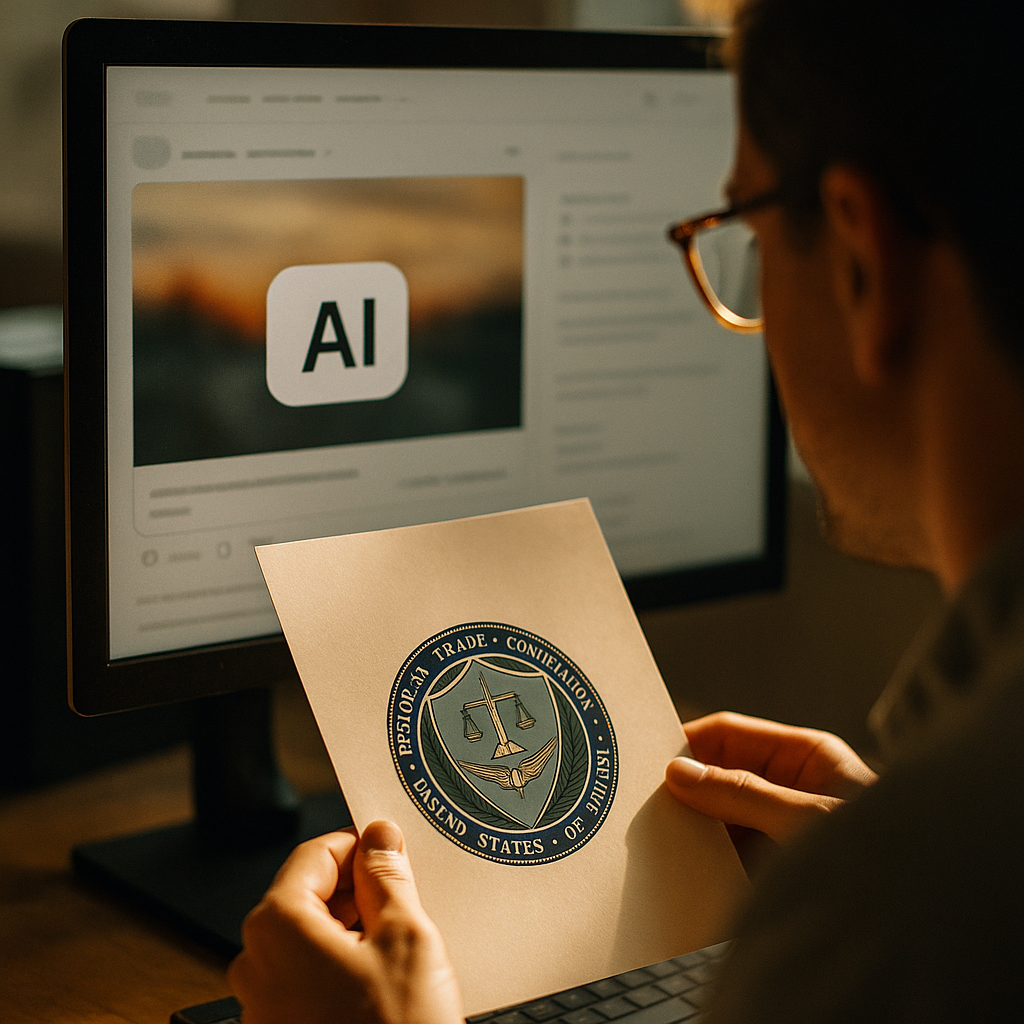
A single auto-applied “AI info” tag on TikTok does not satisfy the FTC’s clear-and-conspicuous disclosure rule. Yet plenty of brand teams are quietly betting their compliance program on it. That gap between platform-generated metadata and legal disclosure standards is where the next wave of FTC enforcement actions will come from, and most marketing teams haven’t even mapped the exposure yet.
Two Different Systems, One Assumption They’re the Same
Here’s the confusion in a nutshell. TikTok and Instagram have both rolled out automatic labeling for AI-generated or AI-edited content — small tags like “AI-generated” or “Made with AI” that appear on posts detected as synthetic. Meta expanded this system across Facebook, Instagram, and Threads, using a mix of user self-disclosure and detection of industry-standard AI image markers. TikTok does something similar, auto-tagging content it identifies as AI-manipulated and requiring creators to self-label the rest.
These labels exist to serve platform trust-and-safety goals: helping users understand when content isn’t authentic footage. They were never designed to satisfy advertising law. The FTC’s disclosure requirements exist for a completely different purpose — telling consumers when there’s a material connection between a brand and an endorser, so people can properly weigh the claims being made. One system flags synthetic media. The other flags paid influence. Brands that conflate the two are building compliance programs on a false equivalence.
Platform AI labels answer “was this made with AI?” FTC disclosure rules answer “is this endorser being paid, and does that change how I should read their claim?” Those are not the same question, and satisfying one does nothing to satisfy the other.
What “Clear and Conspicuous” Actually Requires
The FTC has been explicit for years, and its updated Endorsement Guides only sharpened the language: disclosures must be difficult to miss, unavoidable, and understandable to an ordinary consumer without them having to click, hover, or hunt. A disclosure buried in a caption’s fourth line doesn’t count. Neither does a tiny tag a platform slaps on automatically that a viewer can swipe past in half a second.
Compare that standard to how AI labels actually render. On TikTok, the auto-tag often appears as a small overlay in the corner of the video, sometimes only visible for the first few seconds. On Instagram, the “AI info” label sits under an “i” icon that requires a tap to expand into a readable explanation. Neither format was built with FTC-style prominence in mind — because neither platform is trying to solve that problem. They’re solving for synthetic media transparency, a policy priority driven by election integrity concerns and deepfake backlash, not advertising law.
If your legal team is treating the platform’s AI tag as a stand-in for a paid-partnership disclosure, you have two unmet obligations sitting inside one post, and only one of them is currently addressed.
Where Brands Are Actually Getting This Wrong
The failure mode isn’t usually willful. It’s operational. Creator ops teams see the platform label appear automatically, assume “compliance handled,” and move on. A few patterns show up again and again in briefs and post-audits:
- Assuming AI labels replace #ad tags. A video can be both AI-assisted and sponsored. It needs both disclosures, independently, each meeting its own clarity bar.
- Letting the platform’s detection do the disclosure work. Detection isn’t guaranteed. TikTok and Meta’s systems miss content, especially audio-only AI voice edits or subtle AI-assisted script generation that doesn’t trigger visual-media detection at all.
- Treating AI voice-clone product demos as exempt. If a synthetic voice narrates a paid endorsement, that’s a material fact needing its own disclosure — separate from any platform tag about AI usage.
- Failing to brief creators on stacking disclosures. Many creators genuinely don’t know they need a manual “#ad” plus a manual AI acknowledgment plus whatever the platform auto-generates.
This is the same structural issue explored in synthetic performer disclosure versus platform AI labels — two disclosure regimes running in parallel, and brands assuming one covers the other because they appear in the same post.
The Compliance Gap, Quantified
Nobody publishes a clean “percentage of AI-labeled influencer posts also missing proper FTC disclosure” statistic — the FTC doesn’t release granular enforcement breakdowns at that resolution. But directionally, the signal is loud. The FTC’s ongoing enforcement sweep against fake reviews and undisclosed endorsements resulted in multiple settlements, and the agency has said publicly it’s watching AI-generated content and influencer marketing as overlapping priority areas. The FTC’s own guidance makes clear that new technology doesn’t change the underlying disclosure obligation — it just adds a new category of material fact that needs disclosing.
Meanwhile, adoption of AI tools inside creator content has exploded. Industry surveys tracked by eMarketer show a majority of marketers now using generative AI somewhere in their content pipeline, whether that’s script drafting, voice synthesis, virtual backgrounds, or fully synthetic UGC-style ads. Every one of those touchpoints is a potential second disclosure obligation stacked on top of the standard sponsorship disclosure.
Building a Disclosure Stack That Actually Holds Up
Think of it as layers, not a single tag. A compliant AI-influenced sponsored post typically needs:
- Material connection disclosure — the standard “#ad” / “Paid partnership with [Brand]” language, placed where a viewer can’t miss it, ideally burned into the video itself, not just the caption.
- AI-use disclosure — a plain-language statement (not just relying on the platform’s auto-tag) when AI materially altered the content: synthetic voice, generated visuals, AI-written script delivered as if spontaneous.
- Platform-native labeling — letting TikTok or Instagram’s system apply its tag as a supplementary layer, not a replacement.
None of these substitute for each other. Brands running larger influencer programs are increasingly building this into pre-publish review rather than trusting creators to self-manage it, similar to the workflows described in the FTC video disclosure standard compliance checklist. That kind of pre-flight check catches the stacking problem before a post ever goes live, rather than during a regulatory inquiry six months later.
It’s also worth building a review step specifically for AI-assisted scripts, since script-level AI involvement is often invisible to a casual viewer and easy for creators to forget disclosing. The guidance in auditing AI-assisted creator scripts for brand liability is a useful companion process here — it catches the upstream problem before the video is even filmed.
Contract Language Needs to Catch Up Too
Most influencer agreements still have a single disclosure clause, usually copy-pasted from a template written before generative AI was a production tool. That’s no longer sufficient. Contracts need explicit language requiring creators to flag any AI involvement in content creation — script, voice, visuals, or editing — separately from the standard sponsorship disclosure clause. Without that, you’re relying on a creator’s individual judgment about what counts as “AI enough” to disclose, and that judgment varies wildly.
Brands managing larger rosters are already updating templates to require creators to self-report both disclosure types before content review, which mirrors the contractual thinking behind creator contract clauses for AI agent liability. The same logic applies whether the AI is generating a script, cloning a voice, or acting as an autonomous negotiation agent — the contract has to name the risk specifically, or it doesn’t count.
There’s a parallel compliance thread worth watching too: platform-specific formats like TikTok Shop live streams carry their own disclosure quirks around urgency messaging and countdown timers, covered in the TikTok Shop live-selling compliance checklist. AI-generated hosts and voice clones are starting to show up in that format too, which stacks a third disclosure layer on top of an already crowded one.
What Enforcement Risk Actually Looks Like Here
The FTC doesn’t need a new rule to go after this. Existing endorsement law already covers it — the agency has said as much. What’s likely is enforcement treating an inadequate or missing AI disclosure the same way it’s historically treated missing #ad tags: as a clear violation, with the brand on the hook alongside the creator, particularly if the brand scripted, reviewed, or directed the content. That “who’s the speaker” question isn’t hypothetical — it’s already been tested in cases where brand-side script edits shifted legal responsibility onto the advertiser, a dynamic explored in when script edits turn brands into the FTC speaker.
Platforms themselves face growing scrutiny too, particularly in the EU, where the Digital Services Act imposes its own transparency obligations around AI content and advertising that run parallel to — and occasionally conflict with — US rules. Global brands juggling both regimes should be cross-referencing frameworks like the one in the EU DSA versus US compliance matrix rather than assuming a US-only disclosure strategy travels cleanly across markets.
Practical Next Steps for Brand and Agency Teams
Start by auditing your current influencer contract template. If it has one disclosure clause covering “sponsorship,” you need a second clause covering AI involvement, worded broadly enough to capture script, voice, and visual generation. Then update your creative review checklist to ask two separate yes/no questions: is this sponsored, and was AI materially used in making it? Finally, brief creators directly — don’t assume they know platform tags don’t satisfy FTC law, because most don’t.
Tools that centralize this kind of pre-publish check are becoming standard for programs running at scale, similar to what’s described in building a creator compliance dashboard that catches violations — worth reviewing if your current process is still manual spreadsheet tracking.
Frequently Asked Questions
FAQs
Does TikTok’s automatic AI label satisfy FTC disclosure requirements?
No. TikTok’s AI-content label addresses platform transparency about synthetic media, not the FTC’s requirement to disclose a material connection between a brand and an endorser. Sponsored AI-assisted content needs both disclosures, separately.
What counts as “clear and conspicuous” under FTC rules?
A disclosure a typical consumer can’t miss, doesn’t need to click or tap to see, and understands immediately without special effort. Small overlay tags that disappear quickly or require expanding an icon generally don’t meet this bar on their own.
Who is liable if a creator’s AI disclosure is inadequate — the brand or the creator?
Both can be liable. The FTC has pursued brands directly when they scripted, directed, reviewed, or otherwise controlled the content, treating the advertiser as effectively the speaker regardless of who posted it.
Do brands need separate disclosures for AI-generated voice and AI-generated visuals?
Effectively yes. Any material use of AI that could mislead a consumer about the authenticity of the endorsement — synthetic voice, generated video, AI-written scripts delivered as spontaneous opinion — needs a plain-language disclosure, independent of platform auto-tagging.
How should influencer contracts be updated for AI disclosure risk?
Add a distinct clause requiring creators to flag any AI involvement in content production, separate from the standard sponsorship disclosure clause, and require pre-publish review before content goes live.
The fix isn’t waiting for platforms to redesign their labels — it’s rewriting your own contracts and review checklists now, before an FTC inquiry forces the rewrite for you.
Top Influencer Marketing Agencies
The leading agencies shaping influencer marketing in 2026
Agencies ranked by campaign performance, client diversity, platform expertise, proven ROI, industry recognition, and client satisfaction. Assessed through verified case studies, reviews, and industry consultations.
Moburst

-
2

The Shelf
Boutique Beauty & Lifestyle Influencer AgencyA data-driven boutique agency specializing exclusively in beauty, wellness, and lifestyle influencer campaigns on Instagram and TikTok. Best for brands already focused on the beauty/personal care space that need curated, aesthetic-driven content.Clients: Pepsi, The Honest Company, Hims, Elf Cosmetics, Pure LeafVisit The Shelf → -
3

Audiencly
Niche Gaming & Esports Influencer AgencyA specialized agency focused exclusively on gaming and esports creators on YouTube, Twitch, and TikTok. Ideal if your campaign is 100% gaming-focused — from game launches to hardware and esports events.Clients: Epic Games, NordVPN, Ubisoft, Wargaming, Tencent GamesVisit Audiencly → -
4

Viral Nation
Global Influencer Marketing & Talent AgencyA dual talent management and marketing agency with proprietary brand safety tools and a global creator network spanning nano-influencers to celebrities across all major platforms.Clients: Meta, Activision Blizzard, Energizer, Aston Martin, WalmartVisit Viral Nation → -
5

The Influencer Marketing Factory
TikTok, Instagram & YouTube CampaignsA full-service agency with strong TikTok expertise, offering end-to-end campaign management from influencer discovery through performance reporting with a focus on platform-native content.Clients: Google, Snapchat, Universal Music, Bumble, YelpVisit TIMF → -
6

NeoReach
Enterprise Analytics & Influencer CampaignsAn enterprise-focused agency combining managed campaigns with a powerful self-service data platform for influencer search, audience analytics, and attribution modeling.Clients: Amazon, Airbnb, Netflix, Honda, The New York TimesVisit NeoReach → -
7

Ubiquitous
Creator-First Marketing PlatformA tech-driven platform combining self-service tools with managed campaign options, emphasizing speed and scalability for brands managing multiple influencer relationships.Clients: Lyft, Disney, Target, American Eagle, NetflixVisit Ubiquitous → -
8

Obviously
Scalable Enterprise Influencer CampaignsA tech-enabled agency built for high-volume campaigns, coordinating hundreds of creators simultaneously with end-to-end logistics, content rights management, and product seeding.Clients: Google, Ulta Beauty, Converse, AmazonVisit Obviously →